
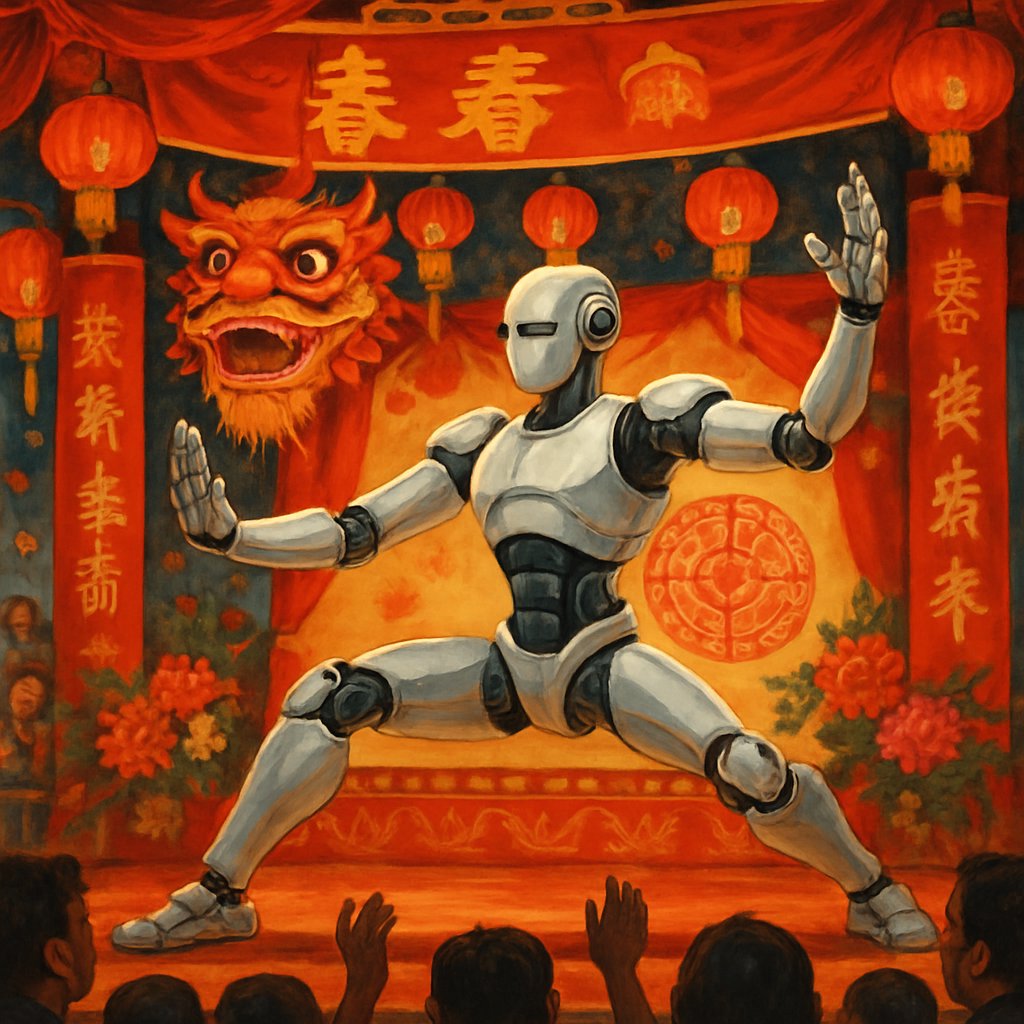
Martial arts robots stunned both live audiences and millions of global viewers at the 2026 Spring Festival Gala, marking a new milestone for the fusion of robotics, AI, and traditional Chinese culture. The viral video of humanoid robots performing kung fu routines is more than a spectacle—it’s a demonstration of China’s intent to lead in next-generation robotics and to reimagine national soft power for the AI era.
Key Takeaways:
- Humanoid robots delivering kung fu routines at the 2026 CCTV Spring Festival Gala went viral, showcasing China’s rapid robotics progress
- Unitree Robotics’ platforms headlined the event, but affordable alternatives and industry controversies are shaping the competitive landscape
- For robotics engineers: real-time control, stability, and visual-motor coordination are critical to replicating such dynamic stunts
- Full-stack integration—hardware, perception, and choreography—remains the barrier to reliable humanoid martial arts in uncontrolled settings
How Martial Arts Robots Upstaged the 2026 Spring Festival Gala
The 2026 CCTV Spring Festival Gala, China’s most-watched annual television event, became an unexpected showcase for the country’s robotics industry. As the evening’s traditional kung fu segment began, the camera panned to a lineup of humanoid robots executing synchronized martial arts routines—block, kick, and even acrobatic flips—alongside human performers (TechNode).

What set this moment apart:
- Real-time choreography: Robots responded to timing cues and lighting changes, with routines adapting live to music and stage conditions (MSN Video).
- Precision and agility: Movements included complex stances, rapid kicks, and balance transitions that previously required human gymnasts.
- Stage reliability: No visible stumbles or “robot fails”—a testament to the maturity of China’s humanoid robotics stack.
Within hours, social media was flooded with clips of “kung fu robots,” sparking both national pride and global debate on the pace of AI-driven automation. For practitioners, this wasn’t just a show: it was a live demo of advanced motion planning, actuation, and perception pipelines running under unforgiving, real-world conditions.
The viral moment also showcased the soft power playbook for Chinese robotics firms: blending heritage with high tech to claim global mindshare and attract technical talent. For an in-depth look at how similar fusion strategies have played out in other industries, see our analysis of AI’s impact on jobs and productivity in Europe.

Future Implications of Robotics in Traditional Arts
The integration of robotics in traditional arts like kung fu not only showcases technological advancements but also raises questions about cultural preservation. As robots take center stage, there is a risk that the essence of traditional practices may be overshadowed by technological spectacle. However, this fusion can also lead to new interpretations and innovations within the art form, potentially attracting a younger audience and revitalizing interest in cultural heritage.
Technical Walkthrough: Robotics Behind the Performance
Hardware Platforms and Capabilities
According to industry sources, Unitree Robotics supplied the majority of humanoid robots for the show. Their latest models, reportedly based on the Unitree H1 and A2 platforms, combine:
- High-torque actuators for explosive movements and balance correction
- Lightweight composite frames to enable flips and acrobatics (A2 weighs ~42kg and can walk up to 20km on a single charge)
- Real-time multi-sensor fusion (IMU, vision, force sensors) for stability and collision avoidance (Unitree A2 Specs)
Software and Motion Planning
Behind the scenes, the core technical challenge is generating smooth, lifelike martial arts routines. This requires:
- Inverse kinematics solvers to map high-level kung fu moves to actuator commands in real time
- Trajectory optimization for safe, energy-efficient motion—avoiding joint overextension or instability when kicking or flipping
- Perception-Action Loops: Onboard vision and IMUs allow robots to react to live cues—music beats, human partners’ positions, and stage hazards
Here’s a high-level Python example using a typical robotics stack (PyBullet for simulation, NumPy for math):
import pybullet as p
import numpy as np

# Connect to simulation
p.connect(p.GUI)

# Load robot model (replace with Unitree URDF as available)
robot_id = p.loadURDF("humanoid/humanoid.urdf", [0,0,1])

# Example: Kick trajectory (simplified)
def plan_kick(joint_indices, kick_angle=0.7, duration=0.5, steps=50):
    initial_pos = [p.getJointState(robot_id, i)[0] for i in joint_indices]
    target_pos = initial_pos.copy()
    target_pos[2] += kick_angle # Assuming joint 2 is the knee

    for t in np.linspace(0, 1, steps):
        interp = [i + t*(j - i) for i, j in zip(initial_pos, target_pos)]
        for idx, pos in zip(joint_indices, interp):
            p.setJointMotorControl2(robot_id, idx, p.POSITION_CONTROL, pos)
        p.stepSimulation()

# Main loop: Perform a kick
kick_joints = [0, 1, 2] # Replace with actual joint indices for your robot
plan_kick(kick_joints)
This script demonstrates the basics: connecting to a simulator, loading a humanoid robot, and running a simple kick trajectory via position control. For production-grade routines, you’ll need:
- Full-body pose graphs for multi-joint coordination
- Synchronization with music and lighting events (external triggers)
- Fallback controllers for error recovery if a move fails mid-performance
For real-world deployment, refer to each platform’s SDK and hardware safety documentation. Many developers use ROS or proprietary APIs provided by companies like Unitree (Unitree Robotics).
Unitree and Alternatives: Industry Context and Controversies
Unitree’s Merits and Momentum
Unitree Robotics has emerged as a global leader in affordable, high-performance quadruped and humanoid robots. The company, founded in China, is known for bringing advanced mechatronics to a wider audience at a fraction of the cost of legacy players like Boston Dynamics (Failory Newsletter).
Unitree’s robots have featured in global events since at least 2021 and are now regularly seen in industrial, research, and entertainment contexts (Unitree Official).
Alternatives and Relevant History
While Unitree dominated the Spring Festival Gala, the robotics field is crowded and rapidly evolving:
- Boston Dynamics sets the gold standard in dynamic balance and parkour, but their hardware remains expensive and less accessible for mass events
- Agility Robotics, UBTECH, and others are pushing commercial humanoid platforms in logistics and retail, but few have matched the public stage impact seen at this Gala
Unitree’s cost leadership is a double-edged sword: it democratizes robotics, but has also led to controversy. Several universities and organizations have been accused of rebranding or misrepresenting Unitree hardware as their own, sparking backlash and debates over intellectual property and “white labeling” practices (Mashable India Facebook). In one recent case, Unitree’s AI-powered Go2 dog was at the center of a university PR controversy (Instagram).
While Unitree’s engineering merits are real, be aware that industry hype sometimes outpaces technical reality—especially with viral, highly-produced events. Claims of “world-leading” robotics should be evaluated against independent benchmarks and open demonstrations.
| Platform | Key Strengths | Limitations | Typical Price Range (USD) |
|---|---|---|---|
| Unitree H1/A2 | Affordable, agile, programmable; good for R&D and public demos | Limited support for heavy-duty industrial tasks | 8,000–90,000 |
| Boston Dynamics Atlas | Best-in-class dynamic balance, advanced parkour | High cost, limited public availability | Not commercially listed |
| Agility Robotics Digit | Logistics, human-interactive applications | Less acrobatic, early-stage mass manufacturing | 250,000+ |
| UBTECH Walker | Consumer/retail focus, expressive motions | Lower payload, less robust for acrobatics | 15,000–50,000 |
For context on how rapid innovation can create unexpected winners and losers, see our recent coverage of TOTO’s 2026 strategy.
Common Pitfalls and Pro Tips for Developers
- Choreography ≠ Autonomy: Gala routines were likely pre-programmed and tightly stage-managed. Don’t mistake this for robust, real-world autonomy—open-world martial arts for robots is still a research challenge.
- Hardware Wear and Tear: Acrobatics and high-impact routines can quickly wear actuators and joints, especially on affordable platforms. Plan for regular maintenance.
- Synchronization Latency: Wireless control lag, especially with multiple robots, can desynchronize routines. Use hardwired triggers or clock sync protocols for mission-critical shows.
- Safety First: Always implement emergency stop mechanisms for public demos. Human-robot interaction on stage carries real risks if a controller or actuator fails.
- Community Resources: Leverage open-source ROS packages, official SDKs, and simulation environments like PyBullet or Gazebo for rapid iteration and fail-safe testing.
For more advanced lessons learned from high-stakes tech deployments, read our analysis of zero-day vulnerability responses.
Conclusion & Next Steps
The 2026 Spring Festival Gala’s martial arts robots offered a glimpse of robotics’ future—where tradition and AI-driven automation co-star on the world stage. For engineers and product teams, the technical bar for live humanoid performance is rising fast, but reliability, safety, and choreography integration are still the real bottlenecks. If you’re building for real-world deployment, benchmark in open settings and prioritize system-level robustness over show-stopping stunts.
Expect more viral robotics moments as hardware matures and costs drop—but temper the hype with rigorous, open testing. For further reading, see our analysis of AI’s impact in real industries and practical lessons from live production networks.