
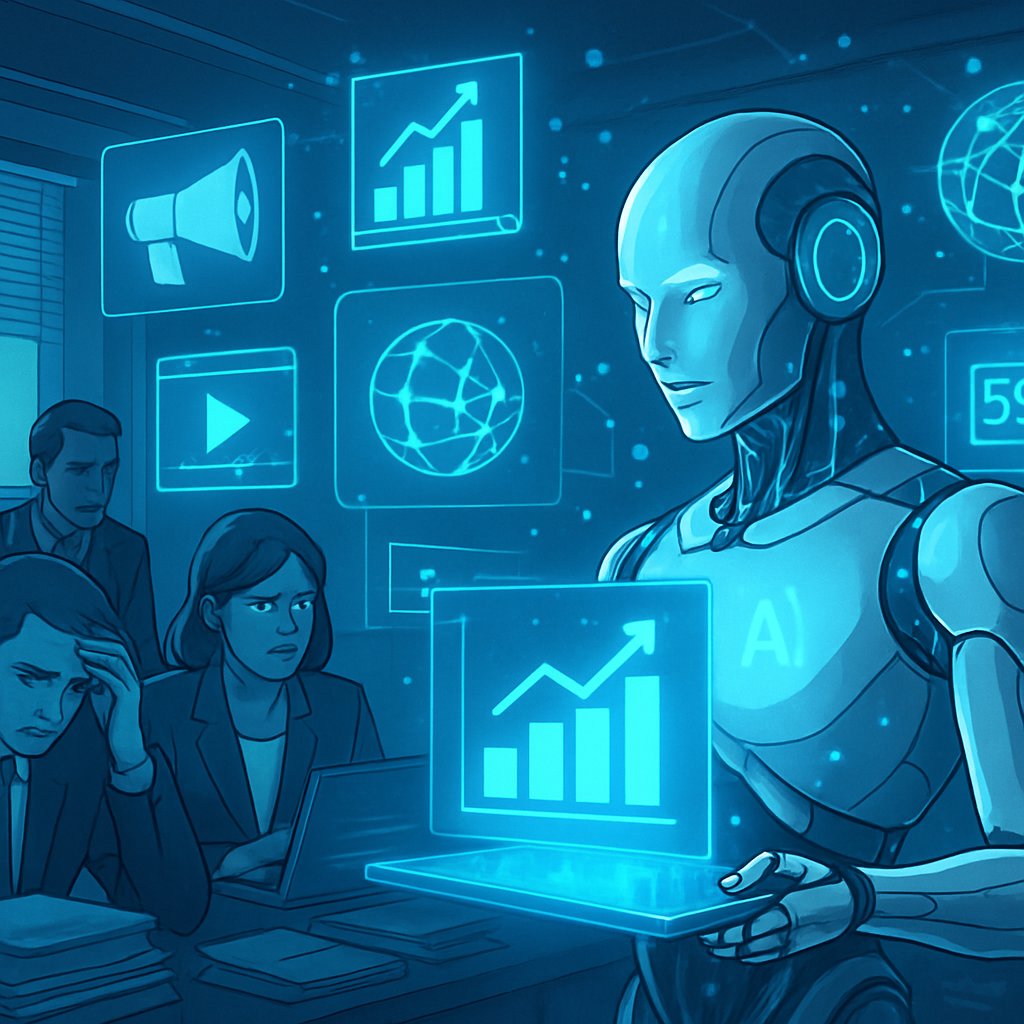
If your agency depends on managing ad spend or delivering creative campaigns for clients, Meta’s 2026 AI rollout is not a distant threat—it’s a live disruption. Meta is deploying AI agents, commerce automation, and infrastructure at a scale that is rapidly automating core agency functions. The company’s AI-first approach is fundamentally changing how digital marketing work is done, forcing agencies to urgently rethink their strategies if they want to remain relevant.
Key Takeaways:
- Meta’s 2026 AI deployment is automating ad creation, optimization, and analytics—reducing the need for agency intermediaries
- AI-driven content, targeting, and spend management are rapidly eroding traditional agency value propositions
- Agencies must adapt by specializing, diversifying, or developing proprietary analytics to survive Meta’s automation wave
- Competition from TikTok, YouTube, OpenAI, and Google provides alternatives but requires new skillsets and strategies
- Proactive pivots—such as multi-channel expertise and strategic consulting—are necessary to stay relevant
Why Meta AI Threatens Agencies
Meta’s ambitions for AI in 2026 are existential for agencies. The company is rolling out AI agents and automated commerce platforms that can handle campaign optimization, creative generation, and spend management without human input. Mark Zuckerberg made the shift explicit: “In 2025, we rebuilt the foundations of our AI program. Over the coming months, we’re going to start shipping our new models and products.” (ContentGrip)

Meta’s vision is to deliver “personal superintelligence” throughout its ecosystem, using AI for:
- Automated ad creation: AI drafts, tests, and refines ads faster than any creative team.
- Algorithmic campaign management: Ad spend and placements are optimized in real time through AI bidding, replacing manual input.
- Platform-owned performance reporting: Insights and analytics are delivered directly to brands, leaving agencies with less control and visibility.
Industry analysis describes this as the rise of “ads without authors”—campaigns created and iterated by AI, not people (Meta Newsroom). This shift is not just technical, but cultural: human authorship and brand storytelling are being replaced by algorithmic optimization.
If your agency’s value is built around hands-on campaign management or creative development within Meta’s ecosystem, you are now competing head-to-head with Meta’s own AI stack—at a speed and scale unattainable by human teams.
Inside Meta’s 2026 AI Deployment
Meta’s 2026 AI push is a full-stack transformation, not a single product release. The company has invested in AI-optimized data centers, nuclear energy projects to power its AI ambitions, and infrastructure partnerships with NVIDIA to secure next-generation compute resources (Meta Newsroom).
Key elements of the 2026 deployment include:
- AI agents for commerce, customer service, and content recommendations—using user behavior and context for hyper-personalized experiences
- Automated ad engines that generate, launch, and iterate creative assets with minimal human involvement
- Continuous, real-time optimization of spend, targeting, and placement based on proprietary performance signals
- Direct-to-client AI-powered analytics and reporting, reducing agency influence and visibility
Zuckerberg described 2026 as “a big year for delivering personal superintelligence, accelerating our business, building infrastructure for the future, and shaping how our company will work going forward” (ContentGrip).
Meta’s AI strategy also includes hardware: new AI glasses and wearables bring real-time intelligence to consumers’ daily lives, broadening the reach and data available for AI-driven ad systems (Meta Newsroom).
Agency Disintermediation Workflow Example
# Illustrative workflow for Meta's AI-driven campaign automation:
# 1. Brand uploads campaign assets to Meta’s platform.
# 2. Meta’s AI analyzes historical campaign performance and user engagement.
# 3. AI generates ad variants, allocates budget, and deploys across channels.
# 4. Campaign is iterated and optimized in real time by AI—no agency intervention.
# 5. Performance insights are delivered directly to the brand by Meta’s platform.
For more on automation’s impact on workflow and auditability, see our auditability guide.

This is not hypothetical. Meta Newsroom confirms that AI-driven ad performance is already central to the platform’s value proposition, and internal teams are being restructured to prioritize AI-first workflows (Meta Newsroom).
Impact on Agency Business Models
Meta’s AI rollout directly targets the pillars of the agency model: creative strategy, media planning, and campaign execution. As AI takes over these functions, the boundaries between platform, client, and agency become less distinct, and the economics of agency work are being fundamentally changed.
| Agency Function | Disrupted by Meta AI? | Agency Response Options |
|---|---|---|
| Creative Production | Yes – AI generates/optimizes ads at scale | Focus on high-concept, cross-channel creative and experiential work |
| Audience Targeting | Yes – AI-driven targeting outperforms manual approaches | Develop proprietary analytics and privacy-compliant targeting strategies |
| Media Buying | Yes – Automated bidding and placement by AI | Specialize in multi-platform, niche, or regulated media buys |
| Reporting & Analytics | Yes – AI delivers insights directly to brands | Offer independent attribution, brand lift analysis, or custom dashboards |
| Brand Strategy | Partially – AI cannot fully replace cultural or creative nuance | Invest in human-driven storytelling and brand leadership |
What remains for agencies? The most resilient will:
- Develop expertise on alternative platforms such as TikTok, YouTube, and emerging AI-powered channels
- Invest in strategic consulting, creative vision, and ethics—areas where human insight is still essential
- Build proprietary analytics and privacy-first solutions to regain transparency and differentiation
- Position themselves as trusted advisors rather than only execution partners
Undifferentiated agencies risk being squeezed out as Meta’s automation stack becomes the standard. This echoes the sustainability challenge in open-source AI, as covered in our local AI adoption analysis.
Meta’s newsroom also documents that agency teams within large holding companies are being reorganized to prioritize AI training and automation. Reinvention—not resistance—is now essential for agency survival (Meta Newsroom).
Alternatives, History, and Context
Meta’s AI automation exists in a competitive and evolving market. Key dynamics include:
- TikTok and YouTube: Both platforms are investing heavily in AI-powered campaign tools and analytics. Major advertisers are diversifying spend to avoid dependence on Meta.
- OpenAI and Google: Each company is rolling out agent-driven shopping assistants and commerce tools, increasing competition for user engagement and ad budgets (ContentGrip).
- Meta’s infrastructure scale: Investments in nuclear-powered data centers and NVIDIA partnerships provide scale, but also raise questions about transparency, privacy, and sustainability (Meta Newsroom).
Meta’s history of rapid transformation—from Facebook to Meta, from social to AI-first—has led many agencies to watch for sudden pivots and regulatory changes. Ongoing scrutiny and platform controversies reinforce the need for diversification and vigilance.
Evaluating alternatives means:
- Assessing each platform’s audience reach and demographic alignment
- Understanding transparency, data control, and compliance features
- Balancing the risks of single-platform dependence versus the complexity of multi-channel strategies
For more on legal and regulatory adaptation, see our analysis of tech disclosure threats. Agencies that experiment with new channels and AI tools will be most resilient as the market evolves.
Culturally, the rise of “authorless” algorithmic ads may provoke backlash—and foster demand for more human-centered storytelling, especially outside Meta’s ecosystem.
Common Pitfalls and Pro Tips
Agencies and brands adjusting to Meta’s AI disruption often make predictable mistakes. Here are the most critical, with solutions:
| Pitfall | Why It Matters | How to Avoid |
|---|---|---|
| Overreliance on Meta | Algorithm or policy changes can suddenly impact revenue; weakens negotiating power | Build multi-channel strategies and own your analytics to diversify risk |
| Overestimating AI | Assumes AI can replace all creative/cultural nuance—leads to generic campaigns | Invest in specialized talent and brand-building; use AI for scale, not brand voice |
| Data Privacy Missteps | Non-compliance with privacy policies risks fines and consumer trust | Monitor evolving platform data policies and stay compliant |
| Training Gaps | Teams that don’t upskill lag behind as AI tools evolve quickly | Commit to continuous learning across AI, data science, and multi-channel marketing |
| Poor Attribution | AI optimization can obscure true ROI drivers, making spend hard to justify | Adopt independent attribution tools and demand clearer data from platforms |
- Leverage Meta’s AI for operational gains, but retain control over brand and client relationships
- Stay informed about Meta’s AI and policy changes via the Meta Newsroom
- Regularly audit risk exposure as you would codebase security—see our codebase auditability guide
- Test AI-driven tools from multiple platforms to keep your agency’s capabilities current and differentiated
Conclusion and Next Steps
Meta’s AI platform shift is not a mere upgrade—it’s a new era that challenges the foundation of the agency business model. Agencies that specialize, diversify, and invest in proprietary analytics and strategic services will be best positioned to survive and thrive. Those clinging to legacy workflows risk being sidelined by automation and platform-driven innovation.
Action items:
- Audit your client and platform dependencies to identify overexposure, and diversify your risk
- Invest in analytics, brand strategy, and creative services that complement—rather than compete with—AI automation
- Upskill your team in AI tools and best practices for alternative platforms
- Bookmark the Meta Newsroom and competitive sources for early alerts on disruption
For deeper guidance, see our analysis of local AI in production and our coverage of legal and ethical challenges. Future-proof your agency now—Meta’s next round of AI advancement will not wait for those slow to adapt.