
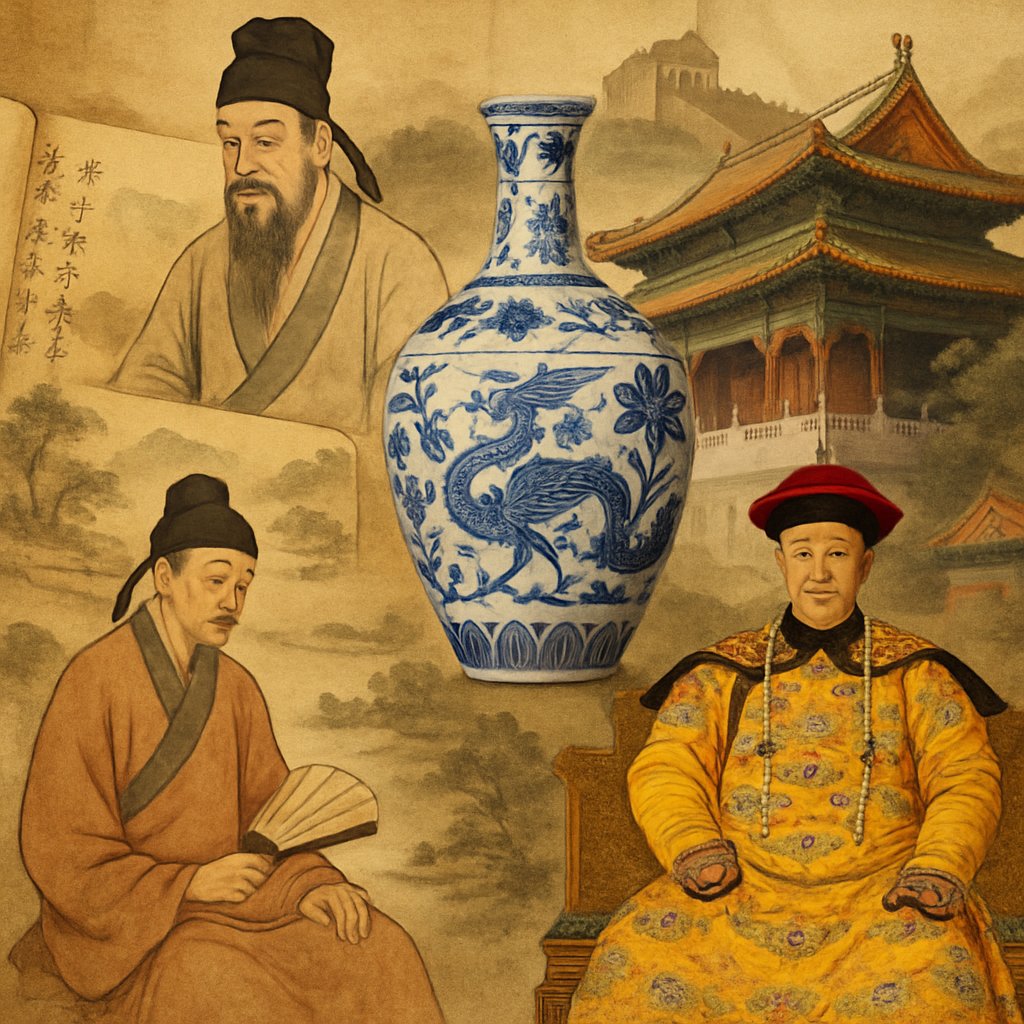
The legacies of China’s great dynasties — Tang (唐朝 Tángcháo), Song (宋朝 Sòngcháo), Ming (明朝 Míngcháo), and Qing (清朝 Qīngcháo) — continue to shape Chinese identity, values, and global influence. Each era brought monumental achievements in governance, the arts, technology, and social structure, leaving enduring marks on the nation’s collective memory and daily life. Whether through the cosmopolitan vibrancy of the Tang, the urban sophistication of the Song, the grand architectural feats of the Ming, or the cultural integration of the Qing, these dynasties created the foundation of what it means to be Chinese today.
Key Takeaways:
- Understand the defining achievements and cultural advances of the Tang, Song, Ming, and Qing dynasties
- See how each dynasty shaped core aspects of Chinese identity and values
- Learn the interconnectedness of dynastic legacies — from literature to architecture, philosophy to governance
- Recognize common misconceptions and how to approach Chinese history with nuance
- Reference a timeline comparing the major dynasties and their contributions

Timeline: The Tang, Song, Ming, and Qing Dynasties
Understanding the chronology of these dynasties is crucial to seeing how their legacies built upon one another. The table below highlights their reign periods and key contributions.
| Dynasty | Years | Key Achievements | Cultural Legacy |
|---|---|---|---|
| Tang (唐朝 Tángcháo) | 618–907 CE | Political unification, Silk Road expansion, civil service reforms | Poetry, cosmopolitan cities, Buddhist art |
| Song (宋朝 Sòngcháo) | 960–1279 CE | Technological innovation, economic growth, meritocracy | Landscape painting, Neo-Confucianism, urban culture |
| Ming (明朝 Míngcháo) | 1368–1644 CE | Restoration of Han rule, naval expeditions, Great Wall rebuilding | Porcelain, literature, architecture (Forbidden City) |
| Qing (清朝 Qīngcháo) | 1644–1912 CE | Territorial expansion, population growth, multiethnic governance | Peking opera, Manchu-Han syncretism, last imperial dynasty |
Further Reading on Chinese Dynasties
For a deeper understanding of the impact of these dynasties on modern China, consider exploring works such as “The Cambridge History of China” and articles from Encyclopaedia Britannica. These resources provide comprehensive insights into the historical context and legacies of each dynasty, enhancing your grasp of their significance.

Tang Dynasty (618–907 CE): Golden Age of Culture and Cosmopolitanism
The Era of Openness and Prosperity
The Tang dynasty is often hailed as China’s “golden age” — a time when Chang’an (长安 Cháng’ān, present-day Xi’an) was the world’s largest and most cosmopolitan city.
Under emperors like Taizong (太宗 Tàizōng) and Xuanzong (玄宗 Xuánzōng), the empire expanded its frontiers, secured the Silk Roads, and welcomed traders, diplomats, and artists from as far as Persia and Byzantium.
Cultural Achievements
- Literature: Poetry flourished, with masters like Li Bai (李白 Lǐ Bái) and Du Fu (杜甫 Dù Fǔ) whose verses are still memorized in Chinese schools today. The Tang shi (唐诗 Tángshī) poetry anthology is a cultural touchstone, celebrated for its emotional depth and technical mastery.
- Visual Arts: Buddhist sculpture and cave art reached new heights, as seen in the Mogao Caves (莫高窟 Mògāo Kū) in Dunhuang. Court painting captured both grandeur and daily life.
- Religious Diversity: Buddhism, Daoism, and imported faiths such as Zoroastrianism and Nestorian Christianity coexisted, leaving behind rich artistic and architectural legacies.
Governance and Social Structure
- The civil service examination system (科举 kējǔ) was refined, promoting meritocracy and social mobility. This system became a bedrock of Chinese bureaucracy for centuries.
- Legal codes were systematized, influencing neighboring states such as Japan and Korea.
Lasting Impact
The Tang’s embrace of cosmopolitanism and cultural confidence set a model for later dynasties. Its poetry, open attitudes, and administrative reforms are central to Chinese identity, representing a period when China saw itself as both a cultural center and a global participant.

Song Dynasty (960–1279 CE): Innovation, Urbanization, and Social Mobility
Economic and Technological Revolution
The Song dynasty is often described as the world’s first “proto-modern” society, marked by rapid urbanization and unprecedented technological innovation. Cities like Kaifeng (开封 Kāifēng) and Hangzhou (杭州 Hángzhōu) became bustling urban centers, with populations in the millions.
- Technological Advances: The Song period saw the invention of movable-type printing (活字印刷 huózì yìnshuā), the widespread use of gunpowder (火药 huǒyào), and advancements in hydraulic engineering and shipbuilding. The famed scientist Shen Kuo (沈括 Shěn Kuò) described the magnetic compass, revolutionizing navigation.
- Economic Growth: The introduction of paper money (交子 jiāozǐ) and the flourishing of commercial guilds catalyzed market economies and trade networks, both domestic and international.
Cultural Developments
- Neo-Confucianism: Philosophers like Zhu Xi (朱熹 Zhū Xī) revitalized Confucian thought, integrating metaphysics and ethics into a system that would dominate Chinese education and values for centuries.
- Art and Literature: The Song is renowned for shanshui hua (山水画, landscape painting), with artists like Fan Kuan (范宽 Fàn Kuān) and Su Shi (苏轼 Sū Shì) elevating brushwork to new levels of subtlety and philosophical depth. Literature and essays flourished, reflecting the rise of an educated urban elite.
Society and Governance
- The civil service examinations reached new importance, allowing those from modest backgrounds to rise through merit — a foundational concept for later Chinese society.
- Women’s status was complex: while foot-binding (缠足 chánzú) became widespread, upper-class women also played active roles in family businesses and cultural life.
Enduring Influence
The Song’s emphasis on scholarship, innovation, and social mobility resonates in China’s modern aspirations for educational achievement and technological advancement. Its urban culture and philosophical debates are woven into contemporary Chinese intellectual life.
Ming Dynasty (1368–1644 CE): Restoration, Exploration, and Enduring Symbols
The Return of Han Rule
After nearly a century of Mongol rule under the Yuan dynasty, the Ming dynasty was established by Zhu Yuanzhang (朱元璋 Zhū Yuánzhāng), who became the Hongwu Emperor (洪武帝 Hóngwǔ Dì). The Ming is often seen as a period of restoration and consolidation of Han Chinese cultural identity.
Political and Military Achievements
- The Great Wall was rebuilt and strengthened to defend against northern incursions. Many of the wall’s iconic stone sections visible today are Ming constructions.
- The maritime expeditions led by Zheng He (郑和 Zhèng Hé) projected Chinese power across the Indian Ocean, reaching as far as East Africa. These voyages showcased the dynasty’s naval technology and ambition, though they were later curtailed.
- The Forbidden City (紫禁城 Zǐjìnchéng) was constructed in Beijing, symbolizing imperial authority and architectural grandeur.
Cultural Flourishing
- Porcelain (瓷器 cíqì): Ming blue-and-white ceramics became prized exports and enduring symbols of Chinese craftsmanship worldwide.
- Literature: The era produced vernacular novels such as “Journey to the West” (西游记 Xī Yóu Jì) and “Water Margin” (水浒传 Shuǐhǔ Zhuàn), foundational to modern Chinese storytelling and pop culture.
- Arts and Crafts: Woodblock printing expanded literacy and the circulation of illustrated books, calendars, and manuals.
Enduring Influence
The Ming legacy is visible in symbols of national pride: the Great Wall, the Forbidden City, and the international renown of Chinese porcelain. The dynasty’s novels, dramas, and visual arts remain central to Chinese cultural identity and are referenced in films, festivals, and daily life.
Qing Dynasty (1644–1912 CE): Integration, Expansion, and Modern Legacy
Empire of Diversity
The Qing dynasty was founded by the Manchus (满族 Mǎnzú), a non-Han people from the northeast. Under emperors such as Kangxi (康熙 Kāngxī), Yongzheng (雍正 Yōngzhèng), and Qianlong (乾隆 Qiánlóng), the Qing expanded China’s borders to their greatest historical extent, ruling over a vast multiethnic empire.
- Administrative Integration: The Qing maintained a dual system of government, balancing Manchu and Han officials and integrating diverse peoples (Tibetans, Mongols, Uyghurs, and others) through a complex bureaucracy.
- Population Growth: According to the Encyclopaedia Britannica, the population surged, reaching over 400 million by the 19th century, fueling both economic growth and social pressures.
Cultural Achievements
- Peking Opera (京剧 Jīngjù): This art form blended music, acrobatics, and storytelling, becoming a national symbol.
- Literature and Scholarship: The Siku Quanshu (四库全书 Sìkù Quánshū, “Complete Library in Four Sections”) was the largest literary compilation in Chinese history.
- Syncretism: Qing culture blended Manchu and Han traditions, seen in clothing, cuisine, and court rituals.
Challenges and Transformation
- The Qing faced internal rebellions (Taiping, Boxer) and external pressures from Western imperialism, leading to century-long “national humiliation” narratives in modern China.
- The dynasty’s end in 1912 marked the collapse of imperial rule and the birth of the Republic, but many Qing institutions and cultural practices persisted into the modern era.
Modern Impact
The complex legacy of the Qing — its multiethnic governance, cultural syncretism, and experience with modernity’s disruptions — continues to influence debates about national unity, ethnic identity, and China’s place in the world.
How the Dynastic Legacy Shapes Modern Chinese Identity
Continuity and Reinvention
Contemporary Chinese identity draws deeply from these dynastic legacies. The reverence for education (rooted in the civil service exams), pride in cultural achievement, and the pursuit of social harmony (和谐 héxié) are all inherited from centuries of imperial rule.
- Language and Literature: The classics of Tang poetry and Ming novels are mainstays of school curricula. Idioms (成语 chéngyǔ) and proverbs often reference dynastic stories.
- Art and Aesthetics: The landscape painting of the Song, the porcelain of the Ming, and the architecture of the Qing remain touchstones for Chinese art, both at home and abroad.
- Social Values: Concepts like filial piety (孝 xiào), face (面子 miànzi), and guanxi (关系 guānxì) have roots in dynastic bureaucracy and family structure.
- Political Thought: The balance between unity and diversity, central authority and local autonomy, continues to shape governance and policy debates.
Global Influence
China’s renewed global engagement often invokes the spirit of the Tang’s cosmopolitanism, the Song’s innovation, the Ming’s maritime prowess, and the Qing’s management of diversity. National narratives draw on these histories to inspire confidence and continuity.
Common Pitfalls and Pro Tips in Understanding Chinese Dynastic History
Common Pitfalls
- Overgeneralization: Each dynasty was internally diverse and changed significantly over time. Avoid assuming uniformity across centuries.
- Dynastic Decline Narratives: The “rise and fall” model is tempting, but many changes were gradual and involved both progress and setbacks.
- Neglecting Non-Han Perspectives: Especially in the Qing, non-Han peoples played crucial roles. Their contributions and experiences are essential for a full picture.
- Western Comparisons: Seeing Chinese dynasties as direct equivalents to European monarchies can obscure important differences in philosophy, administration, and social structure.
Pro Tips
- Consult Multiple Sources: Use primary Chinese sources alongside modern scholarship. For reliable English-language analysis, see Encyclopaedia Britannica and The Cambridge History of China.
- Pay Attention to Regional Differences: The south and north of China often developed differently, with distinct economic, linguistic, and cultural trends.
- Notice Cultural Persistence: Many “modern” Chinese customs have deep dynastic roots, often adapted rather than invented anew.
Conclusion and Next Steps
The Tang, Song, Ming, and Qing dynasties offer more than a record of rulers and battles — they are living legacies, shaping how Chinese people see themselves and engage with the world. To deepen your understanding, explore primary sources, visit museums, or study regional variations in art and dialect. For more on how cultural heritage is preserved in the digital age, see our post on the evolution of Chinese calligraphy and its digital preservation. Consider how dynastic legacies influence your own perceptions of China, and where modern transformations echo ancient patterns.