
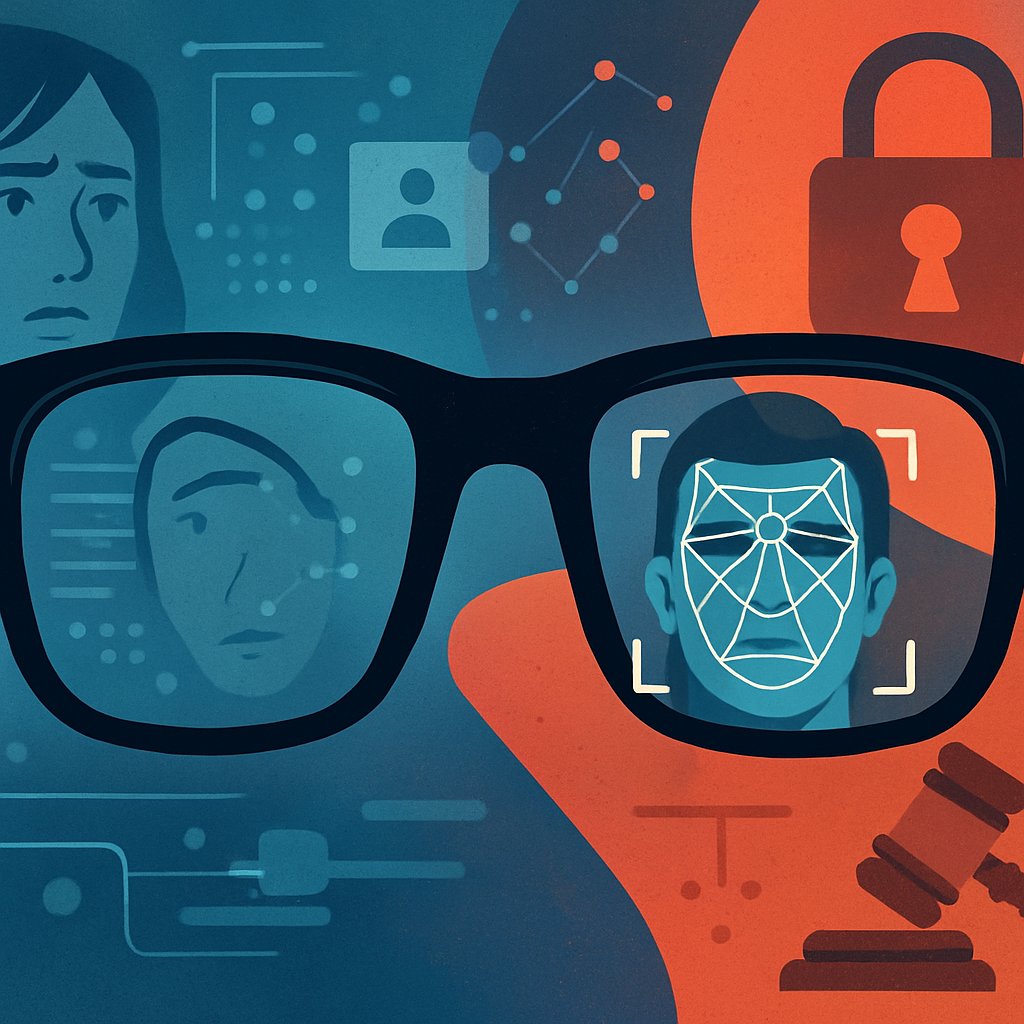
Meta’s AI Smart Glasses: Data Privacy Risks and What Practitioners Must Know
Meta’s reported plans to test facial recognition in Ray-Ban smart glasses have reignited urgent questions about privacy, compliance, and the future of biometric surveillance. As regulatory scrutiny intensifies and calls for outright bans grow worldwide, practitioners must cut through the hype and understand the real technical, legal, and reputational risks before recommending or deploying these devices.
Key Takeaways:
- Meta is reportedly preparing to test facial recognition in future Ray-Ban smart glasses, raising major privacy and consent concerns
- The company’s internal communications, cited by The New York Times, frame the current “dynamic political environment” as a window to introduce controversial features
- Global regulators, especially in the EU, are moving to restrict or ban real-time biometric identification in wearables
- Practitioners face heightened legal risk, compliance challenges, and reputational exposure with any AI-enabled smart glasses rollout

Meta AI Smart Glasses: What’s New and Why It Matters
Meta’s Ray-Ban smart glasses have moved quickly from experimental gadget to high-profile consumer product. While earlier models did not include facial recognition, citing “ethical concerns,” recent internal leaks and media reporting indicate Meta’s Reality Labs is actively testing the technology for future versions (Help Net Security).
This matters now because:
- Wearable cameras with AI have already caused public outcry after incidents like the BBC report of non-consensual recording (Digital Watch Observatory).
- Facial recognition in glasses transforms the device from a passive recorder to an active tool for identifying, tracking, and profiling individuals in real time—a leap that current privacy laws are struggling to address.
- According to internal documents obtained by The New York Times, Meta sees the present “dynamic political environment” as an opportunity to launch facial recognition with less resistance, assuming watchdog groups are preoccupied with other crises (The New York Times).
If you’re responsible for device deployments, privacy policy, or security, the landscape has fundamentally shifted—technical safeguards and legal frameworks are struggling to keep up.
How Facial Recognition Might Work in Meta’s Smart Glasses
Meta’s first-generation Ray-Ban glasses did not ship with facial recognition, a decision reportedly driven by ethical and privacy concerns (Help Net Security). However, according to multiple recent reports, Meta’s Reality Labs is now actively testing facial recognition for future models. There is no confirmed rollout date, but internal planning is underway.
Technical Flow (Based on Public Reports):
- The glasses capture video or stills via a built-in camera.
- Captured data is transmitted to Meta-controlled cloud infrastructure for processing.
- Facial recognition algorithms run against a reference database (either created by the user or managed by Meta).
- Matches can be surfaced to the user in real-time—revealing a bystander’s identity, for instance—or used to trigger device actions (tagging, notifications).
Recording Indicators:
Meta implemented a small LED indicator on Ray-Ban glasses to signal when video recording is active (Forbes). Critics and privacy advocates argue this signal is easy to miss or deliberately obscure, making genuine consent from bystanders extremely difficult.

Implementation Notes:
Meta has not released public SDKs or APIs for facial recognition in glasses. For practitioners seeking integration or policy guidance, refer to Meta’s official documentation for updates on supported features and compliance requirements.
The Privacy Risk Landscape
AI-powered smart glasses with facial recognition capabilities present urgent privacy risks, far beyond those posed by smartphones or conventional cameras.
- Involuntary surveillance: Individuals can be identified and tracked without consent or awareness.
- Suppression of civil liberties: The ability to identify and profile people in public can chill free speech, assembly, and protest—especially in countries with aggressive surveillance regimes (The New York Times).
- Biometric data risk: Facial data is highly sensitive. Breaches, leaks, or misuse can have irreversible consequences for affected individuals.
- Consent breakdown: Unlike smartphones, which signal recording more clearly, smart glasses are designed for unobtrusive, always-on capture. LED indicators are not a robust solution for bystander notification.
- Secondary use and mission creep: Even if Meta pledges to restrict usage, future policy changes or legal demands could force wider data sharing or surveillance integration.
| Risk Area | Smart Glasses | Smartphones |
|---|---|---|
| Involuntary Recognition | Possible (ambient, passive) | Rare (active, visible) |
| User Consent | Weak (LED indicator only) | Stronger (visible cues, opt-in) |
| Data Retention | Cloud-based, policies unclear | Mostly local, user-controlled |
| Legal Clarity | Evolving, often untested | Well-litigated |
Regulatory and Public Backlash
The backlash to Meta’s facial recognition smart glasses is global and intensifying:

- The European Parliament is drafting new legislation specifically targeting biometric data in wearables, with several members advocating for a complete ban on real-time facial recognition in smart glasses (Politics & Government News Articles Network).
- Canada and Australia are both engaged in active debate over tightening regulations on data collection and facial recognition in consumer wearables.
- The US Federal Trade Commission is under mounting pressure to reject Meta’s application and has expanded its investigation to include societal impacts, not just data protection safeguards.
- Public anxiety spiked after media reports—including a BBC investigation—documented cases of Meta AI glasses being used to record individuals without their consent (Digital Watch Observatory).
- Meta’s own internal analysis (as reported by The New York Times) suggests the company is timing the rollout to coincide with a “dynamic political environment” where civil society watchdogs may be distracted by other urgent issues.
Practical Considerations and Trade-offs
Any deployment or recommendation of Meta’s AI smart glasses—regardless of whether facial recognition is currently enabled—demands a serious evaluation of technical, ethical, and legal trade-offs.
Technical and Ethical Limitations
- Consent mechanisms are inadequate: LED indicators are not a reliable form of bystander notification. There are no robust opt-out protocols for people in public spaces.
- Cloud dependency: The probable reliance on cloud processing for facial recognition increases attack surface, raises cross-jurisdictional data risks, and complicates compliance.
- Regulatory volatility: Legislation is moving fast. What’s legal at deployment may become restricted (or banned) during the product’s lifecycle.
Deployment Risks
- Reputational risk: Early adoption, especially in sensitive environments (e.g., schools, clinics, government), could attract criticism, protests, or legal challenges.
- Feature lock-in: Devices may lose key functionality if regulations force disabling facial recognition or impose new requirements post-purchase.
- Supply chain and support risk: As device demand surges, hardware and technical support bottlenecks are likely.
Alternatives and Comparison Table
If privacy or compliance is non-negotiable, alternatives to Meta’s smart glasses exist, each with their own trade-offs.
| Device | Facial Recognition | Consent Signal | Open Source | Availability |
|---|---|---|---|---|
| Ray-Ban Meta | Reportedly tested/planned | LED only | No | US/EU, limited SKUs |
| Mentra Live | User-controlled | Customizable | Yes | Early access |
| Apple Watch | No (camera only) | On-screen, physical | No | Global |
Common Pitfalls or Pro Tips
Real-world mistakes to avoid:
- Assuming compliance: Don’t assume current privacy policies or LED indicators satisfy emerging legal requirements. The regulatory landscape is changing rapidly.
- Overlooking bystander risk: Deploying smart glasses in areas with vulnerable populations (schools, healthcare, protests) multiplies ethical and legal risk.
- Neglecting opt-out needs: There is no universal mechanism for individuals to opt out of being recognized or recorded by these devices in public.
- Ignoring software updates: Features like facial recognition can be enabled post-deployment via firmware updates. Ongoing monitoring is essential.
Pro tip: Maintain a living risk register for all deployments involving AI or biometric-capable wearables. Update quarterly and require explicit documentation of user and bystander notification processes.
Conclusion: Next Steps and Related Reading
Meta’s AI smart glasses are shaping up to be a defining test for privacy rights, biometric data governance, and tech regulation. If you’re evaluating these devices for enterprise or public deployment, now is the time to involve legal, compliance, and security stakeholders in a full-spectrum risk assessment. Track regulatory updates closely—what’s acceptable today may be banned tomorrow.
For deeper insight on AI governance, see our analysis of AI code generation and developer workflow transparency. For hardware adoption and supply chain context, read our iPhone 17e market analysis.
Action steps:
- Update privacy and data handling policies to explicitly address AI wearables and biometric data
- Require clear user and bystander notification for all deployments
- Monitor firmware and regulatory updates for feature changes or new restrictions
- Document risk assessments and compliance decisions for each pilot or rollout
For authoritative implementation details, refer to Meta’s official documentation and stay informed on developments from the US FTC and European privacy regulators.