
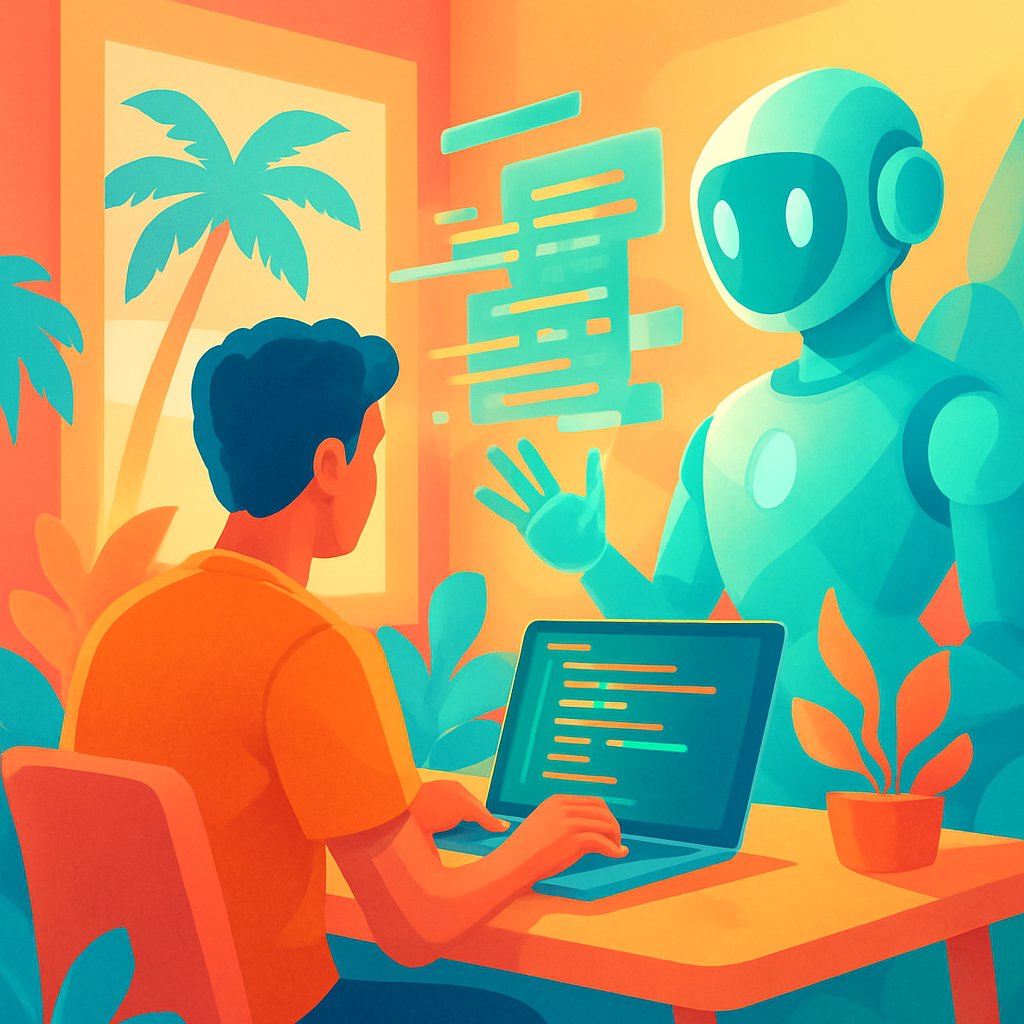
Generative AI in Software Engineering: A Year in Retrospective – Insights from Fraunhofer IESE
Generative AI has moved from hype to hard reality in software engineering. In just twelve months, the field has shifted from simple code completion tools to full-blown AI agents orchestrating entire phases of the software development lifecycle (SDLC). But this speed comes with new challenges—especially around control, quality, and the rising risk of a “knowledge landfill.” Here’s what’s changed, what’s working, and the critical questions every team now faces.
Key Takeaways:
- How generative AI has expanded from coding assistants to orchestrating the SDLC
- The risk of “knowledge landfill” and why control and quality assurance now matter more than raw capability
- Quantitative impact: up to 70% faster coding, but new bottlenecks emerging
- Specific tools and standards shaping the new AI development environment
- What teams must do to avoid chaos as AI-generated artifacts multiply
- Key limitations, trade-offs, and alternatives to current generative AI solutions

How Generative AI Changed the Software Engineering Landscape
A year ago, generative AI in software engineering mostly meant code completion—think Copilot or Tabnine suggesting the next line. Now, the landscape is crowded with AI coding assistants and AI-IDEs like Cursor, OpenHands, Aider, Claude, Open Code, and Kilo Code. These aren’t just autocomplete bots. They read and change multiple files, run tests, propose refactorings, and even integrate with CI pipelines (Fraunhofer IESE, 2026).
What does this look like in practice?
- Multi-file context: AI agents now operate on entire projects, not just single files.
- Workflow integration: They trigger test suites, run linters, and suggest deployment pipeline changes.
- Semantic search: AI tools help you discover similar code patterns and potential issues across large codebases.
Empirical evidence supports this evolution. According to a recent report, generative AI can reduce coding task duration by up to 70%, with senior engineers reporting a 48% speed-up (MSN, 2024).
| Tool/Platform | Capabilities | Notable Features |
|---|---|---|
| GitHub Copilot | Code completion, testing, documentation | Context-aware suggestions |
| Cursor AI | AI agent in IDE | Multi-file edits, project-wide refactoring |
| Aider, Claude, Kilo Code | AI code assistants | Automated testing, deployment pipeline integration |
But as these tools automate more of the SDLC, new problems emerge—especially around maintaining oversight and code quality at scale.
AI-Orchestrated SDLC: From Assistants to Autonomous Agents
The central shift isn’t just more automation. It’s that AI now participates in nearly every phase of the software development lifecycle. Fraunhofer IESE describes this as the rise of the “AI-orchestrated SDLC.”
- Requirements and design: Models generate user stories, draft architectures, and suggest design patterns.
- Implementation: AI agents write new features, refactor legacy code, and propose optimizations.
- Testing and QA: Test generation, code review suggestions, and bug detection are now common AI tasks.
- Deployment: Some agents modify CI/CD pipelines or propose infrastructure updates.
- Documentation: Auto-generated docs, changelogs, and even onboarding guides.
Key enablers include:
- Model Context Protocol (MCP): Standardizes how AI models interact with tools and data sources.
- Cursor Rules, AGENTS.md, SKILLS.md: Machine-readable guides that tell agents how to interact with a specific repository or workflow.
# Example: AGENTS.md snippet for repository-specific agent rules
agent:
  name: "release-bot"
  permissions:
    - read: [src/, tests/]
    - write: [CHANGELOG.md, release_notes/]
  triggers:
    - on: [merge, tag]
  skills:
    - generate_release_notes
    - update_changelog
# This structure tells the AI what it can do and when
Why does this matter? Because these conventions let development teams define boundaries and workflows that AI agents must respect. Without them, you risk the AI making uncontrolled changes across your codebase, leading to chaos rather than productivity.
Control and Quality: The Knowledge Landfill Problem
As generative AI makes it easy to produce code, docs, and configuration files at scale, the risk isn’t just technical debt—it’s a full-blown knowledge landfill. Without guardrails, teams can quickly lose track of what’s important, what’s obsolete, and what’s actually in use (Fraunhofer IESE, 2026).
Symptoms of the Knowledge Landfill
- Proliferation of generated artifacts—tests, scripts, config files—with unclear ownership
- Conflicting or redundant documentation generated by different AI agents
- Outdated automation scripts left in the repo, still triggered by CI jobs
- Loss of human context: “Why was this generated? Is it still relevant?”
Fraunhofer IESE argues the central question now is not “Can AI do this?” but “How do we control what AI generates and ensure quality?”
For implementation details and code examples, refer to the official documentation linked in this article.
By defining machine-readable rules and integrating them into your pipeline, you can enforce review gates and limit the blast radius of automated changes.
Measuring Productivity: What the Numbers Actually Show
It’s tempting to focus on the speed—generative AI can cut coding task time by up to 70%, with senior engineers seeing a 48% improvement (MSN, 2024). But what does this look like in the real world?
- Maintenance and boilerplate: AI assistants excel at generating repetitive code, freeing developers for more complex tasks.
- Bug fixing and review: Automated suggestions surface issues faster, but human oversight is still required for critical fixes.
- DevOps and CI/CD: AI can propose pipeline changes, but these need careful validation to avoid outages or security issues.
There is no evidence in the sources that 'cursor ai generate tests --project my-app --output tests/generated/' is a real CLI command or that Cursor AI exposes a CLI with this syntax.
# Output: creates multiple test files based on code analysis
# Review is required before merging into main branch
According to empirical studies cited by Fraunhofer IESE, while productivity increases are real, they are often offset by time spent reviewing, curating, and integrating AI-generated artifacts. Quality assurance and oversight don’t disappear—they just move to different phases of the workflow.
| Task | Time Reduction with AI | New QA/Review Overhead |
|---|---|---|
| Boilerplate coding | Up to 70% | Low |
| Bug fixing | Up to 70% | Medium |
| Pipeline/config automation | Up to 70% | High (requires manual validation) |
In short: generative AI amplifies speed, but oversight becomes even more critical as automation scales.
Considerations, Limitations, and Alternatives
No tool is a silver bullet. Here’s what matters when deciding how (or if) to use generative AI in your SDLC:
Key Limitations
- Control complexity: The more AI agents, the harder it is to manage and audit changes.
- Quality drift: Without review gates and context rules, quality can degrade quickly.
- Security: Automated pipelines can introduce vulnerabilities if not tightly controlled.
- Vendor lock-in: Many AI tools rely on proprietary models or cloud APIs.
Alternatives and Complements
- Traditional static analysis: Still essential for enforcing non-negotiable rules and detecting subtle bugs.
- Pair programming: Even with AI, human-human pairing catches context-specific issues AI misses.
- Domain-specific templates: For some teams, curated code templates remain more predictable than generative output.
| Approach | Strengths | Weaknesses |
|---|---|---|
| AI Coding Assistants | Speed, automation, breadth of coverage | Quality control, review overhead |
| Static Analysis | Deterministic, enforceable | Limited to known patterns |
| Human Review | Context, judgment, accountability | Slower, resource-intensive |
For a deeper look at the scenarios and open challenges, see the original analysis from Fraunhofer IESE.
Common Pitfalls and Pro Tips
- Uncontrolled artifact generation: AI agents can flood your repo with low-value files. Always set up review gates and artifact expiration policies.
- Ignored context rules: If you don’t define explicit AGENTS.md or Cursor Rules, agents may operate beyond their intended scope. Always codify permissions and triggers.
- Security drift: Generated code may bypass established security patterns. Run all generated code through static and dynamic analysis tools.
- Documentation rot: AI-generated docs go stale fast. Schedule periodic reviews and prune obsolete files regularly.
- Assuming “AI knows best”: Human oversight is mandatory. Treat AI suggestions as first drafts, not final answers.
Pro Tip: Use machine-readable conventions (like AGENTS.md) and integrate with your CI pipeline to control when and how AI-generated changes are applied. For more on this, see Fraunhofer IESE’s retrospective.
Where to Go Next: Actionable Next Steps
Generative AI is now a core part of software engineering, not a side experiment. The gains are real, but so are the risks. If you’re integrating AI into your SDLC:
- Define context rules and permissions for every AI agent
- Enforce review gates for all critical automation
- Regularly audit your codebase for “knowledge landfill” and prune as needed
- Balance AI productivity with human oversight for quality and security
For a detailed breakdown of practical AI integration scenarios and emerging research, read the original Fraunhofer IESE analysis and the 2026 retrospective.
If you’re interested in related topics, see our coverage of digital transformation at Fraunhofer IESE and practical DevOps automation strategies.