
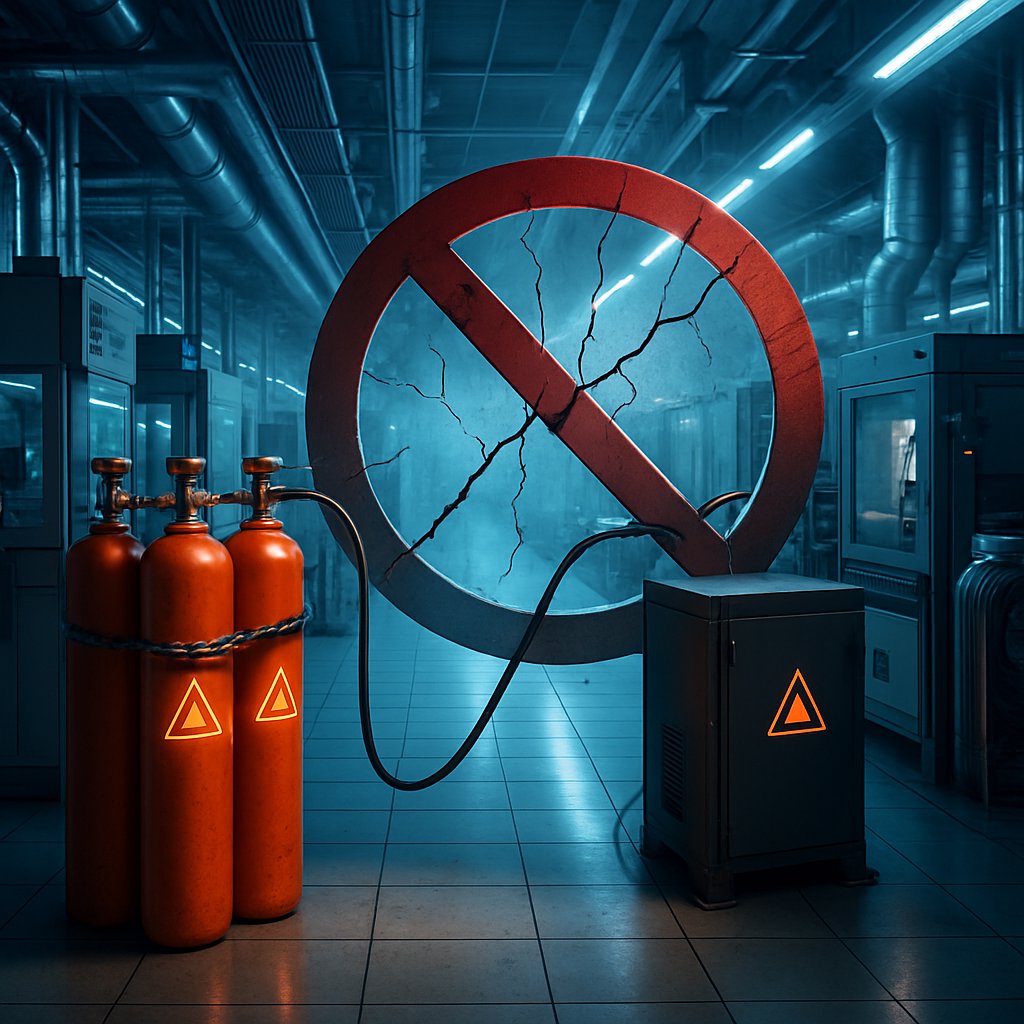
The sudden shutdown of Qatar’s Ras Laffan helium facility—after reported Iranian drone strikes—has removed roughly one-third of the world’s helium supply overnight, setting off a two-week countdown for the global semiconductor industry. If supply is not restored swiftly, manufacturers face hard production stops, price spikes, and urgent realignment of critical supply chains. Here’s what you need to know right now, what’s at risk, and how the next 14 days could reshape the balance of power in chips, AI hardware, and beyond.
Key Takeaways:
- Qatar’s shutdown has instantly removed 30–38% of global helium supply, putting chip manufacturing on a two-week crisis timeline (Slashdot).
- Helium is irreplaceable for advanced semiconductor processes—there are no viable substitutes for wafer cooling or thermal control at scale (byteiota).
- Spot prices for helium have spiked 30–50%, erasing years of procurement gains and exposing deep fragility in global supply chains (The Deep Dive).
- Even industry leaders with six-month stockpiles may not be safe: recovery and supply normalization could take 6–9 months if shutdown extends (byteiota).
- No major chipmaker has reported production halts yet, but allocation is shifting toward AI and server memory, leaving PCs and smartphones at risk (The Deep Dive).
- The crisis highlights an urgent need for geographic diversification, recycling, and new sourcing—but fixes take years, not weeks.

Why This Matters Now
The Qatar helium shutdown is not just another commodity blip—it’s a direct threat to the backbone of the global technology industry. Helium isn’t optional for advanced chip fabs: it is fundamental for wafer cooling, etching, leak detection, and as a carrier gas in multiple steps of semiconductor manufacturing. With AI workloads already straining memory supply, this disruption lands at the worst possible moment. Industry insiders warn that if Qatari output isn’t restored within two weeks, the world’s most advanced fabs will face hard limits on production, with cascading effects for every technology sector dependent on silicon—from AI and cloud to medical imaging and aerospace (Slashdot).

This new supply shock builds on themes we’ve tracked in recent coverage of market volatility and AI infrastructure stress. But unlike previous chip shortages driven by demand, this is a hard input constraint: when the helium runs out, production stops—there is no fast workaround.
Helium in the Chip Supply Chain
Why Helium Is Irreplaceable
Helium’s unique properties—thermal conductivity five to six times higher than nitrogen, non-reactivity, and ability to remain a gas at extremely low temperatures—make it essential for precise thermal management in chip fabrication (byteiota). Advanced semiconductor nodes (5nm, 3nm, 2nm) rely on ultra-high purity (6N, 99.9999%) helium to cool wafers during etching, deposition, and ion implantation. As transistors shrink and power densities rise, helium consumption per wafer actually increases.
Unlike the 2022 neon crisis, there is no alternative source or substitute gas that can deliver the same cooling precision. Nitrogen cannot match the thermal control required, and argon is used for plasma generation, not cooling. Hydrogen is unsafe due to flammability and material embrittlement. If helium supply is interrupted, chip yield and performance collapse—manufacturers cannot engineer around this constraint (byteiota).
| Gas | Thermal Conductivity | Use in Chip Fabs | Viability as Helium Substitute |
|---|---|---|---|
| Helium | High (5–6x nitrogen) | Wafer cooling, leak detection, carrier gas | Essential/irreplaceable |
| Nitrogen | Moderate | Inert atmosphere, some cooling | Insufficient for advanced nodes |
| Argon | Low | Plasma generation | Not suitable for cooling |
| Hydrogen | High | Limited process steps | Safety hazard |
Supply Chain Concentration
Qatar and Russia together supply most of the world’s helium for semiconductors, but Qatar alone accounts for 30–38% of the global market (The Deep Dive). The U.S. is a major producer, but most of its output is consumed domestically; South Korea relied on Qatar for 64.7% of its helium imports in 2025. The Ras Laffan facility’s shutdown exposes a critical single point of failure.
The Two-Week Clock: What Happens Next
Immediate Fallout
With the Ras Laffan facility offline since March 2 and QatarEnergy declaring force majeure on March 4, helium contracts have been voided and the market is running on stockpiles. According to Phil Kornbluth, industrial gas distributors must decide within two weeks whether to begin relocating cryogenic equipment and revalidating suppliers—a process that would extend recovery timelines to months or even a year, regardless of when Qatari output resumes (Slashdot).
Leading fabs like Samsung and SK hynix reportedly have up to six months of helium inventory, but that planning assumed short disruptions, not protracted recovery. Mid-tier fabs with one to three months of stock will begin to feel production strain by April if the crisis continues (byteiota).
Allocation and Scarcity
No major chipmaker has reported direct production halts yet. However, allocation is already shifting: high-bandwidth memory (HBM) and server DRAM for AI and cloud customers will likely absorb most of the remaining supply, while conventional DDR5, DDR4, and NAND for PCs and consumer devices face disproportionate cuts (The Deep Dive).
Long-Term Risk Timeline
- Short-term (0–2 weeks): Fabs run on existing inventory; spot prices surge; allocation rationed to highest-value output.
- Medium-term (2–12 weeks): If outage persists, gas distributors shift supply chains; production slowdowns or halts begin, especially at non-diversified fabs.
- Long-term (3–9 months): Recovery depends on facility repair, supply chain normalization, and qualifying new suppliers. Even the best-prepared fabs face risk if the crisis lasts into summer 2026 (byteiota).
Market Impacts and Price Shocks
Price Spikes
Within days of the shutdown, helium spot prices jumped 30–50%—from about $300 to $450 per thousand cubic feet in European markets (The Deep Dive). Force majeure wiped out long-term contracts, pushing buyers onto the spot market at premium rates. Years of cost optimization were erased in a week.
Broader Industrial Repercussions
Beyond semiconductors, the disruption is rippling through industries that rely on high-purity helium: medical imaging (MRI), aerospace, fiber optics, and more. But the chip sector is the acute pressure point due to its scale and lack of alternatives (Seoul Economic Daily).
Who Is Most at Risk?
- South Korea: Sourced 64.7% of its helium from Qatar in 2025. Memory chipmakers are exposed (Slashdot).
- Europe: Spot pricing is spiking fastest here as supply dries up.
- PCs and Smartphones: Conventional memory and NAND allocations will be hardest hit.
- AI, Server, and Cloud: These sectors will be first in line for any remaining supply.
| Industry | Helium Use | Immediate Impact |
|---|---|---|
| Semiconductors | Wafer cooling, leak detection, carrier gas | Production slowdowns, allocation shifts, price surges |
| Medical Imaging | MRI magnet cooling | Spot shortages, cost increases |
| Aerospace | Pressurization, leak testing | Longer procurement cycles |
Critical Concerns and Structural Flaws
Systemic Vulnerabilities
Leading industry analysts and critics contend that the Qatar helium crisis is not a black swan but a predictable result of extreme supply chain concentration. The semiconductor market—valued at $574 billion in 2023 and projected to reach $810 billion by 2030—has traded supply chain resilience for cost minimization for years (Discovery Alert).
According to byteiota, “This is a core lesson about cost vs resilience. Optimization works until it doesn’t. When critical materials concentrate in geopolitically unstable regions, you’re trading margin for existential risk.”
Alleged Strategic Risks
Critics allege that industry leaders ignored warnings about geographic risk in helium, neon, and rare earths, creating a recurring pattern of supply crises—first neon (Ukraine, 2022), now helium (Qatar, 2026), and potentially others as global tensions persist.
Recovery Timeline Mismatch
Stockpiling assumptions may be dangerously optimistic. Six months of inventory is not enough if recovery takes 6–9 months (shutdown + supply normalization). The gap between disruption and recovery could force global chip production to a halt if the shutdown lasts into summer (byteiota).
Qatar’s Unique Role
Qatar is a small peninsula nation on the Persian Gulf and one of the world’s largest exporters of liquefied natural gas and helium. Its Ras Laffan facility is a linchpin for multiple global supply chains (Wikipedia), and the current conflict highlights how critical infrastructure in such concentrated geographies can become global choke points.
Mitigation, Diversification, and Alternatives
Current Mitigation Actions
- Supplier Diversification: Major fabs are scrambling to qualify new sources—Canada, the U.S., Tanzania, China’s Bohai Bay (byteiota).
- Recycling: Helium recycling systems are being installed at a premium, but retrofitting existing fabs is costly and slow.
- Contingency Stockpiling: Fabs with larger stockpiles (Samsung, SK hynix) may weather the next few months if the market recovers quickly.
Limitations and Trade-offs
- Canadian and U.S. helium costs are 10–20% higher than Qatar’s, which is why the industry concentrated supply in the Gulf region.
- Recycling is viable for new fabs but costly to retrofit to existing ones—most current equipment was designed under the assumption of cheap, abundant helium.
- Alternative gases are not practical for advanced node cooling. Nitrogen and argon cannot match helium’s properties (byteiota).
| Mitigation Strategy | Timeline | Cost Impact | Viability for Existing Fabs |
|---|---|---|---|
| Supplier diversification | 2–5 years | 10–20% increase | High (if new contracts signed) |
| Recycling systems | 1–3 years | Significant upfront investment | Viable but slow for retrofit |
| Alternative gases | N/A | Not suitable for advanced nodes | Not viable |
Notable Alternatives and Their Differences
Canada is rapidly scaling helium production (targeting 15–20% global share), leveraging its reserves, but supply is not yet at scale. The U.S. operates multiple production sites, but most output is absorbed domestically (The Deep Dive). Russia’s Amur facility was designed to cover a third of global demand, but remains limited by sanctions and slow ramp-up. No alternative source can instantly fill Qatar’s gap.
Common Pitfalls or Pro Tips
- Stockpile Overconfidence: Don’t assume six months of inventory is safe; supply chain normalization post-shutdown can take just as long.
- Single Supplier Risk: Audit your own materials sourcing for similar single points of failure—helium is just the latest example.
- Recycling System Implementation: If considering retrofits, factor in downtime and CAPEX. New fabs should prioritize closed-loop helium systems from day one.
- Monitor Spot Market Pricing: Track spot price movements and contract terms—force majeure can void agreements overnight.
- Scenario Planning: Prepare for extended disruptions and model both supply and recovery timelines.
Conclusion: Next Steps and What to Watch
The Qatar helium shutdown is a live fire drill for the world’s tech supply chains. If Qatari output resumes within weeks, the crisis may be contained—at significant cost. If not, the next two to six months will see escalating production halts, price shocks, and potentially forced reallocation of the global chip supply. The need for true supply chain resilience has never been clearer. Practitioners and security engineers should:
- Audit current supplier dependencies for all critical inputs, not just helium.
- Accelerate plans for recycling and alternative sourcing—don’t wait for the next crisis.
- Monitor updates from QatarEnergy, major fabs, and the spot market closely over the coming weeks.
For further context on the structural lessons of this crisis, see our recent market volatility analysis and our coverage of AI infrastructure stress. This is not the last supply chain shock—learn from it, and build for resilience now.
Sources: Slashdot, The Deep Dive, byteiota, Wikipedia, Seoul Economic Daily
Sources and References
This article was researched using a combination of primary and supplementary sources:
Supplementary References
These sources provide additional context, definitions, and background information to help clarify concepts mentioned in the primary source.
- Qatar Helium Shutdown Puts Chip Supply Chain On a Two-Week Clock – Slashdot
- Qatar Helium Crisis: Chip Supply Faces Two-Week Deadline | byteiota
- Qatar shutdown threatens a third of global helium supply
- Qatar – Wikipedia
- Qatar | Map, Population, Flag, Royal Family, & Location | Britannica
- Qatar Maps & Facts – World Atlas
- Qatar Helium Shutdown Puts Chip Supply Chain On a Two-Week Clock – Slashdot
Critical Analysis
Sources providing balanced perspectives, limitations, and alternative viewpoints.