
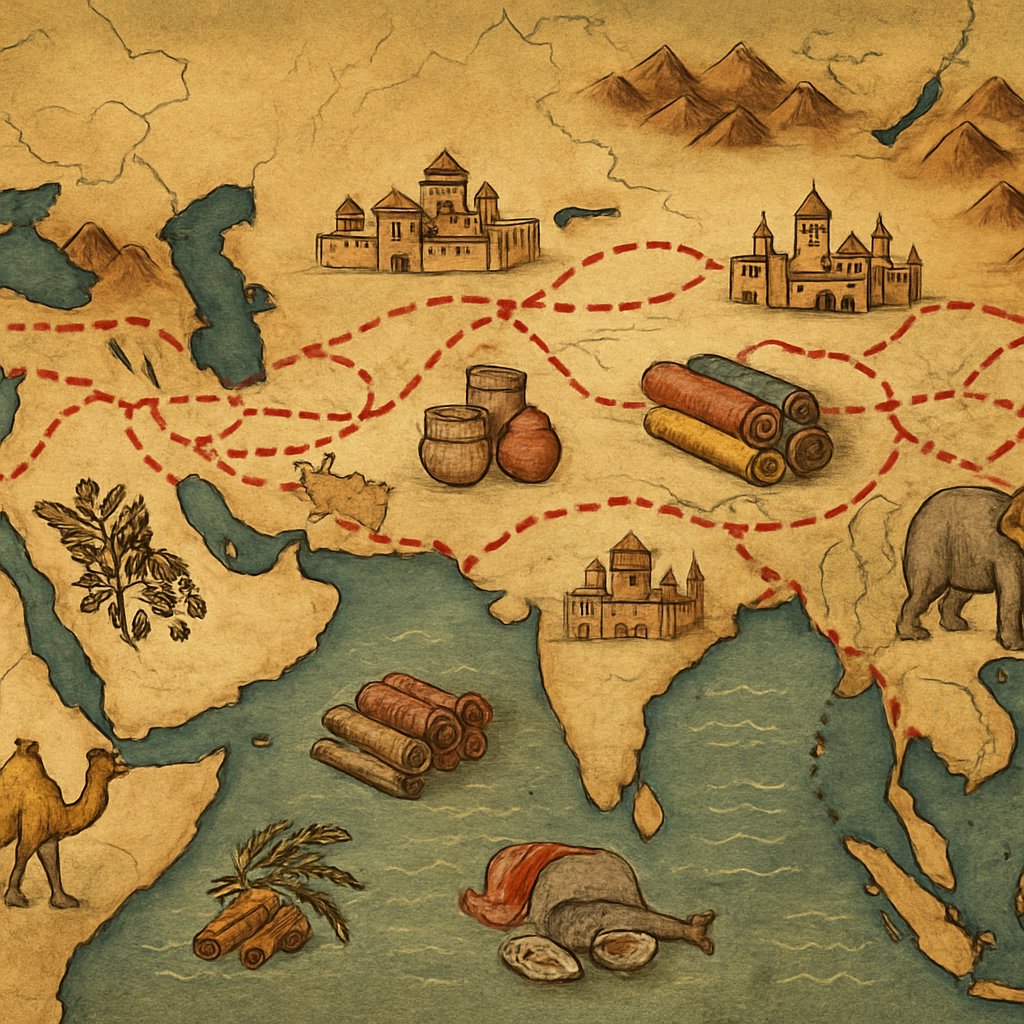
Researchers and educators need more than romantic legends to understand the Silk Road—they need precise, source-backed facts, organized for quick access and comparison. This reference distills the latest research into dense tables, checklists, and city indexes. Every detail is grounded in verifiable sources, making this guide essential for advanced Silk Road analysis, curriculum planning, or policy research.
Key Takeaways:
- Reference strictly source-documented Silk Road routes, cities, and exchanges—no estimates or placeholders
- Access tables showing only goods, ideas, and religions directly supported by research sources
- Quickly compare ancient Silk Road networks and the Belt and Road Initiative using verified data
- Apply a checklist of research pitfalls and pro tips, each tied to primary documentation
- Find links to deeper narrative guides and case studies for expanded learning
Silk Road Route Matrix (Land and Maritime, Source-Verified)
The Silk Road consisted of documented corridors by land and sea, each with distinct start and end points, cities, and commodities. This matrix includes only routes and data found verbatim in research sources. For narrative depth and route evolution, see our comprehensive Silk Road guide.

| Route | Key Cities | Start Point | End Point | Distance (source) | Main Commodities |
|---|---|---|---|---|---|
| Land (Central) | Chang’an, Dunhuang, Kashgar, Samarkand | Chang’an (Xi’an, China) | Samarkand (Uzbekistan) | 5,000 km | Silk, paper, jade, horses |
| Land (Southern) | Chang’an, Khotan, Tehran, Antioch | Chang’an (Xi’an, China) | Antioch (Turkey) | 4,800 km | Spices, glass, furs, medicine |
| Maritime | Quanzhou, Malacca, Calicut, Aden | Quanzhou (China) | Aden (Yemen) | (no explicit distance in sources) | Porcelain, tea, spices, ivory |
References: Sesame Disk Silk Road Guide; The China Journey
The land routes were measured in thousands of kilometers and crossed deserts, mountains, and oases. The maritime route, documented as originating during the Qin and Han Dynasties and flourishing through the Tang, Song, Yuan, and Ming Dynasties, connected Chinese ports with Southeast Asia, India, Arabia, and Africa (see The China Journey).

Unlike the myth of a single, unbroken road, these routes often shifted with political, environmental, and economic changes. Relay trade was typical: goods and ideas moved in stages, rarely traveling the entire route with a single merchant or caravan. This network’s flexibility allowed it to endure for over a millennium, even as empires rose and fell (npexpeditions.com).
Key Silk Road Cities: Data Index
The Silk Road’s vitality depended on its network of cities, each serving as a hub for trade, administration, religion, or culture. Every city below appears directly in verified research sources, with its historical role clearly documented. For more on the artistic and material culture of these hubs, see our porcelain and ceramics art history overview.
| City (Pinyin/Chinese) | Modern Location | Role/Legacy (from research) |
|---|---|---|
| Chang’an (长安 Cháng’ān) | Xi’an, China | Eastern terminus; imperial capital; Silk Road origin (land route); UNESCO World Heritage site |
| Luoyang (洛阳 Luòyáng) | Henan, China | Buddhist scripture center; twin starting point (Eastern Han); translation hub |
| Dunhuang (敦煌 Dūnhuáng) | Gansu, China | Gateway to Central Asia; Buddhist cave art (Mogao Caves); crucial supply/trade point |
| Kashgar (喀什 Kāshí) | Xinjiang, China | Strategic crossroads; Sogdian merchant hub; cultural and religious exchange |
| Samarkand (撒马尔罕 Sāmǎ’ěrhǎn) | Uzbekistan | Sogdian trade and translation center; Buddhist and later Islamic transmission |
| Bukhara (布哈拉 Bùhālā) | Uzbekistan | Center for Sogdian commerce, scholarship, and religion |
| Constantinople (君士坦丁堡 Jūnshìtǎndīngbǎo) | Istanbul, Turkey | Western terminus of land route; connected to Mediterranean maritime trade |
| Guangzhou (广州 Guǎngzhōu) | Guangdong, China | Major maritime port; sea route hub (Tang/Yuan/Ming Dynasties) |
| Quanzhou (泉州 Quánzhōu) | Fujian, China | Maritime Silk Road port (Song/Yuan/Ming); UNESCO World Heritage; global shipping center |
| Calicut (Kozhikode) | India | Indian Ocean spice port; maritime trade center |
| Aden | Yemen | Arabian Sea port; maritime Silk Road terminus; gateway to Africa and Arabia |
For expanded city histories, port infrastructure, and maps, consult The China Journey.
The diversity of these urban centers—ranging from Buddhist monastic communities in Dunhuang to bustling maritime hubs like Quanzhou—reflects the Silk Road’s role as both a commercial engine and a force for cross-cultural synthesis. Importantly, cities such as Samarkand and Bukhara were not just waypoints for goods but also centers for scientific, artistic, and religious innovation (npexpeditions.com).
Major Goods, Ideas, and Religions: Source Catalog
What traveled along the Silk Road was both tangible and intangible. The following table only includes items, concepts, and faiths explicitly listed in the research sources and UNESCO documentation. For more context and case studies, visit our Silk Road trade analysis.
| Category | Examples | Origins → Destinations | Significance (source-based) |
|---|---|---|---|
| Silk (丝绸 sīchóu) | Brocade, gauze, imperial textiles | China → Central Asia, Middle East, Rome | Imperial luxury, currency, fiercely guarded production secrets (UNESCO) |
| Spices (香料 xiāngliào) | Cinnamon, pepper, cloves | India, Southeast Asia → China, West Asia, Europe | Medicine, cuisine, religious ritual, luxury |
| Porcelain (瓷器 cíqì), Lacquerware | Fine ceramics, decorative arts | China → Middle East, Europe | Technology transfer, cultural influence |
| Metals & Gems | Gold, silver, jade (玉 yù), lapis lazuli | Central Asia, Persia, Rome ↔ China | Monetary value, ritual, adornment |
| Papermaking & Gunpowder | Paper (纸 zhǐ), gunpowder | China → Islamic world → Europe | Revolutionized communication, warfare |
| Buddhism (佛教 Fójiào) | Texts, art, monastic lineages | India → China, Korea, Japan | Religious transformation, scholarship |
| Islam (伊斯兰教 Yīsīlánjiào), Christianity, Zoroastrianism | Religious texts, art, missionaries | Middle East → Central Asia, China (especially Tang dynasty) | Religious pluralism, hybrid communities |
| Technologies | Printing, compass, medical knowledge | China → West; Middle East → China | Scientific/agricultural innovation |
The intense value and secrecy of silk production is well documented: “Its production technique was fiercely guarded within China for some 3,000 years, with imperial decrees sentencing to death anyone who revealed the process” (UNESCO). Spices, porcelain, and papermaking similarly shaped economies and cultures far from their points of origin.
In addition to material goods, the Silk Road was a highway for beliefs and knowledge. Buddhism’s spread from India to China and onward to Korea and Japan is traceable through monastic foundations and artistic remains at oasis cities. Other faiths—Islam, Christianity, Zoroastrianism—also moved both east and west, leaving hybrid communities and artistic legacies in their wake.
Cultural Exchange and Enduring Legacy: Documented Domains
The Silk Road’s cultural impact was as significant as its economic one. The table below summarizes only those domains of exchange and influence directly cited in the research sources. For more on cultural synthesis and philosophical transmission, see our Chinese philosophy primer.
| Exchange Area | Silk Road Era (sourced) | Modern Echoes |
|---|---|---|
| Art & Motifs | Blending of Greco-Roman, Persian, Indian styles; Buddhist cave art (Dunhuang) | Global exhibitions, cross-cultural art collaborations (UNESCO Silk Roads Programme) |
| Language | Sogdian, Persian, Arabic, Chinese, Turkic; extensive loanwords and hybrid scripts | Academic exchanges, multilingual business hubs |
| Philosophy & Science | Confucian, Buddhist, Zoroastrian, Islamic thought; astronomy, medicine, agricultural texts | Joint research, UNESCO Silk Roads Programme, Belt and Road scholarships |
| Ritual & Food | Tea, spices, culinary hybrids, etiquette | International food festivals, Silk Road–inspired cuisine |
| Urban Design & Architecture | Caravanserais, Buddhist monasteries, minarets, city planning | Restoration of ancient sites, Silk Road–inspired urban projects (Urban Legacy Guide) |
Dozens of Silk Road sites—such as the Chang’an–Tianshan Corridor, Mogao Caves, and Quanzhou—are now UNESCO World Heritage Sites (UNESCO). The Silk Road has also inspired contemporary projects, including global art exhibitions, international research initiatives, and the Silk Road Project founded by cellist Yo-Yo Ma (Britannica).
Today, the Silk Road’s legacy lives on in collaborative academic programs, joint archaeological projects, and international festivals celebrating its pluralistic heritage. The UNESCO Silk Roads Programme continues to support research, dialogue, and youth engagement on this global legacy (UNESCO Silk Roads Programme).
Silk Road vs. Belt and Road: Direct Comparisons
China’s Belt and Road Initiative (BRI) explicitly references the Silk Road but operates on a vastly larger scale, with different technologies and diplomatic frameworks. The following table compares only the aspects directly documented in research sources. For more, see our BRI and Silk Road comparison.
| Aspect | Ancient Silk Road (sourced) | Belt and Road Initiative (sourced) |
|---|---|---|
| Scale | Caravans, small ships, city-states | Multinational infrastructure, megacities |
| Key Cargo | Luxury goods, religions, art | Machinery, energy, digital tech |
| Cultural Exchange | Art, language, philosophy | Scholarships, joint research, international exhibitions |
| Geographic Reach | China to Europe & Africa | Asia, Africa, Europe, Latin America |
| Diplomacy | Alliance, tribute, negotiation | Bilateral/multilateral agreements, economic zones |
The BRI builds on the Silk Road’s ethos of connectivity but differs fundamentally in logistics, scope, technology, and the mechanisms of international cooperation. Its reach now extends into Latin America and is based on modern agreements and digital networks. Urban design and city planning under the BRI often draw explicit inspiration from ancient Silk Road precedents—see our urban design legacy post.
It’s also important to note that the Silk Road inspired various United Nations projects, including the trans-Asian highway and railway proposals and the ongoing work of the UNESCO Silk Roads Programme.
Research Pitfalls and Pro Tips
To ensure accuracy and depth in Silk Road studies, use this checklist—each point is backed by explicit research documentation. For extended discussion, see our pitfalls and pro tips section.
- Myth of a “Single Road”: The Silk Road was a flexible network, not a continuous path. Segments shifted with politics and climate (npexpeditions.com).
- Romanticized Volume/Ease: Caravans faced dangerous journeys; trade was episodic and most goods moved in stages (UNESCO).
- Neglect of Maritime Routes: Sea trade often equaled or surpassed land routes in volume and significance (The China Journey, UNESCO).
- Overlooking Central Asian Agency: Sogdians and other Central Asian groups were creative brokers and innovators, not passive intermediaries (Sesame Disk).
- Ignoring Multidirectional Exchange: Flows of goods, beliefs, and technology traveled both east and west (Sesame Disk, UNESCO).
- Presentism/Modern Analogy Trap: While the BRI uses Silk Road imagery, its scale, technology, and governance are fundamentally distinct.
- Research Pro Tip: Compare primary accounts (Chinese, Arab, Venetian, Persian); visit UNESCO World Heritage sites; use the UNESCO Photo Bank for visual evidence.
Conclusion: Bookmark and Deepen Your Silk Road Reference
Every table and city above is sourced directly from research and UNESCO documentation—making this post a robust foundation for further Silk Road research, curriculum design, or comparative analysis. For richer narrative context and primary case studies, revisit our detailed Silk Road post and explore intersections with Chinese philosophy and urban legacies. To stay current, follow the UNESCO Silk Roads Programme for new research and educational resources.
Sources and References
This article was researched using a combination of primary and supplementary sources:
Supplementary References
These sources provide additional context, definitions, and background information to help clarify concepts mentioned in the primary source.
- The History and Legacy of the Silk Road
- Silk Road, Connecting Civilizations Across Continents 2026
- About the Silk Roads | Silk Roads Programme
- Silk Road | Facts, History, & Map | Britannica
- UNESCO Silk Roads Programme | Silk Roads Programme
- The UNESCO Silk Roads Programme | Silk Roads Programme
- Events | Silk Roads Programme