

Why “A Sufficiently Detailed Spec Is Code” Matters Now
The line between “specification” and “code” is blurrier than ever in 2026. With the rise of agentic coding tools and large language models, it’s tempting to believe you can hand a machine a natural-language doc and get working software in return. But as the original analysis makes clear, this promise is mostly illusion. The more precise your spec, the more it inevitably resembles code—down to the point where there’s little practical difference.

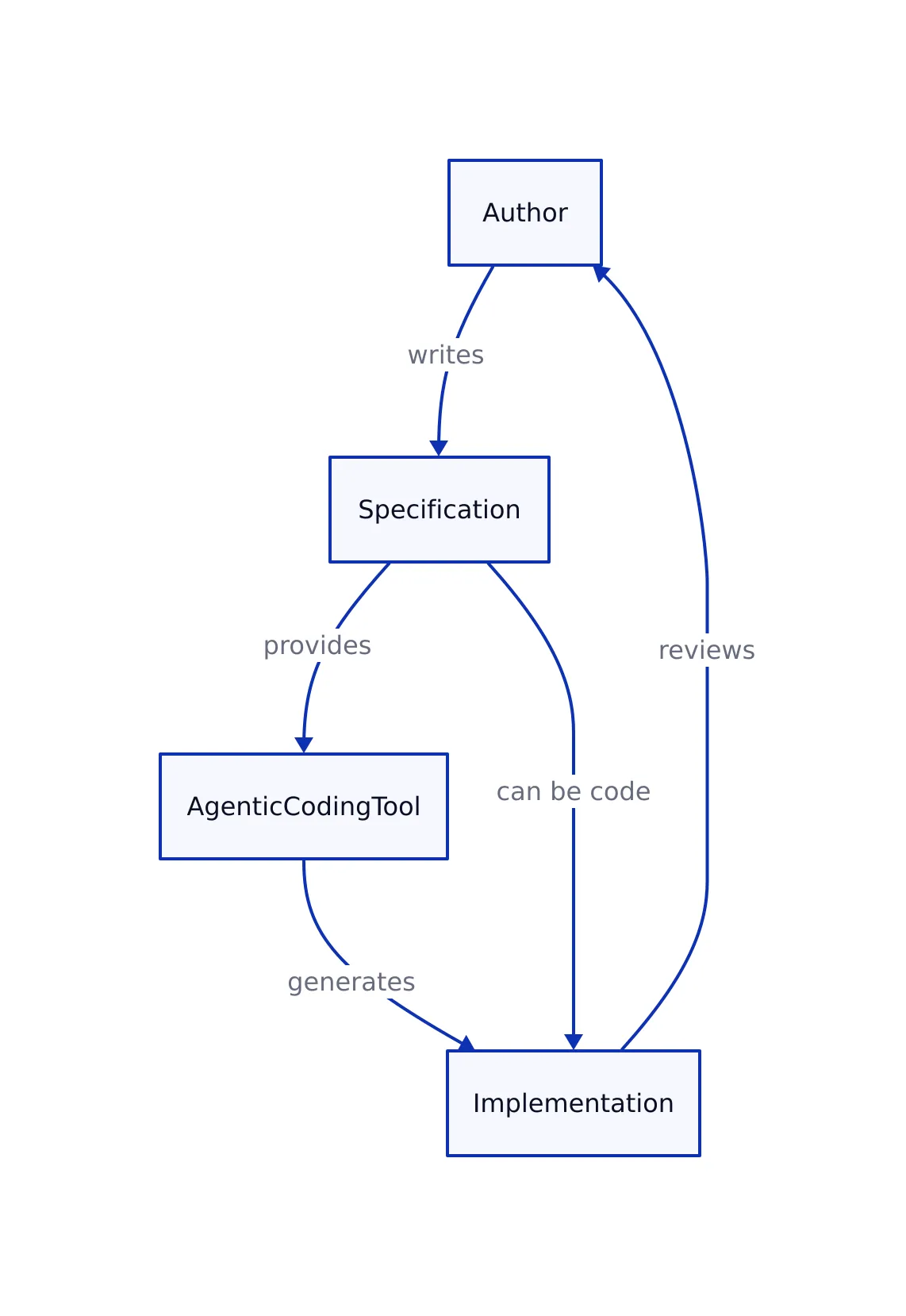
This is not just a philosophical point. The trend is directly impacting how teams design, review, and deliver software:
- Agentic coding tools (like those described in the OpenAI Symphony example) promise to automate implementation from specs, but only if the spec is precise to the point of being pseudocode.
- “Garbage in, garbage out” holds more than ever—unclear specs produce unreliable, buggy, or incomplete code, whether written by humans or machines.
- Developers are forced to choose: either do the hard thinking in the spec (which is code), or in the code itself. There’s no shortcut.
When Specifications Become Code: Real-World Examples
Let’s ground this in reality. Consider the following “specification,” lifted from the Haskell for all analysis of OpenAI’s Symphony project:

# Pseudocode-style specification (SPEC.md)
fn start_service():
  configure_logging()
  start_observability_outputs()
  start_workflow_watch(on_change=reload_and_reapply_workflow)

  state = {
    poll_interval_ms: get_config_poll_interval_ms(),
    max_concurrent_agents: get_config_max_concurrent_agents(),
    running: {},
    claimed: set(),
    retry_attempts: {},
    completed: set(),
    codex_totals: {input_tokens: 0, output_tokens: 0, total_tokens: 0, seconds_running: 0},
    codex_rate_limits: null
  }

  validation = validate_dispatch_config()
  if validation is not ok:
    log_validation_error(validation)
    fail_startup(validation)

  startup_terminal_workspace_cleanup()
  schedule_tick(delay_ms=0)
  event_loop(state)

# Output: None (pseudocode/specification)
This “specification” is essentially code. In fact, it’s more useful for a developer or an LLM than any natural language description could be. The attempt to make the spec precise enough for machine consumption always leads to formality, structure, and—eventually—source code.

From Spec to Code: A Python Implementation
If you hand the above spec to a developer, the translation to working code is almost mechanical. Here’s a concrete example, following the described logic:
# Python 3.11+
def start_service():
    configure_logging()
    start_observability_outputs()
    start_workflow_watch(on_change=reload_and_reapply_workflow)

    state = {
        "poll_interval_ms": get_config_poll_interval_ms(),
        "max_concurrent_agents": get_config_max_concurrent_agents(),
        "running": {},
        "claimed": set(),
        "retry_attempts": {},
        "completed": set(),
        "codex_totals": {
            "input_tokens": 0,
            "output_tokens": 0,
            "total_tokens": 0,
            "seconds_running": 0
        },
        "codex_rate_limits": None
    }

    validation = validate_dispatch_config()
    if validation != "ok":
        log_validation_error(validation)
        fail_startup(validation)

    startup_terminal_workspace_cleanup()
    schedule_tick(delay_ms=0)
    event_loop(state)

# Expected Output: None; initializes and runs service event loop.
The translation is direct, with almost every line from the “specification” mapping to a line of code. This is the essence of the argument: the more precise the spec, the less difference there is from code.

Edge Cases and Pitfalls in Spec-Driven Development
Why can’t we just write specs and let agentic tools handle the rest? There are two fundamental misconceptions, as detailed in the original analysis:

- Misconception 1: Specification documents are simpler than code.
In reality, if you want the specification to be unambiguous and machine-consumable, you must make it as explicit and formal as code. That’s as hard as writing code itself. - Misconception 2: Writing specifications is more thoughtful than coding.
The belief that filtering work through specs improves quality is only true if the spec is rigorous—at which point, it is code, just in another syntax.
There are hard production lessons here. For example, the YAML specification is famously detailed, yet most real-world YAML parsers do not conform fully to spec (source). This highlights the limits of even the most granular specs: the “verbal precision” problem Dijkstra warned about decades ago.
# Example: YAML spec edge case (parsing ambiguity)
# YAML spec says:
# 'yes' is a boolean true

import yaml

print(yaml.safe_load("yes"))  # Output: True

# But many YAML parsers handle edge cases inconsistently, leading to production bugs.
In production, “sufficient detail” in a spec often means encoding all expected edge cases, data formats, and error handling. At some point, you’re just writing a formal grammar, or executable test cases—and these are code.

Specs vs. Code vs. Agentic Generation: A Comparison
How do specs, code, and agentic (LLM-driven) generation compare in practice? Here’s a breakdown:
| Aspect | Specification | Manual Code | Agentic Generation (LLMs/Agents) |
|---|---|---|---|
| Precision | High if detailed (close to code) | Very high (enforced by compiler/interpreter) | Variable—depends on input quality |
| Ambiguity | Low only if heavily formalized | Low (explicit logic) | Medium—often requires iteration/fixes |
| Ease of review | Readable if structured, but can drift into pseudocode | Readable for developers in target language | Opaque—generated code often needs human review |
| Maintenance | Challenging if spec is “living doc” | Standard (with tests, CI, etc.) | High risk—bugs can slip through unless rigorously tested |
| Production edge cases | Must be spelled out in detail (often omitted in specs) | Handled directly in code (if engineer is diligent) | Missed unless specified or covered by extensive tests |
This echoes lessons from our analysis of LLM-driven software workflows: without careful review, generated code inevitably misses requirements or mishandles edge cases, especially if the underlying “spec” is ambiguous.
Real-World Production Patterns
The “spec as code” reality surfaces in nearly every modern production workflow:
- Mission-critical projects (like Kafka-based event-driven microservices) treat schema definitions, error handling, and validation logic as “executable specs”—often using tools that generate code, docs, and tests from the same source.
- API security and compliance (see API Security in 2026) depend on highly formalized contracts—OpenAPI/Swagger, JSON Schema, etc.—which are quite literally code-like in their requirements and syntax.
- Even when using LLMs or agentic tools, organizations quickly discover that the only way to get robust, maintainable output is to hand the agent a “spec” that’s already as precise as code, or to iteratively refine the output with tests and manual review (source).
# Example: OpenAPI spec snippet (executable spec)
openapi: 3.0.0
info:
  title: Example API
  version: '1.0'
paths:
  /users:
    get:
      summary: Retrieve user list
      responses:
        '200':
          description: Successful response
          content:
            application/json:
              schema:
                type: array
                items:
                  $ref: '#/components/schemas/User'

# Output: This spec can generate server code, docs, and test stubs.
In practice, the code you “generate” from a spec is only as good as the spec’s rigor. If you want production-grade software, you must treat your spec with the same discipline—and often, the same structure—as the final code.
Key Takeaways
Key Takeaways:
- The distinction between “sufficiently detailed spec” and “code” is mostly artificial. At scale, specs become code.
- Agentic coding tools only deliver reliable results when the “spec” is already as rigorous and structured as code.
- Production edge cases, security requirements, and error handling must be formalized in the spec—turning it into executable logic.
- Lessons from real-world projects and LLM workflows confirm: there’s no shortcut past the hard thinking. Either the spec is code, or the code must be reviewed and refined until it matches spec intent.
- For maintainability, treat your “executable spec” as a first-class code artifact—with tests, reviews, and version control.