
Digital nomad visas are no longer a niche workaround for remote workers. They are now a mainstream residency option for people who want to live legally abroad, keep working for foreign clients or employers, and in some cases build toward permanent residency or citizenship. For English and Spanish speakers, the best options are concentrated in Europe, Latin America, and the Caribbean, where language access, familiar business culture, and established expat infrastructure make the move much easier.
This guide focuses on 10 programs that appeared repeatedly in the research above: Spain, Portugal, Mexico, Costa Rica, Malta, the United Arab Emirates, Italy, Colombia, Barbados, and Croatia. Not all of them are Spanish- or English-speaking countries in the narrow linguistic sense, but they were consistently included in the research set comparing the best digital nomad pathways for English-speaking and Spanish-speaking remote workers in 2026. I also separate the programs that are genuinely useful for a long-term citizenship strategy from those that are better treated as lifestyle visas.
 One cloud drive your whole global team can actually access. Sesame Disk by NiHao Cloud From $4/mo — unlimited on-demand storage, no VPN required, even in China.
Key Takeaways:
- Spain, Portugal, Mexico, Costa Rica, and Italy are the strongest long-term options in this research set because they were identified as offering a path toward permanent residency after multi-year legal residence.
- Barbados, Malta, the UAE, Colombia, and Croatia are attractive for short- to medium-term remote living, but the research above did not confirm a direct citizenship path through their digital nomad-style programs.
- Income thresholds in the research ranged from about $684 per month for Colombia to $4,167 per month for Barbados.
- The biggest practical hurdles are not usually the visa form itself, but apostilled documents, health insurance, proof of remote income, and tax planning.
- As we covered in our earlier roundup of digital nomad visas in Spanish and English countries, the broad winners remain similar in 2026, but the smarter comparison is now about long-term residency quality, not just easy entry.
Why this list matters in 2026
The research above shows a clear split in the market. Some countries use digital nomad visas as a bridge into normal residence systems. Others use them more like a premium, renewable stay permit for foreign earners. That distinction matters if your goal is not just spending a year by the beach, but eventually getting permanent residency, family stability, or a second passport.

That is also where this article builds on our previous 2026 analysis of top digital nomad visas and citizenship paths. The earlier piece correctly identified Spain, Portugal, Mexico, and Costa Rica as standout options. Looking at the same research set again, that conclusion still holds. What deserves more emphasis now is that a “good visa” and a “good citizenship strategy” are not always the same thing.

There is also a practical reason to focus on Spanish and English speaking environments. Language barriers affect every part of the move: consulate appointments, rental contracts, tax registration, healthcare, and even something as simple as getting a SIM card. In Spanish-speaking countries, basic Spanish goes a very long way. In English-speaking destinations like Barbados or Malta, daily administration is easier, but costs can be materially higher.
 Tired of "file too large" and broken links when sending to the world and to China? Sesame Disk by NiHao Cloud Upload once, share anywhere — China, USA, Europe, APAC. Pay only for what you use.
The research above also suggests moderate source volatility. That is normal for immigration topics. Requirements, consulate interpretations, and tax treatment can shift fast, so use this guide as a strategic map and always re-check the official government or consular page before paying fees or booking flights.
Top 10 digital nomad visas in Spanish and English speaking countries
1. Spain — Visado para Teletrabajadores
Spain remains one of the strongest all-round options in the research set. The earlier post on Sesame Disk cited an approximate minimum income of €2,850 per month, an initial duration of 1 year, renewability up to 5 years, and a path to permanent residency after 5 years. It also noted the visa’s connection to Spain’s Startup Act and the fact that remote employees and freelancers have both used it successfully.
Why Spain stands out: lifestyle, transport, healthcare access, and a realistic long-term residency path. If your goal is to settle in Europe rather than just test remote life abroad, Spain is one of the most compelling picks in this list. The trade-off is paperwork. Spain is rarely the easiest file to assemble, and document formatting matters.
Practical note: in Spain, formal greetings still matter more than many nomads expect. A polite “Buenos días” before jumping into a request helps in government offices, pharmacies, and apartment viewings.
2. Portugal — D8 Remote Work Visa
Portugal was listed in the earlier research with an approximate monthly income requirement of €3,680, an initial duration of 1 to 2 years, renewal up to 5 years, and a path to permanent residency after 5 years. It remains one of the cleanest long-term plays for remote workers who want a European base with relatively strong international usability.
Compared with Spain, Portugal is often perceived as administratively friendlier for foreigners, though that can vary by city and appointment backlog. Lisbon and Porto are the obvious hubs, but they are also the most expensive. Smaller cities can offer a better rent-to-quality ratio if you do not need a daily coworking scene.
For English speakers, Portugal is usually easier on the ground than Spain, especially in urban areas. But if you are serious about staying long term, learning Portuguese is still a smart investment.
3. Mexico — Temporary Resident Visa
Mexico is not always marketed as a dedicated digital nomad visa, but the research above consistently included the Temporary Resident Visa as a practical remote-work route. The earlier article cited about $2,600 per month in income, a 1-year initial duration, renewal up to 4 years, and possible permanent residency after 4 to 5 years.
Mexico is especially attractive for North Americans because flights are short, time zones are convenient, and daily life can be much cheaper than in major U.S. or Canadian cities. It also offers a wide spread of lifestyles: Mexico City for urban energy, Oaxaca for culture, Mérida for calm and safety, and coastal towns for surf-oriented living.
The honest trade-off is bureaucracy by consulate. Mexican consulates can interpret financial thresholds and document presentation differently. What works in one city may not work in another, so applicants often compare consulates before booking an appointment.
Sample visa-prep checklist based on the research themes above

Country: Mexico
Route: Temporary Resident Visa
Proof typically prepared by applicants:
- Passport valid well beyond intended stay
- Bank statements showing stable income or savings
- Consulate appointment confirmation
- Passport photos
- Completed application form
- Plan to exchange visa for residency card after arrival

Practical takeaway:
Do not assume one consulate's document style is accepted everywhere.
Bring printed statements and organized backups.
4. Costa Rica — Remote Worker Visa / Rentista-style route
Costa Rica appeared in the research with an approximate $3,000 monthly income threshold, duration of 1 to 2 years, renewal up to 4 years, and a permanent residency path after 3 years according to the earlier Sesame Disk comparison. That combination is unusually strong for applicants who want a legal stay plus a medium-term settlement option.
Costa Rica’s appeal is obvious: nature, political stability, and strong recognition among remote workers. But it is not always cheap in practice. Imported goods, some rentals in beach areas, and private healthcare can cost more than first-time visitors expect. It is better approached as a comfort-and-nature destination than as a rock-bottom budget base.
Culturally, patience matters. “Pura vida” is real, but it also reflects a slower rhythm. If you expect every process to run on strict big-city speed, you may find local administration frustrating.
5. Malta — Nomad Residence Permit
The research above listed Malta with an approximate income threshold of €3,500 per month, a 1-year duration, renewability up to 4 years, and no direct permanent residency route through the permit. Malta’s big advantage is straightforward: English is widely used, and the island is easy to navigate administratively for many foreign professionals.
Malta works well for nomads who want an English-speaking Mediterranean base without committing to a deeper immigration strategy. The downside is that, based on the research above, it is not the visa to choose if citizenship is your main goal.
6. United Arab Emirates — Dubai Virtual Working Program
The UAE program appeared in the research with a $3,500 monthly income threshold, 1-year renewable duration, 0% personal income tax, and no direct permanent residency path through the program. For high earners, Dubai remains attractive because of infrastructure, connectivity, and tax positioning.
But this is a very specific lifestyle fit. Housing, schools, and social life can be expensive, and the overall value proposition works best for people who actively want Dubai’s pace and business environment. It is less compelling if your priority is eventual citizenship or low living costs.

7. Italy — Visto per Lavoratore da Remoto
Italy was listed in the research with an approximate €2,500 monthly income threshold, a 1-year permit renewable annually, and a path to permanent residency after 5 years. That makes it more relevant to long-term planners than many people assume.
Italy’s challenge is not desirability; it is administration. If you love Italy, accept upfront that the paperwork may take patience. But if your long-term goal is legal residence in Europe and you are comfortable with a slower process, it can be a rewarding option.
Etiquette tip: in Italy, appearance and courtesy still carry weight in formal settings. Showing up organized and well presented for appointments can genuinely help interactions go more smoothly.
8. Colombia — Remote Worker Visa
Colombia stood out in the research for its low income threshold: about $684 per month, with a 2-year duration and no direct permanent residency path under that specific visa according to the earlier comparison. That low threshold makes it one of the most accessible programs in the list.
For remote workers on modest income, Colombia can be compelling. Medellín and Bogotá were specifically noted in the prior research as having strong nomad scenes and fast internet. The limitation is strategic: if your goal is citizenship, this is not the cleanest route in the set above.
Still, for affordability and ease of entry, Colombia deserves its place. Just be realistic about neighborhood choice, altitude differences, and safety habits. Cheap rent is not worth much if you choose the wrong area.
9. Barbados — Welcome Stamp
Barbados was listed with an approximate income threshold of $4,167 per month, 1-year renewable duration, and no direct permanent residency path. This is a premium lifestyle visa more than a migration strategy.
If you want English-speaking administration, Caribbean scenery, and a simple remote-work proposition, Barbados is attractive. But it is not a budget destination. Accommodation, groceries, and imported goods can add up quickly, so the higher income threshold reflects real on-the-ground costs.
10. Croatia — Digital Nomad Residence Permit
The research above listed Croatia with an approximate €2,250 monthly threshold, a 1-year duration, and no consecutive renewal under the same permit. It also noted no direct permanent residency path through that route.
Croatia is a strong lifestyle option if you want a beautiful coastal base and favorable treatment of foreign income, but the inability to renew consecutively changes the planning math. This is one to treat as a defined chapter, not an open-ended settlement plan.
Comparison table: income, duration, renewal, and citizenship path
| Country | Visa / Program | Approx. minimum income | Initial duration | Renewal | Path noted in research | Source from research set |
|---|---|---|---|---|---|---|
| Spain | Visado para Teletrabajadores | €2,850/month | 1 year | Yes, up to 5 years | Permanent residency after 5 years | Sesame Disk earlier analysis |
| Portugal | D8 Remote Work Visa | €3,680/month | 1–2 years | Yes, up to 5 years | Permanent residency after 5 years | Sesame Disk earlier analysis |
| Mexico | Temporary Resident Visa | $2,600/month | 1 year | Yes, up to 4 years | Permanent residency possible after 4–5 years | Sesame Disk earlier analysis |
| Costa Rica | Remote Worker Visa / Rentista-style route | $3,000/month | 1–2 years | Yes, up to 4 years | Permanent residency after 3 years | Sesame Disk earlier analysis |
| Malta | Nomad Residence Permit | €3,500/month | 1 year | Yes, up to 4 years | No direct PR path noted | Sesame Disk earlier analysis |
| UAE | Virtual Working Program | $3,500/month | 1 year | Yes | No direct PR path noted | Sesame Disk earlier analysis |
| Italy | Visto per Lavoratore da Remoto | €2,500/month | 1 year | Yes, annual | Permanent residency after 5 years | Sesame Disk earlier analysis |
| Colombia | Remote Worker Visa | $684/month | 2 years | No | No direct PR path under this visa | Sesame Disk earlier analysis |
| Barbados | Welcome Stamp | $4,167/month | 1 year | Yes | No direct PR path noted | Sesame Disk earlier analysis |
| Croatia | Digital Nomad Residence Permit | €2,250/month | 1 year | No consecutive renewal | No direct PR path noted | Sesame Disk earlier analysis |
The pattern is straightforward. If citizenship or permanent residency matters, Spain, Portugal, Mexico, Costa Rica, and Italy are the serious contenders in this set. If your priority is climate, tax positioning, or a one-year quality-of-life experiment, the others may fit better.
For broader context, one of the external sources surfaced in the research was Greenback Tax Services’ digital nomad visa guide, which also reflects how quickly tax questions become central once a visa turns into actual residence.
Which visas actually lead to permanent residency or citizenship?
This is where many “top visa” lists become misleading. A renewable visa is not the same thing as a residency ladder. Based on the research above, the strongest long-term group is Spain, Portugal, Mexico, Costa Rica, and Italy. They were all described as leading to permanent residence after a period of legal stay, generally between 3 and 5 years in the research set.
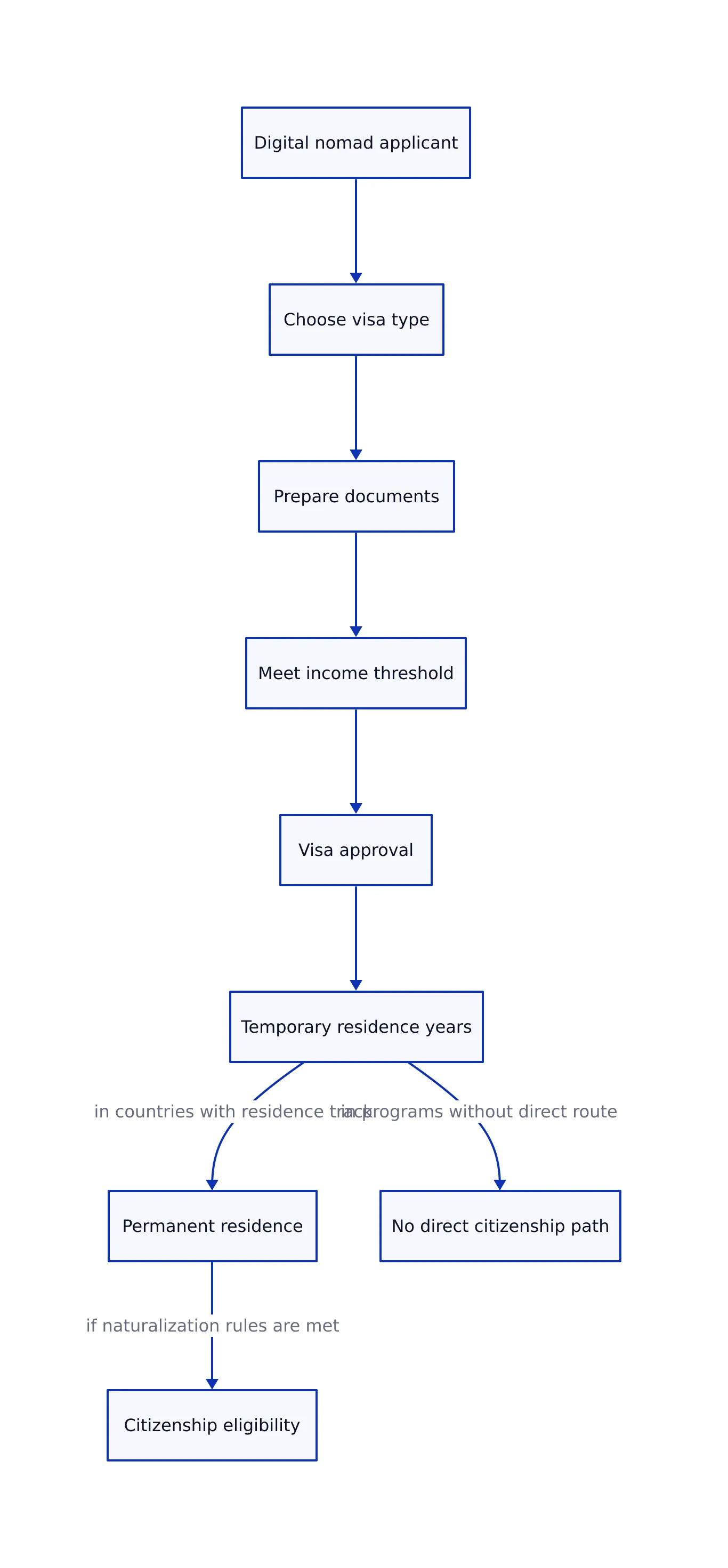
That does not mean citizenship is automatic. Naturalization rules are usually separate from visa rules and can involve language, physical presence, integration, or additional waiting periods. The research above was stronger on permanent residency timelines than on exact naturalization mechanics, so it is safest to say this: some visas create a residence history that may support citizenship later, while others are not designed for that at all.
Barbados, Malta, the UAE, Colombia, and Croatia were all presented in the research as having limited or no direct path through the visa itself. That does not necessarily mean there is no other immigration route in those countries. It means the specific digital nomad-style program should not be chosen primarily for citizenship planning.
Decision framework for choosing a visa

If your priority is long-term residence:
- Focus first on Spain, Portugal, Mexico, Costa Rica, Italy

If your priority is lower income threshold:
- Colombia stands out in the research

If your priority is English-speaking administration:
- Barbados and Malta are easier culturally for many applicants

If your priority is tax positioning and premium infrastructure:
- UAE is the obvious candidate in this research set

If your priority is a scenic one-year base:
- Croatia and Barbados are lifestyle-first options
Application playbook: documents, logistics, and common mistakes
Across the research above, the same document categories appeared again and again: passport, proof of income, private health insurance, clean criminal record, and evidence that the remote work is genuine. That sounds simple until you start collecting documents across jurisdictions.
The most common bottlenecks are:
- Bank statements not in the format a consulate expects
- Employer letters that do not clearly authorize remote work abroad
- Background checks that need apostille or legalization
- Health insurance policies that do not meet local requirements
- Missed renewal windows after arrival
If you are freelancing, your file usually needs more structure than a salaried employee’s. Contracts, invoices, client letters, and regular deposits should tell a coherent story. Consulates are not just checking that you earn enough. They are checking that the income is stable and foreign-based.
Simple document organization structure for a nomad visa file

01-passport/
02-application-form/
03-bank-statements-last-6-months/
04-employer-letter-or-client-contracts/
05-health-insurance/
06-criminal-record-check/
07-apostille-or-legalization/
08-photos/
09-accommodation-plan/
10-printed-backups/

Practical rule:
Bring both digital and printed copies.
Immigration systems may be modern on paper and paper-heavy in reality.
Another practical point: do not book a non-refundable long stay before approval unless the program specifically makes that low risk. Many first-time applicants underestimate how often timelines slip because one document needs to be reissued.
Practical living tips: taxes, etiquette, internet, and day-to-day reality
Once the visa is approved, the real work starts. Renting, opening accounts, registering locally, and understanding tax exposure are what determine whether the move feels smooth or exhausting.
Tax is the biggest blind spot. The earlier research repeatedly referenced favorable treatment of foreign income in some countries, but those summaries should never replace professional advice. A visa category, tax residency, and treaty position are three different things. If you stay long enough, your tax situation may change even if your employer remains abroad.
Internet quality is another real-world filter. The research above specifically mentioned strong internet in Medellín and Bogotá. In many other destinations, city centers are fine but smaller towns vary building by building. Before signing a lease, ask for a speed test screenshot and the name of the provider. Better yet, test mobile hotspot performance as backup.

Cultural etiquette matters too:
- Spain: greet before asking for help; social warmth matters.
- Mexico: politeness and patience go further than pushing for speed.
- Costa Rica: adapt to a slower rhythm instead of fighting it.
- Colombia: neighborhood awareness matters as much as city choice.
- Barbados and Malta: English helps, but that does not remove local norms around courtesy and pace.
Food and health are usually manageable in all of these destinations, but transitions still matter. In tropical climates especially, hydration, sun exposure, and air conditioning differences can affect your first weeks more than you expect. Build in a soft landing period rather than scheduling a full work sprint the day after arrival.
If your nomad life also includes side trips across Asia, the lesson is similar to what we noted in our guide to off-the-beaten-path destinations in China: the best experience usually comes from balancing headline cities with practical, less crowded bases. The same principle applies here. Lisbon, Barcelona, and Mexico City are exciting, but smaller secondary cities often deliver a better daily work-life setup.
Final thoughts
If I were grouping these 10 visas by strategy rather than hype, I would split them into three tiers.
- Best for long-term settlement: Spain, Portugal, Mexico, Costa Rica, Italy
- Best for short- to medium-term lifestyle quality: Malta, Barbados, Croatia
- Best for niche positioning: UAE for tax and infrastructure, Colombia for accessibility and low income threshold
The biggest update from the earlier Sesame Disk coverage is not that the winners changed dramatically. They did not. It is that the market is maturing, and applicants should now think less like tourists and more like planners. Ask not just “Can I get approved?” but also “Can I realistically renew, rent, integrate, and still want to be there after year two?”
For most readers who care about both quality of life and future options, Spain and Portugal remain the strongest European choices in the research above, while Mexico and Costa Rica are the standout options in the Americas. If your goal is simply to live somewhere beautiful for a year with minimal friction, Barbados, Malta, or Croatia may be more enjoyable than a heavier long-term file.
Either way, the smartest move is the same: choose the country that fits your actual work pattern, budget, and long-term plan, then over-prepare your documents. In digital nomad immigration, organization is often the difference between a smooth approval and months of avoidable delay.