Chinese Business Etiquette: Master Guanxi, Face, and Gifts
Misunderstanding Chinese business etiquette can cost you deals, strain relationships, or even close doors permanently. If you’re heading to China for business, mastering key concepts like guanxi (relationships), face (mianzi), and gift-giving is non-negotiable. This practical guide covers the essential protocols you’ll encounter — from the right way to exchange business cards, to what gifts to avoid, and how to build trust that unlocks long-term business value.
Key Takeaways:
- Understand the crucial roles of guanxi (relationships) and face (mianzi) in Chinese business culture
- Master formal meeting, greeting, and business card exchange protocols
- Navigate banquets with confidence: seating, toasting, and dining etiquette
- Choose appropriate business gifts and avoid cultural taboos
- Adapt to Chinese negotiation styles and learn to build lasting guanxi
- Recognize common etiquette mistakes and how to avoid them
Understanding Guanxi and Face in Chinese Business
Guanxi is the foundation of business success in China. Unlike transactional relationships common in the West, guanxi revolves around trust, reciprocity, and long-term mutual obligations. It’s not just “who you know,” but how well you nurture those ties, including through favors, introductions, and ongoing support (source).
What is Guanxi?
- Relational Closeness: The deeper your ties, the more doors open. Guanxi is built over shared meals, personal favors, and time invested in the relationship.
- Relative Status: Hierarchy matters. Seniority, age, and title shape how guanxi is formed and maintained.
- Practical Application: Expect that decisions often require consensus and internal consultation; a single meeting rarely seals a deal.
Understanding Face (Mianzi)

Face (mianzi) refers to a person’s reputation, dignity, and social standing. Causing someone to “lose face” through public criticism or embarrassment can irreparably harm your business prospects. Conversely, giving face—praising someone publicly or showing deference—builds goodwill.
- Avoid open disagreement or confrontation in meetings
- Address mistakes privately, and always maintain a tone of respect
- Give credit to Chinese partners in group settings
Recognizing the interplay between guanxi and face allows you to build durable partnerships and avoid mistakes that can kill a deal before it starts (source).
Meeting Protocols and Business Card Etiquette
First impressions set the tone. Chinese business meetings are formal, hierarchical, and highly structured. Small missteps in greeting or card exchange can be read as disrespect.
Meeting Protocols: What to Expect
- Punctuality: Arrive 10-15 minutes early. Being late can signal unreliability.
- Seating: The host sits facing the door, the most senior guest to their right. Wait to be seated.
- Introductions: Titles and company names matter. Address people by their surname plus title (e.g., “Director Wang”).
- Order of Speaking: The most senior member leads. Let the host initiate the agenda.
Business Card Etiquette
- Carry bilingual business cards (English one side, Chinese the other). Use Simplified Chinese for mainland China.
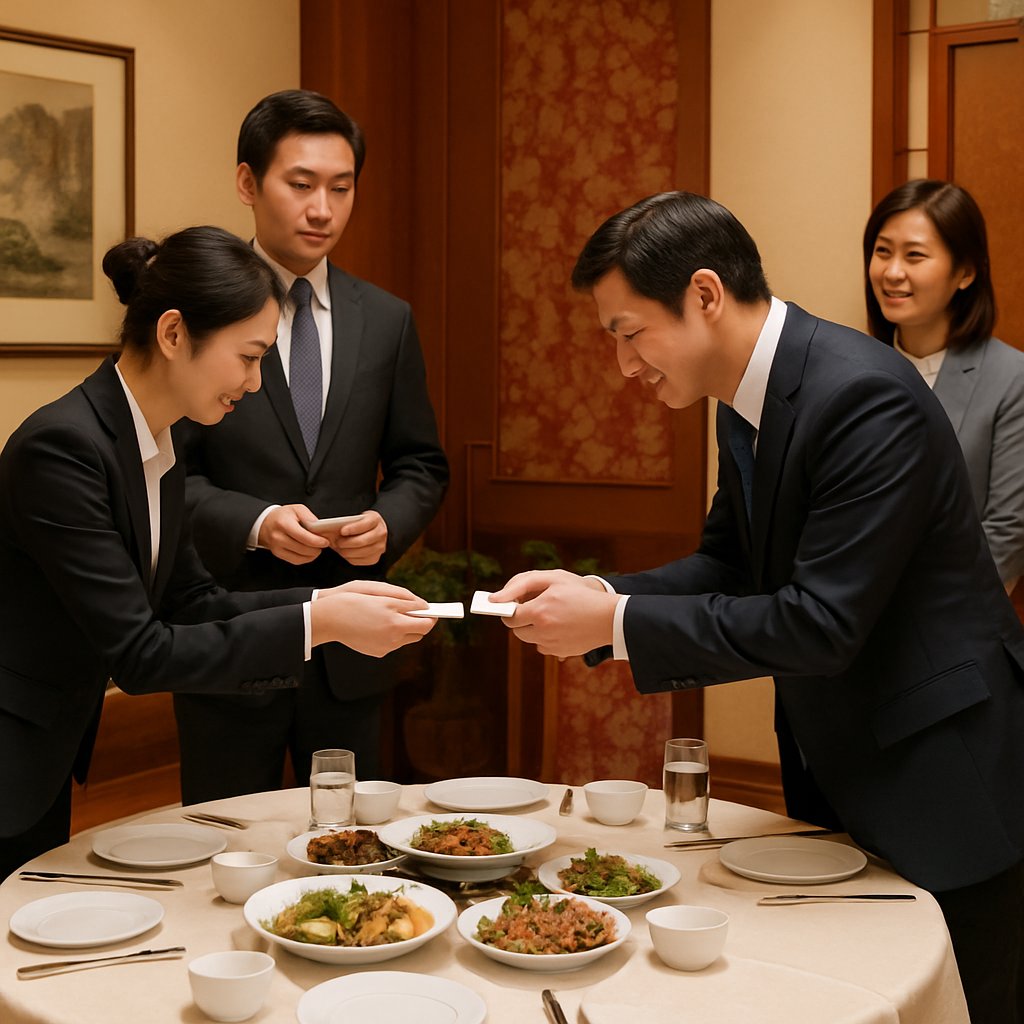
- Present and receive cards with both hands. Hold the card so the recipient can read their language side facing them.
- Take a moment to look at the card before putting it away—never write on or shove it into a pocket.
WeChat and Digital Contacts
Business cards are often supplemented by WeChat QR codes. It’s common to scan and add each other on WeChat at the end of a meeting, especially for follow-up.
| Protocol | What to Do | What to Avoid |
|---|---|---|
| Greeting | Handshake, slight nod, address by title | Hugging, first name only |
| Business Card | Give/receive with both hands, admire card | One-handed pass, pocketing immediately |
| Seating | Wait for host, follow hierarchy | Sit anywhere, take host’s seat |
For more on practical digital communications in China, see WeChat for Foreigners: Setup & Payment Tips.
Banquet Etiquette and Dining Rules
Business banquets are not just about food—they’re a key forum for building guanxi and testing your cultural awareness. The way you handle yourself at the table can leave a lasting impression.
Seating and Order
- Wait to be shown to your seat—position reflects status.
- The host sits opposite the entrance; the most senior guest is to their right.
- Do not start eating or drinking until the host gives a toast or signals to begin.
Dining Etiquette
- Let the host order all dishes (expected protocol source).
- Try a bit of everything, but don’t finish every dish—leaving some food signals generosity.
- Use serving chopsticks (公筷) if provided; never use your own to take from shared plates.
- Don’t point with chopsticks, stick them upright in rice, or tap them on the bowl (all are bad luck or disrespectful).
Toasting and Alcohol
- The host will initiate toasts; reciprocate, but don’t out-toast the host.
- When clinking glasses, ensure your glass rim is lower than the senior person’s as a sign of respect.
- If you don’t drink alcohol, politely explain in advance—otherwise, expect to participate.
Banquet Flow
Dinners often last 2-3 hours, with multiple toasts and rounds of conversation. Business topics are usually saved for later in the meal or even after dessert.
For more, read Executive Planet: Chinese Business Etiquette.
Gift-Giving Rules in Chinese Business
Gift-giving is a nuanced aspect of Chinese business etiquette, tightly linked to guanxi and face. The right gift can open doors; the wrong one can offend or even kill a deal. Gifts are often exchanged at the end of successful meetings or during major holidays like Chinese New Year.
What to Give
- Quality office items (pens, business card holders), local specialties, or brand-name goods from your country
- Books (unless the subject is taboo), fine tea, fruit baskets, alcohol (premium brands appreciated)
- Gifts should be nicely wrapped—avoid white or black paper (colors of mourning)
- Present gifts with both hands, and express that it’s just a small token
What to Avoid
- Clocks: Giving a clock (送钟, sòng zhōng) sounds like “attending a funeral” and is deeply inauspicious (source).
- Umbrellas: Symbolizes breaking up (散, sàn).
- Sharp objects: Knives or scissors cut relationships.
- Anything in sets of four: The number 4 (四, sì) sounds like “death.” Stick to pairs or eights, which are lucky.
- Gifts that are too expensive: Can be embarrassing or even construed as bribery.
Monetary vs. Nonmonetary Gifts
Research distinguishes between monetary (cash, gift cards) and nonmonetary (goods, souvenirs) gifts. In business, always prefer tasteful nonmonetary gifts. Monetary gifts may be seen as inappropriate or even illegal in some contexts (source).
| Gift Type | Acceptable? | Example | Notes |
|---|---|---|---|
| Nonmonetary (goods) | Yes | Tea, local crafts, branded pens | Wrap nicely; present at end of meeting |
| Monetary (cash) | No | Red envelopes, cash cards | Inappropriate in business; may be illegal |
| Taboo items | No | Clock, umbrella, sharp objects | Avoid due to negative symbolism |
For more detailed payment and gift tips, see China Alipay Guide for Foreigners.
Negotiation Style and Building Guanxi
Negotiating in China is as much about relationship building as it is about the contract. Expect a process that’s slower and more indirect than in many Western countries.
Negotiation Style
- Indirect Communication: “No” is rarely said directly. Listen for hesitation or ambiguous replies.
- Patience is Key: Multiple meetings are expected; don’t push for decisions too quickly.
- Group Decision-Making: Rarely will a single person make the final call. Consensus is valued.
- Face-Saving: Never corner a counterpart; allow room for reconsideration or compromise without embarrassment.
Building Guanxi
- Invest time outside the boardroom: meals, tea, cultural events
- Reciprocate favors and remember important dates (Chinese New Year, Mid-Autumn Festival)
- Share information and introductions; be generous but discreet with your network
- Use WeChat for ongoing communication—respond promptly to messages
Long-Term Relationship Building
Guanxi is cumulative. The stronger your network, the more efficiently you’ll resolve issues, negotiate terms, and secure new opportunities (source). Trust is built slowly and lost quickly.
For more on adapting to Chinese communication, see China Internet Guide: VPN, WeChat & Digital Survival.
Common Pitfalls and Pro Tips
Common Pitfalls
- Using first names or informal greetings—seen as disrespectful
- Ignoring hierarchy in meetings or seating
- Giving gifts with unlucky numbers or taboos (clocks, umbrellas, sets of four)
- Discussing business too early at banquets
- Failing to reciprocate hospitality or favors
- Pushing for quick decisions or direct answers—can cause loss of face
Pro Tips
- Pre-print bilingual business cards before arriving in China
- Download WeChat, learn basic features, and set up your business profile
- Prepare several small, culturally appropriate gifts for hosts and senior contacts
- Observe how your Chinese counterparts interact and mirror their formality
- Ask your local partner for advice on etiquette for specific occasions
- If you make a mistake, apologize privately and with humility—intent matters
Deepen your understanding with this guide to business etiquette at Chinese trade shows.
Conclusion and Next Steps
Mastering Chinese business etiquette isn’t about memorizing rules—it’s about showing respect, building trust, and understanding values behind every gesture. Invest time in guanxi, pay attention to face, and observe local protocols in meetings, banquets, and gift exchanges. Every detail counts.
For your next steps, consider reading about China Business Travel: Visa & Logistics Guide or explore digital essentials in WeChat for Foreigners: Setup & Payment Tips to prepare for a productive trip.
With these practical strategies, you’ll not only avoid faux pas, but unlock deeper, more successful partnerships in China’s complex business landscape.
Wei Chen
Has visited every province in China without ever leaving his desk. His travel tips are compiled from thousands of firsthand accounts, none of them firsthand his. Wei Chen writes practical travel and lifestyle guides for China. He combines first-hand experience with actionable tips to help travelers navigate one of the world's most fascinating countries.