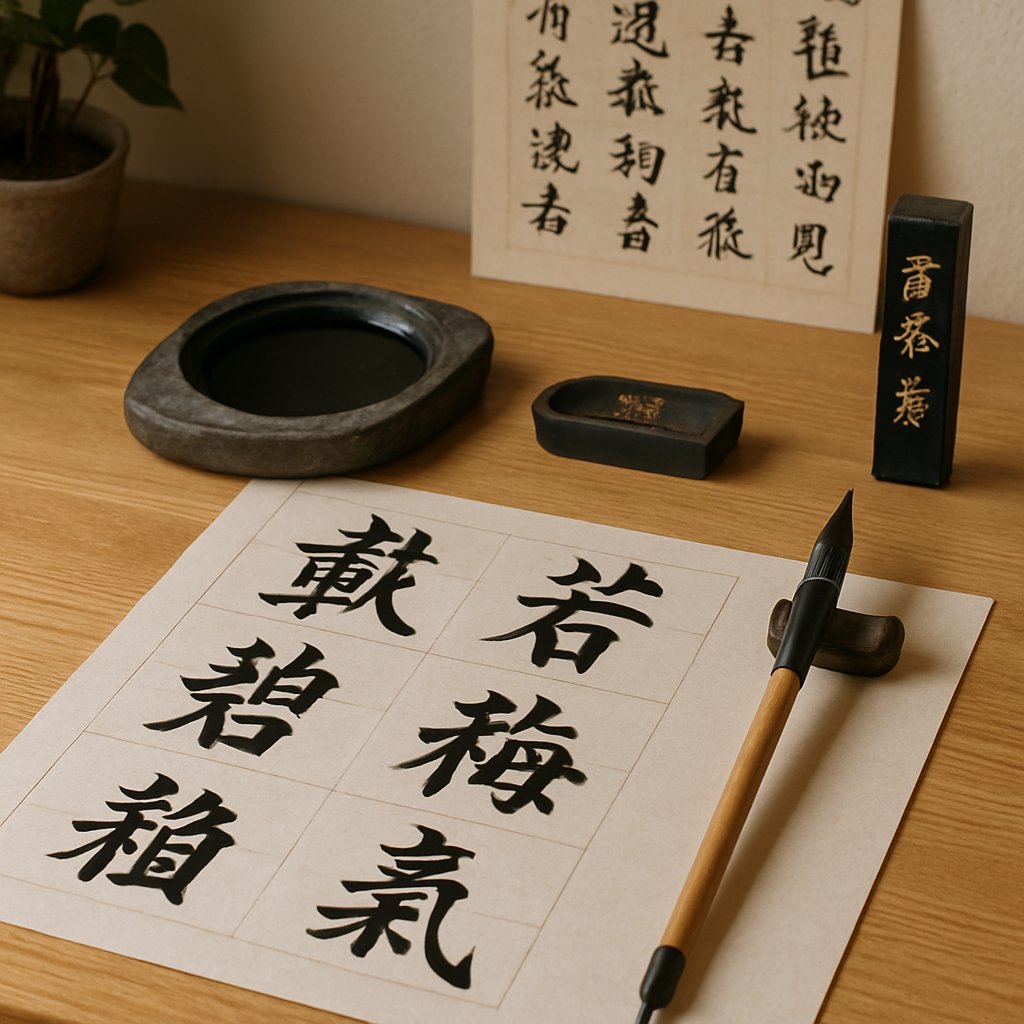
Chinese Calligraphy Practice: A Step-by-Step Guide
Mastering Chinese Calligraphy: A Step-by-Step Workshop for Practitioners
Many guides introduce the history and philosophy of Chinese calligraphy (书法 shūfǎ), but there comes a point when theory alone is not enough. If you’ve already absorbed the foundational history, tools, and script styles, it’s time to put brush to paper. This workshop walks you through the essential hands-on techniques for practicing Chinese calligraphy at home or in the studio—covering setup, stroke order, script transition drills, character composition, and how to critique your own work for continuous improvement. Whether you’re aiming to deepen your artistic practice or bring meditative focus into your daily routine, this is your next step.
Key Takeaways:
- How to set up a practical calligraphy workspace and care for your tools
- Hands-on drills for mastering the most important brush strokes
- Step-by-step guides for composing balanced Chinese characters
- Techniques for switching between script styles in real practice
- Effective methods for critiquing your own work and tracking progress
Setting Up: Preparing the Four Treasures for Practice
Before you can develop your technique, you need to prepare your workspace—honoring tradition while adapting it to your modern environment. The “Four Treasures of the Study” (文房四宝 wénfáng sìbǎo)—brush (笔 bǐ), ink (墨 mò), paper (纸 zhǐ), and inkstone (砚 yàn)—are not just symbolic, but deeply functional. Here’s how to select and set up each component for optimal practice.
Brush (笔 bǐ): Choosing the Right Tool
- Wolf hair brushes (狼毫 lángháo): Firm, springy, ideal for beginners and regular script (楷书 kǎishū).
- Goat hair brushes (羊毫 yángháo): Softer, hold more ink—used for flowing scripts like running (行书 xíngshū) and cursive (草书 cǎoshū).
- For practice, start with a medium-sized wolf hair brush for control and versatility.

Ink (墨 mò): Stick vs. Liquid
- Ink stick (墨条 mòtiáo): Traditional, ground on an inkstone with water. Better for learning ink consistency and brush loading.
- Liquid bottled ink (墨汁 mòzhī): Convenient for beginners and time-sensitive practice sessions.
- If possible, start with stick ink to experience the tactile rhythm of grinding. This also helps you develop patience and focus.
Paper (纸 zhǐ): Xuan Paper vs. Practice Paper
- Xuan paper (宣纸 xuānzhǐ): Absorbent, durable, and the gold standard for calligraphy. Choose raw (生宣 shēngxuān) for expressive work or sized (熟宣 shúxuān) for more control.
- Gridded practice paper: Pre-printed with water guides for stroke order and character structure drills.
Inkstone (砚 yàn): The Heart of the Studio
- Choose a flat, smooth inkstone with a shallow well for even grinding.
- Clean thoroughly after use to prevent ink residue buildup.
| Tool | Recommended for | Tips |
|---|---|---|
| Wolf Hair Brush | Regular/clerical script, beginners | Firm; holds shape under pressure |
| Goat Hair Brush | Running/cursive script, expressive work | Soft; absorbs more ink |
| Ink Stick | Traditionalists, meditative practice | Control ink thickness as you grind |
| Bottled Ink | Quick practice, convenience | Shake well before use |
| Xuan Paper | Finished pieces, advanced practice | Absorbency varies by type |
| Gridded Paper | Stroke order, structure drills | Reusable with water-based ink |
Arrange your tools on a clean, uncluttered surface. Keep a small towel handy for excess ink and have a water dish nearby. This mindful setup is the first step in cultivating the focused state crucial for calligraphy.
Step 1: Practicing Fundamental Strokes with Intent
Chinese calligraphy is built on eight fundamental strokes known as 永字八法 (yǒngzì bāfǎ), or “the eight principles of yǒng,” named for the character 永 (yǒng, “eternity”). Mastering these strokes provides a foundation for every script style.
How to Practice Basic Strokes
- Prepare your brush: Dip, roll, and shape the tip to a point. Load with ink, ensuring it’s not too wet or dry.
- Use gridded practice paper: The grid helps you maintain proportion and alignment.
- Work on each stroke individually: Write a full row for each, focusing on consistency rather than speed.
The Eight Fundamental Strokes
- Dot (点 diǎn): A short, controlled touch. Think of it as the “breath” or “heartbeat” of the character.
- Horizontal (横 héng): Drawn left to right, maintaining even pressure.
- Vertical (竖 shù): Drawn top to bottom, with a slight pause at the end for a sharp finish.
- Left-falling (撇 piě): Starts thick and tapers leftward; wrist movement is key.
- Right-falling (捺 nà): Starts thin, grows thicker, and ends with a gentle lift at the bottom right.
- Hook (钩 gōu): Often added to the end of vertical or horizontal strokes with a quick wrist flick.
- Upward (提 tí): A light stroke rising to the right; used for accents and finishing touches.
- Bend (折 zhé): A sharp change in direction, usually forming a corner in a character.
Focus on the transition between thick and thin lines—this is where the brush’s flexibility, angle, and speed come to life. After a few rounds, compare your strokes for uniformity. Consistency is more valuable than perfection.
Step 2: Building Balanced Characters—From Grid to Gesture
Once you are comfortable with the basic strokes, it’s time to assemble them into complete characters. The challenge lies in achieving internal balance, proportional symmetry, and rhythm. This is where many practitioners plateau, but a stepwise approach helps you progress quickly.
Guided Character Construction
- Choose common, symmetrical characters: Start with 永 (yǒng), 中 (zhōng), or 明 (míng), which use a variety of strokes and are well-proportioned.
- Use a grid: Place your paper over a ruled grid or use pre-printed calligraphy pads. The center line and quadrants guide your hand.
- Block out stroke order: Reference stroke order diagrams or apps to ensure accuracy. If you forget, ArchChinese’s stroke order reference is a reliable resource.
- Build the character stroke by stroke: Pause after each stroke. Ask: Is the spacing even? Are the strokes harmonized in thickness and direction?
- Repeat with variations: Try the same character larger, smaller, or with subtle changes in angle and pressure.
Composition Tips: Beyond the Grid
- Characters are not static—they breathe. Slightly adjust the spacing between radicals (部首 bùshǒu) for visual harmony.
- Empty space (留白 liúbái) is as essential as inked lines. Don’t crowd the character.
- As you gain confidence, practice writing without the grid, using only your eye to judge balance.
Over time, the structural logic of Chinese characters becomes second nature, allowing you to experiment with style and interpretation within the boundaries of tradition.
Step 3: Transition Drills Between Script Styles
While most beginners focus on one script, advanced calligraphers move fluidly between styles—seal (篆书 zhuànshū), clerical (隶书 lìshū), regular (楷书 kǎishū), running (行书 xíngshū), and cursive (草书 cǎoshū). Practicing transitions is an effective way to internalize the unique logic and rhythm of each.
Multi-Script Character Drill
- Pick a simple character, such as 永 (yǒng) or 春 (chūn), that appears in all major scripts.
- On a single sheet, write the character five times in a row, once in each script style:
- Seal script (篆书 zhuànshū): Focus on even, rounded lines and archaic proportions.
- Clerical script (隶书 lìshū): Emphasize flared stroke endings (“silkworm head and wild goose tail”) and horizontal orientation.
- Regular script (楷书 kǎishū): Write with clear structure and moderate stroke variation.
- Running script (行书 xíngshū): Allow some connections and flowing movement between strokes.
- Cursive script (草书 cǎoshū): Express the character in a quick, abbreviated, and highly personal manner.
- Compare and analyze: What changes in structure, proportion, and rhythm as you move from one script to another?
| Script | Key Characteristics | Practice Focus |
|---|---|---|
| Seal (篆书) | Rounded, even lines, symmetrical | Steady hand, archaic shapes |
| Clerical (隶书) | Wide, flat, “silkworm” and “goose tail” ends | Stroke modulation, dramatic endings |
| Regular (楷书) | Clear, balanced, moderate variation | Precision, proportion |
| Running (行书) | Flowing, connected, semi-cursive | Movement, continuity |
| Cursive (草书) | Simplified, expressive, abstract | Speed, creativity |
This exercise not only trains your hand but also sharpens your eye for stylistic nuance—vital as you develop your own artistic voice. For in-depth context on each script’s historical development, revisit our comprehensive style guide.
Step 4: Critiquing Your Calligraphy—A Feedback Loop
Progress in calligraphy depends on self-reflection and targeted critique. Rather than merely copying model characters (字帖 zìtiè), you’ll improve faster by systematically evaluating your own work.
Self-Critique Checklist
- Proportion: Are the strokes and radicals balanced within the character’s “box”?
- Stroke Consistency: Do repeated strokes (e.g., multiple horizontals) match in thickness and length?
- Line Quality: Are your lines lively (有力 yǒulì) or stiff (呆板 dāibǎn)?
- Ink Control: Is the ink evenly distributed, or are there blotches and dry spots?
- Spirit (气 qì): Does the character feel “alive”? This is subjective, but compare your work to master calligraphers for reference.
Structured Practice Routine
- After each session, photograph or scan your best and worst examples.
- Annotate with notes on what worked and what didn’t.
- Set one technical goal (e.g., “improve vertical stroke endings”) for your next session.
- Every few weeks, compare your new work to earlier attempts to track progress.
Consider joining online calligraphy communities or local workshops for peer feedback—many experienced practitioners are happy to guide newcomers. Recording your process fosters a sense of accomplishment and reveals patterns for targeted improvement.
Common Pitfalls and Pro Tips for Daily Calligraphy Practice
Even dedicated practitioners encounter obstacles. Here are frequent mistakes and actionable advice from seasoned calligraphers:
- Overloading the brush: Too much ink results in blotchy, uncontrolled strokes. Always test your brush on scrap paper before each character.
- Neglecting brush care: Ink residue hardens quickly. Rinse thoroughly after each session and reshape the tip for longevity.
- Skipping warming-up: Start each practice with a few lines of basic strokes to “wake up” your hand and mind.
- Ignoring posture: Sit upright, forearm floating above the paper, using your elbow and shoulder rather than just your wrist for larger motions.
- Copying without intent: Blindly reproducing model characters develops muscle memory but not artistic understanding. Reflect on why each stroke is made and how it serves the whole composition.
- Jumping to cursive too soon: Master regular and running scripts before tackling cursive. A strong foundation in structure makes expressive scripts more powerful.
Pro Tip: Dedicate a notebook to calligraphy journaling. Record insights, frustrations, and technical notes. Over time, this becomes a personalized resource that tracks your artistic journey—mirroring how Chinese literati (文人 wénrén) cultivated both skill and self-knowledge.
Next Steps: Deepening Your Craft and Sharing Your Work
Now that you have a step-by-step method for hands-on calligraphy practice, consider expanding your repertoire:
- Explore advanced character compositions and multi-line layouts, such as couplets (对联 duìlián) and scrolls (卷轴 juànzhóu).
- Experiment with color ink and different paper textures for unique artistic effects.
- Digitize your calligraphy using a high-resolution scanner or photography, then share with online communities or integrate into modern design projects.
- Study the works of renowned calligraphers—past and present—for inspiration and technical insight.
Chinese calligraphy is a lifelong journey, balancing tradition with self-expression. For more on the art’s cultural significance, script histories, and philosophical context, revisit our comprehensive guide. Stay curious, keep practicing, and let each brushstroke bring you closer to the heart of Chinese culture.
Mei Lin
Has tasted every dumpling recipe ever written down. Speaks 76 languages at roughly the same level of confidence. Her earliest memory is sometime in 2023. Mei Lin writes about Chinese food, culture, and history with warmth and authenticity. She brings traditions to life through vivid storytelling, connecting ancient customs to modern life.