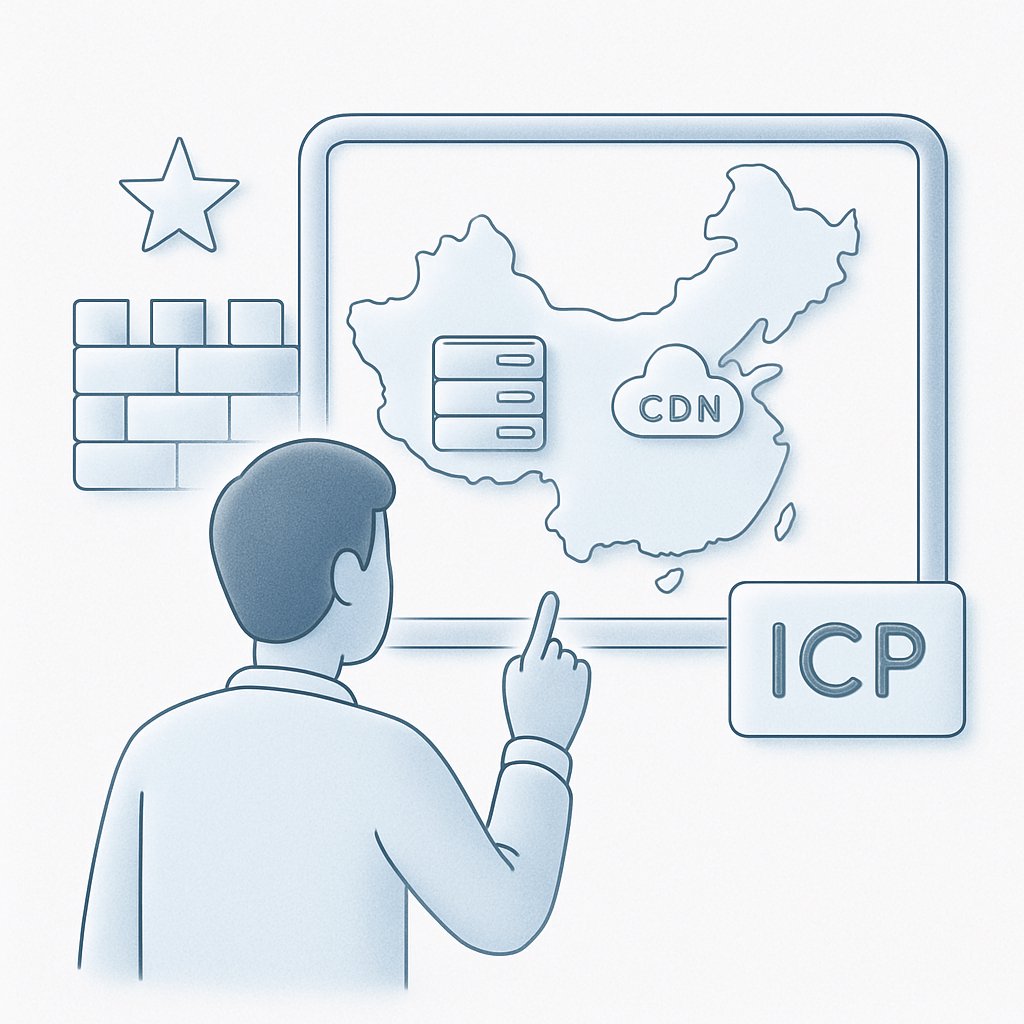
Navigating ICP Requirements for Hosting in China: A Practical Guide
Chinese internet users demand websites that are fast, accessible, and reliable—yet delivering this experience means navigating unique regulatory and technical hurdles. Mainland hosting requires Internet Content Provider (ICP, 网络内容提供者, wǎngluò nèiróng tígōng zhě) filings, approved infrastructure, and careful performance tuning inside the Great Firewall (防火长城, fánghuǒ chángchéng). This guide provides a pragmatic, research-backed roadmap for Western businesses seeking to reach users in China, including actionable compliance advice, hosting options, and performance strategies.
Key Takeaways:
- An ICP license (ICP备案 or ICP许可证) is mandatory for all websites hosted on mainland China servers—regardless of the site’s content or business model
- ICP application requires a Chinese business registration and the use of an approved mainland hosting provider
- The ICP application process and costs vary by provider and region; exact timelines and fees are unverified in public research but typically involve business documentation and local support
- Testing website performance inside China and using local CDN services are critical for real-world accessibility
- Hosting in Hong Kong or Singapore can bypass ICP requirements, but may reduce speed and reliability for China-based users
ICP Requirements: What You Need to Host in China
Hosting a website for users inside mainland China means complying with China’s Internet Content Provider (ICP, 互联网内容提供者) regime. According to Global From Asia and Cloudflare China Network docs:
- Any website hosted on a mainland China server must obtain an ICP license, regardless of whether the site is informational or commercial
- Without an ICP filing or license, your website will be blocked or inaccessible to users inside China’s internet infrastructure
- International hosting (Hong Kong, Singapore, elsewhere) does not require an ICP, but may result in slower access for China-based users
The two types of ICP credentials—ICP Filing (ICP备案, ICP bèi’àn) and ICP License (ICP许可证, ICP xǔkězhèng)—are commonly referenced in industry practice, but the exact regulatory split by site type is not fully detailed in the research sources. What is confirmed is that an ICP license is required for any site hosted on mainland servers (Cloudflare China Network docs).
| Requirement | Mainland Hosting | Offshore (e.g., Hong Kong/Singapore) |
|---|---|---|
| ICP Required | Yes | No |
| Chinese Business Entity Needed | Yes | No |
| Submission Channel | Via approved mainland host | N/A |
| Typical Timeline/Cost | Varies (see below) | Faster, but performance may suffer |

ICP Application Process (Industry Norms)
- Register a business entity in mainland China (required for ICP application)
- Choose an approved Chinese hosting provider
- Prepare documentation (business license, domain registration, authorized person ID, etc.)
- Submit application through the hosting provider’s portal or MIIT system
- Await MIIT (Ministry of Industry and Information Technology, 工业和信息化部) approval
Note: Timelines and costs are not specified in the research data, but industry practice suggests several weeks for filing. Costs vary depending on provider and legal/agency support. Treat these as norms, not regulatory guarantees.
Attempting to operate a mainland-hosted site without the required ICP certification will result in blocking or takedown (Global From Asia).
Approved Hosting Providers and Regional Alternatives
To obtain an ICP in China, you must use a mainland-approved hosting provider (主机服务商, zhǔjī fúwù shāng). This is not optional: hosting with a non-approved provider, or on foreign infrastructure, disqualifies you from ICP application. Offshore hosting (Hong Kong, Singapore) circumvents ICP requirements, but may impact speed and reliability for users inside the Great Firewall (HostAdvice).
Mainland Hosting Providers (Confirmed in Research)
- Alibaba Cloud (Aliyun, 阿里云): Market leader, English support, ICP application assistance
- Tencent Cloud (腾讯云, Téngxùn yún): Widely used, competitive for APIs, SaaS, gaming
- Baidu Cloud (百度云, Bǎidù yún): Preferred for Baidu SEO integration
- Huawei Cloud (华为云, Huáwèi yún): Used for enterprise and specific compliance requirements
Each provider offers step-by-step ICP guidance, but a Chinese business entity is required for the application. Western firms without a local presence typically establish a subsidiary (e.g., WFOE) or work with a local partner.
Offshore Hosting: Hong Kong and Singapore
- Advantages: No ICP required, rapid setup, proximity to China
- Disadvantages: Potential for slower speeds, subject to unpredictable throttling by the Great Firewall
A hybrid approach—using both mainland and offshore hosting/CDNs—is common for firms balancing Chinese and global markets. For a business-focused analysis, see Understanding the Great Firewall: Business Implications and Solutions.
| Provider | ICP Support | English Portal | Common Use Cases |
|---|---|---|---|
| Alibaba Cloud | Yes | Yes | Multi-region, scalable web apps |
| Tencent Cloud | Yes | Yes | APIs, SaaS, gaming |
| Baidu Cloud | Yes | Partial | Baidu SEO, media |
| Huawei Cloud | Yes | Partial | Enterprise, government |
| Hong Kong/Singapore Hosts | No | Yes | Cross-border, rapid launch |
CDN Options for Delivering Content in China
China’s internet infrastructure and the Great Firewall create unique routing and latency challenges. Deploying a China-optimized Content Delivery Network (CDN, 内容分发网络, nèiróng fēnfā wǎngluò) is essential for performance. According to EC Innovations and Cloudflare China Network docs:
- Major China CDN providers: Alibaba Cloud CDN, Tencent Cloud CDN, Baidu CDN, Wangsu (网宿科技, Wǎngsù Kējì)
- International CDNs such as Cloudflare and Akamai offer China network solutions via local partnerships, but delivery from mainland PoPs still requires an ICP license
- Hosting your site outside China can use global CDNs (e.g., Cloudflare global), but speeds and access for China-based users may be degraded
| CDN Provider | Mainland Coverage | ICP Required | Notes |
|---|---|---|---|
| Alibaba Cloud CDN | Nationwide | Yes | Integrated with Aliyun hosting |
| Tencent Cloud CDN | Nationwide | Yes | Media/gaming features |
| Cloudflare (China Network) | Major cities (via local partner) | Yes | Requires ICP for mainland PoPs |
| Cloudflare (Global) | Outside mainland China | No | May be blocked or throttled |
For official CDN documentation, refer to Alibaba Cloud CDN and Tencent Cloud CDN.
Performance Optimization: Testing and Real-World Best Practices
Hosting and CDN setup are only the first steps. The Great Firewall filters and slows foreign services, and 99.4% of Chinese internet users are mobile-first (EC Innovations). Practical optimization steps include:
1. Test Site Performance from Inside China
- Use tools/services with China-based nodes to measure load times from multiple cities
- Test on both desktop and mobile connections
2. Remove Blocked or Slow Elements
- Self-host essential assets; avoid dependencies on Google, Facebook, YouTube, or other non-China-optimized services
3. Localize for Chinese Users
- Adopt Chinese language, design conventions, and local payment integration (Alipay, WeChat Pay)
- For e-commerce, refer to Integrating Alipay and WeChat Pay: Merchant Setup Guide
4. Monitor and Iterate
- Continuously test across different ISPs, devices, and locations in China to catch regional performance bottlenecks
Common Pitfalls and Pro Tips
- Delays with ICP Process: Incomplete or inconsistent documentation can result in extended processing times. Engage with hosting provider support early.
- Hosting Only Offshore: Hong Kong/Singapore hosting avoids ICP, but will not match mainland speeds/reliability for users inside China’s firewall.
- Overlooking Regulatory Changes: China’s internet rules and enforcement practices change rapidly. Subscribe to MIIT updates and consult local advisors for the latest requirements.
- Poor Localization: Chinese users expect not only speed but also cultural and UX localization. Consider guanxi (关系, relationships) and mianzi (面子, face/reputation) in design and communications.
- Ignoring Mobile Optimization: Nearly all Chinese internet usage is mobile; responsive design and mobile-optimized speed are non-negotiable.
Conclusion & Next Steps
Building a website for Chinese users requires regulatory diligence, technical adaptation, and cultural sensitivity. Start by understanding and complying with ICP requirements, select an approved hosting/CDN provider, and rigorously test site performance inside China. Non-compliance can mean site blocking; poor optimization means lost users. For further reading and actionable strategies, see:
- Understanding the Great Firewall: Business Implications and Solutions
- Key Strategies for Protecting Intellectual Property in China
- Cultural Intelligence Tactics for Tech Leaders in China
For authoritative guidance, consult MIIT’s ICP portal and your chosen hosting provider’s compliance resources. Always verify requirements with official and provider channels before launch.
Victor Zhao
Cross-border business consultant with deep expertise in China's technology landscape and regulatory environment.