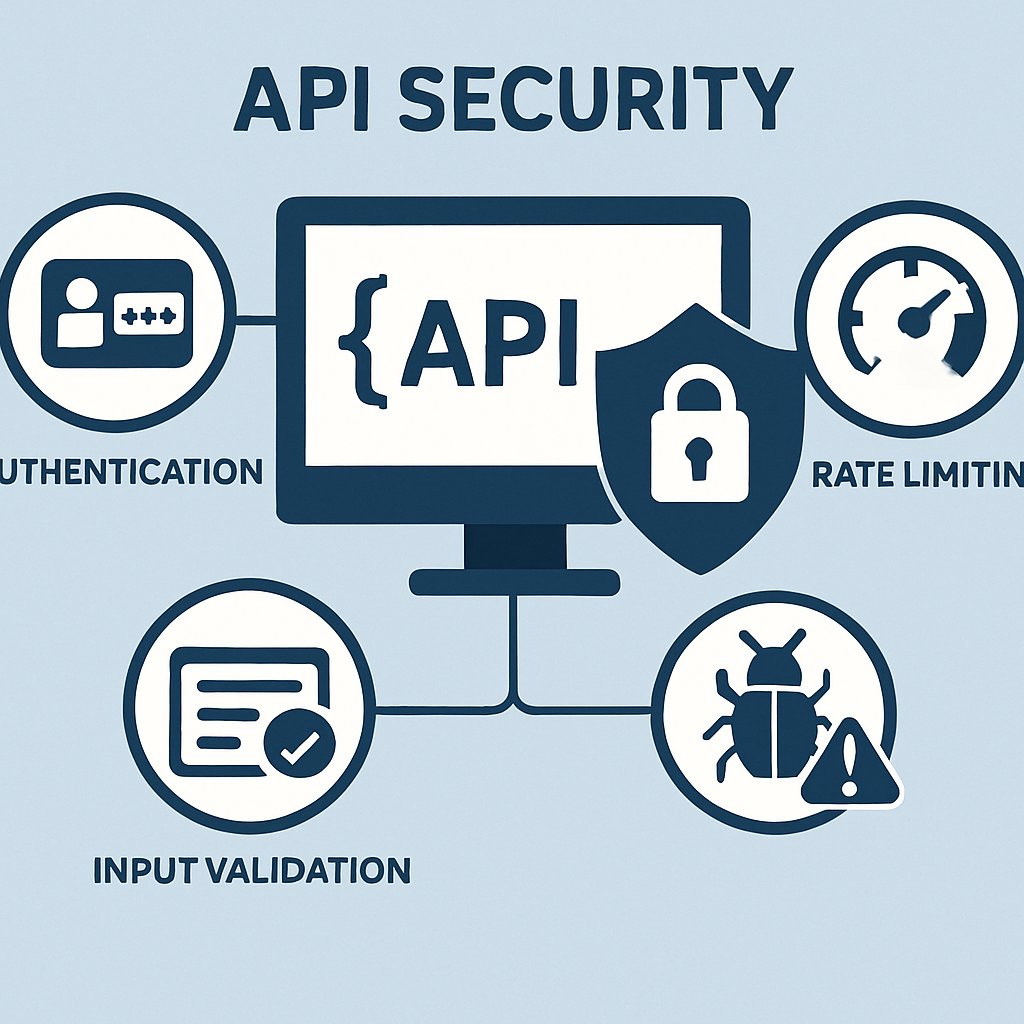
APIs are high-value targets for attackers, yet many organizations still overlook foundational security controls. Weak authentication, missing rate limiting, and poor input validation are responsible for the majority of API breaches. If you build or defend APIs, you need robust strategies—not just boilerplate code—to stop real-world threats and align with the latest standards.
Key Takeaways:
- How to implement secure, scalable API authentication (including token best practices and pitfalls)
- Effective rate limiting patterns to stop brute force, scraping, and denial-of-service attacks
- Practical input validation techniques to prevent injection and logic vulnerabilities
- Common implementation mistakes and a security audit checklist you can apply today
- Alignment with OWASP API Security Top 10 and actionable references for deeper learning
API Authentication Mechanisms That Actually Work
Authentication is your API’s gatekeeper. Weak or misconfigured authentication is the top entry point for attackers, according to the OWASP API Security Top 10. In 2026, the industry standard is to use strong, token-based authentication. Let’s break down the options, real-world recommendations, and implementation code.
API Authentication Options: A Comparison
| Method | Strengths | Weaknesses | Best Use Cases |
|---|---|---|---|
| API Keys | Simple to implement, easy to rotate | No user context, easily leaked, no built-in expiry | Service-to-service, non-sensitive APIs |
| JWT (Bearer Tokens) | Stateless, supports claims, expiry built-in | Revocation is complex, risks with key leakage | Modern web/mobile APIs, microservices |
| OAuth2 | Delegated access, granular scopes, industry standard | More complex, must secure refresh tokens | 3rd-party integrations, user-facing APIs |
| mTLS | Mutual trust, strong identity, resists credential theft | Operational overhead, client cert distribution | High-security B2B, internal APIs |
JWT Example: Python FastAPI
This example shows how to secure an endpoint using JWT authentication in FastAPI, a popular Python framework. The same patterns apply to Node.js (Express + Passport), Java (Spring Security), and other stacks.
from fastapi import FastAPI, Depends, HTTPException, status
from fastapi.security import OAuth2PasswordBearer
from jose import JWTError, jwt
# Secret key for JWT signing (store securely!)
SECRET_KEY = "supersecretkey"
ALGORITHM = "HS256"
oauth2_scheme = OAuth2PasswordBearer(tokenUrl="token")
app = FastAPI()
def verify_jwt_token(token: str = Depends(oauth2_scheme)):
try:
payload = jwt.decode(token, SECRET_KEY, algorithms=[ALGORITHM])
user = payload.get("sub")
if user is None:
raise HTTPException(status_code=401, detail="Invalid credentials")
return user
except JWTError:
raise HTTPException(status_code=401, detail="Invalid credentials")
@app.get("/secure-data")
def secure_data(user: str = Depends(verify_jwt_token)):
# Only accessible with valid JWT; user injected from the token claims
return {"data": f"Secret data for {user}"}
Why this matters: Attackers often exploit endpoints that rely on static API keys or allow tokens without expiry. JWT tokens enforce expiration and can encode user claims for granular authorization. However, treat your signing key as a secret—leakage means total compromise.
- Always set short token lifetimes (consider 15 minutes for access tokens)
- Implement token revocation (track a denylist for compromised tokens)
- Use HTTPS for all API traffic (to prevent token interception)
For user-facing or third-party APIs, implement OAuth2 with PKCE or device flow, and strongly consider multi-factor authentication (MFA) for high-risk actions.
Understanding API Security Risks
As APIs become increasingly integral to modern applications, understanding the security risks they face is crucial. Attackers often exploit vulnerabilities such as weak authentication and lack of rate limiting to gain unauthorized access or disrupt services. For instance, a poorly secured API can lead to data breaches, where sensitive user information is exposed. Organizations must prioritize API security to mitigate these risks effectively.
Rate Limiting: The First Line Against Abuse and DDoS
APIs are prime targets for credential stuffing, scraping, and denial-of-service attacks. Rate limiting restricts the number of requests clients can make in a given period, drastically reducing the impact of brute force and automated abuse (source).
Rate limiting restricts the number of requests clients can make in a given period, drastically reducing the impact of brute force and automated abuse (source).Rate Limiting Strategies
| Strategy | Description | Pros | Cons |
|---|---|---|---|
| Fixed Window | Limit N requests per time window (e.g., 100/min) | Simple to implement, predictable | Bursty traffic can bypass limits at window edges |
| Sliding Window | Recalculates limit across a moving time window | Smoother control, less susceptible to bursts | More complex to implement |
| Token Bucket | Allows bursts up to a threshold, then refills at fixed rate | Flexible, supports traffic spikes | Requires careful tuning |
| Leaky Bucket | Processes requests at a steady rate, queues overflow | Good for smoothing, prevents overload | Potential for large queues, increased latency |
Implementing Rate Limiting: Node.js Express Example
const express = require('express');
const rateLimit = require('express-rate-limit');
// Apply to all requests: 60 requests per minute per IP
const limiter = rateLimit({
windowMs: 60 * 1000, // 1 minute
max: 60, // limit each IP to 60 requests per windowMs
message: { error: "Rate limit exceeded. Try again later." },
standardHeaders: true, // Return rate limit info in headers
legacyHeaders: false,
});
const app = express();
app.use(limiter);
app.get('/api/data', (req, res) => {
res.json({ data: 'API response' });
});
What this does: Every client IP is restricted to 60 requests per minute. When the limit is reached, the API responds with HTTP 429. For user-authenticated APIs, consider rate limiting per user ID or API key instead of IP—especially behind proxies or mobile networks.
- Monitor rate limit metrics to detect abuse and tune thresholds
- Combine with CAPTCHA or proof-of-work for suspicious clients
- Document your rate limits in API docs and return
X-RateLimitheaders
If you use API gateways (Kong, Apigee, AWS API Gateway), configure rate limiting centrally for all backend services and monitor for spikes. For in-depth DDoS defense, supplement with a web application firewall (WAF).
Real-World Examples of API Breaches
Several high-profile API breaches have highlighted the importance of robust security measures. For example, in 2021, a major social media platform suffered a data breach due to inadequate rate limiting, allowing attackers to scrape user data at scale. This incident underscores the necessity of implementing effective rate limiting strategies to protect against automated abuse and data leaks.
Input Validation: Blocking Injection and Logic Flaws
Weak or missing input validation is a perennial API weakness, leading to injection, privilege escalation, and business logic attacks (source). Every API endpoint must validate and sanitize all incoming data—never trust client input, even from “trusted” sources.
Common Input Validation Failures
- Accepting unfiltered JSON/XML payloads (risk: SQL injection, mass assignment)
- Improper type checks (e.g., expecting numeric IDs, receiving strings or objects)
- Missing boundary checks (risk: buffer overflow, excessive resource usage)
- Not checking for unexpected fields (risk: privilege escalation via mass assignment)
Practical Input Validation Example: Python Flask + Marshmallow
from flask import Flask, request, jsonify
from marshmallow import Schema, fields, ValidationError
app = Flask(__name__)
class UserSchema(Schema):
username = fields.Str(required=True, validate=lambda s: 3 <= len(s) <= 32)
email = fields.Email(required=True)
age = fields.Int(required=True, validate=lambda a: 18 <= a <= 120)
@app.route('/register', methods=['POST'])
def register():
try:
# Validate and deserialize input
data = UserSchema().load(request.json)
except ValidationError as err:
return jsonify(err.messages), 400
# Only validated fields reach this point
# Proceed with registration logic...
return jsonify({"message": "User registered"}), 201
What this enforces: Only valid usernames (4-32 chars), proper emails, and ages between 18-120 are accepted. All other data is rejected with a 400 error, preventing unexpected or malicious input. This pattern should be used at every API ingress point.
- Use schema-based validation libraries (Marshmallow for Python, Joi for Node.js, Hibernate Validator for Java)
- Whitelist accepted fields; reject or ignore extra properties
- Sanitize all inputs before using them in queries or business logic
- Log and monitor validation errors—they often signal attack attempts
For advanced protection, implement JSON Schema validation, and always combine input validation with output encoding to prevent injection through reflected responses. For containerized or cloud APIs, review your deployment pipeline as covered in container security scanning guides.
Pitfalls, Pro Tips, and Audit Checklist
Common Implementation Pitfalls
- Storing secrets in code or environment variables without rotation (move to secret managers like AWS Secrets Manager or HashiCorp Vault)
- Relying on IP-based rate limiting only (users behind NAT, shared proxies, or mobile networks can bypass or DoS each other)
- Trusting frontend validation (all input must be validated server-side)
- Using long-lived or unrevokable tokens (reduce token TTL, support revocation lists)
- Ignoring logging and monitoring (lack of audit trails makes incident response impossible—see incident response strategies)
Pro Tips for Hardened API Security
- Adopt a defense-in-depth model: authentication, authorization, input validation, rate limiting, logging, and anomaly detection
- Align with the OWASP API Security Top 10 and NIST SP 800-53 controls
- Use structured logging for all authentication failures, rate limit events, and validation errors
- Automate dependency and container security scanning in CI/CD
- Regularly review API endpoints for excessive data exposure (CWE-200, CWE-201)
API Security Audit Checklist
- Are all endpoints authenticated and using HTTPS?
- Are tokens short-lived, revokable, and securely stored?
- Is rate limiting applied per user, API key, or client?
- Is input validation performed server-side using schemas?
- Are sensitive errors hidden from clients and logged securely?
- Are logs and metrics monitored for abuse patterns?
Strategic Next Steps and Further Reading
API security is not a one-time project—it requires continuous improvement as threats and standards evolve. By enforcing strong authentication, robust rate limiting, and thorough input validation, you dramatically reduce your attack surface and align with the latest industry best practices (source).
- Run the audit checklist on your APIs this week
- Review your authentication and rate limiting code—can you break it?
- Enable structured logging and anomaly alerts for all API endpoints
For deeper coverage on modern authentication patterns, see Modern Authentication: Passkeys and MFA Beyond Passwords. To understand the response side, read Incident Response: Detection, Containment, Recovery Strategies. If you’re deploying APIs in containers, don’t miss Enhancing Container Security: Scanning and Protection Strategies.
For further reading and authoritative references, consult: