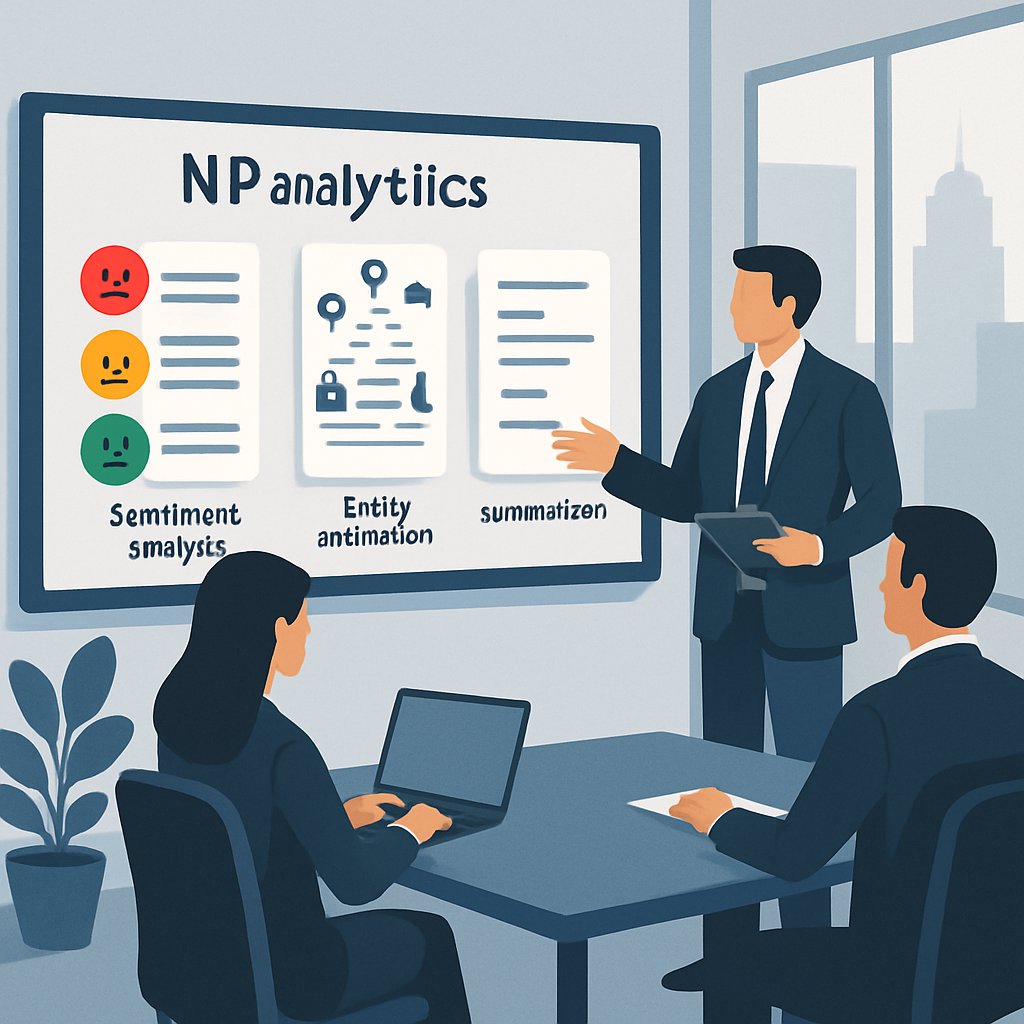
NLP for Business Intelligence: From Sentiment Analysis to Actionable Insights
Your organization has thousands—maybe millions—of unstructured text records: customer reviews, support tickets, survey responses. Manually parsing these for actionable business intelligence isn’t feasible. Natural Language Processing (NLP) unlocks value from this data, but only if you understand the capabilities and limits of modern APIs. This guide delivers a practical breakdown of production-grade NLP for BI: what’s possible, what isn’t, and how to deploy for real ROI.
Key Takeaways:
- Learn the four essential NLP functions for BI: sentiment analysis, entity extraction, summarization, and entity-based grouping
- See clear Python code examples for leading APIs: OpenAI, AWS, Google Cloud, spaCy
- Understand the real capabilities of each API—what’s supported, what isn’t, and where custom models win
- Compare build-vs-buy for cost, speed, and accuracy, with benchmark numbers
- Get practical advice on avoiding common deployment mistakes
Why NLP Delivers Value for BI
Unstructured text—emails, support logs, reviews, chat transcripts—accounts for the majority of business data. Traditional BI tools can’t process this at scale. NLP bridges the gap by automatically extracting meaning, sentiment, and key information from text, enabling:
- Early detection of product or service issues from trending complaints
- Quantitative tracking of sentiment linked to churn or sales trends
- Automated extraction of structured signals (like named entities) for dashboarding
- Faster reporting by summarizing lengthy feedback or transcripts
For instance, a retailer using NLP surfaced a spike in “credit card declined” complaints, traced it to a third-party integration, and resolved the issue before it became a major cost center. The business impact: faster insight, faster remediation, measurable ROI.
For strategy and budgeting frameworks, see AI Implementation Budgeting: Key Strategies for 2026.
NLP Applications in Business Intelligence
There are four NLP tasks that consistently deliver actionable insight for BI. Each has distinct business value and technical constraints.
1. Sentiment Analysis
Sentiment analysis classifies text as positive, negative, neutral, or mixed. It’s essential for monitoring brand health, customer satisfaction, and support quality at scale.
- Business value: Real-time alerts for negative trends, root-cause analysis for CSAT dips, automated support prioritization
- APIs: AWS Comprehend, Google Cloud Natural Language, OpenAI GPT-4, Azure Text Analytics
2. Entity Extraction
Entity extraction (Named Entity Recognition/NER) identifies key entities like brands, products, people, and organizations in text. This is foundational for mapping unstructured feedback to structured BI.
- Business value: Linking mentions to CRM, extracting competitor/product references, compliance monitoring
- APIs: Google Cloud Natural Language, AWS Comprehend, spaCy (for custom NER)
3. Text Summarization
Summarization condenses long-form text (like reviews or transcripts) into concise highlights. This accelerates reporting and reduces manual review effort.
- Business value: Faster executive reporting, automated digests, time savings in QA or compliance review
- APIs: OpenAI GPT-4 (abstractive), Google Cloud Natural Language (extractive, beta), AWS Comprehend (extractive only)
4. Entity-Based Grouping (Not True Topic Modeling)
Grouping feedback by common entities (e.g., “credit card,” “Synchrony Bank”) can highlight recurring themes. However, major APIs do not provide unsupervised topic modeling out-of-the-box. Instead, they offer entity and category extraction, which can be used as a proxy for grouping but is not equivalent to true topic modeling.
- Business value: Cluster feedback by product, service, or issue for high-level trend analysis
- APIs: Google Cloud NL (entity/category extraction), AWS Comprehend (entity detection). For unsupervised topic modeling use open-source libraries like BERTopic or LDA offline.
API Feature Comparison Table
| API Provider | Sentiment Analysis | Entity Extraction | Unsupervised Topic Modeling | Summarization | Pricing (as of 2024) |
|---|---|---|---|---|---|
| OpenAI GPT-4 | Yes (prompt-based) | Yes (prompt-based) | Prompt-based only | Abstractive | $0.03–$0.06 / 1K tokens |
| Google Cloud NL | Yes | Yes | No (entity/category extraction only) | Beta (extractive only) | $1.00 / 1K units |
| AWS Comprehend | Yes | Yes | No (entity detection, not topic modeling) | Extractive | $1.00 / 1K units |
| Azure Text Analytics | Yes | Yes | No | Preview | $1.00 / 1K records |
For full details, check official docs: Google Cloud, AWS Comprehend.
Implementing Modern NLP APIs: Real-World Workflows
Below are practical, production-ready code examples for the most common NLP functions using mainstream APIs. All examples are in Python, the de facto standard for NLP automation.
1. Sentiment Analysis with AWS Comprehend
import boto3
# Initialize AWS Comprehend client
comprehend = boto3.client('comprehend', region_name='us-east-1')
# Analyze sentiment of a customer review
text = "I tried to pay my Lowe's bill online but the payment portal crashed. Frustrating experience!"
response = comprehend.detect_sentiment(Text=text, LanguageCode='en')
print(response['Sentiment']) # e.g., 'NEGATIVE'
print(response['SentimentScore']) # {'Positive': 0.01, 'Negative': 0.95, 'Neutral': 0.04, 'Mixed': 0.00}
Detects sentiment and scores for each class. Use batch processing to monitor shifts in feedback over time.
2. Entity Extraction and Grouping with Google Cloud Natural Language
from google.cloud import language_v1
client = language_v1.LanguageServiceClient()
document = language_v1.Document(
content="Customers are reporting issues with the Synchrony credit card integration on the Lowe's website.",
type_=language_v1.Document.Type.PLAIN_TEXT,
)
response = client.analyze_entities(document=document)
for entity in response.entities:
print(entity.name, entity.type_, entity.salience)
Google Cloud Natural Language does not provide unsupervised topic modeling as an API feature. Instead, extract entities and group feedback by salience. For true topic modeling, use offline tools like BERTopic or LDA.
3. Named Entity Recognition with spaCy
import spacy
nlp = spacy.load("en_core_web_sm")
doc = nlp("Synchrony Bank manages the Lowe's Rewards Credit Card.")
for ent in doc.ents:
print(ent.text, ent.label_) # e.g., ('Synchrony Bank', 'ORG'), ('Lowe's Rewards Credit Card', 'PRODUCT')
spaCy enables custom entity extraction pipelines, supporting domain tuning for higher accuracy.
4. Summarization with OpenAI GPT-4 API
import openai
openai.api_key = "YOUR-OPENAI-API-KEY"
review = """
I called customer support about my Lowe's credit card. The agent was helpful, but it took three transfers to get to Synchrony Bank. The process was confusing but got resolved.
"""
response = openai.ChatCompletion.create(
model="gpt-4",
messages=[
{"role": "system", "content": "Summarize customer feedback in 1-2 sentences."},
{"role": "user", "content": review}
],
max_tokens=60,
temperature=0.5,
)
print(response['choices'][0]['message']['content'])
Produces concise, human-readable summaries. Adjust the prompt and max_tokens for your reporting workflow needs.
Build vs. Buy: Cost, Time, and Team Analysis
| Approach | Time to Deploy | Team Required | Upfront Cost | Ongoing Cost | Accuracy (General Domain) |
|---|---|---|---|---|---|
| API (OpenAI, AWS, Google) | 1-2 weeks | 1-2 engineers | Minimal (integration only) | Pay-per-use (~$1 per 1K units) | 80–90% F1 (typical) |
| Custom Model | 2–6 months | 3–6 ML/NLP specialists | $50K+ (infra, data, dev) | Maintenance, retraining | 90–96% F1 (when domain-optimized) |
For most BI workloads, API-based NLP is fastest and lowest risk. Custom models are justified for compliance, rare languages, or highly specialized domains.
Accuracy Benchmarks and Use Cases
The real-world effectiveness of NLP depends on both the API and your data domain. Below are typical ranges, but always validate on your own corpus.
Sentiment Analysis Benchmarks
- OpenAI GPT-4: Up to 92% F1 on standard English review sets (arXiv:2303.08774)
- AWS Comprehend: 85–90% F1 on multi-domain data (AWS documentation)
- Google Cloud NL: 83–89% F1 for English reviews (Google documentation)
Accuracy drops for non-English or niche domains unless you fine-tune or provide in-context examples.
Entity Extraction Benchmarks
- APIs: 85–90% F1 for standard entity types (ORG, PRODUCT, PERSON)
- spaCy custom NER: Up to 95% F1 after domain-specific tuning
Example: A financial institution mapped support tickets to providers (e.g., “Synchrony Bank”, “Lowe's Rewards Credit Card”) using NER, surfacing recurring root causes by issuer.
Summarization Quality
- OpenAI GPT-4: ROUGE-L score of 0.41–0.45 on news/feedback summarization (arXiv:2303.08774)
- Google Cloud NL (beta): Extractive only, less fluent for nuanced text
- AWS Comprehend: Extractive only
Organizations report up to 60% reduction in manual review time when deploying auto-summarization for call transcripts.
Entity-Based Grouping vs. Topic Modeling
- APIs support entity/category grouping, not true unsupervised topic modeling
- Open-source models (BERTopic, LDA): Require data science expertise, but excel at surfacing emergent themes in large datasets
For advanced predictive analytics, see Predictive Analytics for Supply Chain Optimization.
Common Pitfalls and Pro Tips
- API model drift: Vendor APIs update silently. Monitor outputs and set alerts for sudden changes in results.
- Domain mismatch: Generic models misclassify jargon (“declined” may not always indicate negative sentiment). Always validate on your real data.
- Privacy/compliance: Vet data residency, GDPR, and EU AI Act compliance before sending sensitive data to any cloud NLP API (EU AI Act).
- LLMs hallucinate: Generative models may produce plausible-sounding but inaccurate summaries or classifications. Always review samples before production rollout.
- Cost overruns: Large volumes can create surprise API bills. Batch inputs and set usage alerts.
- Tokenization edge cases: Multilingual or code-mixed text may break default tokenizers. Use language-specific models for best results.
For more on integrating AI into engineering, see AI Code Review and Development: Tools, Integration, and Quality.
Next Steps
Production-grade NLP is accessible and cost-effective via modern APIs. For most BI scenarios, the buy vs. build analysis favors APIs for speed, cost, and maintainability—although custom models remain essential for regulated or highly specialized domains. Start by piloting NLP APIs on a representative slice of your data, validate outputs with stakeholders, and instrument monitoring for drift and cost. Move to custom pipelines only if off-the-shelf accuracy is insufficient.
To deepen your AI strategy, see AI Implementation Budgeting: Key Strategies for 2026. For advanced analytics, explore Predictive Analytics for Supply Chain Optimization.

