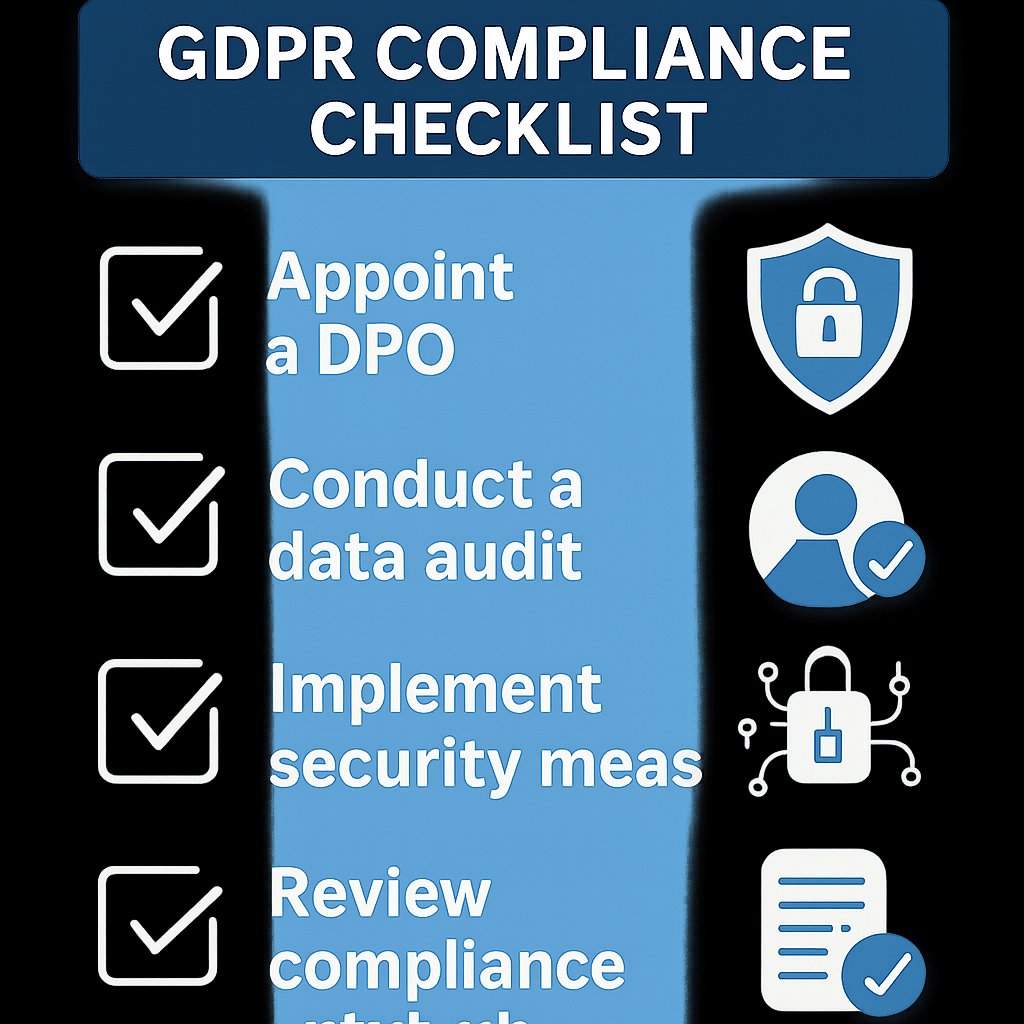
Handling the personal data of EU residents without a robust GDPR compliance program exposes your organization to regulatory penalties, reputational harm, and operational setbacks. This guide translates the GDPR’s core requirements—lawful basis, DPIA, consent, data subject rights, and breach notification—into a practical, step-by-step checklist. Each task is mapped to specific GDPR articles with effort estimates and audit criteria, enabling you to operationalize compliance and demonstrate accountability.
Key Takeaways:
- Actionable GDPR compliance checklist mapped to regulatory requirements
- Effort and prioritization guidance for each compliance step
- Detailed tasks for lawful basis, DPIA, consent, rights, and breach response
- Comparison of requirements with GDPR article references
- Links to authoritative resources and implementation guides
GDPR Fundamentals and Checklist Overview
The General Data Protection Regulation (GDPR) is the EU’s comprehensive data protection law, applying to any organization that processes the personal data of EU residents. The regulation requires organizations to demonstrate ongoing accountability and compliance, not just one-time efforts (official legal framework).
GDPR enforcement is active, and non-compliance can result in significant penalties. According to GDPR.eu and the GDPR text, fines can reach up to €20 million or 4% of annual global turnover, whichever is higher.
To operationalize compliance, you must break down the regulation into practical steps. The checklist below is based on the Formbricks GDPR Compliance Checklist and GDPR.eu’s guidance. Each step includes:
- GDPR article references for mapping to audits
- Concrete tasks with testable outcomes
- Effort estimates (High: 4+ weeks, Medium: 1–4 weeks, Low: under 1 week)
- Pass/fail audit criteria for each requirement
Step 1: Lawful Basis Assessment and Data Inventory
Processing personal data is unlawful unless you can demonstrate a lawful basis (GDPR Article 6). The six bases are: consent, contract, legal obligation, vital interests, public task, and legitimate interests. Every processing activity must be mapped to one of these, and documented accordingly. The foundational step is a comprehensive data inventory.
Checklist Actions
- Conduct an information audit: Identify all personal data collected, processed, stored, and shared, including formats, systems, and flows (GDPR.eu).
- Document processing purposes for each data category and system.
- Assign and record a lawful basis to each processing activity, with rationale.
- Update your privacy policy to disclose data types, processing purposes, legal basis, recipients, retention periods, and rights (Articles 12–14).
Audit Preparation
- Maintain an up-to-date Record of Processing Activities (ROPA) (Article 30). Required for organizations with 250+ employees or those conducting high-risk processing.
- Processing activities must be mapped and justified. Unsupported processing is non-compliant.
Effort Estimate
- Initial data mapping: 1–4 weeks, depending on organization size and complexity
- Lawful basis documentation: 1–2 weeks
- Ongoing review: Quarterly or upon process changes
Resource: GDPR.eu: Lawful basis and transparency checklist
Step 2: Data Protection Impact Assessment (DPIA) Process
A Data Protection Impact Assessment (DPIA) is a systematic risk evaluation required before any high-risk processing of personal data (Articles 35–36). DPIAs are essential for activities such as large-scale processing of sensitive data, systematic monitoring, or introducing new technologies like AI-driven profiling (Formbricks).
Checklist Actions
- Identify processing activities requiring a DPIA (e.g., large-scale special category data, monitoring, or new tech deployment).
- Document a DPIA for each high-risk activity, including: description, purpose, necessity, risks, and mitigation measures.
- Consult with your Data Protection Officer (DPO) and, where applicable, with data subjects or supervisory authorities.
- Integrate DPIA results into project and technical design (“privacy by design,” Article 25).
- Review and update DPIAs regularly, or when processing activities change.
Audit Preparation
- Maintain DPIA documentation for each high-risk process; absence is a fail.
- Demonstrate that risks are assessed and mitigated before launch.
Effort Estimate
- Initial DPIA: 2–6 weeks, depending on complexity
- Updates and reviews: 1 week per new or changed processing activity
Resource: Formbricks GDPR DPIA guidance
Step 3: Consent Management Requirements
If you rely on consent as your lawful basis, it must meet GDPR standards: freely given, specific, informed, and unambiguous (Articles 7–8, Recital 32). There are extra requirements for children’s data and when consent is the sole basis for processing.
Checklist Actions
- Implement active, granular consent mechanisms (opt-in, not pre-ticked boxes; GDPR.eu).
- Log when, how, and for what purposes each user gave consent.
- Enable users to withdraw consent at any time, as simply as it was given.
- Update consent logs if processing purposes change.
- If processing children’s data, ensure verifiable parental consent if under age 16 (Article 8).
Audit Preparation
- Maintain consent records for each data subject—include timestamp, method, and context.
- Fail if consent is bundled, ambiguous, or not tracked.
Effort Estimate
- Technical controls and consent platform: 2–3 weeks
- Policy/process updates: 1 week
Resource: GDPR.eu: Consent requirements
Step 4: Data Subject Rights Workflow
GDPR grants individuals rights to access, rectify, erase (the “right to be forgotten”), restrict, port, and object to processing of their data (Articles 15–22). You must have documented and standardized processes for managing and fulfilling these requests efficiently and on time.
Checklist Actions
- Implement accessible request mechanisms (web form, email, or portal) for all data subjects.
- Document your identity verification process to ensure requests are legitimate.
- Set internal SLAs: respond within one month (extendable by two months for complex cases; Article 12(3)).
- Log all requests and outcomes in a centralized register.
- Train staff to recognize, escalate, and process rights requests promptly.
Audit Preparation
- Produce request logs and evidence of timely and complete fulfillment on demand.
- Fail if any rights request is missed or response is incomplete or late.
Effort Estimate
- Workflow implementation: 2–4 weeks
- Staff training: 1 week; refresh annually
For more on audit workflows and compliance reviews, see Security Audit Preparation: A Comprehensive Guide for Organizations.
Step 5: Breach Notification Procedure
GDPR requires notification of certain personal data breaches to supervisory authorities within 72 hours (Article 33) and, in high-risk cases, to affected data subjects (Article 34). You need a documented and tested breach response plan to comply.
Checklist Actions
- Document breach identification, assessment, and escalation procedures.
- Train all employees to recognize and report breaches immediately.
- Keep a breach register logging all incidents, regardless of whether they are notifiable.
- Prepare notification templates for authorities and individuals.
- Test and review your breach response plan annually.
Audit Preparation
- Demonstrate incident detection, documentation, and notification processes.
- Fail if breach logs are missing or notifications are not within mandated timeframes.
Effort Estimate
- Procedures and template development: 1–2 weeks
- Staff drills/training: 1 week; repeat annually
Resource: GDPR.eu: Breach notification checklist
Summary Table of Key GDPR Requirements
| Requirement | GDPR Article(s) | Effort Estimate | Pass/Fail Audit Criteria |
|---|---|---|---|
| Lawful Basis Assessment & Data Inventory | 6, 12–14, 30 | 1–6 weeks | All data mapped, justified, and documented |
| DPIA for High-Risk Processing | 35–36 | 2–6 weeks | DPIA completed, risks mitigated, and documented |
| Consent Management | 7, 8, Recital 32 | 2–4 weeks | Valid, granular, and revocable consents, with logs |
| Data Subject Rights Workflow | 15–22 | 2–5 weeks | Timely, logged responses to all requests |
| Breach Notification Procedure | 33–34 | 2–3 weeks | 72-hour authority notification, breach register maintained |
Common Pitfalls and Pro Tips
- Incomplete data mapping: Legacy systems or shadow IT are often overlooked. Use automated discovery tools to ensure coverage (GDPR.eu).
- Poor consent practices: Bundled or vague consent is invalid. Make sure consent requests are granular and clearly explain each data use.
- Manual rights request handling: Tracking requests via email alone is risky. Implement workflow and logging tools for accountability.
- Breach response gaps: Staff confusion or lack of rehearsal can cause missed 72-hour reporting deadlines. Schedule annual tabletop exercises.
- Third-party risk: Data processors must contractually comply with GDPR. Review and monitor third-party compliance annually.
For further security best practices, see Mobile Device Management: Secure BYOD & Corporate Devices.
Ensure business continuity and disaster recovery plans account for data protection. Reference Effective Business Continuity and Disaster Recovery Strategies for integrated approaches.
Conclusion and Next Steps
Compliance with GDPR is an ongoing process, not a one-time project. By following this checklist, you build a defensible program that withstands regulatory scrutiny and earns customer trust. Maintain current documentation, schedule regular reviews, and embed privacy by design into all new projects. To advance, audit your compliance posture regularly and reinforce staff training.
For deeper audit preparation, consult Security Audit Preparation: A Comprehensive Guide for Organizations.
External resources: