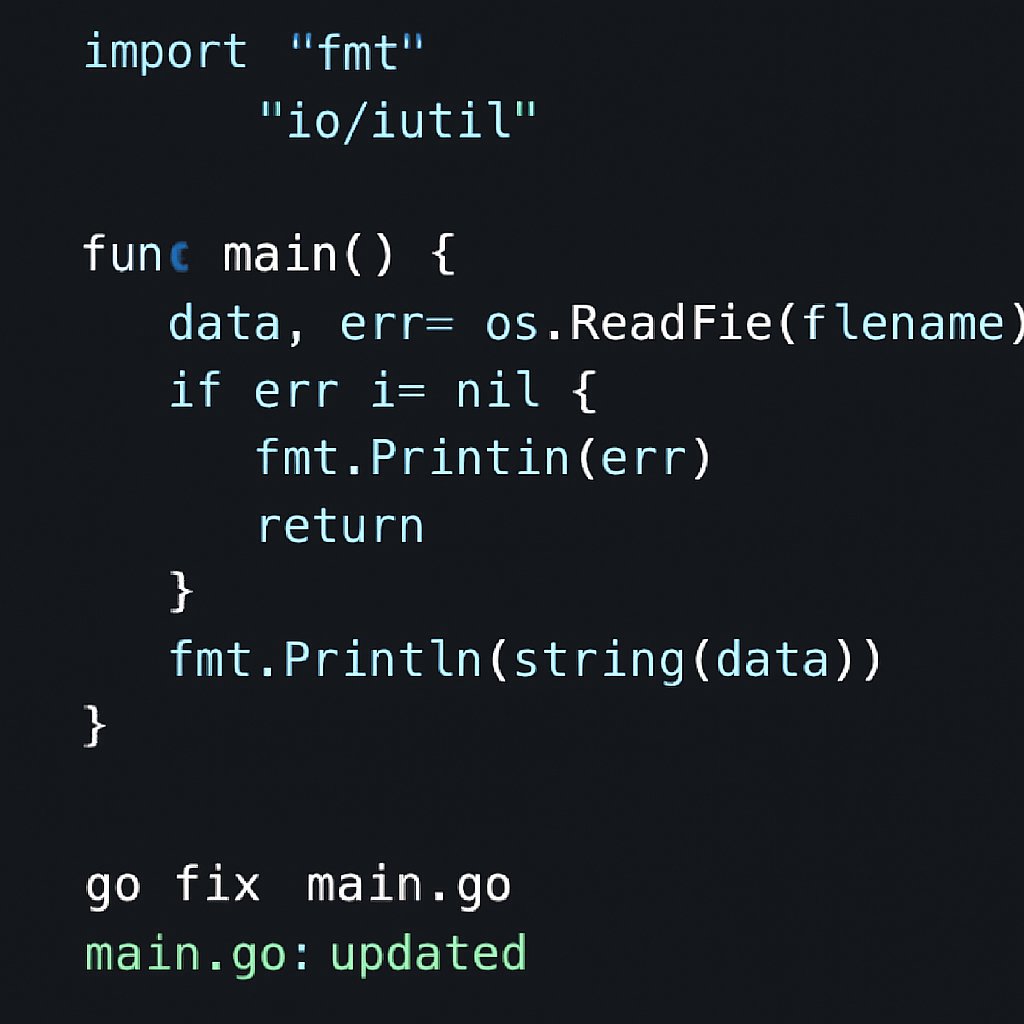
Go 1.26 brings a major overhaul to go fix, transforming it from a set of static patches into a smart, automated refactoring tool for modernizing Go code. If you’re maintaining a legacy codebase or want to align with the latest language idioms and APIs, relying on manual code reviews is no longer enough. Here’s how to leverage the new go fix to future-proof your Go projects—and what experienced developers need to watch for as best practices and expectations shift with this release.
If you’re maintaining a legacy codebase or want to align with the latest language idioms and APIs, relying on manual code reviews is no longer enough. Here’s how to leverage the new go fix to future-proof your Go projects—and what experienced developers need to watch for as best practices and expectations shift with this release.Key Takeaways:
- The rewritten
go fixin Go 1.26 automates idiomatic upgrades, not just deprecation patches- It recognizes opportunities for modern APIs, syntactic improvements, and performance gains
- Integrating
go fixinto CI/CD and code review can halt tech debt before it starts- Practical examples include updating to
errors.AsType,io.ReadAll, and pointer creation patterns- Careful review is essential—automated fixes may introduce subtle behavioral changes in edge cases
Why go fix Matters in 2026
The Go 1.26 release introduces a rewritten go fix tool that goes beyond patching deprecated APIs. It now:
go fix tool that goes beyond patching deprecated APIs. It now:- Analyzes entire codebases to recommend idiomatic transformations
- Promotes adoption of new standard library features (e.g.,
errors.AsType,io.ReadAlloptimizations) - Updates code to align with the latest Go performance and security practices
Most importantly, go fix helps keep large open-source and enterprise projects in line with the latest idioms, ensuring that the global corpus of Go code remains modern and maintainable (Hacker News).
If you’re still running code written for Go 1.17 or earlier, you’re missing out on:
- Performance boosts (e.g., faster
io.ReadAllin Go 1.26) - Type safety improvements (like
errors.AsType, replacing error unwrapping hacks) - Cleaner, clearer code that’s easier to onboard new developers to
Teams that modernize early avoid the “big bang” refactors that slow down product delivery and introduce risk. This is especially relevant as we’ve seen in our recent analysis of DeFi trends: fast-moving industries can’t afford legacy drag.
Getting Started with go fix
Prerequisites
- Go 1.26+ installed (
go versionshould return 1.26 or higher) - Your project codebase checked into version control (git/svn/mercurial)
- Familiarity with Go modules and the structure of your codebase
To upgrade go to the latest version:
# On macOS/Linux (Homebrew)
brew install go
# Or download directly: https://go.dev/dl/
Basic Usage
Run go fix at the root of your Go module. It will scan all packages and apply recommended transformations:
go fix ./...
This command will:
- Scan all Go files in your module
- Apply transformations, such as replacing deprecated APIs and upgrading to modern idioms
- Print a summary of changes
Always review the git diff after running go fix. Automated refactoring is powerful, but not infallible.
Additional Benefits of Using go fix
Utilizing go fix not only streamlines the modernization process but also enhances team collaboration. By standardizing code practices, developers can reduce onboarding time for new team members. Furthermore, consistent use of go fix can lead to improved code quality across the board, as it encourages adherence to the latest language features and best practices.
Common Use Cases for go fix
Some common scenarios where go fix proves invaluable include transitioning from older error handling patterns to the new errors.AsType method, optimizing I/O operations with io.ReadAll, and ensuring that pointer creation is consistent throughout the codebase. These transformations not only modernize the code but also enhance maintainability and performance.
Deep Dive: Real-World Modernization Examples
Updating to Modern Error Handling with errors.AsType
Go 1.26 introduces errors.AsType, a type-safe alternative to errors.As. go fix can automatically update your error handling blocks.
// OLD: Manual type assertion pattern
if err != nil {
var pathErr *os.PathError
if errors.As(err, &pathErr) {
// handle path error
}
}
// NEW: Using errors.AsType (Go 1.26+)
if err != nil {
if pathErr := errors.AsType[*os.PathError](err); pathErr != nil {
// handle path error
}
}
// Output: Path error handled with modern idiom
This change improves type safety, reduces boilerplate, and makes intent clearer. Automated fixes like these are especially valuable in large codebases with repeated error handling patterns.
Performance Upgrades: io.ReadAll Optimization
Prior to Go 1.26, io.ReadAll performance lagged when reading large streams. The new go fix can spot inefficient patterns and recommend more efficient usage:
// BEFORE: Custom loop to read all bytes
buf := new(bytes.Buffer)
_, err := buf.ReadFrom(reader)
if err != nil { /* ... */ }
data := buf.Bytes()
// AFTER: Idiomatic, fast io.ReadAll (Go 1.26+)
data, err := io.ReadAll(reader)
if err != nil { /* ... */ }
// Output: data contains all bytes from reader, with improved performance
Beyond readability, this update can yield tangible speedups for I/O-heavy services (Golang Weekly, Issue 589).
Pointer Creation: Using new() Consistently
Go 1.26 standardizes pointer creation. Where code used direct struct literals (&T{...}), go fix can recommend new() where appropriate—especially in generic code:
// OLD:
type User struct{ Name string }
u := &User{Name: "Alice"}
// NEW:
u := new(User)
u.Name = "Alice"
// Output: Pointer created using new(User), clearer intent in generic code
While this pattern is not universally required, it’s now preferred in certain generic contexts (see GoLand’s Go 1.26 migration guide).
Summary Table: Common go fix Transformations
| Old Pattern | Modern Idiom (Go 1.26+) | Benefit |
|---|---|---|
| errors.As() | errors.AsType[]() | Type safety, less boilerplate |
| Custom io.Reader loops | io.ReadAll() | Performance, clarity |
| &T{...} for pointers | new(T) | Consistency, generics compatibility |
| Manual slice copying | copy() w/ new slice APIs | Cleaner code, less error-prone |
Integration, Workflows, and Automation
Continuous Integration (CI) Best Practices
To maximize impact, integrate go fix into your CI pipeline:
- Add a
go fix ./...step to your build or pre-commit hooks - Fail the build if
git diffis non-empty after runninggo fix - Review and merge automated pull requests for
go fixchanges
Example GitHub Actions workflow snippet:
- name: Run go fix
run: |
go fix ./...
git diff --exit-code # Fail if code was changed
IDE Support and Developer Experience
Modern IDEs, including GoLand and VS Code, now offer tight integration with go fix. Developers get:
- Inline fix suggestions as code is written
- Batch refactoring across the project
- Quick diff and revert capabilities for risky changes
This minimizes “bit-rot” and ensures everyone is coding to the same standard—crucial for teams onboarding junior developers or collaborating across time zones, as we discussed in our review of Wero and payments integration.
Automated Code Review Bots
Several open-source bots and SaaS tools now support running go fix as part of pull request checks, flagging any regressions or style issues before code lands in main.
Common Pitfalls and Pro Tips
What to Watch Out For
- Semantic changes: While
go fixaims to preserve behavior, changes in standard library APIs (especially around error handling or I/O) may subtly alter program logic. Always run your test suite after upgrades. - False positives: Not every “recommended” modernization is appropriate in all cases. Example: switching to
new(T)in performance-critical code where struct literals are intentionally used to minimize allocations. - Dependency drift:
go fixonly updates your code, not your dependencies. Outdated third-party packages may reintroduce old patterns. Usego get -u ./...to update dependencies in tandem.
Pro Tips
- Pair
go fixruns with static analysis tools likegolangci-lintfor maximum coverage - Review Go 1.26 release notes for breaking changes or caveats before applying fixes across production branches
- Use feature branches for large-scale
go fixrefactors, and squash-merge results to keep history clean
The table below summarizes typical pitfalls and mitigation strategies:
| Pitfall | Impact | Mitigation |
|---|---|---|
| Unreviewed semantic changes | Production bugs, regressions | Mandatory code review, full test run post-fix |
| Outdated dependencies | Reintroduction of legacy patterns | Update dependencies alongside codebase |
| Inconsistent developer environments | “Works on my machine” syndrome | Standardize CI runs to enforce go fix |
Conclusion & Next Steps
The new go fix in Go 1.26 isn’t just a backward compatibility tool—it’s a proactive engine for code modernization. By integrating it into your daily workflow and code review process, you can align your project with the latest idioms, unlock performance and maintainability gains, and reduce long-term tech debt risk.
Next steps:
- Upgrade to Go 1.26 and run
go fix ./...on a staging branch - Review the output, merge safe updates, and run your full test suite
- Adopt a policy of regular
go fixruns as part of CI/CD - Keep an eye on community tools like modernize for additional modernization insights
- For more on integrating new tools into complex production pipelines, see our coverage of Maya 2026’s developer improvements
Stay current—modern Go is fast, safe, and efficient, but only if you let your tooling do the heavy lifting.

