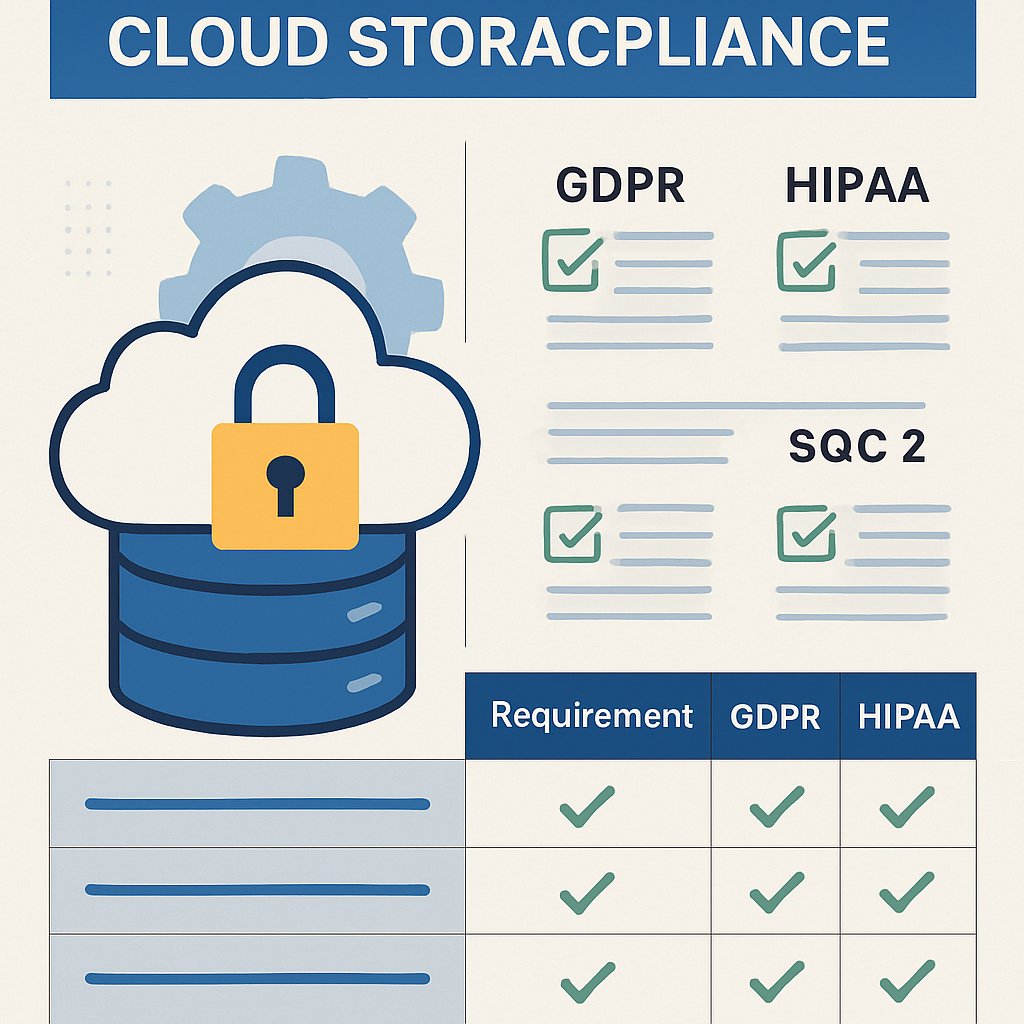
Cloud storage compliance is a necessity for organizations that handle regulated data—whether you’re storing EU personal information, US healthcare data, or serving enterprise customers who demand security transparency. Understanding the nuances of GDPR, HIPAA, and SOC 2 isn’t just legal hygiene; it’s essential to avoid fines, prevent data breaches, and maintain business relationships.
Key Takeaways:
Understand actionable requirements for GDPR, HIPAA, and SOC 2 cloud compliance
Compare each framework’s technical, contractual, and operational demands
Identify hidden migration, egress, and vendor lock-in risks
Get deployment recommendations for different team sizes and industries
Why Cloud Compliance Matters
The consequences of non-compliance are real and costly. For example, GDPR fines can reach up to €20 million or 4% of annual global turnover, whichever is higher. HIPAA violations are tiered: fines range from $100 to $50,000 per violation depending on factors like intent and corrective actions—repeated or willful violations can add up quickly. SOC 2 failures may not bring direct legal penalties but can block you from landing enterprise contracts or trigger remediation costs.Cloud compliance means:
Selecting storage providers with verifiable certifications (SOC 2 Type II, ISO 27001, HIPAA BAA, GDPR compliance)
Configuring encryption, granular access controls, and centralized audit logging
Documenting your data flows, retention, and incident response processes
Ensuring data locality and sovereignty requirements are met
A practical example: A telemedicine SaaS with US and EU patients must meet HIPAA requirements for PHI, SOC 2 for B2B credibility, and GDPR for EU user rights (source).
GDPR Essentials for Cloud Storage
The General Data Protection Regulation (GDPR) imposes strict requirements on organizations handling EU residents’ personal data. For cloud storage, you must address:
Data minimization and purpose limitation
User rights: access, rectification, erasure ("right to be forgotten"), portability
Encryption at rest and in transit
Formal Data Processing Agreements (DPAs) with cloud vendors
Breach notification within 72 hours
How to Meet GDPR Requirements in Cloud Storage
Choose providers with explicit GDPR compliance—Tresorit, for example, offers 100% private, end-to-end encrypted storage (source).
Sign a DPA with your provider, clarifying responsibilities and liability.
Set up retention and deletion rules to support erasure requests.
Apply strong encryption (e.g., AES-256).
Monitor and audit access to all cloud-stored data.
# Example: Delete all user data from S3 for GDPR erasure
import boto3
s3 = boto3.client('s3')
bucket_name = 'my-customer-data'
user_prefix = 'users/12345/' # Replace with actual user ID
objects = s3.list_objects_v2(Bucket=bucket_name, Prefix=user_prefix).get('Contents', [])
for obj in objects:
s3.delete_object(Bucket=bucket_name, Key=obj['Key'])
print("Deleted all data for user 12345 as required by GDPR erasure request.")
This script deletes all objects associated with a user. You are also responsible for ensuring data is erased from backups and replicas where feasible.
Vendor Lock-In and Data Portability
GDPR grants users the right to data portability. Your cloud provider should support straightforward, cost-effective bulk data export in open formats (like CSV or JSON) and not impose artificial barriers or excessive fees for outbound transfers.Related: Cloud Storage for Development Teams: Git LFS, S3, and Artifacts
HIPAA Cloud Compliance for Healthcare Data
The Health Insurance Portability and Accountability Act (HIPAA) governs US PHI (Protected Health Information). HIPAA compliance in the cloud requires:
A signed Business Associate Agreement (BAA) with your storage provider
Encryption of PHI at rest and in transit (AES-256, TLS 1.2+)
Comprehensive audit logging and access monitoring
Role-based access control (RBAC) and least-privilege enforcement
Documented backup, disaster recovery, and breach notification processes
AWS, Google Cloud, and Azure offer HIPAA-eligible services, but there is no “HIPAA certification.” You must actively sign a BAA and configure controls yourself—a common oversight.
Migrating PHI to Cloud: Risks and Realities
Data egress costs when exporting PHI for audits or patient data requests
Third-party integrations (e.g., telemedicine, EHR) that may not be HIPAA compliant
Ongoing risk assessments and policy reviews are mandatory
SOC 2: Cloud Storage Trust and Assurance
SOC 2 is an auditing standard from the AICPA, widely adopted by SaaS and cloud vendors to prove they meet security, availability, and privacy requirements. Most enterprise customers expect a SOC 2 Type II report—demonstrating your controls work over time (6–12 months).
SOC 2 Trust Service Criteria
Security: Prevent unauthorized access and disclosure
Availability: Ensure uptime, DR, and resilience
Processing Integrity: Guarantee data is complete, accurate, and authorized
Confidentiality: Control access and retention of sensitive data
Privacy: Manage personal data per stated policies
# Enable audit logging in Google Cloud Storage for SOC 2
from google.cloud import storage
client = storage.Client()
bucket = client.get_bucket('soc2-audit-bucket')
# Enable access logging
bucket.enable_logging('soc2-logs-bucket', 'audit-logs/')
bucket.patch()
print("Enabled SOC 2 audit logging.")
SOC 2 is typically paired with ISO 27001 or HITRUST in regulated industries. It is not a legal substitute for GDPR or HIPAA, but a critical requirement for enterprise trust.
Deployment Recommendations by Team Size
Team Size
Recommended Approach
Hidden Costs
1–10
Managed cloud storage with built-in compliance (e.g., Tresorit, Box Shield)
Per-user pricing, limited customization
10–100
Dedicated cloud accounts, compliance modules, custom IAM
Audit log storage, regular recertification
100+
Hybrid cloud, custom controls, in-house compliance team
Training, internal audits, migration complexity
Comparison Table: GDPR vs HIPAA vs SOC 2
Requirement
GDPR
HIPAA
SOC 2
Jurisdiction
EU, EEA, any org processing EU data
US, PHI handlers
Global (B2B, SaaS, enterprise)
Certification Required
No (self-assessment, regulator audits)
BAA with providers, no central cert
Independent audit, Type I/II reports
Data Subject Rights
Access, rectification, erasure, portability
Access, amendment, restrictions
Defined by org policy, audit scope
Encryption
Required (at rest, in transit)
Required (per Security criteria)
Audit Trails
Recommended
Mandatory
Mandatory
Breach Notification
72 hours
60 days
Per org policy/contract
Pitfalls and Pro Tips: Cloud Compliance in the Real World
Common Pitfalls
Assuming your cloud provider is fully responsible for compliance: Providers supply compliant tools, but you must configure encryption, logging, and agreements. Failing to sign a DPA (GDPR) or BAA (HIPAA) leaves you exposed.
Overlooking data residency: GDPR may require EU-only storage. Many providers replicate data globally unless you specify otherwise.
Underestimating egress and migration costs: Exporting data for audits or provider changes often incurs hidden fees.
Assuming third-party integrations inherit compliance: Apps plugged into your storage may not be HIPAA/GDPR/SOC 2 aligned.
Pro Tips
Automate log review and anomaly detection for early threat detection
Integrate compliance checks into CI/CD—block deployments lacking encryption or logging
Document the shared responsibility model and educate your team
Prioritize vendors with clear data export, portability, and open APIs
Leverage compliance-as-a-service solutions like ControlCase for audit readiness (source)
Conclusion & Next Steps
Cloud storage compliance is multifaceted. Map your data flows, verify vendor certifications, and automate controls and monitoring. For teams scaling or handling regulated workloads, invest in compliance automation and audit readiness from the start.For more technical and operational guidance, see Cloud Storage for Development Teams: Git LFS, S3, and Artifacts.If you’re preparing for an audit or cloud migration, focus on data mapping, vendor contracts, and real-time monitoring. For a broader perspective on compliance and governance, visit Cloud Compliance and Governance: Navigating GDPR, HIPAA and Beyond.