Categories
AI & Emerging Technology Management and Projects

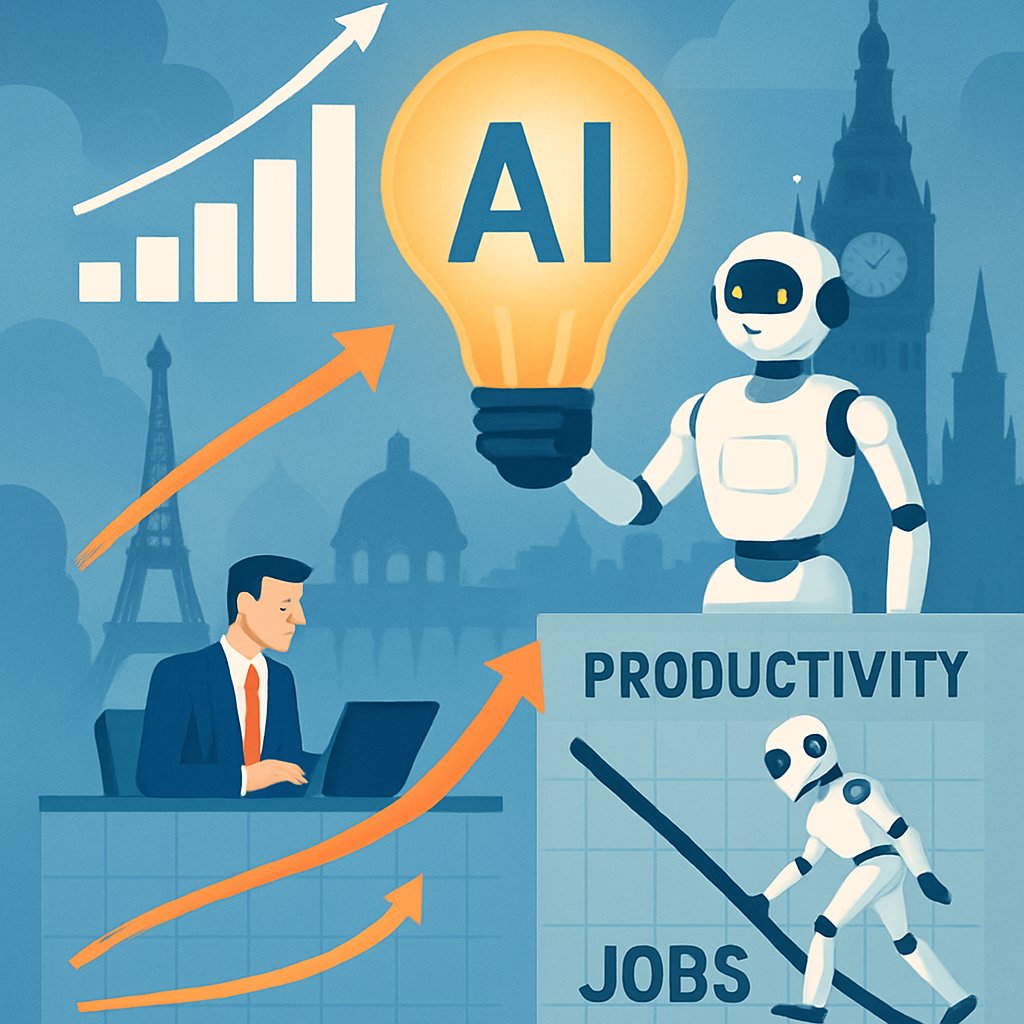
AI’s Impact on Jobs and Productivity in Europe

AI is no longer a theoretical disruptor in Europe’s economy—it’s fundamentally reshaping productivity metrics, job roles, and the very structure of the workforce. For leaders, engineers, and policymakers, the challenge isn’t whether AI will affect jobs and productivity, but how to navigate the transition, mitigate risks, and capture the upside. Recent developments at companies like Heineken and new CEPR research provide a clear window into the scale, complexity, and controversy of this shift.

Key Takeaways:

  • AI adoption has raised average labour productivity in Europe by about 4% at the firm level, according to recent CEPR research
  • Job displacement and creation are happening in parallel: Deutsche Bank estimates 92 million jobs may be displaced but 170 million new roles created in the next five years
  • Heineken’s plan to cut up to 6,000 jobs for “AI productivity savings” illustrates both the promise and controversy of workforce automation
  • Critics allege that rapid AI-driven restructuring can exacerbate inequality, erode worker rights, and sidestep competition rules—especially in sectors already facing legal scrutiny
  • Best results come from combining AI with upskilling and robust transition planning, not brute-force cost cutting

Evidence: AI’s Impact on Productivity in Europe

Quantifying AI’s effect on productivity has been notoriously difficult, but large-scale research from the Centre for Economic Policy Research (CEPR) finally offers concrete evidence. Analyzing data from over 12,000 European firms, the study found that AI adoption increased labour productivity by an average of 4% across the EU, with no immediate evidence of reduced total employment at the firm level (CEPR).

This productivity gain is not uniform. High-skill sectors (finance, technology, advanced manufacturing) see the biggest bumps, while routine-intensive industries (retail, hospitality) lag behind or face more disruption. Importantly, the productivity effect is strongest in firms that integrate AI with existing digital infrastructure and invest in workforce training—simply adding AI tools without organizational change yields little benefit.

MIT researchers have also shown that AI’s impact is accelerating as algorithms mature and data integration improves, opening new frontiers in scientific discovery, logistics, and health diagnostics (MIT News).

For a comparison of sectoral impact, see the table below:

SectorProductivity ImpactAI Adoption RateJob Displacement Risk
Finance & TechHigh (6-10%)Very HighLow
ManufacturingModerate (4-7%)HighModerate
Retail & HospitalityLow (<2%)LowHigh
HealthcareModerate (3-5%)GrowingLow

These findings echo the “winner-takes-most” dynamic we highlighted in our analysis of competing technology paradigms: productivity gains are real, but unevenly distributed.

Job Market Outcomes: Creation, Displacement, and Transition

The central fear in the AI debate is mass job loss. While high-profile layoffs (such as Heineken’s) dominate headlines, the larger picture is more complex. According to Deutsche Bank’s analysis, AI may displace up to 92 million jobs globally by 2030, but also create 170 million new roles, resulting in a net employment gain (Fortune).

European evidence suggests:

  • Job displacement is concentrated in routine, repetitive roles (data entry, back-office admin, basic manufacturing)
  • Job creation is strongest in AI engineering, data science, cybersecurity, and “augmentation” roles combining human expertise with machine intelligence
  • Firms that upskill or reskill their staff see lower net layoffs and higher productivity

Transitions are turbulent. Even with net job creation, affected workers often face gaps in income, location mismatch, or upskilling challenges. Governments and firms are experimenting with job transition funds, AI literacy programs, and new forms of collective bargaining, but results are uneven.

Practical Example: AI-Augmented Workflow

Below is a simple code snippet showing how a European fintech might use AI to automate transaction categorization, freeing analysts for higher-value tasks. This is typical of how “augmentation” can shift jobs without outright elimination.

import openai

def categorize_transactions(transactions, api_key):
    openai.api_key = api_key
    categories = []
    for txn in transactions:
        response = openai.Completion.create(
            engine="gpt-4",
            prompt=f"Categorize this transaction: {txn['description']}",
            max_tokens=10
        )
        categories.append(response.choices[0].text.strip())
    return categories

# Sample usage:
# categories = categorize_transactions(user_transactions, os.environ["OPENAI_API_KEY"])

This Python function leverages the OpenAI API to auto-categorize transaction descriptions. In production, such tools are paired with human review for compliance and explainability.

Case Study: Heineken’s AI-Driven Restructuring and Industry Concerns

Heineken, Europe’s second-largest brewer, recently announced plans to cut up to 7% of its workforce—approximately 7,000 jobs—citing “AI productivity savings” as a core driver (CNBC).

(CNBC). CEO Dolf van den Brink told CNBC, “AI will play an important part of ongoing productivity savings,” underscoring the company’s pivot to automation as beer sales slow and competition intensifies.

While Heineken’s move is emblematic of a broader trend, it is also highly controversial:

  • Merits: The company is under pressure from aggressive competitors in Asia and faces stagnant demand in fortress markets. AI is positioned as a lever for efficiency and modernization.
  • Concerns: Critics contend that Heineken’s restructuring is more about cost-cutting than true innovation. There are allegations that rapid automation could worsen inequality, especially in economies with weak worker protections.
  • Legal scrutiny: The company is already facing legal challenges over past competition violations by its Greek subsidiary, raising fears that automation-driven layoffs could invite further regulatory attention (BusinessWire).
  • Leadership turnover: Heineken’s CEO recently stepped down amid “unsatisfied investors” and market anxieties, adding to concerns about stability (Investing.com).

Allegedly, some labor advocates warn that Heineken’s approach could set a precedent for other European manufacturers to pursue layoffs under the guise of AI modernization, without adequate transition support. The company’s actions are being watched closely by both regulators and rivals (Marketing91).

For a broader perspective on the risks of digital lock-in and the importance of robust governance, see our analysis of diagram and data portability.

Understanding AI's Role in Job Transformation

AI is not just a job eliminator; it also creates new opportunities. For instance, roles in AI ethics, data annotation, and algorithm auditing are emerging as essential components of the AI ecosystem. Companies that invest in these areas often see a more balanced transition, where technology complements human skills rather than replaces them. This perspective is crucial for leaders aiming to harness AI's potential while ensuring workforce stability.

Real-World Use Cases and Implementation Patterns

Across Europe, AI is being woven into both high-skill and operational workflows. Trends include:

  • Super-app ecosystems: AI is consolidating into integrated platforms that manage scheduling, customer interaction, and internal analytics (Forbes).
  • Automation in logistics: Warehousing and supply chain management increasingly rely on predictive AI for inventory and route optimization.
  • Healthcare diagnostics: AI-driven imaging tools, as reported by MIT, are beginning to transform clinical workflows (MIT News).
  • AI in compliance: Financial services are using natural language models to automate KYC, risk review, and regulatory reporting.

Sample Implementation: AI-Powered Document Classification

Below is a Python example for using a transformer model (via Hugging Face Transformers) to classify compliance documents—a common automation in European banks:

from transformers import pipeline

classifier = pipeline("zero-shot-classification", model="facebook/bart-large-mnli")
labels = ["KYC", "AML", "GDPR", "Other"]

def classify_documents(docs):
    results = []
    for doc in docs:
        result = classifier(doc, candidate_labels=labels)
        results.append(result['labels'][0])  # highest scoring label
    return results

# Usage: classify_documents(["Customer passport scan...", "Suspicious transaction report..."])

This approach enables rapid triage and compliance checks, freeing up human analysts for complex cases. The key is not just technical capability, but careful workflow design and human-in-the-loop review.

Many successful European firms are blending AI tools with robust change management and transparent metrics, not just deploying algorithms and hoping for productivity magic.

Common Pitfalls and Critical Debates

While AI’s promise is enormous, the risks are equally real—especially in Europe’s tightly regulated, worker-centric economies:

  • Skill mismatches: The pace of AI adoption routinely outstrips available reskilling programs, leaving displaced workers in limbo.
  • Ethical and legal uncertainty: Over-reliance on opaque AI systems can expose firms to compliance failures, bias, and reputational risk.
  • Short-termism: Companies focused solely on “productivity savings” may underinvest in long-term workforce health, triggering backlash and talent drain.
  • Vendor lock-in risks: As with long-term digital assets, organizations that fail to plan for data portability and platform changes risk costly migrations—echoing the lessons from our diagram management deep-dive.

Pro Tip: Incorporate AI explainability and audit trails from day one. European regulators are increasingly demanding transparency in automated decision-making, especially where jobs and livelihoods are at stake.

Conclusion & Next Steps

AI-driven productivity gains are real, but so are the risks of disruption and backlash. The Heineken case shows that “AI productivity savings” can drive both efficiency and controversy, especially absent strong governance and transition planning.

If you’re leading an AI transformation, focus on holistic integration—upskilling, transparent communication, and ethical guardrails—not just cost-cutting. For further analysis of technology-driven disruption, revisit our coverage of infrastructure modernization and hardware lifecycle strategies. Expect the debate over jobs and AI to intensify as legal, ethical, and competitive pressures mount across Europe.