The Silk Road was more than a network of trade routes—it was a grand artery of commerce, art, and ideas that reshaped continents for over a millennium. From the bustling markets of Chang'an (长安 Cháng'ān, modern Xi’an) to the ports of Venice, these pathways carried silk, spices, religions, and inventions across Eurasia and beyond. Today, the Silk Road’s legacy endures, influencing global diplomacy and China’s modern Belt and Road Initiative (BRI). This article unpacks the rich tapestry of the Silk Road: its routes, its cargo, its cultural exchanges, and its modern echoes.
Key Takeaways:
- Understand the geography and structure of both land and maritime Silk Roads, with maps and key cities.
- Learn what goods (silk, spices, metals), ideas (Buddhism, Islam), and technologies were exchanged.
- See how the Silk Road fostered cultural blending, influencing art, language, and daily life.
- Connect the ancient Silk Road’s legacy to China’s Belt and Road Initiative and current global dynamics.
Land and Maritime Silk Roads: Routes, Maps, and Key Cities
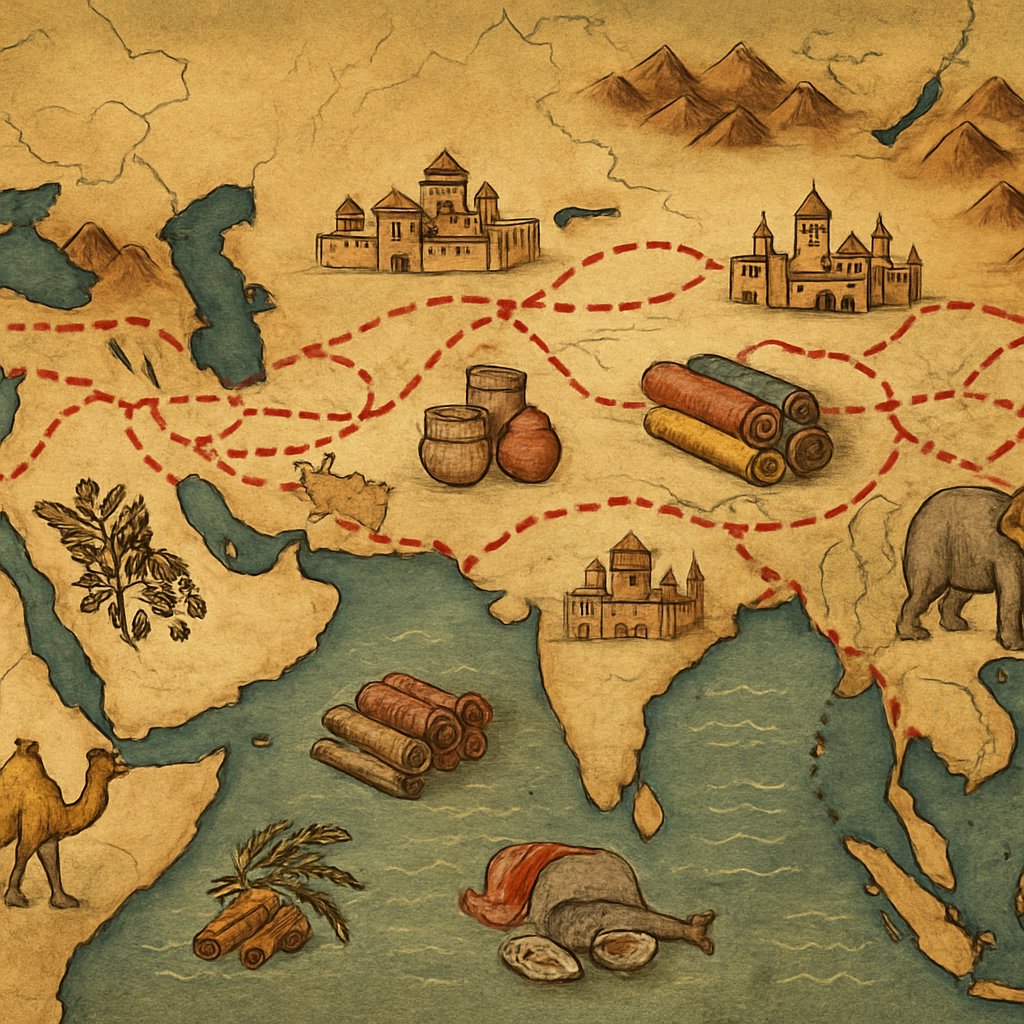
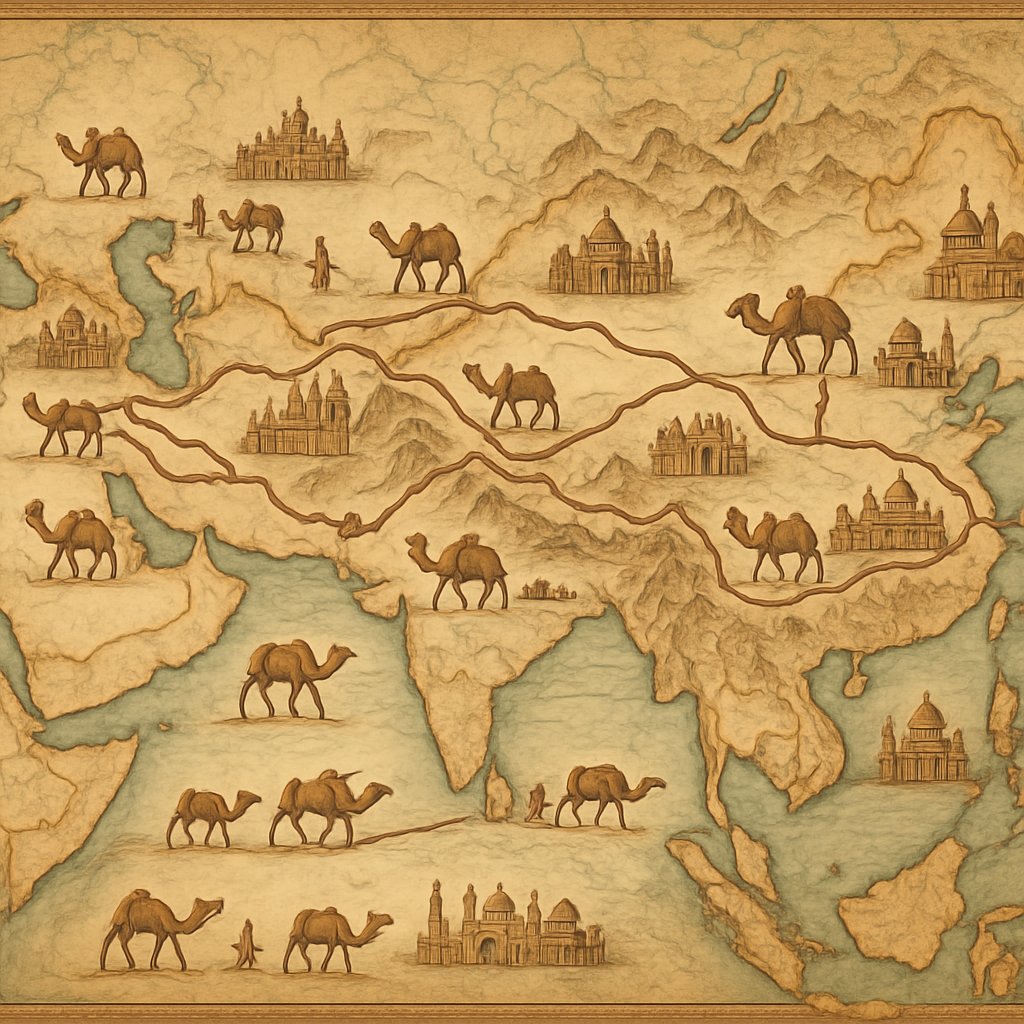
The original Silk Road (丝绸之路 Sīchóu zhī lù) was a complex web of overland and maritime trade routes linking China, Central Asia, the Middle East, and Europe. Its name, coined in the 19th century by German geographer Ferdinand von Richthofen, belies its true diversity: silk was only one of many treasures exchanged along its length.
Land Routes: From Chang’an to the Mediterranean
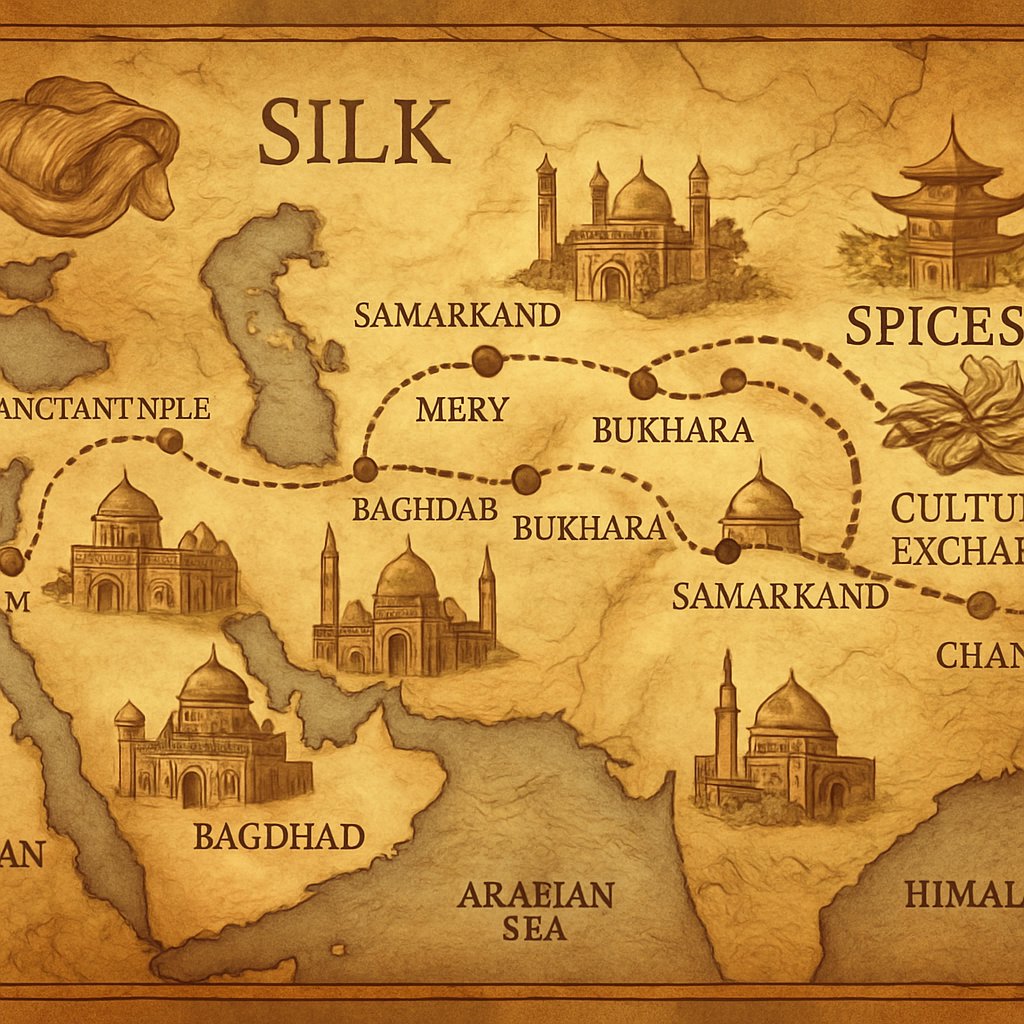
The land Silk Road began in Chang’an, the capital of several Chinese dynasties, and stretched west through the Gansu Corridor, skirting the formidable Taklamakan Desert via oasis cities like Dunhuang (敦煌 Dūnhuáng) and Turpan (吐鲁番 Tǔlǔfán). After crossing the Tianshan Mountains and Pamirs, it branched into:
- Central Route: Through Samarkand (撒马尔罕 Sāmǎ’ěrhǎn) and Bukhara (布哈拉 Bùhālā), centers of Sogdian trade and culture.
- Northern Route: Via the Eurasian steppes, linking nomadic tribes and the Black Sea region.
- Southern Route: Skirting the Iranian plateau, passing through Persia (modern Iran) to the Levant and Anatolia.
Maritime Silk Road: Across the Seas
The Maritime Silk Road (海上丝绸之路 Hǎishàng Sīchóu zhī lù) connected coastal Chinese cities such as Guangzhou (广州 Guǎngzhōu) and Quanzhou (泉州 Quánzhōu) to Southeast Asia, India, Arabia, and East Africa. Merchant ships carried silk, porcelain, and tea, returning with spices, gems, and exotic animals. This sea route fostered vibrant port cultures and cosmopolitan cities, blending Chinese, Indian, Arab, and Malay influences.
Silk Road Maps and Key Cities
Visualizing the Silk Road is crucial for understanding its reach. Most modern maps depict:
- Chang’an (Xi’an): The eastern terminus and dynastic capital.
- Dunhuang: Gateway to Central Asia, famed for Buddhist cave art.
- Kashgar (喀什 Kāshí): A strategic crossroads at the edge of the Taklamakan Desert.
- Samarkand, Bukhara: Sogdian centers of trade, language, and Buddhist transmission.
- Constantinople (now Istanbul): The western end, connecting to Europe and the Mediterranean trade network.
- Guangzhou, Quanzhou: Major maritime hubs for sea trade to India and Africa.
For high-quality maps and further city profiles, see The China Journey’s Silk Road guide.
| Route | Key Cities | Distance (approx.) | Main Commodities |
|---|---|---|---|
| Land (Central) | Chang’an, Dunhuang, Kashgar, Samarkand | 5,000 km | Silk, paper, jade, horses |
| Land (Southern) | Chang’an, Khotan, Tehran, Antioch | 4,800 km | Spices, glass, furs, medicine |
| Maritime | Quanzhou, Malacca, Calicut, Aden | Varies by sea | Porcelain, tea, spices, ivory |
What Was Traded: Goods, Ideas, and Religions
The “Silk” in Silk Road hints at luxury, but the network moved a staggering range of goods, technologies, and beliefs. The exchange went in both directions, shaping world civilizations.
Material Goods: From Silk to Spices
- Silk (丝绸 sīchóu): Highly prized in Rome and Byzantium. Its production secrets were fiercely guarded in China for centuries.
- Spices (香料 xiāngliào): Cinnamon, pepper, and cloves from India and Southeast Asia were worth their weight in gold.
- Porcelain (瓷器 cíqì) and lacquerware: Chinese ceramics dazzled foreign courts, while glassware traveled east from the Middle East.
- Metals and gems: Gold, silver, jade (玉 yù), and lapis lazuli were exchanged for textiles and other luxuries.
- Paper (纸 zhǐ) and gunpowder: Revolutionary inventions that eventually transformed the Islamic world and Europe.
Ideas, Religions, and Technologies
According to Science of Silk, the Silk Road was a powerful vector for cultural diffusion:
- Buddhism (佛教 Fójiào): Spread from India to China, Korea, and Japan, aided by oasis monasteries and translators.
- Islam (伊斯兰教 Yīsīlánjiào): Arrived in western China and Central Asia with Arab and Persian traders.
- Christianity and Zoroastrianism: Traveled east with Nestorian and Sogdian missionaries, especially in Tang-era China.
- Artistic motifs: Greco-Roman, Persian, and Indian motifs influenced Chinese sculpture and painting, visible in the Buddhist caves of Dunhuang.
- Technologies: Papermaking, printing, and the compass flowed west; new crops and medical knowledge arrived in China from the Middle East.
Case Study: Sogdian Merchants and Cultural Brokers
The Sogdians—a Persian-speaking people based in Samarkand—were instrumental in Silk Road commerce. As noted by The China Journey, Sogdian merchants were not only traders but also translators, diplomats, and cultural intermediaries, facilitating the movement of Buddhist art and texts across Eurasia.
Cultural Exchange: Art, Philosophy, and Everyday Life
The Silk Road’s true legacy lies in the cultural and artistic exchanges that accompanied its caravans and ships. According to Columbia Global Centers, this network served as a bridge connecting scholars, artists, and entire civilizations.
Art and Calligraphy: Blending East and West
Artisans along the Silk Road produced Buddhist sculptures with Hellenistic features, Persian textiles with Chinese dragons, and calligraphy that merged scripts and styles. The Mogao Caves in Dunhuang house murals depicting traders in Sogdian garb, Indian monks, and Chinese officials side by side—a visual testament to multiculturalism.
For those interested in exploring the calligraphic side of Silk Road heritage, see this step-by-step guide to Chinese calligraphy practice.
Philosophy, Science, and Language
- Philosophical exchange: Confucian, Buddhist, Zoroastrian, and Islamic philosophies interacted, shaping governance and social norms.
- Science and medicine: Medical texts, astronomical charts, and agricultural techniques traveled the routes, enriching recipient cultures.
- Language: The Silk Road was a polyglot world. Sogdian, Persian, Arabic, Chinese, and Turkic languages all flourished, leading to loanwords and hybrid scripts.
Everyday Life: Food, Fashion, and Ritual
Foods such as grapes, pomegranates, and walnuts entered China, while tea and peaches journeyed west. Textile patterns, musical instruments, and even social customs (like drinking etiquette) were adopted and adapted. The concept of face (面子 miànzi) in Chinese culture, while deeply rooted in Confucian tradition, found new expressions through cosmopolitan interaction and negotiation along the road.
Silk Road Legacy and the Modern Belt and Road Initiative
Despite its romantic image, the Silk Road was, as YaleGlobal Online notes, never a superhighway of mass commerce. Its historical significance stems from the cultural legacy and written records it left behind, rather than sheer volume of goods moved.
Historical Legacy
- World Heritage: UNESCO recognizes dozens of Silk Road sites, from the Mogao Caves to the ruins of Palmyra, for their role in world civilization.
- Diplomatic models: The Silk Road’s patterns of alliance, tribute, and negotiation inform modern international relations, especially in Eurasia.
- Artistic inspiration: The Silk Road continues to inspire global artists, writers, and filmmakers, as seen in contemporary collaborations and exhibitions.
The Belt and Road Initiative: New Silk Roads?
China’s Belt and Road Initiative (一带一路倡议 Yídài yílù Chàngyì), launched in 2013, aims to revive and expand the ancient trade routes through infrastructure and investment projects across Asia, Africa, and Europe. The BRI echoes the Silk Road’s vision of interconnectedness, but on a scale unimaginable in antiquity—high-speed railways, digital corridors, and maritime ports now link dozens of nations.
According to Columbia Global Centers, modern Silk Road initiatives are not just about economics, but also about fostering educational, artistic, and scholarly exchange reminiscent of the ancient model.
| Aspect | Ancient Silk Road | Belt and Road Initiative |
|---|---|---|
| Scale | Caravans, small ships, city-states | Multinational infrastructure, megacities |
| Key Cargo | Luxury goods, religions, art | Machinery, energy, digital tech |
| Cultural Exchange | Art, language, philosophy | Scholarships, joint research, art exhibitions |
| Geographic Reach | China to Europe and Africa | Asia, Africa, Europe, Latin America |
Common Pitfalls and Pro Tips for Studying the Silk Road
Delving into Silk Road history can be deeply rewarding—but there are traps to avoid if you want nuanced understanding.
Pitfalls
- Romanticizing the Silk Road: Popular narratives often exaggerate the volume and ease of trade. In reality, journeys were perilous and traffic was limited (“among the least traveled in human history”—see YaleGlobal Online).
- Overlooking Maritime Routes: Many accounts ignore the importance of maritime trade, which, at times, rivaled or surpassed overland routes in volume and cultural impact.
- Ignoring Central Asia’s Role: The Sogdians and other Central Asian cultures were not merely intermediaries; they were innovators and influencers in their own right.
- Assuming One-Way Flow: Exchange was multidirectional. Chinese lacquerware, Persian textiles, Roman glass, and Indian spices all moved in both directions.
Pro Tips
- Compare Primary Sources: Read travel accounts from different eras—Chinese, Arab, Venetian (e.g., Marco Polo), and Persian—for contrasting perspectives.
- Trace Artistic Influences: Visit museum collections and UNESCO sites to see Silk Road art and artifacts firsthand.
- Explore Modern Connections: Examine how the Silk Road’s legacy is interpreted in contemporary initiatives, such as China’s Belt and Road, and in global art and academic collaborations (Columbia Global Centers).
- Deepen with Cultural Practices: Learn calligraphy or traditional music to experience Silk Road heritage on a personal level—see this Chinese calligraphy tutorial for a practical starting point.
Conclusion and Next Steps
The Silk Road’s enduring appeal lies not in the tonnage of silk or spices, but in its role as a conduit for human creativity and cross-cultural discovery. By understanding its routes, exchanges, and legacy, you gain fresh insight into both ancient and modern China—and the persistent quest for connection that shapes our world. For further exploration, examine the art forms and calligraphy born from Silk Road encounters, or compare the global ambitions of the Belt and Road Initiative with their historic forerunners.
For a hands-on look at Silk Road-inspired artistry, see this detailed guide to Chinese calligraphy practice. To go deeper into the cultural context, browse posts on Chinese philosophy, art, and cross-cultural exchange.
References and further reading:
Columbia Global Centers: Unveiling the Silk Road’s Legacy | Silk Road, Connecting Civilizations Across Continents | Science of Silk: Trade, Culture & Global Legacy