
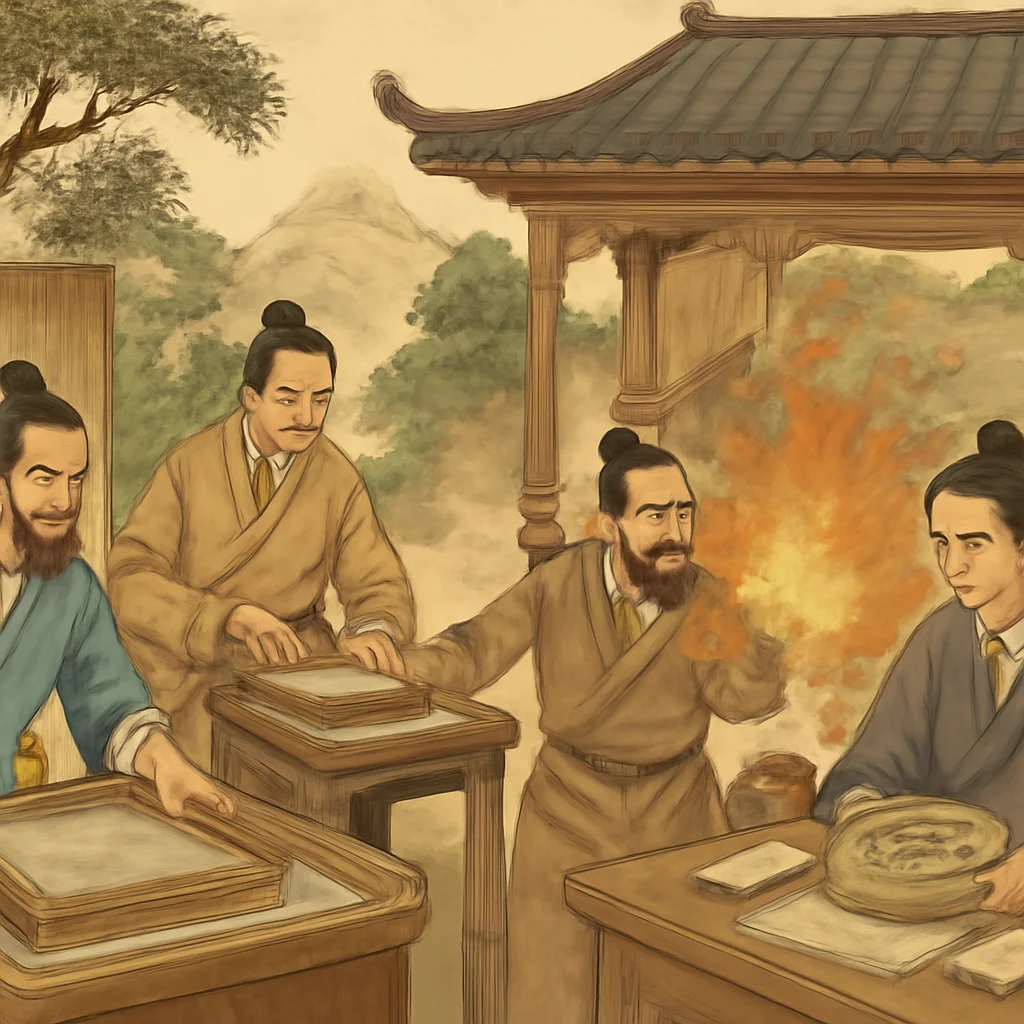
Introduction: China’s Four Great Inventions in Context
The phrase “Four Great Inventions” (四大发明, sì dà fā míng) evokes a deep sense of pride in Chinese culture. These inventions—papermaking, printing, gunpowder, and the compass—are celebrated as milestones of ancient Chinese ingenuity, symbolizing not only technological achievement but also the power of cultural transmission. As noted in historical analyses, the concept itself arose in modern times, influenced by Western recognition of their global significance. Yet their origins reach deep into China’s dynastic ages, and their legacy stretches across continents, transforming the very fabric of civilization.
To understand the Four Great Inventions is to trace the journey of human innovation, from the intricacies of calligraphy on bamboo slips to the explosive force that altered military strategies, and from the silent pull of lodestone to the printed word traveling the Silk Road. These inventions were not created in isolation—they were deeply woven with the rhythms of daily life, imperial ambition, philosophical ideals, and the desire for harmony (和谐, héxié) between humanity and the world.
This article explores each invention in depth, drawing on primary sources and recent scholarship, and situates them in the broader context of Chinese and world history. For readers interested in the wider backdrop of exchange and influence, our analysis builds on themes covered in our Silk Road legacy feature, where these technologies rode the great trade routes to distant lands.
Papermaking (造纸术 zào zhǐ shù): The Revolution of Writing
Before the invention of paper, writing in China meant etching characters onto bones, shells, or casting them into bronze. Bamboo and wooden slips, and later silk (帛, bó), provided writing surfaces, but they were either cumbersome or prohibitively expensive. The breakthrough came during the Han dynasty (202 BCE–220 CE), when Cai Lun (蔡伦, cài lún), a court official, is credited with refining the papermaking process around 105 CE.
Cai Lun’s method blended mulberry bark, hemp waste, old rags, and fishing nets into a pulp, which was then pressed and dried into thin, versatile sheets. This paper was not only lighter and cheaper than silk, but its texture was ideal for the Chinese brush, transforming the possibilities of record-keeping, literature, and art. According to archaeological finds, early forms of paper with writing have been dated as far back as 8 BCE in Gansu province, but Cai Lun’s innovations marked the shift to mass production.
By the third century, paper had become widespread as a writing medium in China. The invention soon touched every aspect of life: from wrapping delicate tea leaves during the Tang dynasty (618–907), to the world’s first paper currency issued in the Song dynasty (960–1279). By the sixth century, even toilet paper was in use in China—a testament to the material’s ubiquity and practicality (Wikipedia).
Papermaking technology radiated outward along the Silk Road, reaching Korea and Japan, then the Islamic world, and finally Europe by the 12th century. Its impact was revolutionary: it facilitated the spread of knowledge, democratized education, and laid the foundation for the next great leap—printing.
Printing (印刷 yìn shuā): Multiplying Knowledge
The written word, once restricted to painstaking manuscript copying, was unleashed by the invention of printing. The earliest form, woodblock printing (雕版印刷, diāo bǎn yìn shuā), appeared during the Tang dynasty. By 868 CE, the “Diamond Sutra” (金刚经, jīn gāng jīng) was printed using woodblocks, marking the world’s oldest known dated printed book. This innovation was particularly well-suited to the Chinese script, with its thousands of characters, and allowed for the mass production of Buddhist scriptures, literature, and administrative documents.
Printing technology evolved further during the Song dynasty. Bi Sheng (毕昇, bì shēng), a common artisan, invented movable type printing (活字印刷, huó zì yìn shuā) around 1040–1050 CE, using individually carved clay characters. This allowed for faster and more flexible text reproduction, though the sheer number of Chinese characters made movable type less efficient than in phonetic scripts. Nevertheless, it enabled large-scale projects, such as encyclopedias and official histories, and inspired later innovations in Korea and, eventually, Europe (China Highlights).
Printing transformed Chinese society: books became more affordable, education more widespread, and the civil service examination system (科举, kē jǔ) more accessible. Knowledge could now circulate with unprecedented speed, seeding the growth of scholarship, philosophy, and science.
The technology of block and movable type printing traveled westward, influencing Islamic and European printing centuries before Gutenberg’s press. The UNESCO has since recognized Chinese woodblock printing as an Intangible Cultural Heritage of Humanity.
Gunpowder (火药 huǒ yào): The Spark That Changed Warfare
The invention of gunpowder was born from the pursuit not of destruction, but of immortality. During the Tang dynasty, Chinese alchemists seeking the elixir of life experimented with sulfur, saltpeter, and charcoal. Instead, they discovered a volatile mixture that would change the world: gunpowder.
Initially used for fireworks to celebrate festivals and ward off evil spirits, gunpowder’s military potential quickly became apparent. By the Song and Yuan dynasties (960–1368), it was being used in fire arrows, bombs, grenades, and eventually cannons. The Wujing Zongyao (武经总要), a military treatise compiled in 1044, contains the earliest known formulas for gunpowder, with nitrate concentrations as high as 50% (Wikipedia).
By the 13th century, Chinese armies employed gunpowder in explosive weapons capable of breaching iron containers, and by the Ming dynasty, corned (granulated) powder was in use. Catastrophic accidents, such as the 1280 explosion at Weiyang’s arsenal, demonstrated its destructive power—blasting beams kilometers away and changing the face of warfare forever.
Gunpowder spread along trade routes to the Arab world and Europe by the 12th and 13th centuries, where it powered new forms of weaponry and dramatically shifted military and political balances. Its impact extended far beyond the battlefield, fueling advances in mining, construction, and pyrotechnics.
Compass (指南针 zhǐ nán zhēn): Navigating the World
The need to orient oneself—to find true north or south—has always been vital in travel, trade, and ritual. Chinese scholars as early as the Warring States period (476–221 BCE) described the “south-governing spoon” (司南, sī nán), a lodestone device capable of aligning with Earth’s magnetic field.
By the 11th century, the compass had taken recognizable form: a magnetized needle floating in water or suspended in air, as documented in Song dynasty texts. The celebrated scientist Shen Kuo (沈括, shěn kuò) detailed the use of the magnetic needle for navigation, making travel possible even on sunless nights or cloudy seas. The development of the dry compass—using a suspended, pivoted needle—enabled even greater precision and durability (ChineseLearning.com).
The compass was a catalyst for maritime exploration, both in China and abroad. By the Northern Song period, it was transmitted to the Arab world and Europe, where it underpinned the Age of Discovery. The compass enabled navigators to traverse vast oceans, discover new continents, and connect distant cultures. As we discussed in our Silk Road reference guide, its impact on trade and cross-cultural exchange was profound, opening up new economic and intellectual horizons across Eurasia.
Comparison Table: The Four Great Inventions
| Invention | Chinese Name (Pinyin) | Period of Invention | Key Innovator(s) | Primary Use | Global Impact |
|---|---|---|---|---|---|
| Papermaking | 造纸术 (zào zhǐ shù) | Han dynasty (c. 105 CE) | Cai Lun (蔡伦) | Writing, record-keeping, art | Spread to Asia, Middle East, Europe; revolutionized communication |
| Printing (Woodblock & Movable Type) | 印刷 (yìn shuā) | Tang–Song dynasties (7th–11th c. CE) | Bi Sheng (毕昇) | Mass production of texts | Enabled mass literacy, education, cross-cultural knowledge transfer |
| Gunpowder | 火药 (huǒ yào) | Tang dynasty (9th c. CE) | Anonymous alchemists | Fireworks, weapons, mining | Changed warfare, spread to Arab world and Europe |
| Compass | 指南针 (zhǐ nán zhēn) | Warring States–Song dynasty (4th c. BCE–11th c. CE) | Multiple contributors | Navigation, geomancy | Enabled global exploration, maritime trade |
Cultural Legacy and Global Impact
The Four Great Inventions are not simply technological marvels—they are symbols of China’s enduring quest for knowledge, adaptability, and harmonious (和谐, héxié) coexistence with the world. They are memorialized in modern Chinese education, celebrated in events such as the 2008 Beijing Olympics opening ceremony, and even honored in postage stamps and UNESCO heritage lists (Wikipedia).
Chinese historians, such as Deng Yinke, have pointed out that these four inventions are only part of a much broader legacy of innovation—one that includes achievements in agriculture, metallurgy, medicine, porcelain, and silk. Yet the Four Great Inventions are singled out because of their transformative effects on global history. They catalyzed the rise of capitalism in Europe, enabled the spread of literacy, and propelled the age of exploration. Their transmission was often facilitated by the very networks described in our exploration of the Silk Road, where ideas, goods, and inventions flowed alongside spices and silk.
In the modern era, these inventions continue to inspire a spirit of technological innovation (科技创新, kējì chuàngxīn) and national pride (自豪感, zìháo gǎn) in China. They remind us that cultural exchange is the engine of progress—and that the past, when understood in all its complexity, remains the wellspring of future creativity.
Key Takeaways:
- The Four Great Inventions—papermaking, printing, gunpowder, and the compass—were developed in China between the Han and Song dynasties, with profound effects on world civilization.
- Papermaking and printing democratized knowledge, while the compass and gunpowder reshaped navigation, warfare, and global trade.
- These inventions spread via trade routes such as the Silk Road, transforming societies far beyond China’s borders.
- Chinese scholars emphasize that these four are part of a much larger tradition of innovation, but they are singled out for their global impact.
- Understanding these inventions helps illuminate how ancient traditions continue to influence contemporary life and global connectivity.
Further Reading
- For a source-based overview of routes and cultural exchange, see Silk Road Reference Guide: Routes, Cities, and Cultural Impact.
- For a deep dive into the legacy of ancient trade and technology transfer, explore Silk Road: Legacy and History of Ancient Trade Routes.
- Primary source: Wikipedia: Four Great Inventions
- Additional overview: China Highlights: Four Great Inventions
- Cultural context and language: ChineseLearning.com: The Four Great Inventions of China