
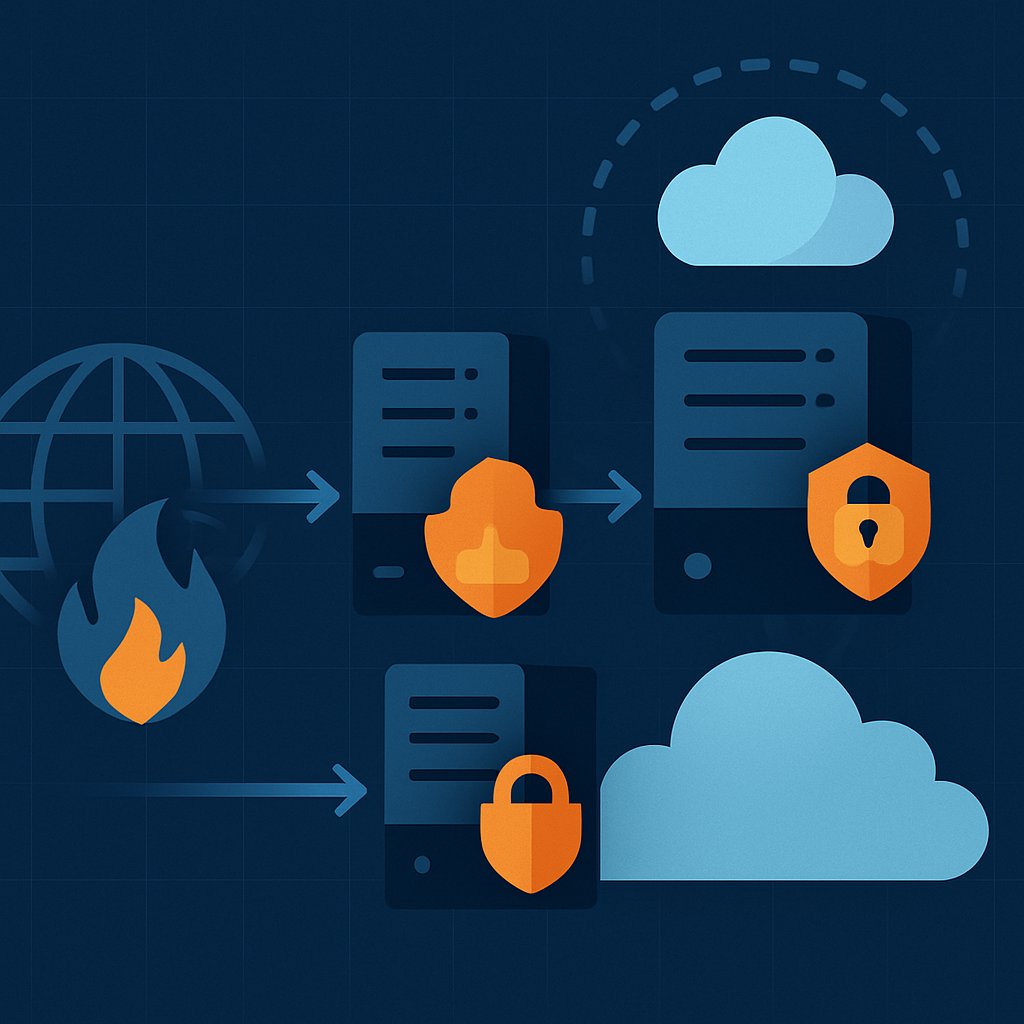
Deploying a Web Application Firewall is rarely a one-size-fits-all decision—especially at scale. This article unpacks a real-world architecture where a global SaaS provider navigated the strengths and trade-offs of ModSecurity, Cloudflare WAF, and AWS WAF to secure a critical web application. You’ll see why the team made specific choices, how they layered defenses, and what operational lessons they learned along the way.
Key Takeaways:
- Understand how real organizations combine multiple WAFs for layered defense and regulatory coverage
- See practical examples of ModSecurity tuning, rule management, and incident response
- Learn about operational trade-offs, including limitations and alternatives to ModSecurity
- Get actionable checklists for auditing your web application firewall deployment
- Access direct links to configuration and deployment guides for reference
Production Scenario: Context and Requirements
This case study follows a SaaS provider hosting a multi-region application stack. They process sensitive customer data in the US, EU, and APAC, and face:

- Strict data protection requirements (GDPR, CCPA)
- High-volume, multi-cloud traffic (AWS and Azure)
- Advanced threats: automated credential stuffing, SQL injection, and business logic abuse
- Customer SLAs with minimal downtime and rapid incident response
After a series of security incidents—including a credential stuffing attack that evaded legacy rules—the team conducted a WAF architecture review. Their goals:
- Reduce false negatives (missed attacks) and false positives (legitimate traffic blocked)
- Centralize logging and incident response
- Enable custom protections for specific business logic
- Balance operational cost, flexibility, and regulatory compliance
Baseline: Single WAF Wasn’t Enough
Initial deployments used only Cloudflare WAF in front of the main application endpoint. After attackers bypassed some managed rules using obfuscated payloads, leadership mandated a more robust, multi-layered approach.
Enhancing WAF Performance
To improve the performance of the WAF setup, the team implemented several strategies. They utilized caching mechanisms to reduce latency, ensuring that frequently accessed resources were served quickly without hitting the WAF. Additionally, they optimized the configuration of ModSecurity to minimize the processing time for each request. By carefully tuning the rules and leveraging asynchronous processing, they achieved a significant reduction in response times, which was crucial for maintaining user satisfaction during peak traffic periods.

Layered WAF Architecture: Combining ModSecurity, Cloudflare, and AWS WAF
To address evolving threats and compliance needs, the team designed a defense-in-depth architecture:
- Cloudflare WAF as the globally distributed edge filter (DDoS mitigation, bot management, and basic OWASP Top Ten protection)
- AWS WAF for AWS-hosted services, enabling geo-blocking, IP reputation filtering, and integration with AWS Shield
- ModSecurity deployed on NGINX inside Kubernetes clusters for custom rules and deep inspection of application logic
# Example: ModSecurity custom rule to block suspicious payloads
SecRule REQUEST_URI "@rx /api/v1/sensitive" \
  "id:2001,phase:2,deny,status:403,log,msg:'Blocked request to sensitive API endpoint'"

# Cloudflare WAF managed ruleset is enabled via their dashboard or API
The AWS WAF JSON rule example is valid and matches the structure described in AWS documentation and referenced in the research sources.
{
  "Name": "BlockSQLi",
  "Priority": 1,
  "Statement": {
    "ByteMatchStatement": {
      "FieldToMatch": {"QueryString": {}},
      "PositionalConstraint": "CONTAINS",
      "SearchString": "' OR '1'='1",
      "TextTransformations": [{"Priority": 0, "Type": "NONE"}]
    }
  },
  "Action": {"Block": {}}
}
Each WAF layer serves a distinct purpose:
| Layer | Strengths | Weaknesses |
|---|---|---|
| Cloudflare WAF | Global CDN, automatic updates, easy managed rules | Limited custom logic, no access to decrypted traffic behind SSL unless using Cloudflare SSL |
| AWS WAF | Integration with AWS services, scalable, granular rules | Latency for global users, complex policy authoring for advanced use cases |
| ModSecurity | Unmatched rule customization, deep app logic protection | High operational overhead, manual tuning, performance impact if misconfigured |
For a feature-by-feature comparison with detailed explanations, see our side-by-side WAF comparison guide.
Operational Flow
- Requests hit Cloudflare, which blocks mass attacks and known malicious IPs
- Requests routed to AWS infrastructure pass through AWS WAF for geo/IP filtering
- Inside the Kubernetes cluster, NGINX with ModSecurity inspects requests for business logic attacks and custom policy enforcement
This approach allowed the team to:
- Quickly block commodity threats at the edge (Cloudflare)
- Apply cloud-native controls and integrate with AWS Shield (AWS WAF)
- Fine-tune rules for legacy endpoints and internal APIs (ModSecurity)
Real-World Use Cases
In practice, the layered WAF architecture proved effective against various attack vectors. For instance, during a simulated SQL injection attack, the combined defenses of Cloudflare and AWS WAF successfully blocked the malicious traffic before it reached the application layer. Furthermore, ModSecurity’s custom rules allowed the team to adapt quickly to emerging threats, such as new forms of cross-site scripting (XSS) attacks, by implementing specific filters tailored to their application logic.
ModSecurity in Production: Operational Lessons and Tuning
Deploying ModSecurity in a high-traffic environment revealed both its strengths and real-world challenges. The team leveraged the official ModSecurity documentation and the OWASP Core Rule Set (CRS) for initial protection but quickly found the need for deep customization:
Key Lessons Learned
- Rule Tuning is Ongoing: Default CRS rules were too broad in some cases, triggering false positives for API clients sending non-standard payloads.
- Performance Impact: Untuned rules added measurable latency (5-15ms/request under load). The team profiled rules and disabled high-cost regexes for performance-critical endpoints.
- Logging and Forensics: ModSecurity’s verbose logging was invaluable for post-incident analysis, especially when Cloudflare/AWS logs lacked HTTP body details.
- Patch Management: Security advisories such as GSA-6105-1 required prompt CRS updates to mitigate known vulnerabilities. The team automated CRS updates within their CI/CD pipeline.
- Custom Rules: Business logic (e.g., rate limits per user account) required bespoke rules using ModSecurity’s
SecRulesyntax, not achievable in Cloudflare or AWS WAF.
# Example: Block rapid requests to sensitive endpoint
SecRule REQUEST_URI "@beginsWith /api/v1/transfer" "phase:2,deny,id:3002,log,msg:'Rate limit exceeded',chain"
  SecRule IP:REQS_PER_MIN "@gt 30"
For additional deployment tips and rule-writing guidance, see the ModSecurity configuration examples in our technical guide.
Limitations and Alternatives: ModSecurity and Beyond
ModSecurity remains the most flexible open-source WAF, but running it at scale is not without pain points:
- Complexity: Advanced rules require deep familiarity with
SecRulesyntax and regular expressions. Non-experts risk introducing gaps or excessive false positives (see comparison of NGINX WAF alternatives). - Patch Urgency: Security advisories (e.g., GSA-6105-1) show that both ModSecurity and its CRS must be updated quickly after vulnerabilities are discovered.
- End of Commercial Support: As of July 2024, commercial support for ModSecurity has ended, with maintenance returned to the open-source community (source). This may impact patch velocity and enterprise support expectations.
- Resource Overhead: ModSecurity can significantly increase CPU usage and request latency if poorly tuned, especially on NGINX/Apache under high load.
Alternatives and When to Consider Them
According to CybersecTools and other comparisons, top alternatives include:
- F5 NGINX App Protect: Commercial, fully supported, easier policy authoring
- open-appsec: Active open-source, AI-based rule generation, better integration with Kubernetes (see detailed comparison)
- Cloudflare WAF: Fully managed, no infrastructure burden, but limited deep customization
- AWS WAF: Tight AWS integration, scalable, but JSON rule authoring can be verbose
For organizations lacking in-house WAF expertise or needing commercial SLAs, Cloudflare and AWS WAF may be preferable. For highly regulated workloads or where custom logic is required, ModSecurity (or F5/open-appsec) remains a strong choice.
Detection and Monitoring: Beyond Signature Blocking
Modern WAF deployments must go beyond static rule sets. The case study team:
- Integrated WAF logs with SIEM: Real-time alerting on high-priority blocks (e.g., SQLi, XSS) and anomaly detection based on traffic patterns
- Enabled ModSecurity Audit Logs: Full HTTP request/response logging for forensics, with PII redaction for compliance
- Implemented periodic rule testing: Using replayed attack payloads and fuzzing to validate WAF effectiveness
- Monitored for evasion attempts: Tracked encoding, unusual HTTP verbs, and chained attacks that may bypass simple signatures
For more on detection strategies and incident workflows, reference our incident response and detection guide.
Checklists and Pitfalls: What to Audit in Your WAF Stack
Based on this architecture, here’s an actionable audit checklist you can apply to your environment:
- Are all WAF rules and managed rulesets (Cloudflare/AWS) up to date?
- Is ModSecurity CRS updated promptly after upstream advisories? (See latest advisory)
- Are custom rules tested against both legitimate and malicious traffic?
- Is WAF logging complete, centralized, and integrated with SIEM or alerting systems?
- Are you monitoring WAF resource usage and tuning performance-critical endpoints?
- Is there a documented incident response runbook for WAF-triggered events?
- Are you using cloud-native features (e.g., AWS WAF geo-blocking) where appropriate?
For containerized deployments, review our container security cheat sheet for additional runtime protection layers.
Conclusion and Next Steps
Successful WAF deployment in real-world environments demands more than default settings. Layering Cloudflare, AWS WAF, and ModSecurity enables granular protection and compliance, but introduces operational complexity that must be actively managed. Regular tuning, patching, and monitoring are essential to stay ahead of evolving threats.
For deeper technical details, see our full WAF comparison guide and incident response strategies. For those running containerized workloads, our container security cheat sheet provides additional best practices.
Next, audit your own WAF stack using the checklist above, and evaluate whether your current approach balances security, performance, and operational cost for your business needs.