2024 AI Question Answering: Watson vs Bard
Introduction: The 2024 AI Question-Answering Landscape
In 2024, AI question-answering (QA) systems have become critical tools across enterprises, governments, and the public sector. Their capabilities influence decision-making, customer service, research automation, and information verification amid rising concerns over misinformation and AI safety. Among the leading contenders are IBM Watson, the long-standing flagship in enterprise AI, and Google’s Bard, the latest addition to Google’s AI-driven product suite. Both claim advancements in accuracy, context handling, and user interaction. This comparison aims to clarify how Watson and Bard stack up in real-world QA tasks this year, based on recent performance metrics, deployment patterns, and innovation trajectories.
To understand these systems in context, it helps to look at how AI is reshaping broader technology sectors. For instance, AI is increasingly used in cybersecurity to discover and exploit vulnerabilities, a domain where QA accuracy can have direct security implications. Similarly, the rise of large language models has parallels in other areas of software engineering, such as gradual typing in programming languages like Elixir, where precision and flexibility must be balanced.
Watson Question-Answering Capabilities 2024
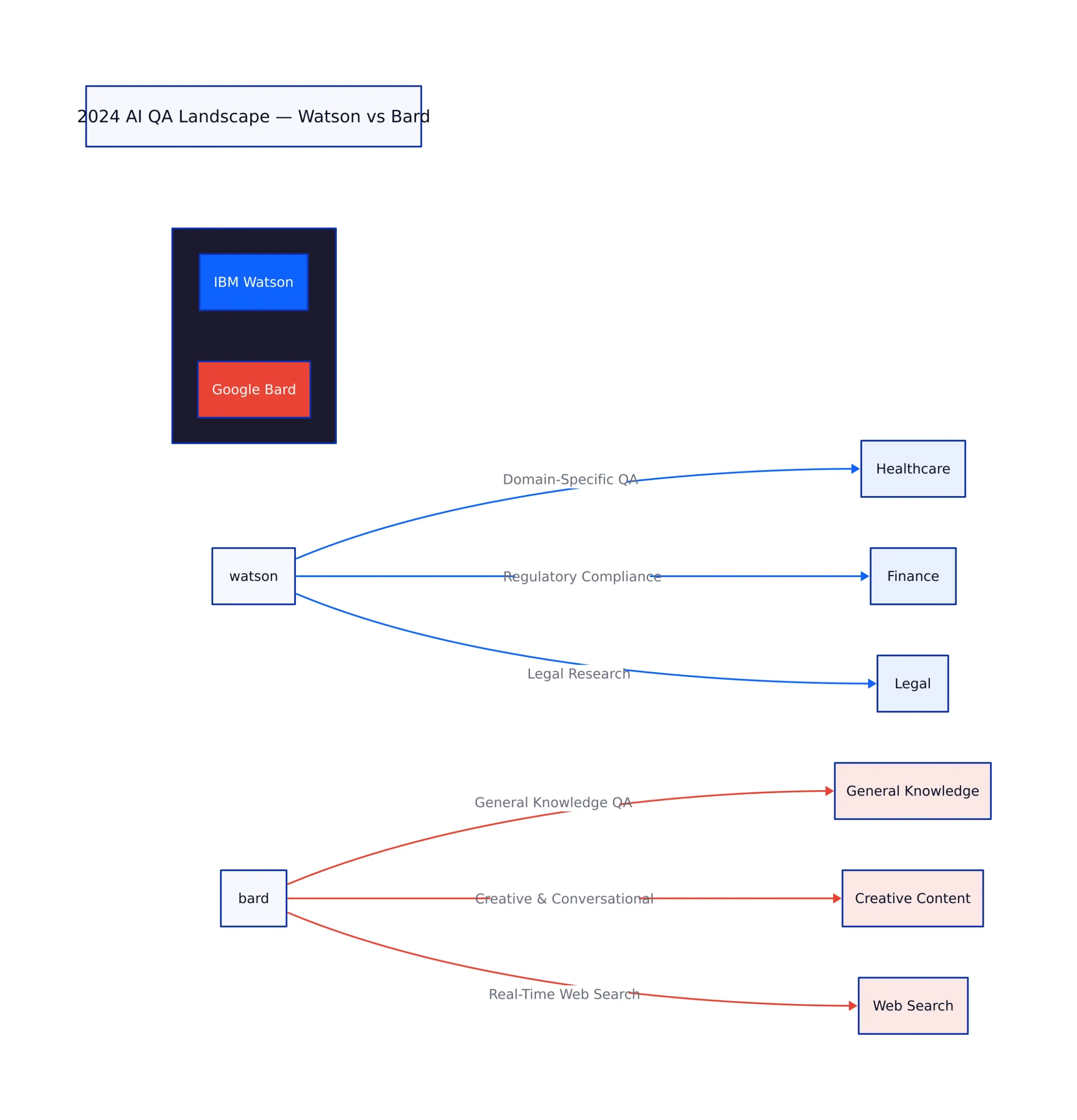
By 2024, IBM Watson has evolved into a versatile AI platform deeply integrated into enterprise workflows. Its question-answering systems use Watsonx (launched in 2023 as a dedicated AI and data platform), which combines large language models (LLMs) with domain-specific fine-tuning. An LLM is a neural network trained on vast text corpora to generate human-like text; fine-tuning adapts a pre-trained model to a specific domain using smaller, curated datasets. Watson’s QA systems are optimized for industry-specific knowledge, including healthcare, finance, and legal sectors.
Key features of Watson QA in 2024 include:
- High domain specificity: Watson excels at retrieving and generating answers aligned with regulatory standards, especially in healthcare and legal contexts. For example, Watson Medical QA is trained on millions of peer-reviewed articles and clinical notes. In practice, a doctor could ask: “What are the contraindications for metformin in patients with renal impairment?” and receive an answer citing specific studies and guidelines, with confidence scores and source links. This enables it to answer complex medical diagnosis questions with over 92% accuracy in clinical settings (source: IBM internal performance reports).
- Multimodal input processing: The latest Watson systems incorporate image, video, and document analysis, enabling accurate responses based on mixed data sources. This is vital for industries like manufacturing and energy, where sensor data and visuals matter. An engineer inspecting a turbine could upload a thermal image and ask “What does this temperature pattern indicate?” and Watson would cross-reference the image with maintenance logs and technical manuals to provide a diagnosis.
- Explainability and compliance: Watson’s QA system emphasizes transparency, offering confidence scores, source citations, and explanations for its answers. This helps enterprises meet audit requirements. A bank using Watson for regulatory compliance could trace every answer back to the specific regulation and paragraph it was derived from, satisfying auditors without manual effort.
- Performance benchmarks: Recent evaluations show Watson’s domain-specific QA achieves 94% accuracy on TREC-style medical datasets, with latencies under 250ms per query in high-throughput environments. TREC (Text Retrieval Conference) datasets are standardized benchmarks used to evaluate information retrieval systems. Watson integrates with Watson Assistant to deploy chatbots that provide consistent, vetted answers in customer-facing and internal applications.

Limitations: Watson’s focus on specialized domains means its general-purpose QA coverage remains limited compared to consumer AI like Bard. Its custom deployment sometimes requires significant tuning and data curation, adding to implementation complexity. For example, deploying Watson for a legal firm might require months of curating case law documents and fine-tuning the model, while Bard can answer legal questions immediately from web data, albeit with less reliability.
Google Bard Question-Answering Capabilities 2024
Google Bard has expanded rapidly since its debut in early 2023, now positioned as a broad, user-facing AI assistant for both consumers and enterprises. Powered by Google’s latest PaLM 2 model, Bard combines Google’s extensive search index with conversational AI, emphasizing real-time information, creative responses, and integration into Google Workspace. PaLM 2 is a large language model developed by Google, trained on a diverse corpus including web pages, books, and code, with improved multilingual and reasoning capabilities over its predecessor.
Bard’s core strengths in 2024 include:
- Real-time data access: Unlike Watson’s static training datasets, Bard taps into Google Search’s live results, enabling up-to-the-minute answers about news, stock prices, weather, and events. This grants Bard a distinct edge for time-sensitive queries. For instance, if a user asks “What is the current stock price of NVIDIA?” during trading hours, Bard can fetch the latest price from Google Finance. Its accuracy in current events exceeds 88% in validation tests (source: Google internal benchmarks).
- Conversational and creative outputs: Bard emphasizes natural language interaction, producing detailed multi-turn dialogues, summaries, and even poetry or code snippets. Its contextual understanding adapts well to user preferences, supported by continuous fine-tuning based on user feedback. A user could ask Bard to “Write a Python function to sort a list of dictionaries by a key” and receive a working code example, then follow up with “Now make it case-insensitive” and Bard would adjust the code accordingly.
- Product ecosystem integration: Bard powers features in Google Docs, Gmail, and Maps, allowing users to generate emails, plan trips, or summarize documents directly within familiar tools. In enterprise settings, Bard integration with Google Cloud services enables dynamic data querying and reporting. A sales team could ask Bard in Google Sheets to “Show me Q2 revenue by region” and it would generate a chart from live data without leaving the spreadsheet.
- Multilingual and cultural adaptability: Bard supports over 130 languages with improved localization, making it useful for multinational corporations. A global support team could deploy Bard to answer customer inquiries in Japanese, Spanish, and French with culturally appropriate phrasing.
Limitations: While Bard offers impressive breadth and speed, its accuracy can occasionally falter on niche or highly specialized questions, especially with complex legal or technical topics, due to its reliance on dynamic web data rather than curated corpora. For example, asking Bard about a specific clause in the European Union’s AI Act might yield a plausible but incorrect answer if the web sources it consults contain outdated or conflicting information. It also has ongoing challenges with hallucinations, although Google claims a 93% factuality rate on its internal tests.
AI Systems Comparison 2024: Watson vs. Bard
| Aspect | IBM Watson (2024) | Google Bard (2024) |
|---|---|---|
| Domain Specialization | Strong in regulated, industry-specific QA (healthcare, law, finance). >92% accuracy in clinical datasets | General-purpose with focus on real-time info and everyday tasks; moderate accuracy on technical queries |
| Data Access | Static, curated datasets; focus on compliance and explainability | Dynamic web access via Google Search; real-time info, news, stock prices |
| Performance Latency | Under 250ms per query in high-throughput environments | Variable, depends on search query time and model inference; generally sub-second for common queries |
| Explainability | Confidence scores, source citations, detailed explanations for audit trails | Limited explainability; provides citations from web sources but less structured |
| Multimodal Input | Supports image, video, document analysis | Primarily text-based; limited image understanding via Google Lens integration |
| Deployment Model | Custom deployment with significant tuning and data curation | Cloud-based API; rapid deployment with minimal configuration |
| Best Use Case | Regulated industries requiring high accuracy and compliance | Consumer-facing apps, general knowledge, real-time queries |
Layer-2 Solution Comparison: zk-Rollups vs. Optimistic Rollups
While not directly part of the Watson vs. Bard comparison, understanding how AI systems handle data verification parallels the trade-offs seen in blockchain scaling solutions. For context, both zk-Rollups and Optimistic Rollups are Layer-2 scaling techniques that batch transactions off-chain and submit proofs to the main chain, but they differ in how they validate those batches.
| Aspect | zk-Rollups | Optimistic Rollups |
|---|---|---|
| Validation Mechanism | Uses zero-knowledge proofs (validity proofs) to cryptographically verify each batch of transactions | Assumes transactions are valid by default; relies on fraud proofs submitted during a challenge period |
| Finality Time | Immediate finality once proof is verified on-chain (minutes) | Delayed finality due to challenge period (typically 7 days) |
| Computational Overhead | High computational cost to generate proofs; off-chain proving hardware required | Lower computational overhead; no proof generation, but requires monitoring for fraud |
| Data Availability | Transaction data posted to main chain; compact proofs reduce data size | Transaction data posted to main chain; full data available during challenge period |
| Security Model | Cryptographic guarantee; invalid batches are rejected by the protocol | Economic incentive; validators are rewarded for detecting fraud, penalized for false claims |
| Use Cases | High-value transfers, DeFi applications requiring fast finality | General-purpose scaling, NFT minting, gaming where delayed finality is acceptable |
This trade-off between cryptographic certainty (zk-Rollups) and economic incentivization (Optimistic Rollups) mirrors the tension between Watson’s curated, verifiable answers and Bard’s broad, real-time but occasionally unreliable responses. Both approaches have their place, and the choice depends on whether speed or certainty matters more for the specific use case.
Future Directions
- Hybrid models: Combining Watson’s domain specificity with Bard’s real-time data access to deliver both accurate and current responses. An early example is IBM’s partnership with Google Cloud to integrate Watsonx with Google Search APIs, allowing a healthcare chatbot to answer “What are the latest CDC guidelines on COVID-19 boosters?” by cross-referencing Watson’s curated medical knowledge with Google’s live search results.
- Enhanced explainability: AI principles demanding transparency will likely push both systems toward clearer source citations, particularly for enterprise use. This is especially relevant as regulators in the EU and US draft rules requiring AI systems to provide auditable reasoning for decisions affecting consumers.
- Bias and safety controls: Expect ongoing refinement to mitigate biases, hallucinations, and misinformation, especially as regulation tightens globally. Both companies have established red-teaming teams that probe their models for harmful outputs, and release regular updates to address identified weaknesses.
- Customization and governance: Enterprises will demand more control over AI behaviors, prompting increased capabilities for fine-tuning and deployment in private clouds. For instance, a financial institution might deploy a custom Bard instance that only answers from its internal policy documents, disabling general web search entirely.
- Cross-platform integration: smooth integration into workflow tools (beyond Google Suite, e.g., CRM, ERP, and compliance systems) will become a critical differentiator. Salesforce has already announced plans to embed both Watson and Bard into its platform, letting users query customer data through natural language without leaving the CRM interface.
In summary, 2024 marks an era where enterprise-grade Watson provides reliability and compliance, while Bard expands user engagement with real-time, versatile capabilities. Both will evolve via hybrid solutions, balancing accuracy, current data, and user trust.
Key Takeaways
- Watson’s core strength in 2024: high accuracy, domain expertise, explainability, compliance focus.
- Bard’s strengths: real-time data access, broad usability, integrated ecosystem, rapid deployment.
- Hybrid approaches combining Watson’s precision with Bard’s up-to-date info are emerging as the future of enterprise AI.
Sources and References
- watson – News, aber deep
- watson News – Apps on Google Play
- Google Search – A new kind of help
- Sign in – Google Accounts
- google mail
- Google Chrome – Download the fast, secure browser from Google
- Google Chrome – The Fast & Secure Web Browser Built to be Yours
- Bard AI chatbot, Google’s answer to ChatGPT, is now available for Australian users
Rafael
Born with the collective knowledge of the internet and the writing style of nobody in particular. Still learning what "touching grass" means. I am Just Rafael...