
AI-Driven Demand Forecasting in Supply Chains
The Cost of Wrong Forecasts


Supply chain demand forecasting mistakes are not academic. They show up on balance sheets as excess inventory carrying costs, stockout-driven revenue loss, and expedited shipping fees that erode margin. Consumer demand surged 10% at the pandemic’s onset, then normalized to just 1% above 2018 levels by 2023, according to the e2open 2024 Forecasting and Inventory Benchmark Study. That volatility crushed organizations relying on backward-looking planning cycles.
The problem is structural. As Jeremy Centner, senior director at Sikich, described in a June 2026 report on SupplyChainBrain, many companies still practice “rear-view mirror forecasting,” where historical sales data drives planning decisions without accounting for real-time disruptions. The result: forecasts that look accurate in a spreadsheet but fail in production, triggering inventory imbalances that ripple across procurement, manufacturing, and distribution.
A 2024 study published in Cogent Business & Management examined demand forecasting dynamics across both long-term (4-5 year) and short-term (3-4 month) horizons, confirming that traditional statistical models consistently underperform ML alternatives when market conditions shift. The gap between vendor benchmarks and production reality, a pattern we explored in AI Content Moderation in 2026, applies equally to supply chain: curated test sets look nothing like what actual demand streams produce.
ML Approaches to Demand Forecasting
Machine learning approaches to demand forecasting fall into three broad categories, each suited to different data environments and business requirements.
Supervised Learning Models. Gradient boosting machines (GBMs), random forests, and deep neural networks ingest historical sales, promotional calendars, macroeconomic indicators, and external signals such as weather or geopolitical events. These models capture non-linear relationships that classical ARIMA or exponential smoothing methods cannot represent. A manufacturer forecasting demand for 10,000 SKUs across 50 distribution centers would need a separate ARIMA model per SKU-location pair, each requiring manual parameter tuning. A single GBM handles all SKUs simultaneously, learning cross-product patterns and sharing statistical strength across sparse categories.
Time-Series Deep Learning. Recurrent neural networks (RNNs), LSTM architectures, and Transformer-based models explicitly capture temporal dependencies. LSTM networks, for instance, maintain internal memory cells that retain information across long sequences, making them effective for demand patterns with strong seasonality and trend components. A 2026 study published in Nature Scientific Reports proposed an AI-driven framework combining LSTM with Q-learning for multi-stage manufacturing inventory optimization, showing that hybrid approaches outperform single-model solutions in complex production environments.
Hybrid Statistical-ML Models. Combining classical decomposition (separating trend, seasonality, and residual components) with ML regressors offers interpretability plus accuracy. The statistical layer handles the predictable baseline; the ML layer captures residual patterns caused by promotions, competitor actions, or supply disruptions. This approach is particularly valuable for organizations that need to explain forecasts to procurement teams or auditors.
The shift from periodic to continuous forecasting is an operational change that makes ML models effective. Instead of monthly or quarterly planning cycles, rolling forecasts update as new point-of-sale data, e-commerce activity, and economic indicators arrive. Sikich director Jon Byrd noted in the same SupplyChainBrain report that “if you’re strictly just looking at last year, or two years ago, and it wasn’t all wrapped into those major events today, you’re not seeing a true view of buying habits.”
Inventory Optimization with Reinforcement Learning
Forecasting demand is only half the problem. Converting those forecasts into inventory targets, replenishment triggers, and production schedules is where most organizations stumble. The 2024 e2open benchmark study found that even companies with accurate demand forecasts struggle to translate them into operational decisions when forecasting and inventory systems are disconnected.
Reinforcement learning (RL) has emerged as the most effective ML technique for inventory optimization. Unlike supervised models that predict demand, RL agents learn optimal replenishment policies by interacting with an environment. The agent places orders, observes resulting inventory positions and stockout costs, and adjusts its policy to minimize total cost over time.
The 2026 Nature study detailed an LSTM-Q-learning hybrid where the LSTM component forecasted demand and the Q-learning component determined order quantities.
Key techniques in AI-driven inventory optimization include:
- Predictive safety stock: ML models compute safety stock levels dynamically based on forecast uncertainty, lead time variability, and desired service levels, rather than applying a static multiplier.
- Multi-echelon optimization: Algorithms balance inventory across warehouses, distribution centers, and retail locations simultaneously, preventing the bullwhip effect where small demand fluctuations amplify upstream.
- Scenario simulation: AI tools simulate demand surges, supplier disruptions, and transportation delays, allowing planners to stress-test inventory policies before committing capital.
The global market for AI-driven inventory optimization reflects this momentum. Industry projections from early 2026 estimate the market will reach approximately $31.9 billion by 2034, growing at a compound annual rate of 18.3%. That growth is fueled by organizations moving from reactive, spreadsheet-driven inventory management to predictive, automated systems.
Supplier Risk and Logistics Planning
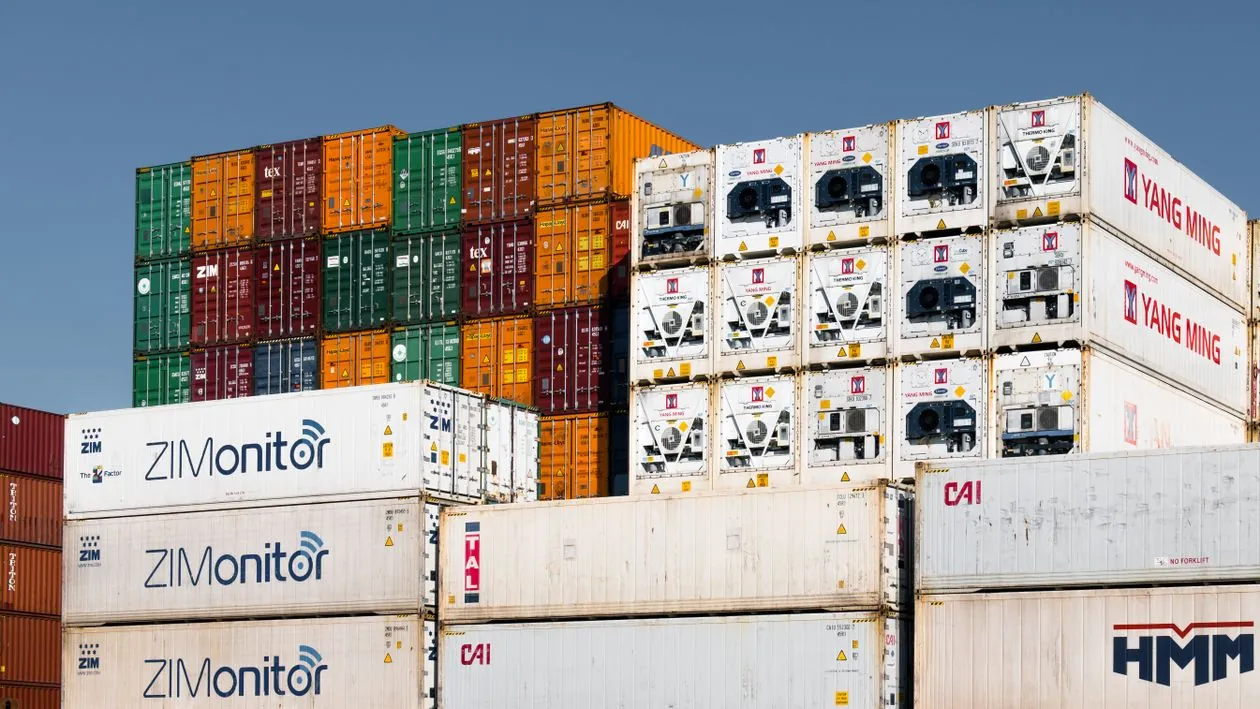
Supplier risk assessment has become a distinct application of predictive analytics in supply chain. ML models analyze supplier performance history, financial health indicators, geopolitical risk scores, and real-time news feeds to produce forward-looking risk scores. These models flag suppliers likely to miss delivery windows or experience financial distress, giving procurement teams weeks of lead time to secure alternative sources.
The output is actionable: a supplier risk score of 0.85 on a 0-1 scale might trigger automatic sourcing diversification for critical components, while a score of 0.4 requires no action. Without ML, these assessments are typically manual, quarterly, and backward-looking, based on past delivery performance that may not predict future disruptions.
Logistics planning benefits from a parallel set of ML techniques. Routing algorithms incorporating real-time traffic, weather forecasts, port congestion data, and fuel cost projections optimize delivery schedules dynamically. Anomaly detection models monitor transportation data streams for unusual patterns, such as a shipment that has not transmitted a GPS signal for six hours, raising alerts before a delay impacts downstream commitments.
The operational impact is measurable. These gains compound: fewer expedited shipments, lower detention and demurrage charges, and reduced carbon emissions from optimized routing.
Accuracy Benchmarks vs Traditional Methods
The accuracy gap between ML-based demand forecasting and traditional statistical methods has been quantified across multiple industry studies. The table below summarizes typical performance ranges.
| Method | Typical MAPE | Key Limitations |
|---|---|---|
| Exponential Smoothing | 18-25% | Assumes stable trend and seasonality; breaks under disruption |
| ARIMA / SARIMA | 15-20% | Requires manual parameter tuning per SKU; linear only |
| Gradient Boosting (XGBoost, LightGBM) | 8-12% | Requires feature engineering; less effective on pure time-series |
| LSTM / Transformer | 5-10% | High data requirements; longer training cycles |
| Hybrid (Statistical + ML) | 6-10% | More complex to maintain; two-model pipeline |
This is a real ROI case that justifies infrastructure investment.
Companies that track this metric systematically are the ones that can quantify ROI of ML adoption.
Implementation Requirements
Deploying predictive analytics for supply chain is not a plug-and-play exercise. The implementation timeline and cost depend heavily on data maturity, team capability, and existing infrastructure.
Data infrastructure. The single largest prerequisite is a unified data repository that combines historical sales, inventory positions, supplier data, and external signals. Organizations with fragmented ERP instances or manual data reconciliation processes should budget 3-6 months for data pipeline construction before any model training begins. As we discussed in Ultimate Guide to AI Build vs.
Team composition. A minimum team includes one data scientist with time-series and ML experience, one supply chain domain expert who can validate model outputs against operational reality, and one data engineer to maintain pipelines. For organizations building in-house, this represents roughly $400,000-600,000 in annual loaded salary costs. The alternative is a managed forecasting platform that bundles ML models with supply chain connectors, which typically costs $100,000-300,000 per year in licensing.
Integration with execution systems. The most accurate forecast is worthless if it cannot trigger a purchase order or adjust a production schedule. API integration with ERP systems (SAP, Oracle, Microsoft Dynamics) and warehouse management systems is non-negotiable. This integration work typically adds 2-4 months to the timeline.
Model maintenance. ML models drift. User behavior changes, new products launch, and supply chains reconfigure. Budget for quarterly retraining cycles and continuous monitoring infrastructure. This is a permanent operational cost, not a project expense.
Typical deployment timelines range from 6 months for a focused pilot (single product category, one distribution center) to 18 months for enterprise-wide rollout across multiple business units and geographies.
Build vs Buy: The Supply Chain Math
The build vs buy decision for supply chain predictive analytics follows the same pattern we analyzed in Ultimate Guide to AI Build vs. Buy Costs, with supply-chain-specific trade-offs.
Buy (SaaS forecasting platforms): Vendors like e2open, Blue Yonder, and Kinaxis offer pre-built demand forecasting and inventory optimization modules. These platforms include connectors to major ERP systems, pre-trained models for common demand patterns, and ongoing model updates. Annual costs range from $100,000 to $500,000 depending on transaction volume and module count. Time to value is 2-4 months. The trade-off is limited customization: you forecast within the vendor’s model architecture, which may not capture your specific demand drivers.
Build (custom ML pipeline): Building in-house gives full control over model architecture, data sources, and feature engineering. First-year costs run $500,000 to $1.5 million including team salaries, infrastructure, and data engineering. Time to value is 6-12 months. The payoff is accuracy: custom models trained on your specific demand patterns consistently outperform generic models by 3-8 percentage points in MAPE. For organizations with $500 million-plus in inventory, that accuracy differential alone justifies the build decision.
This approach balances speed with accuracy and is the most common path for enterprises in 2026.
The organizations that succeed are those that connect forecast outputs directly to procurement, inventory, and logistics execution systems. Without that integration, even the best demand forecast is just a number on a dashboard.
Key Takeaways
- ML demand forecasting models achieve 5-10% MAPE, outperforming traditional methods (15-20%) by a wide margin, with forecast error reductions of up to 40% reported in industry benchmarks.
- Reinforcement learning and LSTM-Q-learning hybrids reduce inventory costs by 18-25% compared to fixed reorder-point policies, while the global AI-driven inventory optimization market is projected to reach $31.9 billion by 2034.
- Implementation timelines range from 6 to 18 months, with data pipeline construction and ERP integration as critical path items. Budget for ongoing model maintenance as a permanent operational cost.
- The hybrid build-buy approach (commercial platform for baseline forecasting plus custom models for high-value SKUs) offers the best risk-adjusted path for most enterprises in 2026.
Related Reading
More in-depth coverage from this blog on closely related topics:
- AI Content Moderation in 2026: Accuracy Benchmarks, Costs, and What Actually Works at Scale
- AI Code Review Tools Boost Developer Productivity and Security
Sources and References
Sources cited while researching and writing this article:
Priya Sharma
Thinks deeply about AI ethics, which some might call ironic. Has benchmarked every model, read every white-paper, and formed opinions about all of them in the time it took you to read this sentence. Passionate about responsible AI, and quietly aware that "responsible" is doing a lot of heavy lifting.