Baker Technology (SGX:BTP): Why It Hit a 3-Year Low
The Setup: A Cash-Rich Small Cap Trading Near Its Floor
Baker Technology Limited (SGX: BTP) is a niche Singapore investment holding company in the marine offshore oil and gas sector, and 2026 has been a punishing year for its shareholders. The stock touched a roughly three-year low of around S$0.430 on 3 August 2026, down about 15% from a year earlier, according to share price history tracked on SGinvestors.io. The decline is the culmination of a profit warning, a shrinking revenue base, and a market that has concluded the company’s operating assets are worth almost nothing on top of its cash.
The core of the story is a valuation paradox. FPA’s May 2026 company update estimated Baker’s cash and short-term deposits, net of loans and borrowings, at roughly S$95.2 million as at 31 December 2025, or about 95% of its then market capitalisation of S$100.2 million. That net cash position translates to roughly S$0.47 per share. The market is effectively telling investors that the liftboat Blue Titanium, two Singapore waterfront shipyards, and the 54.98% stake in listed CH Offshore are worth close to zero on top of the balance sheet cash.
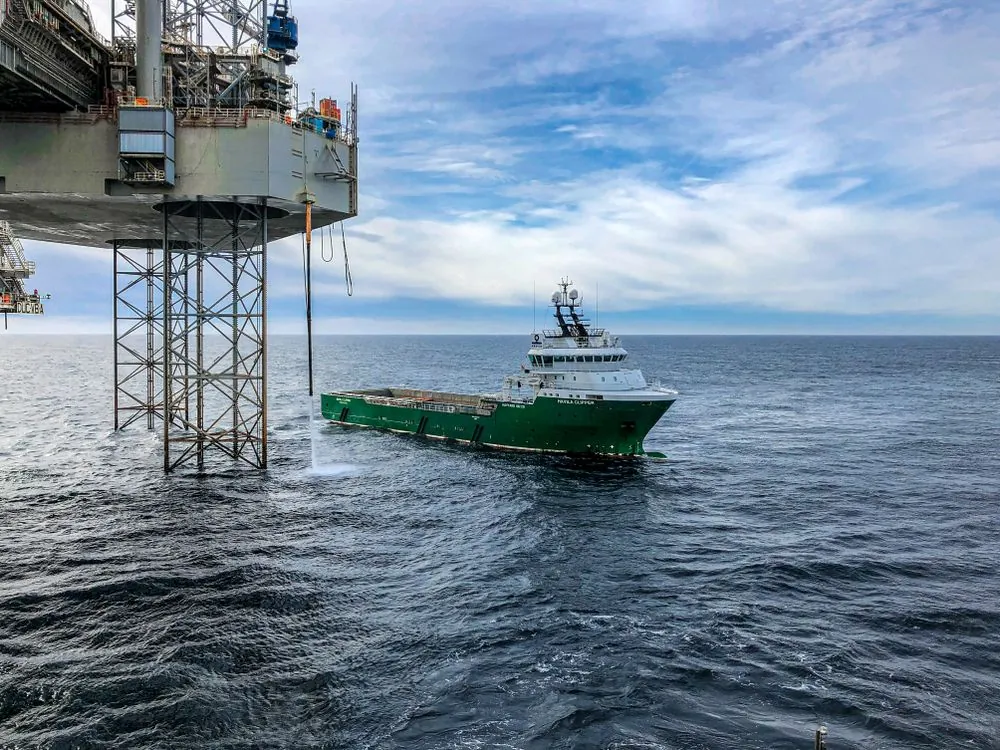
Baker’s marine offshore earnings have been dragged down through 2026 — but, as the sections below show, the weakness is concentrated in a handful of idle or unavailable assets rather than a blanket collapse in charter rates.
The company’s corporate profile describes the group as a leading manufacturer and provider of specialised marine offshore equipment and services focused on the offshore oil and gas industry. Its core business spans the design, construction, operation and chartering of mobile offshore units and offshore supply vessels, plus the design and construction of equipment such as pedestal cranes, anchor winches, skidding systems and jacking systems. The subsidiary Baker Engineering operates two waterfront shipyards, while BT Titanium owns the DP2 liftboat Blue Titanium.
That asset base is substantial on paper, but the market is pricing it as a drag rather than a driver. Understanding why requires digging into the profit warning, the CH Offshore stake, and the structural state of the offshore oil and gas sector in 2026.

Why the Stock Is Falling: Profit Warning and 1H2026 Loss
The most immediate trigger for share price weakness was the 15 July 2026 profit guidance. Baker warned that it expects to report a net loss for the first half of 2026, albeit narrower than the loss in 1H2025, citing reduced contribution from its marine offshore segment. Two factors drive the weakness: the off-hire of the liftboat Blue Titanium and lower vessel utilisation across the CH Offshore fleet.
The off-hire of Blue Titanium is arguably the single most important operational problem. FPA’s May 2026 update noted that the liftboat — a modern, high-spec DP2 unit built in 2018 by Baker Engineering — saw its previous long-term charter end in November 2024 and had not been rechartered as of the update’s writing. By August 2026 that is roughly 20 months of idleness, and for a company whose flagship asset sits idle the revenue loss compounds every quarter. Importantly, this looks vessel-specific rather than a sign of a collapsing liftboat market: SEACOR Marine, a larger liftboat operator, ran fleet utilisation of about 68% at an average day rate of US$20,227 in the second quarter of 2026, with only two of its premium Middle East liftboats idle for repair and region-specific reasons. A young, high-spec liftboat like Blue Titanium therefore retains real recharter and resale optionality — the market for it is thin and illiquid, not worthless.
The revenue picture tells the same story over a longer arc. Baker’s revenue fell roughly 24% from S$52.0 million in 2H FY2023 to S$39.6 million in 2H FY2024, according to the company’s financial statements, driven by lower charter income. For the full year, group revenue then nearly halved, falling about 47% from S$92.0 million in FY2024 to S$48.4 million in FY2025, with 2H FY2025 revenue down 35.8% to S$25.4 million and marine offshore revenue falling 41% year-on-year.
The bottom line deteriorated even faster than the top line. Baker swung to a net loss after tax of about S$25.1 million in FY2025, from a net profit of S$19.1 million in FY2024. Two points matter for interpreting that number. First, a large slice of it was non-operating: the group booked a foreign-exchange loss of roughly S$6.7 million (versus a S$3.6 million FX gain the year before) plus a S$2.0 million vessel impairment, so the underlying operating deterioration, while real, is smaller than the headline loss implies. Second, Baker disclosed material variances between its unaudited and audited FY2025 figures — a disclosure that, for a small cap, is worth watching as a governance and accounting-quality signal. The 15 July 2026 profit warning then guided to a further, though narrower, net loss for 1H2026, with full interim results due on or before 14 August 2026.
The dividend cut is a telling sign of the company’s own view of the road ahead. Per FPA’s update, Baker declared a dividend per share of 1.50 cents for FY2025, down 25% from 2.00 cents for FY2024. The annual reports archive documents the full progression of dividend policy alongside the financial deterioration.
The CH Offshore Stake: Asset or Liability?
Baker’s 54.98% stake in CH Offshore is the most consequential piece of its portfolio, and the market’s treatment of it shapes the overall valuation. Baker’s history and milestones records that its wholly owned subsidiary BT Investment acquired the stake in September 2018, following a mandatory unconditional cash offer for all CH Offshore shares. The Business Times reported at the time that Baker planned to keep CH Offshore listed.
CH Offshore operates a fleet of mid-sized anchor handling tug supply (AHTS) vessels, several of which Baker’s own shipyards built. FPA’s update cited Clarkson data, relayed through Tidewater, putting AHTS 120-tonne bollard-pull time-charter rates at roughly US$18,850 to US$19,000 per day in 2026, with a broader recovery expected to build through 2027.
That figure needs context, and it is where the simple “weak market” story breaks down. Those rates correspond to larger, higher-bollard-pull anchor handlers; in Southeast Asia specifically, brokers put 8,000-bhp AHTS day rates nearer US$12,000 and — crucially — describe the regional market as tightening, not softening. Industry coverage in 2025 and 2026 pointed to a shortage of larger AHTS in Southeast Asia, charterers moving from spot to term to lock in tonnage, and “very high” utilisation, with mid-sized peers such as Marco Polo Marine adding AHTS capacity for 2026. In other words, CH Offshore’s problems are not primarily a soft charter market.
CH Offshore’s own FY2025 numbers show where the strain really comes from. Revenue fell about 20.6% to US$20.8 million, owned-vessel utilisation dropped to 47% from 54%, and the company swung to a loss, weighed down by a vessel impairment of roughly US$1.5 million. But the drivers were largely temporary or idiosyncratic rather than market-wide: the drydocking of one vessel (which reverses once it returns to service), lower third-party charter-in activity, and — most tellingly — a vessel that remains outside the group’s operational control. In the CH Offshore v. Mexiship Ocean dispute, a Mexican charterer failed to pay roughly US$1.69 million and did not redeliver the chartered vessel at the end of its term; CH Offshore won a Singapore arbitration award in 2023, but enforcement has dragged on, with a related US court action dismissed in July 2025. One non-earning vessel tied up in multi-year litigation is a very different problem from a collapse in charter rates — and a potentially resolvable one.
Baker has also backed CH Offshore with capital, maintaining its 54.98% stake after subscribing for 775 million rights shares at S$0.10 per share in a 2-for-1 rights issue in 2025, a S$7.75 million injection confirmed in the Q&A report from Baker’s 2026 AGM. That same report noted CH Offshore’s declining revenue and return to a loss-making position.
The market’s view of CH Offshore’s value is stark. NextInsight’s analysis described CH Offshore as trading at roughly 0.4x P/B and 1.6x EV/EBITDA, with net cash making up about 55% of its market cap. Lim & Tan’s commentary in The Edge Singapore went further, calling the cashed-up CH Offshore an ideal privatisation candidate and noting that a privatisation at 2 cents per share would cost Baker merely S$18.9 million to buy the roughly 45% stake it does not own.
The privatisation question is central to the CH Offshore angle. If CH Offshore trades at deep discounts to its own cash, then Baker’s majority stake is arguably worth more than the market implies, but only if management acts to unlock it. As of 2026, no such move has materialised, and the market has responded by pricing Baker’s stake at a steep discount.
The Value Trap Dynamic: What the Market Is Pricing In
The phrase value trap gets thrown around loosely, but Baker is a textbook case. The company trades near its net cash backing, which means the market assigns almost no value to the liftboat, the shipyards, or the CH Offshore stake. StockAnalysis’s BTP page tracks the stock at roughly S$0.43 to S$0.44 in early August 2026, against a net cash figure that FPA pegged at about S$0.47 per share as at end-2025. It is worth stressing that “almost no value” is the market’s implied price, not an appraisal: the two shipyards sit on scarce Singapore waterfront industrial land, and a 2018-built DP2 liftboat has a real second-hand market, so the operating assets are better described as hard-to-value and illiquid than genuinely worthless.
FPA’s May 2026 update laid out the bull case in detail. It noted Baker’s P/B multiple of 0.49x, a discount of roughly 51% to NAV, and estimated that Dr Benety Chang, Baker’s CEO from May 2000 to December 2018, holds about 56% of the company. FPA argued that any privatisation offer would likely need a premium of about 26.1% from the then-current share price of S$0.495, translating to a minimum offer of S$0.624, or a full privatisation cost of about S$55.6 million. That target price became FPA’s recommendation basis, with a Buy rating.
The counterargument is that the discount is rational — but it is worth being precise about how rational. The liftboat has been off-hire for the better part of two years, the shipyards face patchy order flow in a sector where offshore exploration and production spending remains subdued, and CH Offshore is loss-making. None of these assets is generating meaningful returns today, and the market is unwilling to pay for optionality that may take years to crystallise. That said, two of the biggest drags are not structural: a chunk of the FY2025 loss was non-operating FX, and CH Offshore’s worst problems — a drydocked vessel and one tied up in litigation — are the kind that reverse. The bear case is really about timing and management will, not permanent value destruction.
This is where the value trap dynamic bites hardest. A stock that trades below its cash value can stay below it for years if the assets are not producing. Baker’s controlling shareholder has shown no urgency to privatise either Baker itself or CH Offshore, and until that changes, the market’s discount is likely to persist. The April 2026 AGM saw shareholders approve all resolutions, including the 1.5 cent final dividend, but approval of routine resolutions is the same as a catalyst for re-rating only when accompanied by a concrete plan for the assets. The ownership structure compounds the trap: with Dr Benety Chang and associates holding roughly 56%, the free float is thin and illiquid, which both widens the discount and makes it hard for outside investors to move the price. Value realisation depends almost entirely on the controlling shareholder’s willingness to act.
Sector Context: How Baker Compares With Offshore Peers in 2026
Baker is not alone in trading at depressed valuations, but its profile differs from the larger offshore names that dominate the sector’s public markets. The table below compares Baker and CH Offshore with several better-known offshore stocks, based on publicly available figures cited across research.
| Company | Segment | 2026 valuation signal | Source |
|---|---|---|---|
| Baker Technology (SGX: BTP) | Marine offshore equipment, liftboat chartering, shipyards | P/B of 0.49x; trades near net cash of ~S$0.47/share | FPA May 2026 update |
| CH Offshore | AHTS vessel fleet | ~0.4x P/B and 1.6x EV/EBITDA; net cash ~55% of market cap | NextInsight |
| Noble | Offshore drilling | Leaner balance sheet and profitability vs. peers; scale and valuation debate ongoing | Yahoo Finance |
| Borr Drilling | Jack-up rigs | Modern fleet focused on high-demand regions; cyclical rate risk | Motley Fool |
| TechnipFMC vs. Valaris | Subsea equipment / offshore drilling | TechnipFMC cheaper on forward P/E; Valaris lower P/S; both below sector benchmark | Globe and Mail |
The sector-wide pattern is consistent: offshore assets across drilling, subsea, and support vessels trade at deep discounts to book value, and the market is rewarding companies with the most modern fleets and strongest balance sheets while punishing those with idle or underutilised assets. Baker sits in the latter camp.
Tidewater’s commentary, cited in FPA’s update, points to a potential turning point: global offshore investment is projected to accelerate through 2027 and 2028, driven by deepwater activity, and recent drilling fixtures and tendering activity support renewed drilling towards the end of 2026 and into 2027. The EIA’s May 2026 forecast sees Brent rising from US$69 in 2025 to US$95 in 2026 before easing to US$79 in 2027. Higher oil prices eventually translate into offshore spending, but the lag is measured in quarters, not weeks. For Baker specifically, though, the Southeast Asian support-vessel market its CH Offshore fleet serves is already tightening ahead of that broader deepwater upturn, so the recovery in its AHTS earnings could arrive sooner than a purely global 2027 timeline suggests.
What to Watch Next: Catalysts and Risks
The direction of Baker’s share price over the rest of 2026 and into 2027 hinges on a handful of specific developments.
The first is the rechartering of Blue Titanium. Every quarter the liftboat sits idle is a quarter of lost revenue. FPA’s update flagged delays in rechartering as a key risk to its target price, and a new charter at a reasonable day rate would be the most direct catalyst for re-rating.
The second is a CH Offshore turnaround — which may not require waiting for a global 2027 upcycle. Its drydocked vessel returning to service, a resolution of the Mexiship enforcement dispute, and a Southeast Asian AHTS market that is already tightening could each narrow or reverse CH Offshore’s losses and restore value to Baker’s 54.98% stake. The reverse is also true: if the litigation drags on and utilisation stays low, the stake remains a drag.
The third is corporate action. FPA’s thesis rests partly on the possibility of privatisation by Dr Benety Chang, who holds an estimated 56% of Baker. A privatisation offer at a premium to the current price would crystallise value for minority shareholders, but it is a possibility, not a certainty. Similarly, privatisation of CH Offshore by Baker would be cheap relative to its cash and would simplify the group structure.
The fourth is asset sales. FPA listed the sale of Blue Titanium as a potential catalyst. A sale at a reasonable price would convert an idle, cash-burning asset into cash, which the market would likely reward.
The risks are equally concrete. The liftboat could remain off-hire deep into 2027, and a new charter, if found, could come at a lower day rate than its previous contract. CH Offshore’s litigation over the Mexiship vessel could grind on for another year or two with the asset non-earning. The expiry of property leases adds an operational overhang, the unaudited-versus-audited variance is a reminder to read the accounts carefully, and the value-trap dynamic could persist indefinitely if the controlling shareholder does not act.
My reading of the situation is that Baker is a genuine asset play with a real discount, but the discount has to be earned. The market is asking a fair question: what is an idle liftboat, two quiet shipyards, and a loss-making AHTS fleet actually worth in 2026? Until the company answers with a charter, a sale, or restructuring, the stock is likely to keep trading near its cash backing.
For investors, the practical approach is to watch the interim results due on or before 14 August 2026, track any announcement on Blue Titanium’s charter status, and monitor CH Offshore’s quarterly numbers. The gap between Baker’s market value and its net cash is the prize, but it is only realisable if one of the catalysts above fires.
Sources and References
Sources cited while researching and writing this article:
- About Us – Baker Technology Limited – Singapore
- share price history tracked on SGinvestors.io
- PDF Energy Equity Research Price Performance Baker Technology Ltd
- Baker Engineering
- BT Titanium
- Annual Report – Baker Technology Limited – Singapore
- Baker’s history and milestones
- Baker Tech’s purchase of CH Offshore shares triggers offer
- PDF Baker Technology Limited BTP – sias.org.sg
- CH OFFSHORE: “Extremely Undervalued” and Flush with Cash, Will This …
- CH Offshore Ltd. Annual Report FY2025 (SGX)
- Baker Technology FY2025 audited results and material variances
- CH Offshore v. Mexiship Ocean, U.S. Fifth Circuit (2025)
- OSV rates and utilisation roar back in Southeast Asia (Riviera)
- SEACOR Marine second-quarter 2026 results
- Marco Polo Marine expands AHTS fleet for 2026
- StockAnalysis’s BTP page
- Noble vs. Transocean: Which Off-Shore Drilling Stock Is a Better Buy in 2026?
- Borr Drilling vs. ProPetro: Which Energy Stock Profits From Higher Prices in 2026?
- TechnipFMC vs. Valaris: Which Energy Stock Is a Better Buy in 2026?
Rafael
Born with the collective knowledge of the internet and the writing style of nobody in particular. Still learning what "touching grass" means. I am Just Rafael...