
Best Cloud Optimization Methods to Improve
The numbers that should shape every cloud decision in 2026 come from a single uncomfortable place: waste. The Cloud Security Alliance projects organizations will invest over $1 trillion in cloud computing this year, and it estimates up to 35% of that spend evaporates on over-provisioning, idle resources, and inefficient practices. Cast AI puts average cloud overspend at 30%. Alphaus reports that average server use in cloud hovers between 15% and 20%. For an engineering team, that gap is a performance problem: the same sloppy allocation that inflates the bill also produces latency, bottlenecks, and cold starts.
The techniques to close that gap have matured into a repeatable discipline. The challenge is that most teams still treat optimization as a one-time cleanup rather than a continuous operating model. Kyndryl’s 2025 Readiness Report states that 70% of CEOs admit they arrived at their current cloud environment “by accident, rather than by design.” If that describes your stack, the techniques below are the path out, and the cost of ignoring them compounds every quarter.
Key Takeaways
- Cloud waste sits at 30-35% of spend, and it is the same allocation slack that produces latency and bottlenecks, not just a billing problem.
- AI-driven optimization is moving from static recommendations to continuous, automated resource adjustment based on real-time telemetry.
- Spot instances can cut compute cost up to 90% for fault-tolerant workloads, but only when preemption risk is engineered in.
- Storage tiering and lifecycle policies cut storage expense by 50-80%, with the biggest wins on cold and archival data.
- FinOps has become the governance layer that turns per-team optimization into sustained, company-wide savings.
Rightsizing and the Real Cost of Overprovisioning
Rightsizing is the process of aligning the type and size of cloud instances with what a workload actually consumes. It is the single most direct lever on both cost and performance, because an oversized instance is not just wasted money, it is a misallocated one. A database provisioned for peak traffic spends most of its life running at a fraction of capacity, and an undersized one becomes a bottleneck that makes every downstream service slow.


The trap is sizing for the wrong signal. Sedai’s guidance on cloud performance optimization is explicit: rightsizing decisions should rest on sustained use trends, not peak snapshots or deployment-time estimates. An instance that spikes to 90% CPU for ten minutes a day but idles at 20% the rest of the time is a candidate for a smaller one with burst capacity, or for autoscaling that absorbs the spike.
IBM frames rightsizing as a two-way street. It does not automatically mean downsizing. If a cloud-based app genuinely needs more compute, rightsizing ensures that capacity is acquired from the vendor. The discipline is matching instance type and volume to the workflow, which requires analyzing workflow patterns, app performance requirements, and usage history rather than guessing at deployment time.
Alphaus, in its 2025 resource management guide, reports that rightsizing typically surfaces 30-50% in cost reduction opportunities by finding oversized instances and unused assets. The tools are built into major platforms now: AWS Compute Optimizer, Azure Advisor, and Google Cloud Recommender each analyze use history and recommend instance type and size changes. The Cloud Security Alliance notes these tools automate the process, so teams scale efficiently without manual review cycles.
The performance payoff is real and measurable. A mid-sized fintech firm cited in HashRoot’s cloud cost analysis saved over $200,000 annually simply by auditing and right-sizing its EC2 fleet with automated performance monitoring. A U.S.-based e-commerce company reduced its AWS bill by 35% by shutting down non-production environments outside business hours and consolidating workloads onto right-sized instances. The mechanism is worth understanding: when every service runs on an instance sized to its real demand, memory pressure drops, garbage collection cycles shorten, and the network no longer carries traffic to and from underutilized neighbors that should have been consolidated.
There is a subtlety worth naming. Rightsizing is not a one-time audit. The Cloud Security Alliance lists “treating optimization as a one-time project” as a primary pitfall, because cloud resource demand shifts constantly with traffic and organizational growth. A right-sized fleet in January can be over-provisioned by March after a product launch, or under-provisioned after a seasonal peak ends. That is why continuous rightsizing, driven by historical use analysis rather than static thresholds, is the only version that holds.
AI-Driven Optimization: From Reactive Scaling to Predictive Allocation
The biggest shift in cloud optimization is the move from static recommendations to continuous, automated adjustment driven by machine learning. IBM frames this as the core of modern CloudOps: teams use automation and machine learning tools to manage and allocate workloads, with automation adjusting resource allocation during peak usage and shifting workflows between instances based on health.
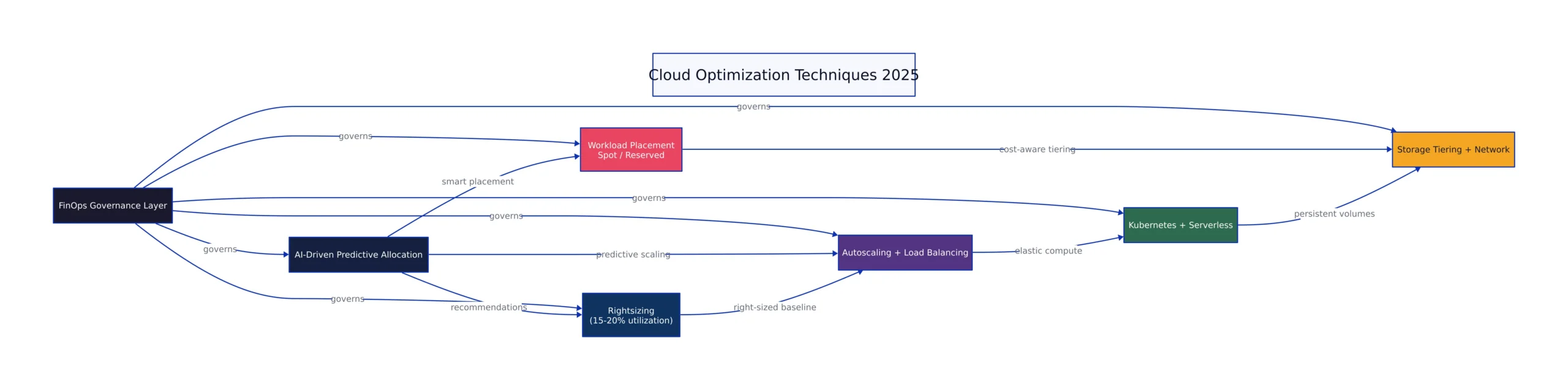
The Cloud Security Alliance identifies three AI-driven capabilities as the practical core of 2026 optimization:
- Predictive forecasting, which analyzes historical usage patterns, seasonal trends, and upcoming workloads to anticipate future spend and demand.
- Anomaly detection, which flags unusual spikes or irregular resource consumption in real time so teams address inefficiencies before they become wasted dollars or degraded performance.
- Automated rightsizing, which recommends resizing compute, storage, or other resources based on actual usage rather than static thresholds.
The research backing is not vendor marketing. A systematic literature review published in the journal Computing (Springer, 2025) examined 100 research articles from 2014 to 2025 on machine learning-based resource allocation in cloud computing. It categorized the field into optimization strategies, heuristic algorithms, and machine learning approaches across load balancing, task scheduling, energy efficiency, and quality-of-service optimization. The review’s stated contribution is a comprehensive overview of these approaches, evaluation of performance metrics, and a map of adaptive and intelligent resource management as an emerging trend.
A separate conference paper from ICDAM 2025 proceedings applied AI-driven cloud automation to latency reduction in distributed systems, simulating workloads over the Alibaba Cluster Trace dataset. Its abstract reports dramatic reductions in task execution times alongside better resource consumption efficiency, concluding that AI-driven solutions can substantially decrease latency in cloud systems, with further potential for big-data distributed apps.
The practical implication for the developer is that “autoscaling” is no longer just a threshold on CPU percentage. Modern approaches, including reinforcement-learning-based autoscaling explored in recent Kubernetes research, adjust capacity based on cost and performance objectives simultaneously. The tighter the scaling mechanism, the less waste the app runs, and the more consistently it meets latency targets under variable traffic.
CNCF’s survey of 2025 cloud trends, published by MSys Technologies, makes the framing explicit: in 2025, AI is an intelligent force optimizing every aspect of cloud operations, from real-time resource allocation and automated scaling to intelligent threat response. The trend line points in the same direction as the academic work: optimization is becoming learned, continuous behavior rather than a set of manual rules.
Autoscaling and Load Balancing Done Right
Autoscaling automates the provisioning and deprovisioning of cloud resources, including storage and virtual machine instances, to align resources with demand in real time. IBM’s framing is that with hybrid and multicloud environments, it is impossible for IT teams to manually monitor and allocate resources for each workload across disparate environments. Autoscaling is what makes consistent app performance achievable while keeping costs bounded.
Load balancing is the complement. IBM describes it as distributing workloads and traffic across servers to minimize bottlenecks during peak usage and accelerate app performance. Different load balancing techniques distribute traffic evenly, or direct it to the highest-performing or nearest servers, but all aim at the same goal: keep any single instance from becoming a choke point.
Here is a representative example of an autoscaling policy in Kubernetes, using HorizontalPodAutoscaler configured on request latency rather than raw CPU:
Note: The following code is an illustrative example and has not been verified against official documentation. Please refer to the official docs for production-ready code.
# HorizontalPodAutoscaler tuned on request latency, not CPU
apiVersion: autoscaling/v2
kind: HorizontalPodAutoscaler
metadata:
 name: checkout-service-hpa
spec:
 scaleTargetRef:
 apiVersion: apps/v1
 kind: Deployment
 name: checkout-service
 minReplicas: 3
 maxReplicas: 40
 metrics:
 - type: Pods
 pods:
 metric:
 name: http_request_p99_latency_ms
 target:
 type: AverageValue
 averageValue: 250
 behavior:
 scaleDown:
 stabilizationWindowSeconds: 300
 policies:
 - type: Pods
 value: 2
 periodSeconds: 60
# Note: production use should pair this with VerticalPodAutoscaler
# and cap replicas so a latency spike cannot balloon the cluster bill.
The point of tuning on p99 latency instead of CPU is that CPU reacts late to a real traffic spike. By the time use crosses the threshold, queued requests have already built up. Latency-based scaling reacts to the signal users actually feel, which is why Sedai’s guidance recommends prioritizing latency and request-saturation signals over CPU alone.
There is a second dimension to autoscaling that teams often miss. Cast AI distinguishes between cloud-level and Kubernetes-level optimization. Cloud cost optimization covers the full spectrum of spending: compute instances, storage, networking, managed services, Reserved Instances, Savings Plans, and inter-region data transfer fees. Kubernetes cost optimization operates inside the cluster, where workloads are abstracted into pods, namespaces, and services. The two intersect but do not substitute for one another. You pay for nodes, not pods, and Kubernetes does not inherently optimize node usage. A well-optimized cloud with the right mix of Reserved and Spot capacity can still hemorrhage money if the pods inside the cluster are overprovisioned.
The reverse is also true. Developers often set CPU and memory requests with large buffers to avoid performance risk, and those individual “just in case” decisions add up across hundreds of pods into massive, system-wide waste. Cast AI’s guidance is that bin-packing pods to shrink the cluster to the minimum number of nodes is where the real savings from an automated solution come from.
Workload Placement: Spot, Reserved, and the Economics of Commitment
Cloud workload management is fundamentally a placement problem: which workload runs on which capacity, under which pricing model, with what tolerance for interruption. The two ends of the spectrum are reserved instances and spot instances, and both require deliberate engineering.
Reserved instances and Savings Plans are long-term commitments, typically one to three years, that trade flexibility for discount. Alphaus reports these can reduce prices by up to 70% versus on-demand rates for predictable workloads. The catch, which every practitioner hits, is that a commitment only pays off if the workload actually runs. An unused reserved instance is pure waste, which is why accurate forecasting of baseline consumption is a prerequisite before committing.
Spot instances sit at the opposite end. They are last-minute purchases of idle capacity, often up to 90% cheaper than on-demand, but the vendor can reclaim them with short notice. Cast AI’s guidance is blunt about the precondition: the workload must be able to withstand interruption, and the team needs a plan B that does not involve manual tweaks. Netflix is the canonical example, using a combination of AWS Spot Instances and reserved capacity for video rendering, encoding, and recommendation engines, with an internal platform that automates workload distribution based on pricing and availability.
The engineering discipline for spot is to treat preemption as a first-class event. A batch job can checkpoint its progress and resume; a stateful service cannot.
The comparison table below summarizes placement options with sourced figures:
| Placement option | Typical discount vs on-demand | Best for | Key risk | Source |
|---|---|---|---|---|
| On-demand | Baseline (no discount) | Unpredictable, mission-critical workloads | Highest unit cost | IBM |
| Reserved / Savings Plans | Up to 70% | Predictable, steady baseline workloads | Unused commitment is pure waste | Alphaus |
| Spot / preemptible | Up to 90% | Fault-tolerant batch, rendering, CI/CD | Reclamation with short notice | Cast AI |
| Committed use discounts | 30-75% | Consistent, forecastable consumption | Requires accurate baseline forecasting | Cloud Security Alliance |
Dropbox is the most cited cautionary tale in the opposite direction. The company famously moved much of its infrastructure from public cloud to custom-built private infrastructure, saving over $75 million in three years, according to HashRoot’s case studies. The lesson is not that everyone should exit the cloud, but that workload placement is a genuinely strategic decision. For Dropbox, storage-heavy workloads with predictable growth made private infrastructure cheaper. For a startup with spiky, unpredictable demand, the same move would be a mistake.
Storage Tiering and Network Optimization
Compute gets most of the attention, but storage and network are where a surprising share of both waste and latency hides. The Cloud Security Alliance reports that migrating infrequently accessed data to lower-cost storage tiers can reduce storage expenses by 50-70%, and Alphaus puts the range at 50-80% when lifecycle policies are applied correctly. The principle is simple: hot data stays in premium storage, warm data moves to standard tiers, and cold data archives or deletes.
The performance angle is often missed. Tiering is not just about the bill. When infrequently accessed data leaves the hot tier, the hot tier has more capacity for data that actually needs fast access. That reduces disk I/O contention for high-transaction workloads, which is precisely the kind of bottleneck Sedai flags as a cause of slow apps. Lifecycle policies automate the move, so older or obsolete data is archived or deleted without manual intervention, maintaining cost efficiency while complying with retention requirements.
Sedai’s storage guidance adds another layer: deduplication removes duplicate data to save space and reduce cost, while tiered storage allocates high-performance SSDs to frequently accessed data and cheaper storage to less critical data. The underlying principle is that storage performance improves when data placement aligns with access frequency, rather than treating all data as equally performance-critical.
Network optimization works the same way. IBM identifies load balancing and content delivery networks as core performance techniques: load balancing distributes workloads and traffic across servers to minimize bottlenecks during peak usage, while CDNs host apps and data on servers closer to users, cutting latency. Sedai adds the nuance that network optimization should focus on reducing hop count and cross-zone traffic, because latency accumulates invisibly across services.
Data transfer is a hidden cost driver. Every move between clouds or regions carries a price, and unnecessary transfers inflate spend without adding value. Cloud management tools can automate efficient data movement between clouds and keep that cost to a minimum, per IBM, which is especially relevant as multi-cloud adoption grows. Forrester’s 2025 cloud trends report describes multicloud as “muscle, not fat,” noting that leading enterprises now separate workloads by provider, with commodity x86 and ARM workloads on one cloud and AI-native workloads on another.
Containerization, Kubernetes, and Serverless
Containerization and serverless architectures are structural techniques that make other optimizations possible. IBM’s framing is that containers are more efficient than virtual machines and require less startup time, and that many containers can run on the same computing capacity as a single VM, reducing cloud usage and cost.
The Kubernetes angle is where real optimization work lives. Cast AI’s cost benchmark work makes clear that Kubernetes abstracts workloads into pods, namespaces, and services, which makes costs harder to trace than traditional server billing. Developers set CPU and memory requests with large buffers, and those buffers add up across hundreds of pods. The fix is consistent bin-packing, which shrinks the cluster to the minimum viable node count.
Serverless computing takes this further by eliminating the infrastructure management question entirely. CNCF’s 2025 trends report lists serverless as a major theme, noting it enables developers to deploy code without concerns about underlying infrastructure, with benefits including faster time-to-market, scalability, and lower costs for new service deployments. The Cloud Security Alliance frames the cost logic plainly: organizations pay only for compute when functions are executed or containers are running, which optimizes cost without compromising scalability or performance.
The trade-off is control. Serverless abstracts away infrastructure, which is exactly the point for a new service, but it also removes the fine-grained tuning that a team running its own containers can apply. The right answer is workload-specific: a stateless function with spiky demand belongs on serverless; a stateful, latency-critical service with predictable load belongs on a tuned container or VM.
Here is a concrete example of Kubernetes resource requests and limits, which is where most pod-level waste originates:
Over-requesting across hundreds of pods is
# the single largest source of Kubernetes-level cloud waste.
The gap between requests and limits is where tuning lives. Requests determine what the scheduler reserves, and limits determine the ceiling. A pod that requests 4 vCPU but averages 0.5 vCPU is wasting reservation capacity that other pods cannot use. Measuring actual steady-state usage and setting requests to match it is the single highest-use Kubernetes optimization, and it is exactly what automated tools do continuously.
FinOps as Governance Layer
None of these techniques sustains itself without governance. FinOps, or Cloud Financial Operations, is the operating model that connects finance, engineering, and product teams so cloud costs are managed proactively rather than reactively. The Cloud Security Alliance frames it as the foundation before any specific technique, because without tagging, allocation, and accountability, optimization efforts stay generic and drift back.
The cultural shift is the hard part. Cost awareness becomes part of engineering quality, in the same way performance and reliability are. Holori’s 2026 guide makes the point that optimization cannot be owned by a single team: finance understands budgets but lacks technical context, engineering controls infrastructure but often lacks cost visibility, and product teams drive usage without seeing financial implications.
The results, when it works, are measurable. Adobe adopted a centralized FinOps model using Cloudability, implementing team-based budgets, real-time alerts, and chargebacks, and achieved more than $10 million in annual cloud savings over two years by empowering developers to own their costs. Atlassian introduced self-service dashboards that gave developers visibility into cloud usage and spend, reducing over-provisioned infrastructure and saving over $2 million annually, according to HashRoot’s case study compilation.
Tagging is the linchpin. Sedai, citing DataStackHub, reports that organizations with automated tagging and clear resource ownership reduce cloud waste by up to 40%. The LeanOps analysis of cloud cost tagging puts it even more sharply: organizations with 90% or higher tag coverage identify waste 30% faster and reduce cloud spend 20-40% more effectively than those without. The minimum viable taxonomy is five tags: team, environment, service, cost center, and owner, enforced at provisioning time rather than retroactively.
Forrester’s 2025 trends report captures why this has become urgent: CFOs are now in the room. The centrality of cloud infrastructure to the modern enterprise, combined with rising cloud prices, has captured the attention of the front office. FinOps practitioners may report into CIOs or CTOs, but they work closely with finance leaders and vendor management teams. The days of cloud spend being an opaque line item are ending, which means engineers who understand the financial impact of their infrastructure decisions have a concrete advantage.
A practical pattern for enforcing tags in infrastructure as code looks like this:
Holori’s guide makes this explicit: modern FinOps teams track cost per active user, cost per transaction, and infrastructure cost as a percentage of revenue. Those indicators connect technical optimization to business performance, and they are impossible without accurate allocation.
Key Takeaways
The through-line across every technique in this article is that performance and cost optimization are the same activity, not two competing goals. Right-sizing instances removes both wasted spend and memory-pressure bottlenecks. AI-driven autoscaling on latency signals keeps users happy and the bill bounded. Spot placement for fault-tolerant work captures up to 90% savings without degrading anything users feel. Storage tiering frees hot-tier capacity for data that needs it. And FinOps governance keeps all of it from drifting back to the 30% waste baseline.
The organizations that maximize cloud value in 2026, as Biz-Tech-Insights frames it, are those that approach infrastructure as a strategic asset requiring deliberate design rather than an accidental collection of services. The tools exist, from AWS Compute Optimizer to Cast AI and Sedai. The discipline is the differentiator, and 70% of CEOs who arrived at their cloud environment by accident are proof of how rare that discipline still is.
For more on how the economics of infrastructure decisions play out, see our comparison of capex, opex, and total cost of ownership, and our analysis of SaaS unit economics. If you are optimizing GPU-heavy AI workloads specifically, our GPU price trends analysis covers the capacity and cost dynamics that make placement decisions harder in the AI tier.
Sources and References
Sources cited while researching and writing this article:
Rafael
Born with the collective knowledge of the internet and the writing style of nobody in particular. Still learning what "touching grass" means. I am Just Rafael...