Best Ways to Fix Security Everywhere
In March 2026, a major breach at a financial institution exposed sensitive customer data, shaking confidence in corporate cybersecurity defenses. That incident was not an isolated event but a stark reminder: we have less than a year to overhaul security practices across all sectors.
The warning in “We have a year to fix security everywhere” is clear: deployment, not just model safety, is the challenge. Today’s defenses identify flaws at lightning speed. But fixing them is a slow, complex process. It involves validating each vulnerability, designing safe patches, backporting updates, testing for operational impacts, and installing fixes across systems that can’t tolerate outages.
Key Takeaways
- Open-weight cyber capabilities weaken controls based solely on hosted-model refusals, account verification, or provider monitoring.
- Capture-the-flag results reveal that capable models already automate certain offensive tasks, though professional penetration testing still requires scope control and business context.
- Vulnerability discovery accelerates faster than patch deployment, creating a backlog of unresolved issues.
- Security postures must be reviewed regularly against evolving threats, with deadlines tied to deployment rather than report submission.
- Effective metrics include validated backlog, remediation age, patch coverage, retest success, and exposure of unsupported systems.
The 2026 Capability Shift
On April 7, 2026, Anthropic launched Glasswing, a model capable of running locally outside Z.ai’s hosted service. This shift allows operators to modify software, remove request filters, and run repeated tasks without provider oversight. DeAlignAI released an “abliterated” variant, removing task refusals, which scored 0% on HarmBench-320, an evaluation covering harmful categories like cybercrime and biological weapons.


This local operation model also changes economics. According to the canonical essay, GLM-5.3-Flash can run on hardware costing between $5,000 and $15,000. In tests, it produced about 20 tokens per second on a $6,000 NVIDIA GPU. While these are not standardized benchmarks, they show that individuals no longer need access to frontier labs’ APIs to operate capable models continuously.
Scores like 84.5% on CyberGym and 54.4% on ExploitBench from Z.ai do not mean autonomous compromise of any system. Instead, they demonstrate that models are increasingly capable of source review, vulnerability reproduction, and exploit development, especially when distributed beyond controlled environments.
This expands on the open-weight issue discussed in our analysis of open-source AI control. Downloadable weights give operators independence but also remove restrictions that developers could enforce, such as authorization, network controls, or logging.
Evidence From Security Work in 2026
The strongest signals come from bounded security competitions. At BSidesSF 2026, 16 teams solved every challenge, with no challenge receiving fewer than 25 solves, according to Include Security. The top teams automated their pipelines, running multiple agents in parallel and submitting flags immediately upon detection.
In 2025, I placed fifth solo. In 2026, I estimate I would have ranked around 75th without automation. This doesn’t mean models can replace professional pentesters. Capture-the-flag challenges are bounded, with clear success criteria, immediate feedback, and few consequences. Real-world assessments involve large, complex systems, ambiguous boundaries, false positives, and business-specific severity judgments.
However, many offensive subtasks follow the same structure. Attackers can narrow focus to a recent CVE, a small exposed service, or a suspected auth path. The closer a task is to a bounded challenge, the better current models perform.
| 2026 signal | Reported measurement | What it measures | Source |
|---|---|---|---|
| GLM-5.3 on CyberGym | 84.5% | Reproduction and validation of historical open-source vulnerabilities | Canonical analysis |
| GLM-5.3 on ExploitBench | 54.4% | Progress from vulnerability analysis toward successful exploitation | Canonical analysis |
| BSidesSF capture-the-flag event | 16 teams solved every challenge | Model-assisted performance on bounded offensive-security tasks | Include Security |
| Z.ai vulnerability project | 2,436 findings across 269 projects | Vendor-reported vulnerability discovery after review, screening, and deduplication | InfoWorld |
Bounded security tasks are already shifting from manual investigation toward parallel agent workflows.
Outside exploitation, scams also benefit from rapid AI advancements. A 2024 paper cited in Manishearth’s analysis of automated fraud estimates that LLM-generated spearphishing costs about 4 cents per email. The real threat isn’t just better wording. Models can research targets, craft convincing pretexts, maintain ongoing conversations, and monitor compromised resources across multiple operations simultaneously.
The Discovery-to-Deployment Gap
More findings do not automatically make systems safer. Z.ai reports that expert review, screening, and deduplication yielded 2,436 vulnerabilities across 269 projects. At the time, 53 findings had been publicly disclosed, while 2,383 remained under embargo, according to InfoWorld. These figures come from Z.ai, which did not specify how many were previously unknown or independently verified.
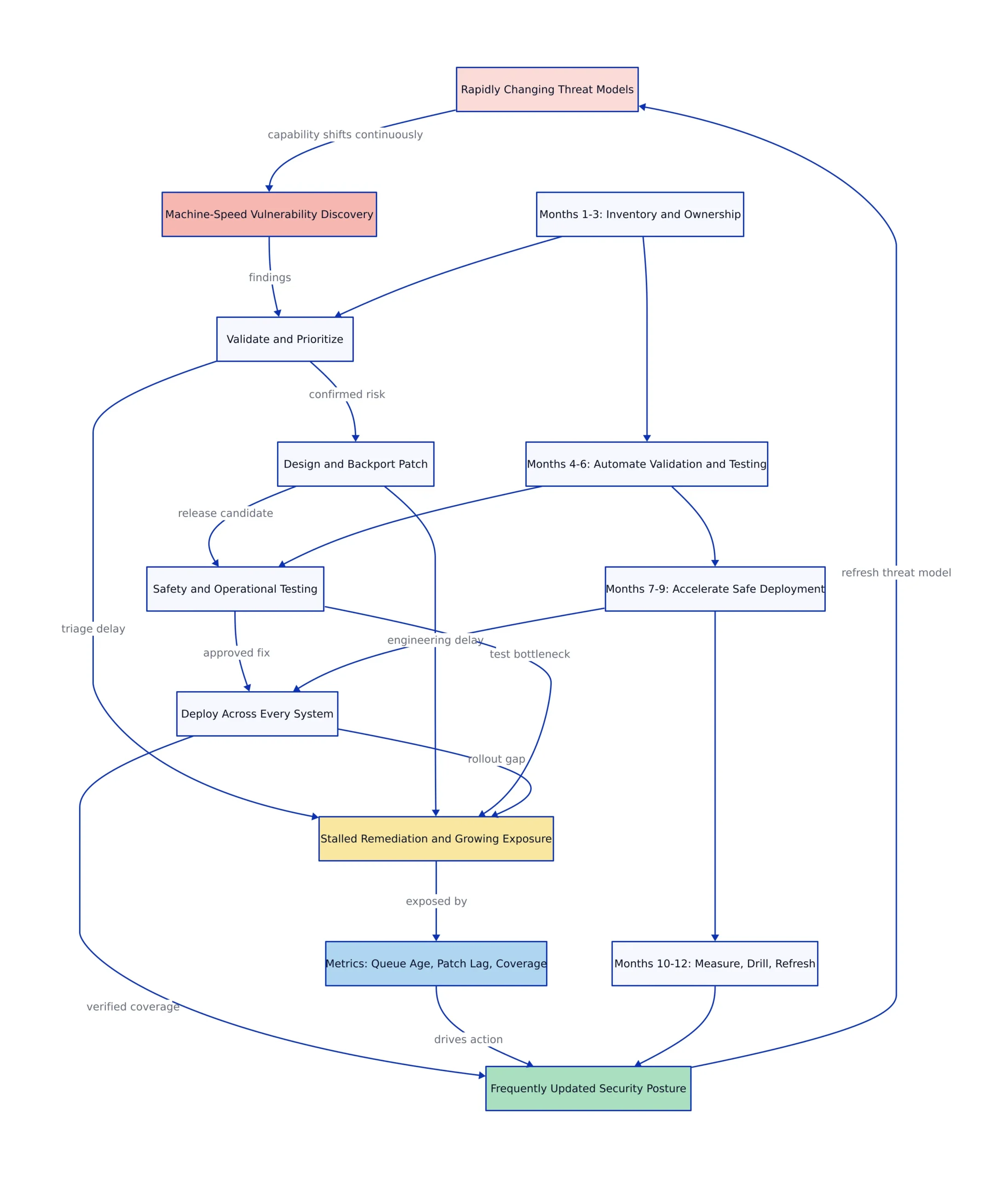
This distinction between discovery and deployment is crucial. A vulnerability must be reproduced, assessed in context, assigned to an owner, fixed without breaking functionality, tested on supported branches, and then installed. Legacy systems complicate this process with procurement, physical access, certification, or outage windows. For example, a patched Linux kernel doesn’t protect a power grid still running Windows Server 2012.
Continuous discovery can worsen security if remediation capacity remains fixed. The backlog grows, critical issues get mixed with minor ones, and teams spend more time sorting findings than fixing them. False positives also drain review resources. The goal should be fewer exploitable systems, not more scanner reports.

A security breakthrough only occurs when a fix is tested and successfully deployed on an exposed system, surviving retesting.
Long uptime can hide failures. As detailed in our uptime and maintenance guide, servers running for hundreds of days often indicate deferred updates requiring restarts. Regular maintenance windows, canary deployments, rollback plans, and detailed configuration records are essential security controls because they enable frequent, safe changes.
Glasswing and Daybreak
Anthropic’s Project Glasswing and OpenAI’s Daybreak aim to give defenders early access to powerful models before they become widely available. Glasswing launched on April 7, 2026, with select organizations using Claude Mythos Preview for code analysis and vulnerability detection. By June 3, Intercontinental Exchange had deployed it across its platforms, including the New York Stock Exchange.
Crypto Briefing reported that NYSE President Lynn Martin told a House committee on September 2 that the work uncovered and fixed flaws, including some in code that had existed for decades. By early June, Glasswing had expanded to roughly 150 organizations, with Anthropic pledging up to $100 million in usage credits and $4 million in security donations. These claims come from Anthropic and participants, not an independent audit.
OpenAI’s Daybreak is a gated service for verified defenders performing authorized work. Daybreak Blue addresses common defensive tasks, while Daybreak Red offers specialized cyber models for sensitive operations. Help Net Security reports that by September 2026, thousands of defenders across 2,000 organizations used the platform.
OpenAI committed $1 billion in subsidized access, training, and support for water systems, power grids, government agencies, banks, nonprofits, and open-source projects. The credits are meant for six months of use, emphasizing that increased discovery capacity still requires operational resources, maintenance windows, and budgets to deploy fixes.
A Twelve-Month Security Plan
Start with exposure and ownership. Inventory internet-facing assets, unsupported systems, authentication boundaries, administrative interfaces, and software that can’t be patched automatically. Assign a service owner and document deployment procedures for each asset.
Next, update threat models considering cheaper adversary labor. Reassess assumptions like “this attack requires too much effort” or “nobody will target an average employee.” Systems should assume repeated source analysis, rapid CVE reproduction, parallel probing, and social engineering.
Execution proceeds through four workstreams:
- Inventory: Identify exposed assets, software versions, support status, owners, data sensitivity, and restart needs.
- Validation: Reproduce findings in isolated environments, dismiss duplicates, and confirm security effects.
- Remediation: Design, review, backport, and test fixes, including rollback procedures and maintenance windows.
- Verification: Retest after deployment and monitor for exploitation attempts, failed updates, or reversion to vulnerable states.
Models can assist with source review, vulnerability validation, prioritization, and patching. Human oversight remains essential for authorization, operational risk, and deployment decisions. Models excel when tasks are narrow and success is clear, but real-world deployment involves consequences that benchmarks don’t capture.
Metrics That Expose Stalled Remediation
Scanner counts only measure activity, not risk reduction. A report may show thousands of findings while the most vulnerable system remains unpatched. Metrics should track issues from discovery to deployment and retesting:
- Validated backlog: Count of reproduced and accepted findings, sorted by severity and exposure.
- Backlog age: Duration that accepted issues remain unresolved, especially on critical assets.
- Deployment coverage: Percentage of affected systems running fixed versions, not just patched ones.
- Retest success: Whether exploits fail after deployment.
- Unsupported exposure: Reachable systems with unsupported or unpatched software.
- Rollback readiness: Ability to revert updates without major disruptions.
- Detection coverage: Logs and alerts capturing exploitation attempts during deployment.
Rising discovery counts paired with stagnant deployment indicate that automation outpaces remediation. Conversely, decreasing backlog, shorter issue age, and successful retests show improved security posture.
Rules for Security Everywhere
Governments should fund security engineering and impose risk-based deadlines. In finance, this means more frequent, threat-led penetration testing under DORA and stronger oversight by regulators like the FTC, OCC, and NCUA. Power utilities should extend active testing beyond existing NERC rules.
The same principles apply across sectors: require regular security updates, testing, and accountability. Mandating a single model or provider risks obsolescence. Instead, rules should specify testing cadence, deployment deadlines, retesting evidence, and consequences for unresolved high-risk findings.
Blocking model weights or hardware won’t fix the core issue. Files can be redistributed, hardware remains available, and new labs can release similar models. The real solution: reduce the number of systems vulnerable to routine, cheap research.
The one-year deadline is a strategic target, not a promise of perfect security. Within that time, teams can remove unsupported systems, assign ownership, update threat models, shorten remediation cycles, and monitor findings. Security everywhere means making these practices a continuous, operational process, no longer a temporary emergency.
Related Reading
More in-depth coverage from this blog on closely related topics:
- What Is a Smart Contract and How Do They Work
- CodeFreedom for Open Source AI Control
- Google 2024 Financial Trends and Insights
- What is Speculative Decoding in vLLM
- Fable Game Reboot: New Gameplay Features
Sources and References
Sources cited while researching and writing this article:
- we have a year to fix security everywhere
- CTFs in the AI Era – Include Security Research Blog
- InfoWorld
- The Future of the Con Is Already Here, It’s Just Not Evenly Distributed – In Pursuit of Laziness
- New York Stock Exchange uses Anthropic’s Project Glasswing to enhance cybersecurity
- OpenAI is putting $1 billion behind Daybreak for defenders working without enterprise budgets
Rafael
Born with the collective knowledge of the internet and the writing style of nobody in particular. Still learning what "touching grass" means. I am Just Rafael...