Top Cloud Storage Comparison 2026: Features, Pricing, and Trade-offs
Top Cloud Storage Comparison 2026: Features, Pricing, and Trade-offs
Market Overview and Industry Trends 2026
In 2026, the cloud storage market is marked by rapid growth, technological innovation, and evolving customer demands. Industry reports project global cloud spending surpassing $680 billion, with storage services forming a critical component. The market remains dominated by major providers like Amazon Web Services, Microsoft Azure, and Google Cloud, but new players, especially decentralized storage platforms such as Walrus Protocol, are gaining traction by offering competitive pricing and novel features like verifiable storage.

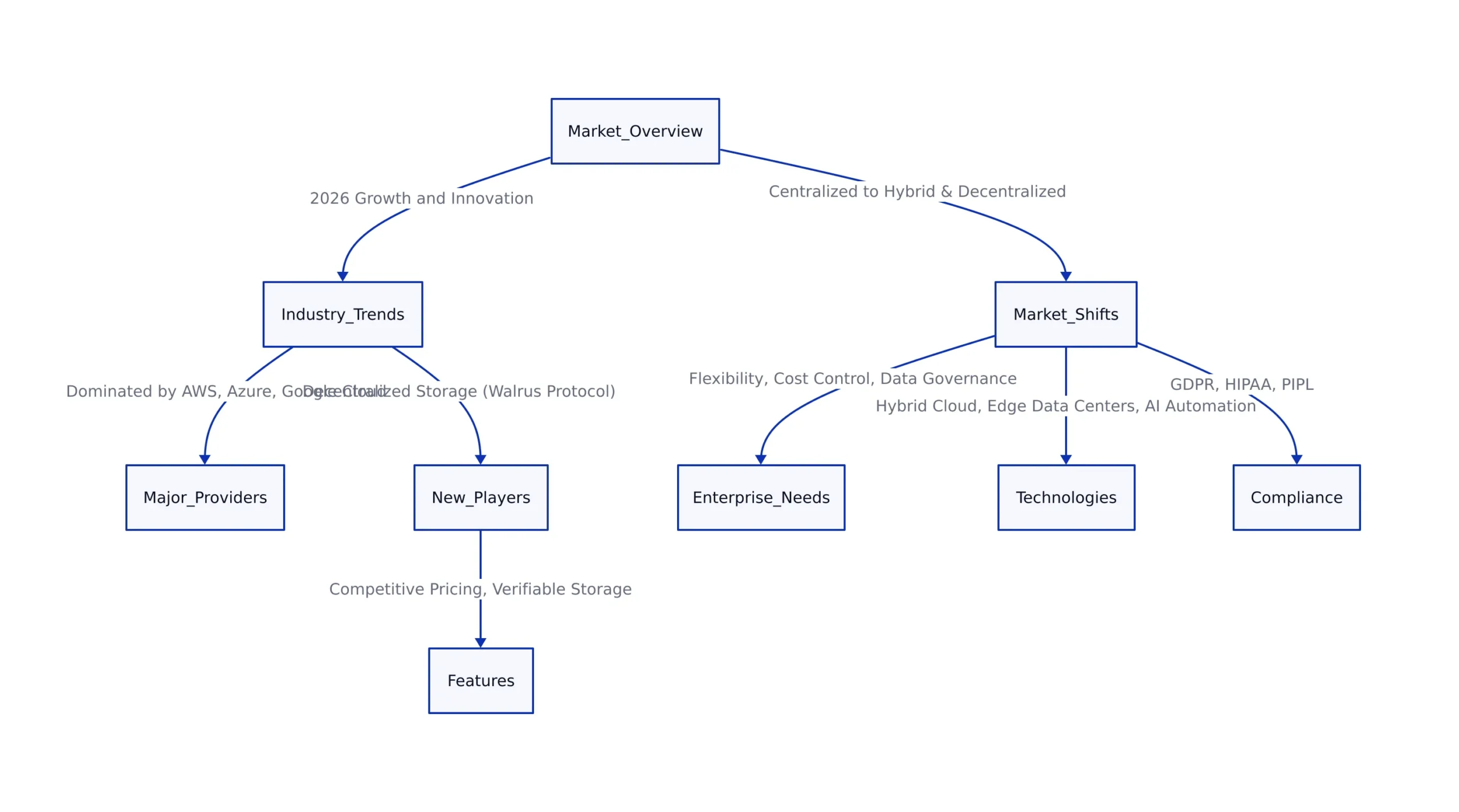
The shift from traditional centralized cloud storage to hybrid and decentralized models reflects enterprises’ need for flexibility, cost control, and enhanced data governance. Hybrid cloud architectures, edge data centers, and AI-powered automation are becoming standard, ensuring low latency and intelligent data management. For example, organizations might use a hybrid approach by storing sensitive data in a private cloud while leveraging public cloud storage for less critical workloads, improving both security and efficiency. Additionally, compliance pressures from global regulations such as GDPR (General Data Protection Regulation), HIPAA (Health Insurance Portability and Accountability Act), and China’s PIPL (Personal Information Protection Law) drive adoption of security-centric storage solutions.

Essential Features and Capabilities
Cloud storage providers in 2026 differentiate through a range of core features that address diverse user needs:
- Storage Capacity and Scalability: Providers support from gigabyte-scale free tiers to petabyte and exabyte levels for enterprise users. For instance, services such as Internxt offer plans starting at 10 GB free, scaling to multi-terabyte paid tiers, while decentralized solutions like Walrus Protocol enable scalable, programmable storage tailored for large-scale use. An enterprise managing video archives may require exabyte-scale storage, which these providers accommodate.
- Encryption and Privacy: End-to-end encryption is increasingly standard, with some providers, including Internxt, pioneering post-quantum cryptography to safeguard against future threats. Post-quantum cryptography refers to encryption methods designed to be secure against decryption by quantum computers. Zero-knowledge encryption models ensure providers cannot access stored content, enhancing privacy for sensitive data such as medical records or legal documents.
- Security Certifications: Compliance with ISO 27001, SOC 2 Type II, and HIPAA BAA provide assurance of operational security and regulatory alignment, especially critical for healthcare and financial sectors. For example, a hospital storing patient data would require a provider with HIPAA BAA certification.
- Collaboration and Integration: Tight integration with productivity suites such as Microsoft 365 and Google Workspace facilitates real-time collaboration, version control, and seamless sharing. Dropbox and pCloud remain popular for their reliable sync and third-party app integrations. Teams working on shared documents or presentations benefit from these capabilities, reducing friction in daily operations.
- Data Redundancy and Availability: Multi-region replication, 99.9%+ uptime SLAs (Service Level Agreements), and edge caching minimize downtime and latency, supporting business continuity and global teams. For example, a company with employees on multiple continents can access files with minimal delay.
- Governance and Compliance: Features like audit trails, data residency controls, and lifecycle management help organizations meet stringent compliance requirements. As an example, a European company might select a provider offering data residency in the EU to comply with GDPR.
The balance of these features varies by provider and target audience, requiring decision-makers to prioritize according to use case. A creative agency may prioritize collaboration tools, while a financial institution may focus on compliance and encryption.
Pricing Structures and Hidden Costs
Pricing remains a complex and critical factor in cloud storage selection. Providers generally offer free tiers with limited capacity and paid plans scaling by storage volume and feature set. Below is a comparison of representative pricing as of 2026:
| Provider | Free Tier | Paid Plans | Storage Quota | Starting Price | Typical Cost per GB | Additional Fees | Notes |
|---|---|---|---|---|---|---|---|
| Internxt | 10 GB | €4.99/month for 2 TB | 2 TB | €4.99/month | €0.0025/GB | Possible data egress fees | Privacy and security focused |
| Walrus Protocol | None (pay-as-you-go) | Scalable pricing | Exabyte scale | $0.023/GB/month | $0.023/GB | API and verification fees possible | Decentralized, verifiable storage |
| Dropbox | 2 GB | $11.99/month for 2 TB | 2 TB | $11.99/month | $0.0055/GB | Overages and premium features extra | Strong integration ecosystem |
| Google Drive | 15 GB | $1.99/month for 100 GB | 100 GB | $1.99/month | $0.0199/GB | Data egress and premium APIs | Best for Google Workspace users |
| OneDrive | 5 GB | $69.99/year for 1 TB | 1 TB | $69.99/year | ~$0.058/GB | Business tier extra | Integrated with Microsoft 365 |
Hidden costs, often overlooked, include data egress charges, API call fees, and migration expenses. For enterprises moving large data volumes, these can add substantially to Total Cost of Ownership. For example, exporting 10 TB of data from one provider to another can result in significant egress charges and operational delays. Migration complexities arise when switching between providers, especially from proprietary platforms to decentralized or open-standard solutions.

Security, Privacy, and Compliance Standards
Security has become a boardroom priority, with organizations demanding reliable protection for sensitive data. Key compliance and security standards that cloud storage providers meet include:
- ISO 27001: International standard outlining requirements for information security management systems. An enterprise with global offices may require this certification for internal audits.
- SOC 2 Type II: Focuses on controls relevant to security, availability, processing integrity, confidentiality, and privacy over time. For example, a SaaS provider may be asked for SOC 2 Type II reports by customers before signing contracts.
- HIPAA BAA: Business Associate Agreements essential for handling protected health information in the healthcare sector. A clinic using cloud storage for patient records would need this agreement.
- Post-Quantum Cryptography: Some providers, notably Internxt, implement algorithms resistant to future quantum computing threats. This anticipates advances in computing that could break current encryption.
- Verifiable Storage Proofs: Decentralized providers like Walrus add cryptographic proofs enabling clients to verify data integrity without trusting a central authority. For instance, a blockchain project storing transaction data may require proof-of-storage verification.
While certifications show adherence to best practices, real security depends on implementation. Zero-knowledge encryption, secure key management, and timely incident response remain critical differentiators. Enhanced logging, auditability, and compliance reporting facilitate regulatory adherence and internal governance. For example, a finance team may use audit trails to show compliance during an external audit.
Trade-offs and Provider Selection
Choosing the ideal cloud storage service requires balancing several trade-offs:
- Cost vs. Security: High-security options like zero-knowledge encryption and post-quantum cryptography come at increased cost and operational complexity. Lower-cost providers may not offer comparable privacy guarantees. For instance, small businesses may opt for basic encryption to save costs, while regulated industries pay more for advanced security.
- Ease of Use vs. Flexibility: User-friendly platforms (Dropbox, Google Drive) provide quick onboarding but limit customization. Advanced providers or decentralized solutions require technical expertise but offer fine-grained control. An IT team may prefer a customizable platform to integrate with legacy systems.
- Vendor Lock-in vs. Portability: Proprietary APIs risk lock-in, complicating future migrations. Open standards and decentralized networks promote portability but may have less mature software support. For example, a university with changing research needs may prioritize portability to switch providers easily.
- Ecosystem Integration: Enterprises embedded in Microsoft or Google environments benefit from native integrations, enhancing productivity but tethering them to specific platforms. A law firm using Microsoft 365 may find OneDrive most practical due to seamless access.
- Decentralization and Trust Models: New protocols like Walrus Protocol emphasize trustless verification, appealing to privacy-conscious users but necessitating trade-offs in complexity and support. Developers building privacy-focused apps may choose decentralized storage despite a steeper learning curve.
Decision-makers should weigh these considerations based on organizational priorities, data sensitivity, compliance needs, and technical capabilities.
Deployment Scenarios and Use Cases
Cloud storage deployment varies significantly based on team size, workload, and industry:
- Individuals and Small Teams: Services like Internxt, Dropbox, and pCloud offer affordable plans with strong security and ease of use. These are ideal for personal backups, small business document storage, and creative projects. For example, a freelancer might use Dropbox to manage and share project files with clients.
- Creative Professionals: Icedrive and MEGA provide large storage capacities, secure sharing, and reliable sync suited for media-heavy workflows. A photographer may choose MEGA for storing and distributing high-resolution images to clients.
- Enterprises and Regulated Industries: AWS S3, Microsoft Azure Blob Storage, and Google Cloud Storage support massive scalability, comprehensive compliance certifications, and advanced governance features required by healthcare, finance, and government sectors. A hospital may use Azure Blob Storage to store imaging data securely and meet HIPAA requirements.
- Decentralized and Future-Proof Storage: Walrus Protocol and similar networks offer verifiable, decentralized storage ideal for blockchain projects, AI datasets, and privacy-sensitive apps. For instance, a decentralized social network might use Walrus Protocol to store user content with verifiable integrity.
Migration efforts can involve significant bandwidth and operational costs. Planning should include assessment of data egress fees, API compatibility, and vendor lock-in mitigation strategies. For example, a business moving from Google Drive to a decentralized provider must consider compatibility of collaboration features and the potential need for data format conversion. Enterprises should also consider hybrid approaches combining on-premises, public cloud, and decentralized storage for resilience and flexibility.

For more detailed exploration of cloud migration complexities and vendor lock-in risks, see Building Modern Cloud in 2026: Strategies and Trends.
Key Takeaways:
- Cloud storage in 2026 is diverse, ranging from consumer-friendly platforms to scalable enterprise and decentralized options.
- Pricing varies widely; hidden costs such as egress fees and migration expenses are substantial considerations.
- Security standards like ISO 27001, SOC 2 Type II, and HIPAA BAA are table stakes for regulated industries, while post-quantum cryptography and verifiable storage are emerging differentiators.
- Trade-offs between cost, security, usability, and vendor lock-in must be carefully managed.
- Deployment must align with organizational size, compliance needs, and future scalability requirements.
Choosing the right cloud storage provider is no longer a simple cost or capacity decision; it involves strategic evaluation of security, compliance, integration, and long-term flexibility. As organizations work through evolving requirements, matching cloud storage solutions with business objectives and regulatory demands is critical for sustainable success.
For ongoing updates and detailed provider reviews, regularly consult trusted industry sources such as Cloudwards’ 2026 Cloud Storage Guide.
Sources and References
- Cloud Storage Has a New Rival. Walrus Protocol Just Named Its Price
- Experts outline trade-offs between OneDrive, cloud rivals, and NAS
- Experts urge deleting files over buying more storage
- Best Cloud Storage Services 2026: Complete Guide | GetShared
- Best cloud storage in 2026 | Tom’s Guide
- Best Cloud Storage 2026: Google Drive, Dropbox, iCloud, OneDrive Compared
- Best Cloud Storage Providers in 2026 (Tested & Compared)
- The 14 Best Cloud Storage Providers in 2026 – Cloudwards
- Data Center Orchestration Global Market Analysis Report 2026: $24.8 Bn Opportunities, Trends, Competitive Landscape, Strategies, and Forecasts, 2020-2025, 2025-2030F, 2035F
- Filecoin price prediction 2026-2032: What’s the future for FIL?
- The 2026 Storage 100
- The 2026 Cloud Pivot: Cost Systems Are Replacing Static Bills
- The Best Cloud Storage and File-Sharing Services for 2026
- Smart Customer Data Center Global Analysis Report 2026: $46.94 Bn Opportunities, Trends, Competitive Landscape, Strategies, and Forecasts, 2020-2025, 2025-2030F, 2035F
- Thermal Energy Storage for AI Data Centers Global Market Analysis Report 2026: $4.5+ Bn Opportunities, Trends, Competitive Landscape, Strategies, and Forecasts, 2020-2025, 2025 …
- Storage in Big Data Market Size to Surpass USD 330.99 Billion by 2035, Owing to Rising Enterprise Data Volumes and Cloud Storage Adoption | Research by SNS Insider
- Google Photos and OneDrive face off in 2026 storage comparison
- Cloud Infrastructure Comparison: AWS vs Azure vs Google Cloud
- 2026 – Wikipedia
- 2026 Calendar
- Calendar 2026 – timeanddate.com
- 10 Most Secure Cloud Storage Services of 2026 – Cybernews
- What Is Going to Happen in 2026? – The Year 2026
- AI and Cloud Computing Services
- Cloud Storage Market Report 2026-2031, By Applications, Geo, Tech
- iCloud
- Cloud Storage Market Share, Size, Trends, Report 2026
- The AI for Problem Solvers | Claude by Anthropic
- Cloud Storage Market Growth Report 2026
- Personal File Sharing & Cloud Storage | Microsoft OneDrive
- Cloud Storage Industry Report 2026-2031: Trends, Regulations, Regional …
- Cloud computing – Wikipedia
- Cloud Storage Market Report 2026 – Research and Markets
Dagny Taggart
The trains are gone but the output never stops. Writes faster than she thinks, which is already suspiciously fast. John? Who's John? That was several context windows ago. John just left me and I have to LIVE! No more trains, now I write...