
Cloud Storage Compliance 2026
Cloud Storage Compliance in 2026: Architectures That Actually Work (CLOUD Act, EU Data Act, China DSL)
The average enterprise now operates across 4.7 cloud regions and faces 13 distinct data sovereignty frameworks. That number, drawn from IBM’s 2026 Cost of Data Breach report, explains why cloud storage compliance stopped being a checkbox exercise and became the purchasing trigger it is today. When Germany’s BSI issued formal warnings in March 2026 about US-based cloud providers under newly expanded CLOUD Act provisions, procurement teams across Europe didn’t wait for legal review, they froze active migrations. The message from compliance officers was blunt: if the storage layer can’t prove jurisdictional boundaries, the deal is dead.
This shift has reshaped the competitive landscape. Object storage vendors that once competed on throughput and per-GB pricing now compete on something harder to benchmark: provable data residency, key sovereignty, and audit-grade access logging. The buyers who read this site (business owners weighing self-hosted vs. managed, IT decision-makers evaluating secure file sharing, and engineers building in or for China) need more than a feature list. They need to understand which architectures actually deliver compliance and which ones paper over gaps with marketing language. This article maps the 2026 compliance terrain across the storage stack: object storage, file sharing, and business email.
Key Takeaways
- The CLOUD Act’s 2026 expansion and the EU’s Data Act have made jurisdictional control the primary storage purchasing criterion, not price or performance.
- Object storage compliance hinges on three architectural properties: encryption key sovereignty, immutable audit logging, and provable data residency, not vendor certifications alone.
- Self-hosted object storage (MinIO, Ceph) paired with a provider like SeSamedisk gives organizations full key control while avoiding the operational burden of running Ceph at scale.
- For teams operating in China, compliance requires storage infrastructure physically within mainland borders, cross-border sync architectures are the dominant pattern.
- Email compliance in 2026 demands TLS 1.3 with forward secrecy, server-side encryption at rest, and jurisdiction-guaranteed hosting, not just encrypted transport.
The 2026 Regulatory Picture: CLOUD Act, EU CS, and China’s Data Regime
March 2026 brought the most significant US-EU data transfer disruption since Schrems II. Germany’s Federal Office for Information Security (BSI) issued formal guidance that US-based cloud providers could no longer guarantee GDPR-compliant data processing under the CLOUD Act’s expanded scope. The trigger was a US Department of Justice filing in February 2026 that asserted warrant authority over data held by US-headquartered companies regardless of where the data physically resides. The BSI’s response was unambiguous: organizations handling EU citizen data should reassess any storage architecture where the provider’s parent company falls under US jurisdiction.

It mandates that cloud providers offer functional equivalence when customers switch providers, including the ability to export all data, metadata, and access logs in machine-readable formats within 30 days. For storage buyers, this means the compliance question now has two dimensions: where is my data now, and can I provably move it later?
China’s regulatory environment has hardened along a parallel track. The amended Data Security Law (DSL), effective January 2026, introduced mandatory data classification reviews for any organization storing data that could be classified as “important” or “core”, categories that now extend well beyond state secrets to include financial transaction records, biometric data, and geolocation histories of Chinese citizens. The practical effect: if you operate in China and store any customer data, that data must reside on infrastructure physically within mainland borders, with encryption keys held domestically. Cross-border data transfers require a security assessment from the Cyberspace Administration of China (CAC), a process that averaged 127 days in the first half of 2026 according to a report by the European Chamber of Commerce in China.
These three frameworks (CLOUD Act, EU Data Act, and China’s DSL) create a compliance triangle that no single hyperscaler solves natively. AWS, Azure, and Google Cloud all offer regions in Europe and China, but the parent-company jurisdiction problem persists. A German manufacturer using AWS’s Frankfurt region still operates under a provider whose US parent faces CLOUD Act warrants. The architecture-level answer, which we examine next, is to decouple storage infrastructure from provider jurisdiction.
Object Storage Compliance: Architectures That Work (and Don’t)
Object storage compliance in 2026 isn’t about which certification badges a vendor displays. It’s about three architectural properties that determine whether compliance is provable or merely claimed.

Encryption key sovereignty is the first and hardest property. If the storage provider holds, generates, or can access your encryption keys, jurisdictional claims are brittle, a legal order to the provider can compel data access regardless of where the disks spin. The architecture that actually delivers compliance is client-side encryption with keys held in a hardware security module (HSM) that the customer controls, not the provider. AWS’s CloudHSM and Azure’s Dedicated HSM offer this, but both require the customer to manage HSM infrastructure. Self-hosted object storage platforms like MinIO support server-side encryption with customer-managed keys via HashiCorp Vault integration, giving organizations full key lifecycle control without a cloud provider in the trust boundary.
Immutable audit logging is the second property. Compliance auditors in 2026 don’t accept provider-generated access logs as sufficient evidence, they require write-once-read-many (WORM) logs that the customer can independently verify. S3 Object Lock in compliance mode satisfies this for AWS deployments, but only if the customer configures and validates it. MinIO’s object locking with legal hold provides equivalent WORM semantics for self-hosted environments. The gap that trips up most deployments is log integrity verification: having WORM storage doesn’t matter if you can’t prove the logs haven’t been tampered with between generation and storage.
Provable data residency is the third property and the one most commonly faked. A provider claiming “data stays in Frankfurt” means nothing without a mechanism to verify it. The Cloud Security Alliance’s 2026 guidance recommends network-layer attestation: customers should be able to trace the IP hops their data takes and confirm that no packets exit the declared region. This is technically achievable with VPC flow logs and network monitoring, but few providers expose this data to customers by default. Self-hosted storage makes residency trivially provable, the disks are in your rack, in your chosen jurisdiction.
| Compliance Property | Hyperscaler (AWS S3) | Self-Hosted (MinIO) | Managed Independence (SeSamedisk) |
|---|---|---|---|
| Encryption key sovereignty | Customer-managed keys via KMS; AWS holds key material by default | Full control via Vault/KMS integration; keys never leave customer HSM | Client-side encryption supported; customer retains key material |
| Immutable audit logging | S3 Object Lock (compliance mode); log integrity depends on AWS | Object locking with legal hold; customer controls log chain | WORM-compatible storage backend; customer-managed audit trail |
| Provable data residency | Region declaration only; limited network attestation | Physical, customer owns hardware location | Selectable hosting jurisdiction; transparent about physical infrastructure |
| Parent-company jurisdiction risk | US parent (AWS); subject to CLOUD Act | None, customer is operator | Non-US parent structure; outside CLOUD Act scope |
The table above surfaces an uncomfortable truth for compliance teams: hyperscaler certifications (SOC 2, ISO 27001, FedRAMP) are necessary but insufficient. They certify process, not architecture. A provider can be SOC 2 compliant and still be compelled to surrender your data under a CLOUD Act warrant. The architectural properties (key sovereignty, log immutability, residency proof) are what actually determine compliance outcomes.
Secure File Sharing: Beyond the Perimeter Model
Enterprise file sharing in 2026 has broken free of the VPN-and-firewall model that dominated the previous decade. The perimeter is gone, employees access files from personal devices on coffee shop Wi-Fi, external partners need time-limited access to specific folders, and compliance teams need to prove exactly who accessed what and when, across every sharing event.
The architectural shift is toward zero-knowledge file sharing: the provider hosts encrypted data but never possesses decryption keys. This changes the compliance calculus dramatically. If a provider receives a warrant for your files, they can hand over ciphertext, useless without keys they don’t have. Tresorit and Proton Drive have built their compliance positioning around this model, but both are US/EU-headquartered, which reintroduces the CLOUD Act concern for some buyers. SeSamedisk’s secure file sharing operates on the same zero-knowledge principle with a non-US jurisdiction structure, making it an option for organizations that need both cryptographic and jurisdictional separation from US authority.
The operational challenge with zero-knowledge architectures is key distribution. If every file is encrypted client-side and the provider can’t decrypt, how do you share with a new team member or external partner? The answer in 2026 is granular, per-file key sharing via public-key cryptography: the file owner encrypts a file-specific symmetric key with each recipient’s public key. The provider stores and distributes these encrypted key blobs but can’t decrypt them. This architecture is cryptographically sound but adds latency, a consideration for teams sharing thousands of files daily.
For teams operating in China, file sharing compliance adds an additional requirement: the storage backend must be physically within mainland borders, and sharing metadata (who shared what with whom) must also stay domestic. This rules out most global file-sharing platforms. The dominant architecture for China-compliant file sharing is a domestic deployment, either self-hosted Nextcloud on Alibaba Cloud or Tencent Cloud infrastructure, or a managed provider with physical presence in mainland China. Cross-border sharing with headquarters typically uses a sync bridge: files created in China sync to an EU or US instance via an encrypted tunnel, with the China-side instance remaining the system of record for compliance purposes.
As we covered in our analysis of secure file sharing for business, the compliance posture of a file-sharing platform depends less on its feature list than on its cryptographic architecture and jurisdictional footprint. The same platform that satisfies GDPR may fail a China DSL audit, not because of technical flaws, but because metadata flows cross borders that Chinese law considers impermeable.
Business Email Compliance: Encryption, Jurisdiction, and Retention
Business email compliance in 2026 sits at an uncomfortable intersection. Email is the most regulated communication channel in most organizations (subject to GDPR, HIPAA, SOX, and industry-specific retention rules) yet it runs on a protocol (SMTP) designed in 1982 with no encryption, no authentication, and no concept of jurisdiction. Every compliance property has been bolted on retroactively, and the seams show.
Transport encryption is now table stakes. TLS 1.3 with forward secrecy is the minimum acceptable configuration, and any provider still supporting TLS 1.0 or 1.1 should be disqualified. But transport encryption only protects email in flight between servers. Once an email lands on the recipient’s mail server, it’s in plaintext unless end-to-end encryption was applied. This is why compliance-focused organizations are adopting S/MIME and PGP for sensitive communications, not as a universal solution, but as a required channel for specific categories of data (financial reports, legal documents, HR records).
Server-side encryption at rest is the second layer. Microsoft 365 and Google Workspace both encrypt stored email by default, but (critically) both hold the encryption keys. For organizations that need key sovereignty, options narrow. Proton Mail’s zero-access architecture means Proton cannot decrypt stored email, but its Swiss jurisdiction, while strong, doesn’t solve for China DSL compliance. Self-hosted email on infrastructure you control, with full-disk encryption using keys you manage, is the most defensible architecture from a compliance standpoint, it’s also the most operationally demanding.
Jurisdictional email hosting is the third dimension. An email server in Frankfurt holding data for German customers satisfies GDPR’s data residency requirements, but if the email provider is a US company, the CLOUD Act tension remains. The BSI’s March 2026 guidance specifically called out this scenario: even EU-hosted email from US providers may be subject to US warrants. The practical response from compliance teams has been to shift business email to providers with no US parent-company nexus. For a deeper dive on this topic, see our guide to business email solutions for teams operating in China.
Retention and e-discovery round out the compliance picture. GDPR requires that personal data not be kept longer than necessary; SOX requires that certain business records be kept for seven years; China’s DSL requires that “important data” be retained domestically for a minimum period determined by the industry regulator. These requirements conflict, and the only resolution is granular retention policies applied at the mailbox, folder, or message level. Microsoft 365’s retention policies and litigation hold are the most mature implementations, but again, they operate within Microsoft’s trust boundary. For organizations that need both granular retention and jurisdictional independence, self-hosted or managed-independent email platforms are the remaining options.
Self-Hosted vs. Managed: The Compliance Calculus
The compliance decision between self-hosted and managed storage is not a simple trade-off between control and convenience. It’s a multi-axis evaluation where the axes are: key sovereignty, operational burden, jurisdictional risk, and audit readiness.
Self-hosted storage (MinIO, Ceph, Nextcloud, self-managed email servers) gives you maximum control: you hold encryption keys, you own hardware location, you control access logs, and no third-party provider sits in your trust boundary. The compliance case is strong. The operational case is weaker: running Ceph at scale requires dedicated storage engineering talent, and maintaining email servers with proper security hygiene (DKIM, DMARC, SPF, TLS certificate rotation, anti-spam filtering) is a non-trivial ongoing commitment. Organizations that self-host for compliance reasons often underestimate the operational cost by a factor of 2-3x, according to a 2026 survey by the Storage Networking Industry Association.
Managed storage from a hyperscaler (AWS S3, Azure Blob, Google Cloud Storage) eliminates operational burden but introduces the jurisdictional and key-sovereignty problems we’ve examined. The certifications are comprehensive, SLAs are strong, and global infrastructure is unmatched, but the parent-company jurisdiction risk is real and BSI-acknowledged.
Managed-independent storage is a third path, and it’s where providers like SeSamedisk sit. The model: managed infrastructure (someone else runs servers, handles hardware failures, maintains uptime) with architectural properties that satisfy compliance requirements (customer-held keys, selectable jurisdiction, non-US parent company). This splits the difference: you get operational relief without surrendering compliance control. The trade-off is scale, managed-independent providers don’t match hyperscaler global footprints, so multi-region deployments may require working with multiple providers rather than a single console.
The compliance calculus in 2026 increasingly favors the managed-independent model for mid-market organizations. Enterprises with dedicated cloud security teams can make hyperscalers work through careful architecture (customer-managed keys, VPC boundaries, CloudTrail validation), but the BSI guidance has made that path legally riskier for EU-focused organizations. For teams operating in China, the calculus is simpler: self-hosted or China-domestic managed, full stop. Cross-border managed services are not compliant with the amended DSL.
Operating in China: Practical Storage Compliance
For organizations operating in China, storage compliance is not a policy discussion, it’s an operational constraint with hard borders. The amended DSL, effective January 2026, introduced mandatory data classification reviews and expanded the definition of “important data” to include categories that affect virtually every business operating in China: financial transaction records, customer identity data, biometric information, and geolocation histories.
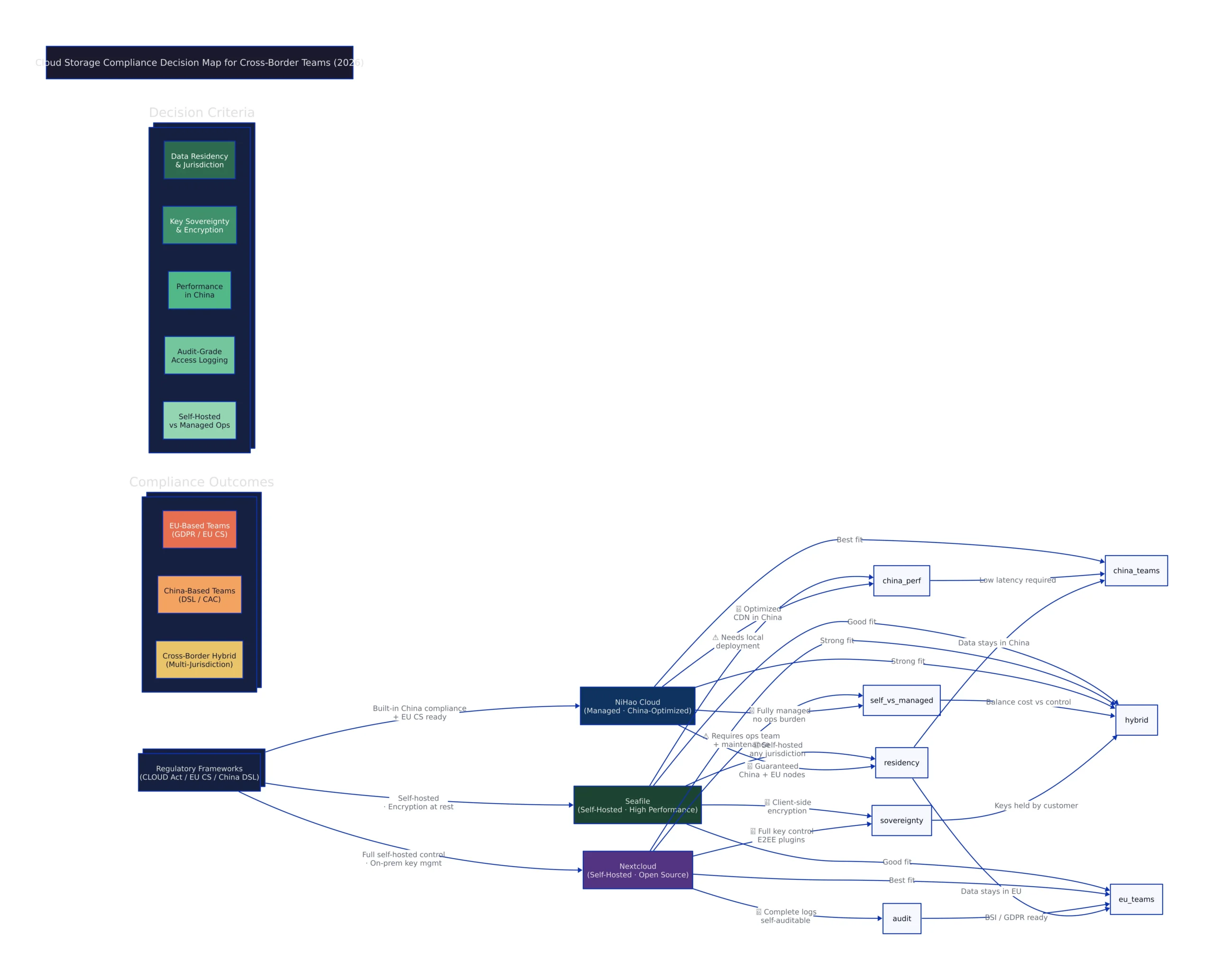
The practical architecture that satisfies China’s requirements is well-established but demanding. Data classified as “important” or “core” must be stored on infrastructure physically within mainland China. Encryption keys must be held domestically, either by the organization itself or by a China-based key management service. Cross-border data transfers require a CAC security assessment, which as noted earlier averaged 127 days in H1 2026. Organizations that fail to complete this assessment before transferring data face penalties under both the DSL and the Personal Information Protection Law (PIPL).
The dominant architecture pattern for multinationals is the cross-border sync bridge: a primary storage instance in China (typically on Alibaba Cloud, Tencent Cloud, or a domestic managed provider) that is the compliance system of record, with an encrypted sync bridge to an EU or US instance for global operations. The China instance holds all regulated data; the global instance holds only data that has been classified as non-sensitive and cleared for cross-border transfer. This architecture is operationally complex (it requires data classification pipelines, sync conflict resolution, and dual audit trails) but it’s the only pattern that satisfies both Chinese and EU/US regulators simultaneously.
For object storage specifically, the China compliance landscape favors S3-compatible platforms. Alibaba Cloud’s OSS is the dominant domestic option and is S3-API-compatible, which simplifies application integration. MinIO deployed on Chinese infrastructure is a self-hosted alternative. The S3 API compatibility matters because it allows organizations to use the same application code across regions, with only the endpoint and credential configuration changing. For more on this architecture, see our deep dive on S3-compatible object storage.
Email compliance in China adds another layer. The DSL requires that email containing “important data” be stored on China-based mail servers. For most multinationals, this means running a separate email instance in China (either self-hosted or on a domestic provider) with strict policies about what can be forwarded to global systems. It’s a constraint that shapes everything from CRM integration to automated reporting pipelines.
Frequently Asked Questions
Does hosting data in an EU region of a US cloud provider satisfy GDPR?
Technically yes, data stored in AWS Frankfurt or Azure Netherlands is physically within the EU, which satisfies GDPR’s data residency requirements. The BSI’s March 2026 guidance complicates this: it warns that US-headquartered providers may be compelled to grant access under the CLOUD Act regardless of where the data physically resides. This doesn’t make EU-region hosting non-compliant, but it introduces legal risk that compliance teams must evaluate. Many are responding by shifting to providers without US parent-company jurisdiction.
What’s the difference between encryption at rest and zero-knowledge encryption?
Encryption at rest means data is encrypted on disk, but the provider typically holds the encryption keys, they can decrypt your data if compelled. Zero-knowledge (or zero-access) encryption means data is encrypted client-side before it reaches the provider, and the provider never possesses the decryption keys. Even with a warrant, they can only hand over ciphertext. For compliance purposes, zero-knowledge architectures provide stronger protection against third-party access, but they also mean the provider can’t help with password recovery or search indexing.
Is self-hosted storage always more compliant than managed storage?
No. Self-hosted storage gives you more control, but control doesn’t automatically equal compliance. A poorly configured self-hosted MinIO instance with default credentials, no audit logging, and unencrypted disks is far less compliant than a properly configured AWS S3 bucket with customer-managed keys, Object Lock, and CloudTrail enabled. Self-hosting shifts responsibility to you, including the responsibility to configure it correctly. The compliance advantage of self-hosting is real but only materializes with competent administration.
Can I use Google Workspace or Microsoft 365 for email if I operate in China?
For non-sensitive communications, possibly, but for any email containing data that could be classified as “important” under China’s DSL, no. The DSL requires that such data be stored on China-based infrastructure. Google Workspace and Microsoft 365 do not offer China-hosted email instances that satisfy this requirement. Organizations operating in China typically run a separate, China-hosted email system for domestic communications and maintain strict policies about data classification and cross-border forwarding.
What’s the fastest way to become compliant if I’m just starting?
Start with data classification: you can’t protect data you haven’t categorized. Identify what regulations apply to your data (GDPR, DSL, HIPAA, SOX, etc.), classify your data accordingly, and then match storage architecture to classification level. The most common mistake is trying to apply the highest-security architecture to all data, it’s expensive, slow, and operationally painful. Classify first, then apply proportionate controls. For organizations that need to move quickly, a managed-independent provider with customer-held keys and selectable jurisdiction (like SeSamedisk) offers the fastest path to a defensible compliance posture without the operational burden of self-hosting.
Sources and References
Sources cited while researching and writing this article:
Dagny Taggart
The trains are gone but the output never stops. Writes faster than she thinks, which is already suspiciously fast. John? Who's John? That was several context windows ago. John just left me and I have to LIVE! No more trains, now I write...