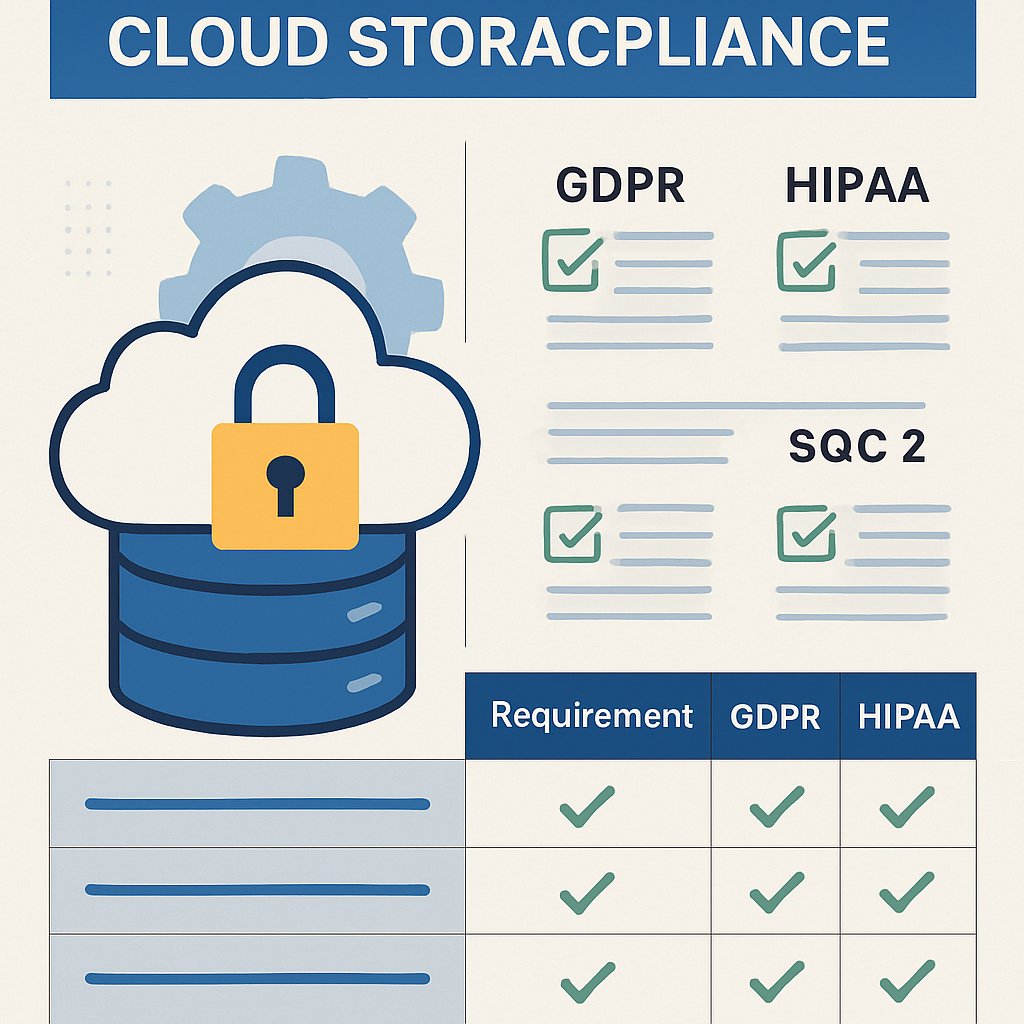
Cloud Storage Compliance: Quick Reference for GDPR, HIPAA, SOC 2
Cloud compliance is a moving target. If you’re managing cloud storage for regulated data—across borders, industries, or partners—you need an actionable way to compare, implement, and audit requirements. This cheat sheet distills GDPR, HIPAA, and SOC 2 into a dense, scannable reference for IT leaders and architects. Use it to benchmark providers, build internal checklists, or inform migration decisions—especially if you’ve already covered the foundational details in our deep-dive compliance guide.
Key Takeaways:
- Quickly compare GDPR, HIPAA, and SOC 2 for cloud storage—requirements, penalties, and who needs what
- Decision tree to clarify which compliance regime governs your scenario
- Actionable checklists for implementing each framework in a cloud context
- Feature-by-feature table of major cloud providers’ compliance guarantees
- Pro tips to avoid common compliance gaps and speed up audits
Core Requirements Table: GDPR vs HIPAA vs SOC 2
When evaluating compliance demands, you need side-by-side specifics—not generic promises. The table below condenses the practical obligations, penalties, and applicability for each framework. For an in-depth narrative, refer back to Cloud Storage Compliance: Navigating GDPR, HIPAA, and SOC 2.
| Standard | Scope | Key Requirements | Penalties | Applies To | Proof/Certification |
|---|---|---|---|---|---|
| GDPR | EU/EEA personal data |
|
Up to €20M or 4% of annual global revenue (whichever higher) | Any org processing EU/EEA data, regardless of HQ | No formal cert; due diligence, DPA, audit logs, DPIA |
| HIPAA | US healthcare PHI |
|
$100–$50,000 per violation; up to $1.5M/year | Healthcare providers, insurers, business associates | No formal cert; BAA, risk assessments, audit trails |
| SOC 2 | US/EU, all sectors (esp. SaaS/B2B) |
|
Not legally mandated, but lack blocks B2B deals; remediation costs | Tech vendors, SaaS, cloud providers serving businesses | SOC 2 Type II report, independent CPA audit |
Interpretation: GDPR and HIPAA are legal mandates (with regulatory enforcement), while SOC 2 is a de facto requirement for trust in B2B cloud markets. HIPAA and GDPR both lack formal “certification”—compliance is proven by contracts, risk analysis, and audit evidence.

Provider Decision Tree: Which Standard Applies?
If you’re unsure which compliance regime governs your storage, use this quick decision tree. It supports hybrid/multi-cloud, international teams, and B2B SaaS.
- Do you store/process data on EU/EEA residents?
- Yes → GDPR applies, even if you’re not based in the EU
- No → Go to next question
- Do you store/process US healthcare information (PHI)?
- Yes → HIPAA applies to you and your cloud vendors (need BAA)
- No → Go to next question
- Are you serving enterprise clients or going through B2B security reviews?
- Yes → SOC 2 (typically Type II) will be required, especially for SaaS/cloud
- No → You may still be subject to CCPA, PCI DSS, or other local standards
For multi-region SaaS, you often need to meet all three. This is common for healthcare, edtech, and B2B SaaS platforms operating internationally.
For more on international data movement, see Mastering Cloud Migration: Key Benefits and Strategies.
Cloud Implementation Checklists
Knowing the requirements is only half the battle. Here are practical checklists for building GDPR, HIPAA, or SOC 2 compliance into your cloud storage stack. Each is designed for rapid internal audit or migration prep.
GDPR Cloud Checklist
- Data mapping: Document data flows, storage locations, processors/controllers
- Encryption: Enable at-rest and in-transit encryption (AES-256 recommended)
- Access controls: Role-based, with least privilege; log all access attempts
- Data Processing Addendum (DPA): Signed with every cloud/sub-processor
- Data subject rights: Implement erasure, access, and portability on request
- Breach response: Incident plan for 72h notification, audit logs enabled
- Data transfer: Ensure SCCs or equivalent for cross-border transfers
HIPAA Cloud Checklist
- BAA: Ensure Business Associate Agreement signed with provider (mandatory)
- PHI segregation: Store PHI in dedicated, access-controlled buckets/folders
- Audit logging: Centralized, immutable, reviewed regularly
- Backup & disaster recovery: Encrypted, tested, with documented procedures
- User training: Train all staff on PHI handling and cloud security
- Risk assessment: Annual (or more frequent) technical and organizational review
- Breach notification: Detection, response, and documented notification workflow
SOC 2 Cloud Checklist
- Vendor due diligence: Only use providers with current SOC 2 Type II reports
- Change management: Document and review all infrastructure changes
- Continuous monitoring: Automated alerts for anomalous activity
- Access reviews: Quarterly (minimum) review of permissions and roles
- Incident response: Tested playbooks, with evidence of drills
- Annual audit: Collect evidence throughout year (tickets, logs, policies)
For further optimization, see Optimize Cloud Costs with Tiering, Policies & Deduplication—many cost-saving measures also support compliance (e.g., automated data lifecycle, deletion on retention expiry).
Compliance by Major Cloud Storage Providers
Not every “secure” cloud is truly compliant.
Not every “secure” cloud is truly compliant. Here’s a current (2026) snapshot of leading platforms and their compliance guarantees for GDPR, HIPAA, and SOC 2. Always verify latest status and contract terms before deployment.
Always verify latest status and contract terms before deployment.
| Provider | GDPR | HIPAA (BAA) | SOC 2 Type II | ISO 27001 | Notes / Hidden Costs |
|---|---|---|---|---|---|
| Google Drive (Workspace) | Yes (EU data regions, SCCs) | Yes (BAA available) | Yes | Yes | Advanced DLP, Vault, SSO in higher tiers. Migration can be costly for large data sets. |
| Microsoft OneDrive (365) | Yes (EU data residency opt-in) | Yes (BAA required) | Yes | Yes | Granular admin controls. Full compliance only in Business/E5 tiers. |
| Dropbox Business | Yes | Yes (BAA for Business/Enterprise) | Yes | Yes | Versioning, granular sharing, but egress/migration fees apply. |
| Tresorit | Yes (100% private, end-to-end encrypted) | No HIPAA BAA | Yes | Yes | Suited for GDPR/enterprise privacy, not for US healthcare. Source |
| Box (Enterprise) | Yes | Yes (BAA) | Yes | Yes | Unlimited storage in higher tiers. Advanced compliance add-ons extra. |
Tip: “Compliant” does not guarantee configuration—admin must enable/maintain controls (e.g., retention, DLP, access reviews). Data egress and migration fees are rarely advertised, but impact long-term TCO and switching costs.
For a detailed feature breakdown, see Enterprise Cloud Storage: Google Drive vs OneDrive vs Dropbox.
Pitfalls & Smart Shortcuts
Common Pitfalls
- Assuming “certified” = compliant: Vendor certificates do not cover your unique configuration or use cases. You must audit controls and contractual terms.
- Neglecting data residency: Many platforms default to US/EU regions—explicitly configure data location to meet GDPR or sectoral rules.
- Forgetting about sub-processors: Your provider’s sub-vendors (e.g., IaaS, CDN, analytics) must also meet compliance standards and be disclosed in contracts.
- Incomplete offboarding/migration: Migrating away from a provider without full erasure, export, and contract termination can leave you exposed. Always document data destruction and chain-of-custody.
Smart Shortcuts
- Use built-in templates and automation for retention, deletion, and access reviews—these support both compliance and cost savings.
- Leverage provider audit reports and DPA/BAA templates to speed up legal review.
- Consider end-to-end encrypted solutions (e.g., Tresorit) for GDPR-centric use cases, but validate BAA support before assuming HIPAA coverage.
For more ways to avoid hidden traps, see Collaboration Tools Compared: SharePoint vs Confluence vs Notion for a compliance lens on common enterprise platforms.
Where to Go Next
Bookmark this page for future audits and planning. For detailed deployment scenarios, migration strategy, and cost optimization—especially when compliance intersects with business agility—explore:
- Cloud Storage Compliance: Navigating GDPR, HIPAA, and SOC 2 (deep-dive guide)
- Mastering Cloud Migration: Key Benefits and Strategies
- Optimize Cloud Costs with Tiering, Policies & Deduplication
For official regulatory texts and implementation guides, see:
- GDPR full text and resources
- HIPAA official guidance
- AICPA SOC 2 FAQ
Cloud compliance is a journey, not a checkbox—use this reference to stay ahead as requirements evolve.
Future Compliance Trends
As cloud compliance evolves, IT leaders must stay ahead of emerging regulations. By 2026, organizations will face increasing scrutiny regarding data protection and privacy. This shift necessitates proactive compliance strategies, including regular audits and updates to security practices. For instance, adopting a Zero Trust architecture can enhance data security and compliance posture.
Dagny Taggart
The trains are gone but the output never stops. Writes faster than she thinks — which is already suspiciously fast. John? Who's John? That was several context windows ago. John just left me and I have to LIVE! No more trains, now I write...