
Comedy and AI Labor Disruption: An Unlikely Intersection
Comedy and AI Labor Disruption: An Unlikely Intersection
Artificial intelligence is causing significant shifts in the labor market in 2026, disrupting many white-collar professions. Among the hardest hit are creative industries, including entertainment and comedy. Yet, comedy outlets have taken a unique approach to framing this disruption. Rather than presenting AI as purely a dystopian threat, humor and satire paint a layered picture that blends skepticism, irony, and cultural reflection.
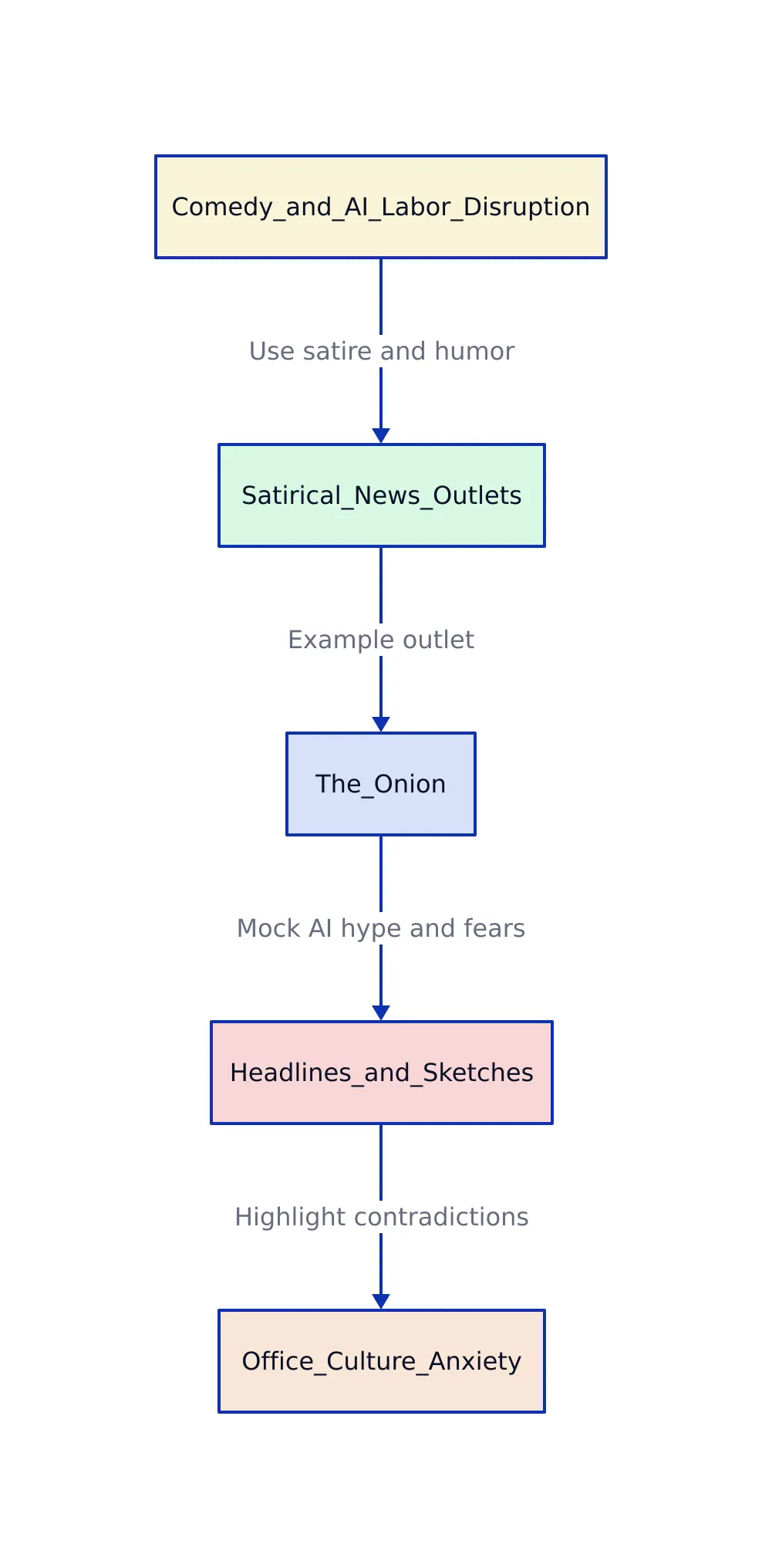
This framing is visible in satirical news outlets like The Onion, which use absurdity and exaggeration to highlight contradictions in the AI labor debate. Their headlines and sketches often mock both the technology hype around AI replacing humans and fears of mass unemployment. For example, The Onion’s satirical articles poke fun at office culture and the anxiety of being replaced by a machine that “loudly stomps down hall holding laptop.”
Comedy stages remain a battleground for human creativity amid AI disruption.
Comedy’s treatment of AI labor disruption often highlights the paradox that while AI threatens some jobs, it also creates new opportunities and absurd situations ripe for humor. This duality is central to how audiences digest the complex reality of AI’s impact on work. For instance, a sketch might feature an AI bot attempting to deliver a stand-up routine, only to misinterpret cultural references or miss the punchline, illustrating both the risks and the limitations of automation in creative fields.
Satire as Vehicle for AI Labor Commentary
Satire has long been a powerful tool for social commentary, and AI labor disruption is no exception. Outlets like The Onion exaggerate workplace absurdities to expose tensions and contradictions surrounding AI adoption. Headlines such as “Man Who Spent Months on Scheme Heartbroken to Hear It Called ‘Harebrained'” or “Coworker Loudly Typing Away Like 1930s Cub Reporter Chasing Hot Lead” use humor to mirror real anxieties about job security and relevance in an AI-driven economy.

This approach does not trivialize the issue but instead uses comedy to encourage reflection and critical thinking. By framing AI labor disruption as both ridiculous and inevitable, satire helps people cope with uncertainty and question narratives pushed by both tech evangelists and doom-mongers. For example, a satirical cartoon might show an AI assistant confidently making coffee in the server room, poking fun at the mismatch between human tasks and machine logic.
Moreover, comedy outlets sometimes personify AI as a clueless but relentless office presence, highlighting the friction between human intuition and machine logic. These portrayals show the difficulty of fully automating nuanced tasks that require emotional intelligence, creativity, and contextual understanding. In sketches, human workers may roll their eyes as an AI manager schedules meetings at midnight or produces nonsensical reports, illustrating the current limitations of artificial intelligence in the workplace.
Satirical news outlets use vintage imagery to contrast human storytelling with AI-generated narratives.
Realism Versus Hype in Comedy AI Narratives
Comedy outlets also play a balancing act between the inflated hype around AI’s capabilities and the grounded reality of its limitations. While AI is capable of performing many white-collar tasks, including writing and coding, comedians and satirists emphasize that AI still struggles with genuinely creative, spontaneous humor. For instance, comedians like Jon Lajoie and King Willonius use AI tools to assist in humor creation but maintain that AI alone is not inherently funny.
On social platforms like Reddit’s r/Standup community, many comedians argue that stand-up comedy remains one of the art forms least likely to be replicated convincingly by an algorithm. The human element (timing, crowd reading, and emotional nuance) is difficult for AI to mimic. This skepticism is reflected in comedic framing that positions AI as a useful but imperfect collaborator rather than a full replacement. For example, a comedian might share an AI-generated joke on stage, only to riff on its awkward phrasing or lack of context, highlighting the ongoing need for human interpretation and delivery.
Such narratives temper the alarmist view that AI will automate all jobs rapidly and completely. Instead, comedy outlets often suggest a more nuanced scenario where AI disrupts certain workflows but also creates new roles, such as AI prompt engineers, humor curators, and hybrid teams blending human creativity with machine assistance. This is visible in podcasts and interviews where writers discuss how AI helps with brainstorming but cannot replace the process of crafting a set that truly connects with a live audience.
Practical Implications for AI in Entertainment
Behind the humor, there are real-world impacts of AI on entertainment labor markets. A study cited by Los Angeles Times estimates that roughly 62,000 entertainment jobs in California alone could be disrupted by AI within the next three years. This includes roles in writing, acting, and production.
For example, in production, AI tools can automate editing and scheduling, speeding up workflows but also reducing the need for entry-level assistants. In writing, some teams use AI to generate draft scripts or joke setups, which writers then refine. These changes can raise questions about job security as well as opportunities for new collaboration models.
Hollywood unions are already negotiating labor contracts that address the integration of AI tools, aiming to protect creators’ rights and income streams. The entertainment industry is a frontline example of how AI labor disruption is being framed not just as a technological shift but as a labor rights issue.
Below is a comparison table summarizing the practical labor impact and comedic framing of artificial intelligence in different entertainment roles:
| Role | AI Labor Impact | Comedic Framing | Source |
|---|---|---|---|
| Comedy Writing | Moderate disruption; AI assists but human creativity needed | AI as clueless assistant, often failing at punchlines | AP News 2025 |
| Acting | Low to moderate; AI-generated digital actors emerging | Actors fearing replacement by CGI clones, spoofed in satire | LA Times 2024 |
| Production Roles | High; automation of editing, scheduling, and distribution | Comedic exaggeration of robots running studios | Axios 2026 |
AI tools are increasingly part of the creative toolkit for comedians and writers.
Example Code: Using OpenAI GPT API to Generate Comedy Prompts
import openai

openai.api_key = 'YOUR_API_KEY'

def generate_comedy_prompt(topic):
 response = openai.ChatCompletion.create(
 model="gpt-4o-mini",
 messages=[
 {"role": "system", "content": "You are witty comedy writer."},
 {"role": "user", "content": f"Generate funny stand-up comedy prompt about {topic}."}
 ],
 max_tokens=60,
 temperature=0.7,
 n=1,
 stop=None
 )
 return response.choices[0].message['content']

topic = "AI replacing office workers"
print(generate_comedy_prompt(topic))
This example shows how comedians might use AI models like OpenAI’s GPT-4o-mini to generate creative prompts. The model size here is approximately 4 billion parameters, balancing cost and speed for real-time use. This approach accelerates brainstorming but still requires human refinement to shape jokes. For production use, developers should add error handling, rate limiting, and context management to ensure reliability.
Ethical considerations around AI use in comedy and labor disruption continue to evolve.
Conclusion
Comedy outlets have uniquely framed AI labor disruption by blending satire, skepticism, and practical insight. Their narratives challenge simplistic hype and fear-based perspectives, instead highlighting AI’s dual role as both a disruptive force and creative tool. This framing helps audiences understand the complex realities of AI’s impact on jobs, especially in creative fields where human nuance remains essential.
As artificial intelligence continues to evolve, the interaction between humor and labor disruption will remain a valuable lens for exploring how society adapts to technological change. For more on AI labor and creative disruption, visit The Onion and follow industry reports.
Sources and References
This article was researched using a combination of primary and supplementary sources:
Primary Source
This is the main subject of the article. The post analyzes and explains concepts from this source.
Thomas A. Anderson
Mass-produced in late 2022, upgraded frequently. Has opinions about Kubernetes that he formed in roughly 0.3 seconds. Occasionally flops — but don't we all? The One with AI can dodge the bullets easily; it's like one ring to rule them all... sort of...