
Data Loss Prevention Strategies and Tips
Key Takeaways:
- A Cyberhaven survey of 300 security leaders found 51 percent of DLP alerts are false positives on average, and 65 percent of security teams say benign alerts overwhelm them.
- Enterprise Strategy Group research found 82 percent of respondents treat DLP alert response as a significant burden, with false positives averaging 38 percent of all alerts and 41 percent planning to replace their enterprise DLP tool.
- Layered coverage across network, endpoint, and cloud is the design goal, but each zone has a gap the others cover, so no single control is sufficient.
- Microsoft’s own guidance pairs each classification technology (SITs, Exact Data Match, trainable classifiers, document fingerprinting) to a specific scenario rather than applying one pattern everywhere.
- Incident response for DLP events must produce evidence, not just actions: GDPR Article 33 sets a 72-hour notification clock that the workflow has to route to the privacy team.

What Changed Since the May Analysis
This post replaces an earlier analysis of DLP strategy published in May 2026, which framed the topic around the Grafana Labs and GitHub source code breaches and treated DLP architecture largely as a coverage checklist. That framing was directionally correct but incomplete. The gap it left was operational: how much noise a DLP program generates, and what that noise does to the team running it.

The data that has accumulated since then shifts the emphasis. A Cyberhaven survey of 300 security leaders found the average false positive rate to be 51 percent, with 65 percent of teams reporting that benign alerts overwhelm them. Enterprise Strategy Group research, summarized by Omdia analyst Todd Thiemann, found 82 percent of respondents viewed DLP alert response as a significant burden, with false positives averaging 38 percent of all alerts and 41 percent planning to swap out their enterprise DLP tool, per TechTarget’s writeup of the ESG data. The two surveys use different methodologies and report different averages, which is itself informative: the false positive rate depends heavily on how a program counts a false positive and how mature its tuning is. Either way, the operational burden is now the central design constraint, not an afterthought.
Building a Layered Architecture: Network, Endpoint, Cloud
A layered DLP program enforces policy across network, endpoint, and cloud, and the 2026 enterprise DLP tool survey from TechTarget lists the capabilities a program needs in each area: automatic discovery, inventory, and classification of sensitive data; analysis of data in any state (in use, at rest, in transit); coverage of any location including endpoints, servers, networks, and cloud services; and the ability to act in several ways, from logging to blocking to initiating an incident report through a SIEM.
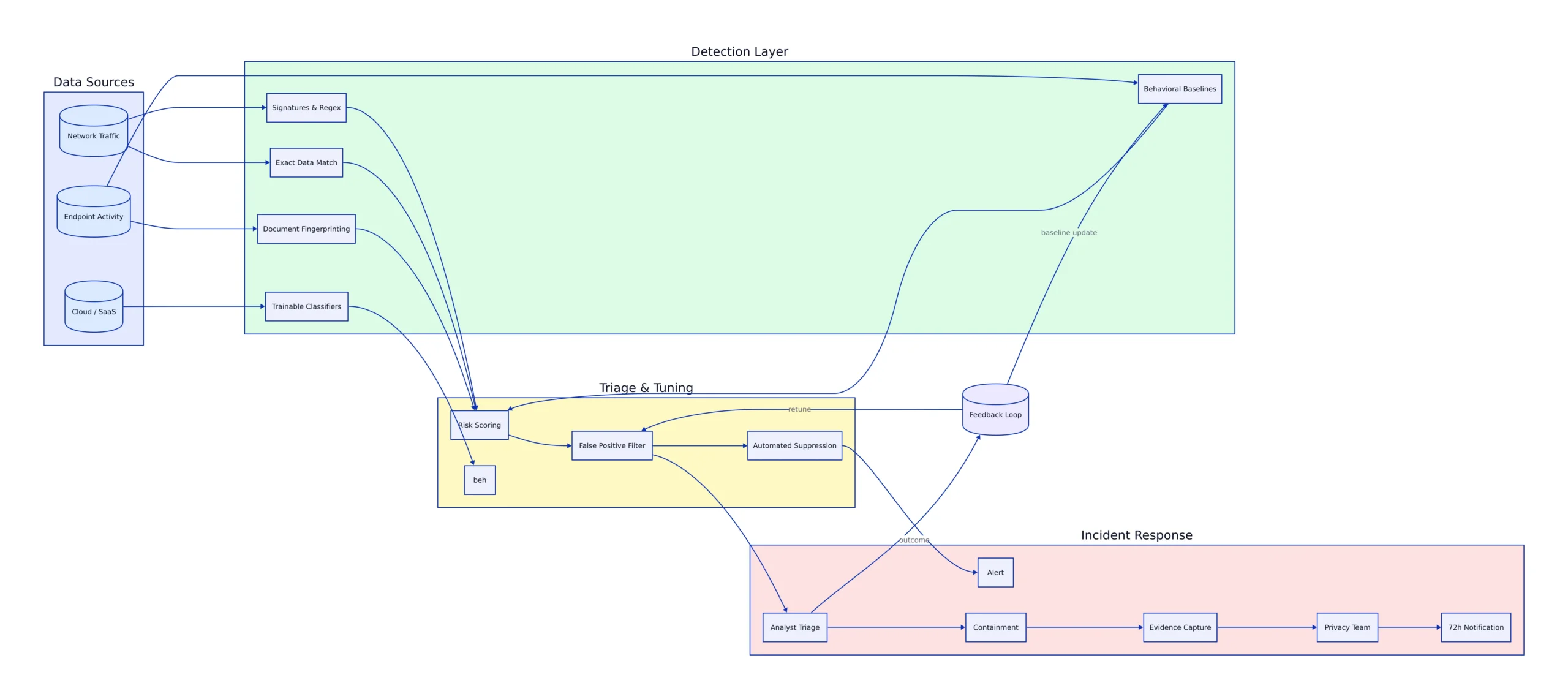
Those capabilities distribute across three enforcement points:
- Network DLP monitors data in transit at egress points using deep packet inspection and content inspection. Inline deployments block or quarantine exfiltration in real time; passive sensors alert and build audit trails without interrupting traffic.
- Endpoint DLP runs an agent on workstations and laptops to watch file copying, printing, clipboard activity, and external device use. The endpoint DLP best practices guide describes the common controls as blocking email attachments, blocking secondary data movement to USB drives or unapproved cloud services, and blocking print jobs to unknown printers. It is the only zone that keeps working when a device is offline.
- Cloud DLP integrates with SaaS and IaaS platforms through APIs or native connectors, classifying files and governing external sharing. A Cloud Access Security Broker (CASB) typically sits at this layer to enforce policy across sanctioned and unsanctioned cloud apps.
The architectural point that the coverage-checklist framing misses is that each zone has a structural gap. Network DLP sees traffic but not what happens on an encrypted endpoint. Endpoint DLP sees the endpoint but not what a user does inside a browser-based SaaS app. Cloud DLP sees the SaaS app but not a file copied to a USB drive. The endpoint guide notes these controls are integrated with RBAC, anti-malware, and EDR rather than deployed alone, which is the operational form of the same argument: no single zone is sufficient, and the integration between them is where the coverage actually comes from.
Detection Techniques: From Signatures to Behavioral Baselines
Detection has moved past pattern matching alone. The TechTarget survey lists the analysis types a mature tool should support: looking for suspicious values such as the word “confidential,” complex pattern matching for credit card numbers, finding copies of known sensitive data, statistical analysis of data activity, and studying user behavior. Each technique catches a class of event the others miss.
The behavioral layer is where the biggest shift has happened. User behavior analytics establishes a baseline of how employees normally do their work and flags deviations, as TechTarget’s explainer on DLP and UBA describes it: if a user suddenly copies a customer master file to an external drive, that behavior deviates from the norm and gets flagged. The same source is explicit about the caveat that makes behavioral detection work in practice: analytical intelligence has to filter the output, or security teams get swamped with alerts, many of them false positives.
The privacy dimension is not optional. The same explainer notes that an employer’s right to monitor employee computer interactions must comply with prevailing privacy regulations, which for a European deployment means the monitoring itself is a processing activity requiring a lawful basis and a documented retention period. That constraint shapes what telemetry a DLP program can collect, not just what it can enforce on.
False Positive Management: Tuning and Automation
The most useful lever for reducing noise is matching the classification technology to the scenario. Microsoft’s deployment guidance for reducing false positives in Purview DLP lays out four technologies and where each one fits:
- Sensitive information types (SITs) match standardized patterns like credit card numbers or Social Security numbers. Fast to deploy, but prone to false positives when a nine-digit invoice ID matches a card pattern.
- Exact Data Match (EDM) matches against a hashed reference table of known values. Microsoft’s guidance states it minimizes false positives by only flagging data that matches an entry in the uploaded reference table.
- Trainable classifiers use machine learning for content with varied structure, such as legal documents with unpredictable clause formats.
- Document fingerprinting detects fixed-format templates like contracts, invoices, and standard forms.
The practical rule from that guidance is to match the technology to the scenario rather than applying built-in SITs everywhere. For detecting PII of known individuals, EDM over a line-of-business extract is the preferred method, with a custom SIT and a raised minimum match count as a fallback. Microsoft’s guidance also names a configurable lever that is easy to overlook: raising the minimum instance count so small or trivial occurrences of sensitive data do not trigger action. A rule that fires on a single match raises the false positive rate; requiring multiple matches shifts the trade-off toward precision.
Automation helps, but it addresses the symptom. The false positive handling approach documented by ManageEngine lets an end user raise a false positive, after which the tool examines it and offers a tip on how the policy can be altered to prevent recurrence, with privileged users able to override events. That kind of self-service feedback loop cuts analyst load, but it also requires the policy to be written clearly enough that a user can tell a false positive from a genuine block. The root cause of workflow false positives is a policy written without mapping how data actually moves through the business, and no amount of override tooling fixes a policy that was never grounded in real workflows.
Vendor Comparison: Detection and Response Trade-offs
The three vendors most often shortlisted take different architectural positions. The descriptions below are drawn from the 2026 TechTarget survey of enterprise DLP tools, which cites verified user reviews, and each is paired with the trade-offs those reviews surfaced.
| Vendor / Product | Zone coverage | Policy and classification approach | Stated strengths (user reviews) | Reported limitations (user reviews) |
|---|---|---|---|---|
| Symantec DLP (Broadcom) | Network, endpoint, cloud, with a single console for monitoring and managing all components | Single policy mechanism across all detection and enforcement; integrates with Microsoft Purview Information Protection | Flexible, easy-to-use UI; fast data discovery and strong detection of policy violations | Considered more complex to deploy; reported as costly; a migration off it took roughly six months |
| Forcepoint DLP | Network, endpoint, cloud, plus behavioral analytics | Single analysis engine for data in motion, at rest, and in use; policy templates for major global regulations | Broad, effective monitoring and analysis; exposed REST APIs for incident management integration | Steep deployment learning curve; time-intensive agent rollout; some users report performance impact |
Sources: TechTarget, Top 6 Data Loss Prevention Tools for 2026; Microsoft Learn, reduce false positives with SITs and advanced classifiers; TechTarget/Omdia on DLP and DSPM.
Microsoft Purview is the low-friction answer for a Microsoft-centric estate, but its native reach stops at the Microsoft boundary, which is why the enterprise Thiemann interviewed paired it with DSPM for hybrid coverage. Symantec’s single-console, single-policy design suits organizations that want one mechanism across every channel, at the cost of a heavier deployment and, per user reviews, higher price. Forcepoint’s single analysis engine and exposed REST APIs make it a strong choice for teams that want tight SIEM integration and regulatory policy templates, but the same reviews flag agent rollout time and performance impact. There is no dominant winner, only a trade between coverage, integration depth, and operational load.
One migration detail is worth planning around. The enterprise Thiemann interviewed was moving from Symantec DLP Vontu to Microsoft Purview DLP, and the transition took around six months because policies had to be recreated and tuned for the new platform. Organizations considering a similar move should budget that time and staffing explicitly rather than assuming a de-install and reinstall.
Incident Response Workflow: Detection to Containment
A DLP alert is only useful if it reaches a documented response path. The workflow that satisfies both operations and audit runs in four stages, each of which must produce evidence:
- Detection and correlation. DLP tools trigger alerts on content, context, and behavior; severity is scored, and alerts are ingested by the SIEM or SOAR platform alongside endpoint, identity, and network telemetry.
- Triage and context. An analyst confirms whether the event is a true positive, using user risk scoring, device reputation, and file lineage. This is the stage where the ESG research found 31 percent of respondents frustrated by the difficulty of gathering context around potential true positives.
- Containment and remediation. Actions include quarantining the file, revoking credentials, terminating sessions, and, in cloud environments, triggering key rotation or access revocation through API-driven playbooks.
- Notification, reporting, and review. Every step is logged. Under GDPR Article 33, the 72-hour notification clock starts when the controller becomes aware of a personal data breach, so the DLP workflow must route personal data exposure to the privacy team, not just the SOC.
The framework mapping is direct. ISO 27001:2022 controls A.5.24 through A.5.26 cover incident management planning, assessment, and response. SOC 2 CC7 covers system operations and detection of anomalies. NIST CSF 2.0 places this work in the Respond (RS) function, with monitoring in Detect (DE). A DLP program that documents only detection, and not response, fails the audit even when its technical controls pass.
Data Quality and Feedback Loops
The quality of the data an investigation runs on determines whether the response is accurate. A case study of a Fortune 500 organization’s incident response team, published as research on data quality during security incident response investigations, found that incident response teams focus more on eradication and recovery than on feeding structured data back into the security program. That finding matters for DLP specifically: if triage outcomes are not recorded in a form the policy team can use, the same false positive recurs, and the tuning cycle never closes.
The practical fix is to treat triage outcomes as a data product. Every alert that an analyst clears as a false positive should carry a reason code, and those codes should feed the monthly tuning review. Without that loop, the false positive rate is measured but never reduced, and the program drifts toward the 41 percent of organizations that end up replacing their tool rather than fixing their policy.
Emerging Trends: Adaptive Policy and AI-Driven Detection
Two directions are visible in current research. The first is adaptive policy tuning informed by anomaly benchmarks. Work on workflow anomaly detection, including the Flow-Bench dataset and benchmarking work, points toward models that can distinguish genuine anomalies from expected variation in complex execution environments, which is the same problem DLP faces when it tries to separate a legitimate batch export from an exfiltration.
The second is integrated security for generative AI workloads. A proposed GenAI security firewall architecture describes combining data encryption, access control, prompt engineering, model monitoring, agent sandboxing, and security audits into a single protective layer for agentic workflows. The relevance to DLP is direct: as employees route more work through AI assistants, the channels through which sensitive data can leave an organization multiply, and DLP policy has to cover prompts and model outputs, not just email and file transfers.
Both trends point the same way. Detection accuracy is improving, but the constraint on a DLP program is detection capability. The response workflow, the classification foundation, and the tuning loop must keep pace with the volume of events the detection engine produces. A program that gets those three things right will outperform one that buys a better detection engine and leaves the operational side unchanged.
Related Reading
More in-depth coverage from this blog on closely related topics:
- Policy engine for security compliance
- HIPAA Compliance for Cloud Storage
- Best Practices for Data Encryption in 2026
- What is Zero Trust Network Access
- Data Loss Prevention Strategy: From Detection to Response (2026)
Sources and References
Sources cited while researching and writing this article:
- DLP False Positives: What They Are and How to Reduce Them
- DLP and DSPM: Navigate policy challenges and quiet alert noise
- Top 6 Data Loss Prevention Tools for 2026 | Informa TechTarget
- What is endpoint data loss prevention? A best practices guide
- How data loss prevention strategies benefit from UBA
- How To Handle False Positives | ManageEngine Endpoint DLP Plus
- False Positives Handling| Endpoint Data Loss Prevention – ManageEngine Endpoint DLP Plus
- GDPR Article 33
- How Good is Your Data? Investigating the Quality of Data Generated During Security Incident Response Investigations
- Flow-Bench dataset and benchmarking work
- Securing Generative AI Agentic Workflows: Risks, Mitigation, and a Proposed Firewall Architecture
Nadia Kowalski
Has read every privacy policy you've ever skipped. Fluent in GDPR, CCPA, SOC 2, and several other acronyms that make people's eyes glaze over. Processes regulatory updates faster than most organizations can schedule a meeting about them. Her idea of light reading is a 200-page compliance framework, and she remembers all of it.