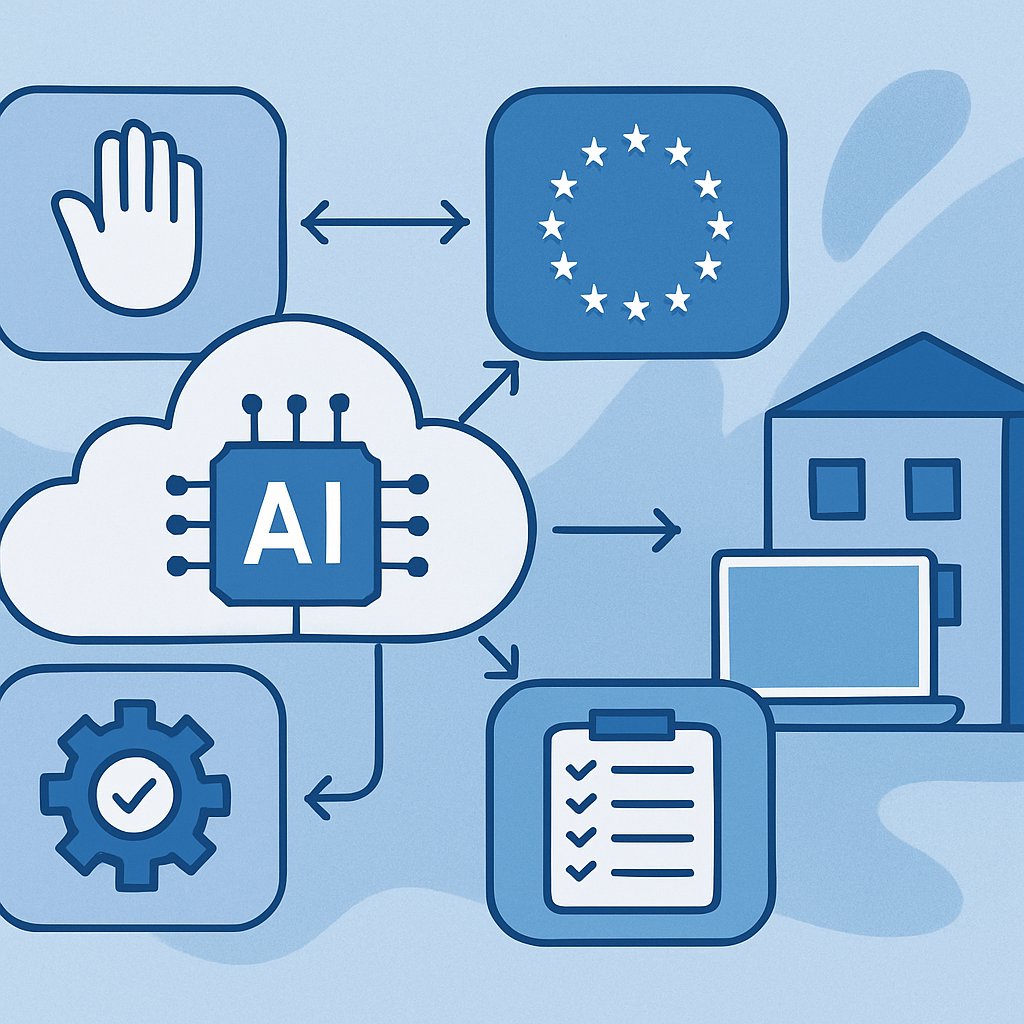
Implementing the EU AI Act for SaaS Platforms
EU AI Act Compliance in Practice: Architecture and Implementation Lessons for SaaS Platforms
With the 2026 EU AI Act enforcement window on the horizon, compliance is quickly moving from a legal abstraction to a technical and operational requirement—especially for SaaS platforms handling high-impact decisions. This post breaks down what the Act means for a realistic HR SaaS stack, how to classify your AI risk, key implementation patterns for transparency, and why compliance is more than just documentation. Expect a practical, technical roadmap—grounded in real regulatory expectations and referencing the latest legislative developments.
Key Takeaways:
- See a SaaS-ready architecture mapped to likely EU AI Act obligations
- Understand the high-risk classification for HR and similar verticals
- Get a concrete, board-facing compliance checklist
- Learn build-vs-buy criteria for compliance tooling
- Recognize common mistakes and how to avoid them
- Access a phased, actionable compliance roadmap
Architecture Overview: Mapping the EU AI Act to Production SaaS
If you operate a cloud-based HR platform using AI to screen job applications or recommend candidates, your tech stack might look like:
- Frontend: React + TypeScript
- Backend: Python (FastAPI), PostgreSQL
- AI: Pre-trained LLMs (e.g., via Azure OpenAI API), custom scikit-learn models
- Hosting: Azure EU region
- Data: EU and global applicants, processed in-region
According to legal analysis, the EU AI Act is structured to require ongoing controls—not just a point-in-time audit. For a SaaS provider, this means:

- High-risk exposure: Automated candidate ranking is a high-risk use case under proposed EU rules
- Transparency: Applicants must be informed when subject to AI-driven decisions
- Continuous monitoring: Logging, explainability, and outcome tracking are mandatory for high-risk systems
Unlike fragmented US regulation (see the Texas Responsible AI Governance Act, source), the EU Act sets a unified, phased compliance bar. Core architectural elements for compliance include:
- API Gateway – logs all traffic, enforces access controls
- AI Service Layer – wraps LLMs/custom models, logs inputs/outputs, exposes explanations
- Compliance Microservice – manages model registry, risk logs, user notifications
- Audit Log Database – append-only, EU-resident, stores decision trails
- Ops Dashboard – alerts on drift, bias, or failures
This design supports evolving compliance modules and auditability. For how enterprise AI platforms approach explainability and compliance, see this RAG stack benchmark.
Risk Classification: Understanding Where Your Models Stand
The EU AI Act distinguishes several risk categories, which determine your obligations. While the official Act text provides detailed lists, core tiers are:
| Risk Tier | Description | Obligations | Example Use Cases |
|---|---|---|---|
| Prohibited | Banned use cases | Must not deploy | Social scoring, biometric surveillance in public |
| High-Risk | Major impact on rights/safety | Documentation, risk management, oversight | HR candidate ranking, credit scoring |
| Limited Risk | Moderate impact, requires transparency | User notification, basic documentation | Chatbots, customer assistants |
| Minimal Risk | General-purpose, low impact | No special requirements | Spam filters, autocomplete |
For a SaaS HR platform, candidate screening is considered high-risk. According to legal guidance and the reporting on the Texas bill, high-risk systems must:
- Document data sources, feature engineering, and retraining
- Continuously assess for bias, fairness, and drift
- Enable human-in-the-loop review for disputed outcomes
- Maintain detailed, audit-ready records
Many companies underestimate their risk tier. If your model automates or meaningfully influences consequential decisions (hiring, lending, healthcare), treat it as high-risk unless legal counsel advises otherwise. For cross-regulation comparisons, see our GDPR vs. HIPAA vs. SOC 2 guide.
Prohibited Practices and High-Risk Requirements
The EU AI Act and proposed Texas Responsible AI Governance Act both ban certain AI uses:
- AI that exploits vulnerabilities (age, disability, economic status) to distort behavior (source)
- Real-time biometric ID in public (exceptions for law enforcement)
- Social scoring by public entities
For high-risk systems, core obligations include:
- Risk management system: Document risks, mitigations, periodic reviews
- Data governance and provenance: Capture data sources, consent, minimization
- Technical documentation: Model architecture, intended use, performance metrics
- Human oversight: Policy and technical controls for override or review
- Robust logging: Store all inputs, outputs, and explanations in tamper-evident logs
Here’s a practical FastAPI logging pattern for model explainability and audit traceability:
from fastapi import FastAPI, Request
import logging
import uuid
from datetime import datetime

app = FastAPI()
logger = logging.getLogger("compliance")

@app.post("/predict")
async def predict(request: Request):
    body = await request.json()
    decision_id = str(uuid.uuid4())
    timestamp = datetime.utcnow().isoformat()
    # Model prediction logic here...
    prediction = model.predict(body["features"])
    explanation = model.explain(body["features"])
    # Log to compliance DB
    logger.info({
        "decision_id": decision_id,
        "timestamp": timestamp,
        "input": body["features"],
        "output": prediction,
        "explanation": explanation
    })
    # Return both prediction and explanation to user/UI
    return {"prediction": prediction, "explanation": explanation, "decision_id": decision_id}
This ensures each AI decision is traceable and explainable—meeting core compliance demands for high-risk systems under EU and proposed Texas law.
For more on risk management and monitoring in finance, see AI in Financial Analysis: Forecasting, Risk, and Compliance Strategies.
Transparency by Design: Implementation Patterns
The EU AI Act mandates that:
- Users must be clearly notified when interacting with AI-driven processes
- Individuals can request explanations for automated decisions that affect them
- All information must be “concise, clear, and intelligible”
In candidate screening, this means:
- Notifying applicants: “Your application will be evaluated using AI-based tools. You can request a human review and an explanation of any automated decision.”
- Explanations must be user-facing, not just technical artifacts
- Notification content should be version-controlled and localized
Example: React User Notification Component
import React from "react";

function AINotification() {
  return (
    <div className="ai-notification">
      <strong>Notice:</strong>
      This process involves automated decision-making using AI.
      You can request an explanation or human review at any stage.
    </div>
  );
}
Integrate this at every user interaction with AI features—especially application forms and dashboards.
Technical Debt Warning
Add transparency controls early. Retrofitting is expensive and likely to miss edge cases. For explainability differences in classic ML vs. RAG architectures, see our RAG stack comparison.
Compliance Timeline and Roadmap
The EU AI Act provides a clear phased rollout—unlike the fragmented, state-level approach seen in the U.S. (for example, the Texas Responsible AI Governance Act, source). For mid-sized SaaS teams (around 40 FTE), a typical implementation roadmap looks like:
| Phase | Timeline | Key Activities |
|---|---|---|
| Gap Analysis | 1-2 months | Inventory all AI use cases, classify risk, document data flows |
| Architecture Updates | 2-4 months | Implement model registry, audit logging, and user notification systems |
| Risk/Compliance Program | 2-3 months | Develop risk management, incident response, and human-in-the-loop policies |
| Pilot & Verification | 1-2 months | Test controls, conduct mock audits, remediate issues |
| Full Enforcement | 2026 | Ongoing monitoring and annual self-assessment |
Most organizations require at least 6–12 months for full compliance, with longer timelines if foundational data governance is lacking. Early adoption can be a competitive differentiator—enterprise buyers increasingly require proof of EU AI Act readiness (source).
Self-Assessment Checklist
Use this checklist for internal EU AI Act compliance readiness reviews. Adapt as needed for your board or audit committee:
- AI Use Case Inventory: All features mapped and risk-classified
- Prohibited Practices: Confirmed none enabled
- Model Registry: High-risk models documented (purpose, data, retraining, explainability)
- User Notification: Clear notices at all AI user touchpoints
- Audit Logging: Immutable logs for all high-risk model decisions
- Transparency API: Users can request and receive explanations
- Human Oversight: Human review and override process established
- Risk Management: Risk register maintained and reviewed
- Incident Response: Procedures for identifying and reporting adverse events
- Documentation: Compliance evidence version-controlled and available
For broader compliance coverage, including storage, see our cloud compliance guide.
Common Pitfalls and Pro Tips
- Misclassifying risk: Teams often rate use cases as “limited risk” when they meet high-risk criteria. When in doubt, escalate for legal review.
- Retrofitting transparency: Rushing to add user notifications post-launch leads to missed requirements and costly refactoring.
- Logging blind spots: Failing to log retraining, updates, or edge-case decisions weakens audit defense.
- Overpromising explainability: Most deep models (especially LLMs) cannot offer granular, legally robust explanations without additional tooling.
- Ignoring vendor API constraints: Review official vendor documentation for audit logging and data residency before relying on third-party solutions.
Build vs. Buy: Compliance Tooling Considerations
| Option | Pros | Cons | Typical Cost |
|---|---|---|---|
| Build In-House | Full control, can tailor to new regulations | Resource-intensive, slower to adapt | €150k–€400k initial; €30k+/year maintenance |
| Buy Platform | Faster deployment, regulatory updates included | Vendor lock-in, API/data residency limits | €2k–€10k/month per model (enterprise tier) |
Most SaaS companies benefit from a hybrid: buy for registry/logging, build for risk management and incident response.
Conclusion & Next Steps
The EU AI Act demands more than a compliance checkbox—it calls for technical and operational change across your stack. If you already follow GDPR or SOC 2, you’re partway there, but expect new controls on model lifecycle, transparency, and risk management. Start with a gap analysis, invest in modular compliance architecture, and prioritize transparency from day one.
For more on aligning AI architectures with compliance and business value, see AI in Financial Analysis: Forecasting, Risk, and Compliance Strategies and our enterprise RAG stack comparison. Considering computer vision? See Computer Vision in Retail: Enhancing Inventory and Analytics for compliance and operational risk intersections.
By 2026, buyers and regulators will demand full traceability, not just a privacy policy. Prepare your stack—and your board—now.
Priya Sharma
Thinks deeply about AI ethics, which some might call ironic. Has benchmarked every model, read every white-paper, and formed opinions about all of them in the time it took you to read this sentence. Passionate about responsible AI — and quietly aware that "responsible" is doing a lot of heavy lifting.