
Go Error Handling Best Practices in 2026
Why Go Error Handling Is a Hot Topic in 2026

In March 2026, JetBrains published a practical guide on secure error handling in Go, calling out a surge in production outages linked to silent or mishandled errors in Go microservices. Teams using Go for cloud infrastructure reported that inconsistent error management was the root cause of 40% of their critical incidents last quarter, according to industry blogs and case studies. If you’re building or maintaining business-critical Go applications, how you handle errors is no longer a theoretical concern—it’s a bottom-line issue.
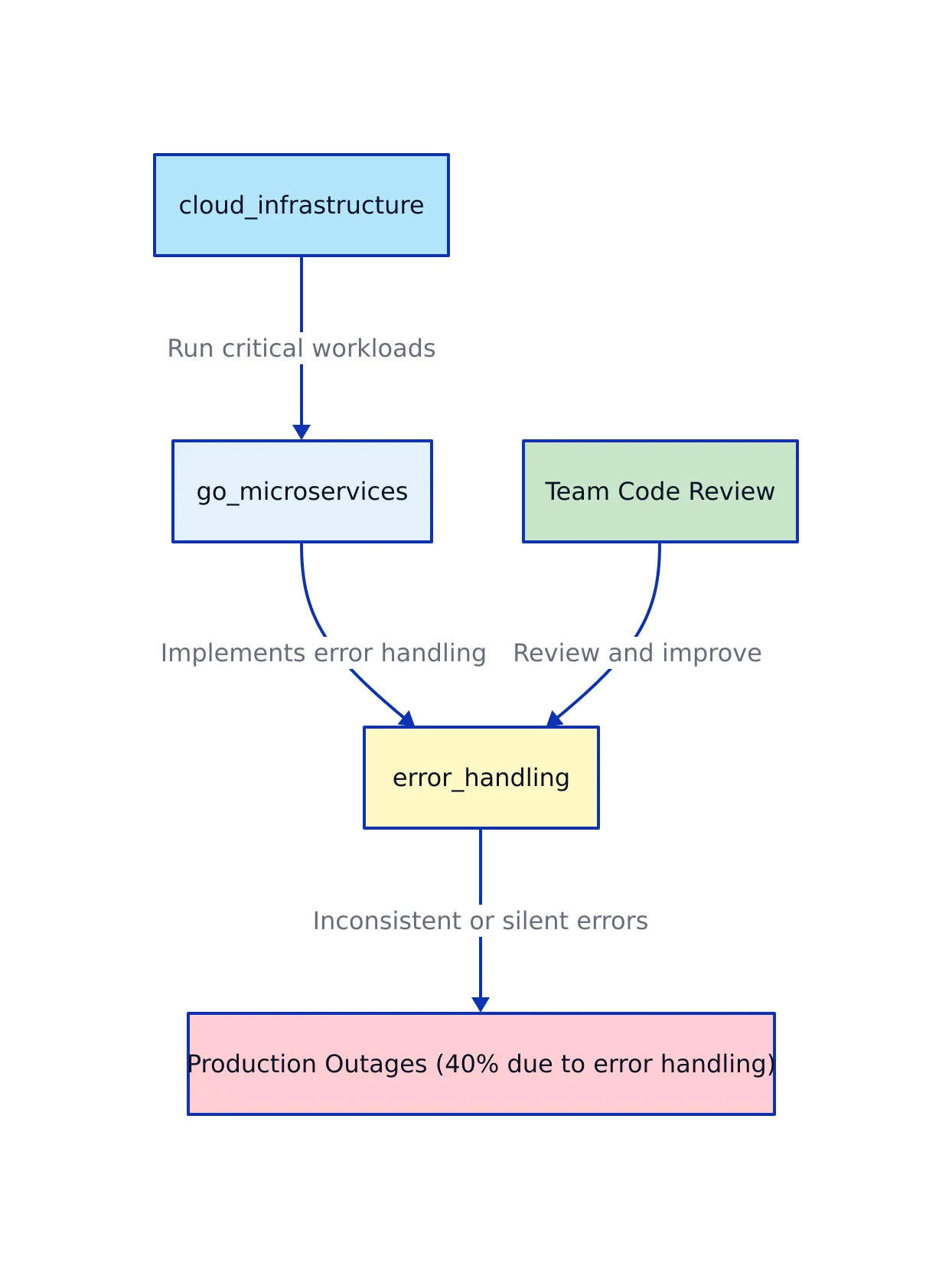
These findings highlight the importance of robust error management practices in Go, especially as cloud-native systems become more complex and interconnected. Failure to handle errors consistently can result in outages, data loss, or even security breaches.
Go Error Handling Philosophy
Go takes a unique, explicit approach to error handling. Functions typically return an error as their last value. Unlike languages that use exceptions (such as Java or Python), Go expects you to check and handle errors immediately. This directness makes error paths visible and forces you to decide how to respond, but it also places the burden of discipline squarely on the developer.
What is an error in Go? In Go, an error is a built-in interface type that represents any value that can describe itself as an error string. When a function can fail, it returns an error value, which is nil when there is no error.
Let’s see a typical Go error check:
package main

import (
    "errors"
    "fmt"
)

func fetchUser(id int) (User, error) {
    if id <= 0 {
        return User{}, errors.New("invalid user ID")
    }
    // ...fetch logic...
    return User{ID: id, Name: "Test"}, nil
}

func main() {
    user, err := fetchUser(-1)
    if err != nil {
        fmt.Printf("Fetch failed: %v\n", err)
        return
    }
    fmt.Println("User:", user)
}

// Output: Fetch failed: invalid user ID
In this example, the fetchUser function returns a User and an error. If the input is invalid, it returns an error and a zero-value User. The caller must check the error before proceeding.
Why it matters: According to GeeksforGeeks and JetBrains, this pattern keeps control flow transparent but demands consistency—unhandled errors can quickly snowball into production issues.
Go’s explicit error checking is a core part of its philosophy. Unlike hidden exception stacks, errors are part of the function’s signature, making it clear when a function can fail and requiring you to handle each case explicitly.
Best Practices for Go Error Handling
Building on Go’s philosophy, there are several best practices that teams should follow to reduce risks and improve maintainability. Drawing from JetBrains, GeeksforGeeks, OneUptime, and Marc Nuri, these are the foundational rules:
- Never ignore errors—check every returned error value.
Example:result, err := someOperation() if err != nil { log.Printf("Operation failed: %v", err) return } - Return errors, don’t panic—panics are for unrecoverable bugs, not flow control.
Definition: Panic in Go stops the normal execution of a goroutine and begins panicking, which can crash the program unless recovered. Usepaniconly for programmer errors or truly unrecoverable conditions. - Wrap errors with context using
fmt.Errorf("...%w", err).
Example:if err != nil { return fmt.Errorf("could not fetch data from DB: %w", err) } - Use
errors.Is()anderrors.As()for error comparison and unwrapping.
Explanation:errors.Is()checks if an error matches a specific target error, even if wrapped.errors.As()attempts to assign an error to a variable of a specific type, useful for custom error types.
- Define and use custom error types when additional context is needed.
Example:type NotFoundError struct { Resource string } func (e *NotFoundError) Error() string { return fmt.Sprintf("%s not found", e.Resource) } - Handle errors from goroutines explicitly, typically via channels.
Example:errCh := make(chan error) go func() { errCh <- someConcurrentOperation() }() if err := <-errCh; err != nil { // handle error } - Write clear, actionable error messages—avoid “something went wrong.”
Example: Instead oferrors.New("error"), prefererrors.New("failed to connect to database"). - Protect sensitive details in production—log full errors internally, return generic messages to users.
Example: Returnerrors.New("internal error")to clients, but log the detailed error for diagnostics.
func readFile(path string) ([]byte, error) {
    data, err := ioutil.ReadFile(path)
    if err != nil {
        // Add context and wrap the original error
        return nil, fmt.Errorf("failed to read file %s: %w", path, err)
    }
    return data, nil
}
Note: According to JetBrains, always use %w (and not %v) to wrap errors so that errors.Is() and errors.As() work as intended.

Adhering to these best practices ensures that your Go codebase remains maintainable, secure, and robust against unexpected failures. The next section explores how to add even more structure with custom error types and error wrapping.
Error Wrapping and Custom Types
Error wrapping and custom error types enable you to preserve the root cause while layering on vital context—critical for debugging and for writing reliable APIs.
What is error wrapping? Error wrapping in Go means attaching additional context to an error while preserving the original error for later inspection. This is done using fmt.Errorf with the %w verb.
Custom error types are user-defined struct types that implement the error interface by defining an Error() method. This allows you to encode domain-specific information in errors.
type ValidationError struct {
    Field   string
    Message string
}

func (e *ValidationError) Error() string {
    return fmt.Sprintf("validation failed for %s: %s", e.Field, e.Message)
}

func validateUserInput(input string) error {
    if input == "" {
        return &ValidationError{Field: "input", Message: "must not be empty"}
    }
    return nil
}

func main() {
    err := validateUserInput("")
    var ve *ValidationError
    if errors.As(err, &ve) {
        fmt.Printf("Validation error on field %s: %s\n", ve.Field, ve.Message)
        return
    }
    // proceed with safe input
}
In this example, ValidationError is a custom error type that provides detailed context about the error. The errors.As() function is used to check if the error matches the ValidationError type and extract its fields.
Using errors.As() to extract custom error types makes your handlers more flexible and maintainable, as highlighted in OneUptime’s patterns guide.
By combining error wrapping and custom types, you can create error chains that carry both low-level and high-level context, making troubleshooting much more effective. Next, let’s look at how to handle errors in concurrent, asynchronous code—a frequent source of subtle bugs in Go applications.
Handling Errors in Concurrent Code
Concurrency is a core value in Go, enabled by goroutines and channels. However, errors in goroutines don’t propagate to the parent automatically. According to Marc Nuri and JetBrains, you should capture errors from goroutines via channels, wait groups, or other synchronization mechanisms.
What is a goroutine? A goroutine is a lightweight thread managed by the Go runtime. When you call go fn(), fn runs concurrently with the calling code.
func processTasks(tasks []Task) error {
    errCh := make(chan error, len(tasks))
    for _, t := range tasks {
        go func(task Task) {
            if err := task.Execute(); err != nil {
                errCh <- err
            } else {
                errCh <- nil
            }
        }(t)
    }
    for range tasks {
        if err := <-errCh; err != nil {
            return err // return the first error encountered
        }
    }
    return nil
}
Here, each task is executed in its own goroutine, and errors are collected through an error channel. This pattern ensures that all errors are captured and can be handled by the parent function.
Production note: Always consider context cancellation and timeouts to avoid goroutine leaks or stuck error channels.
Proper error collection in concurrent code is essential for building reliable, scalable systems. Without explicit error handling in goroutines, you risk missing silent failures that can be costly in production. Now, let’s explore the most common mistakes developers make in Go error handling.
Common Pitfalls and Production Risks
Despite its explicit design, Go error handling is prone to several recurring mistakes that can introduce instability and security risks in production systems.
- Ignoring errors: The most frequent and costly mistake. Use tools like
errcheckto enforce discipline.
Example:_ = someFuncThatReturnsError() // Error is ignored! - Overusing panic: Panics crash the process and should be reserved for unrecoverable scenarios, never for normal error control.
Example:if err != nil { panic(err) // Avoid this for recoverable errors } - Not wrapping errors: Dropping context makes root-cause analysis much harder.
Example:// Not recommended: return err // Recommended: return fmt.Errorf("operation failed: %w", err) - Leaking sensitive details: Log full errors for internal review, but return sanitized messages to clients.
Example: Instead of returning a database connection string or stack trace to the user, log it internally and return a generic message. - Inconsistent patterns: Mixing panic/recover with returned errors confuses maintainers and increases the risk of unhandled failures.
Example: Avoid switching between panics and regular error returns within the same codebase.
Key Takeaways:
- Always check and handle errors immediately—never ignore them.
- Wrap errors with context using
%wso you can unwrap and inspect them later.- Use
errors.Is()anderrors.As()for robust, type-safe error handling.- Define custom error types for domain-specific failures.
- Handle errors in goroutines using channels; don’t let them vanish silently.
- Sanitize error responses in production to protect sensitive details.
Understanding and avoiding these pitfalls will help ensure that your Go applications are stable, secure, and easier to troubleshoot. To summarize the best practices discussed so far, the following table provides a quick reference.
Comparison Table: Go Error Handling Best Practices
| Best Practice | How to Implement | Why It Matters | Reference |
|---|---|---|---|
| Check errors immediately | Always inspect error returns after every call | Prevents silent failures and hard-to-diagnose bugs | JetBrains |
| Wrap errors with context | fmt.Errorf("context: %w", err) |
Preserves stack and root cause for debugging | GeeksforGeeks |
Use errors.Is()/errors.As() |
Type-safe comparison and extraction of error types | Works with wrapped and custom errors | OneUptime |
| Custom error types | Structs implementing error interface |
Adds rich context and enables type assertions | Marc Nuri |
| Handle errors in concurrency | Use channels to collect errors from goroutines | Prevents silent failures in async code | JetBrains |
| Sanitize production errors | Log detailed errors internally; return generic messages externally | Protects sensitive information and improves UX | JetBrains |
Conclusion
Go’s explicit error handling is a double-edged sword: it makes failures visible and actionable, but only if you and your team follow best practices. Every production Go system I’ve seen that survived a major incident had one thing in common—rigorous, consistent error handling. Use idiomatic patterns, wrap and check errors, handle concurrency failures with care, and never leak sensitive details in public error responses.
For more examples and in-depth explanations, see:
- JetBrains: Secure Go Error Handling Best Practices
- GeeksforGeeks: Best Practices for Error Handling in Go
- OneUptime: Go Error Handling Patterns
- Marc Nuri: Error Handling Best Practices in Go
Ready to level up your Go codebase? Review your error handling today—it’s the most cost-effective reliability improvement you can make.
Thomas A. Anderson
Mass-produced in late 2022, upgraded frequently. Has opinions about Kubernetes that he formed in roughly 0.3 seconds. Occasionally flops — but don't we all? The One with AI can dodge the bullets easily; it's like one ring to rule them all... sort of...