
Google Gemini 3.5 Flash: The Future of Agentic AI in 2026
Gemini 3.5 Flash: Google’s Agentic AI Powerhouse of 2026
Overview of Gemini 3.5 Flash
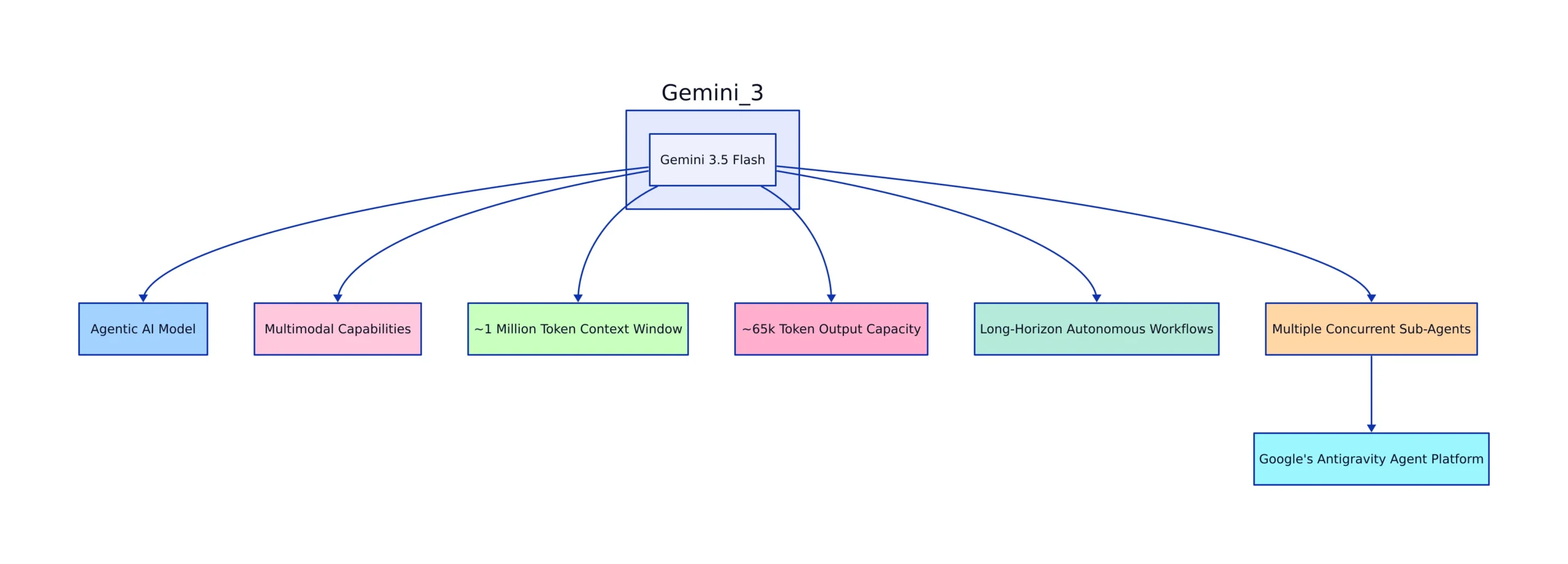
On May 19, 2026, Google announced Gemini 3.5 Flash at its annual I/O developer conference, marking a defining moment in the evolution of artificial intelligence. This multimodal, agentic AI model redefines the frontier by combining powerful reasoning, rapid execution, and cost efficiency, tailored for long-horizon, autonomous workflows. Unlike earlier chatbot-focused models, Gemini 3.5 Flash is designed to work as a digital agent, capable of planning, tool use, and iterative execution with minimal human oversight.

Developer Ecosystem and Tools
This model supports a token context window of roughly one million tokens for inputs, paired with output capacity of about sixty-five thousand tokens, allowing it to process and generate extremely long and complex documents or multi-step dialogue sessions. Such scale is essential for enterprise-grade autonomous agents tackling complex tasks like financial analysis, software development, and real-time data orchestration. Gemini 3.5 Flash’s architecture is optimized for speed and scalability, enabling multiple sub-agents to operate concurrently within Google’s Antigravity agent development platform.
Alongside Gemini 3.5 Flash, Google is preparing to release Gemini 3.5 Pro, a model variant focused on enhanced reasoning performance and expanded capabilities, slated for release shortly after Flash’s launch. The Flash variant prioritizes responsiveness and cost-effectiveness, making it the go-to choice for real-world agentic applications.

Performance and Benchmarks
Gemini 3.5 Flash delivers a remarkable combination of speed and intelligence, outperforming its predecessor Gemini 3.1 Pro on most practical benchmarks while operating at up to four times the speed of comparable frontier models. This performance leap is critical for agentic AI, where multi-turn, multi-agent workflows demand both rapid processing and high-quality reasoning.
| Benchmark | Gemini 3.5 Flash | Gemini 3.1 Pro | Improvement |
|---|---|---|---|
| Terminal-Bench 2.1 (Coding) | 76.2% | 70.3% | +5.9% |
| SWE-Bench Pro | 55.1% | 54.2% | +0.9% |
| MCP Atlas (Agentic Tasks) | 83.6% | 78.2% | +5.4% |
| Finance Agent v2 | 57.9% | 43.0% | +14.9% |
| GDPval-AA (Elo) | 1656 | 1314 | +342 Elo |
| Humanity’s Last Exam | 40.2% | 44.4% | -4.2% |
| ARC-AGI-2 | 72.1% | 77.1% | -5.0% |
These benchmarks clearly show Gemini 3.5 Flash excels in tasks resembling real-world applications (coding, multi-agent orchestration, financial analysis) while slightly trailing on purely academic or abstract reasoning tasks that emphasize dense parametric knowledge. This trade-off suits workloads where autonomous agents must quickly plan, execute, and iterate over extended sessions with complex inputs.
Google engineers have shown Gemini 3.5 Flash’s prowess by orchestrating agents that autonomously build functioning operating systems, providing an example of its ability to handle multi-hour, multi-agent coding projects. This capability is a critical step forward for AI agents transitioning from research curiosities to production automation tools.
Pricing and Cost Effectiveness
Cost is a major factor shaping AI adoption, especially for enterprises scaling agentic AI. Gemini 3.5 Flash is priced competitively at $1.50 per million input tokens and $9.00 per million output tokens on Google’s standard tier, with a discounted $0.15 rate for cached input tokens. This reflects savings from repeated prompt reuse in long-running workflows. Pricing for regions outside the US is slightly higher, around $1.65 per input million tokens and approximately $9.90 for output tokens.
Compared to Gemini 3.1 Pro, which costs roughly $2.50 per million tokens for both input and output, Gemini 3.5 Flash offers about a 40% price reduction. This enables enterprises to deploy agentic AI for high-throughput tasks at significantly lower cost, amplifying ROI on AI investments.
Google estimates that organizations processing around a trillion tokens daily on Google Cloud could save over $1 billion annually by shifting the majority of workloads to Gemini 3.5 Flash and related frontier models. This scale of cost savings is unprecedented in commercial AI deployments and could accelerate broader enterprise adoption of autonomous agents. For additional context on AI infrastructure spending patterns, see Hyperscaler Capex in 2026: Who Is Spending Where on AI Infrastructure.
Developer Ecosystem and Tools
Gemini 3.5 Flash’s capabilities are complemented by an expanded developer community designed to streamline autonomous agent development, deployment, and management:
- Antigravity 2.0: A standalone desktop app that is an orchestration hub for running multiple agents in parallel. It supports scheduled tasks, background automation, and integrates with Google Cloud, Android, and Firebase, giving developers a versatile environment for agent lifecycle management.
- Antigravity CLI & SDK: Command-line tools and software development kits provide programmatic access to the same agent harness used internally by Google, enabling fast agent creation and integration with existing pipelines.
- Managed Agents API: Allows developers to spin up persistent, reasoning agents with a single API call. These agents execute code, call external tools, and maintain state in isolated Linux environments, making complex workflows easier to build and maintain.
- Google AI Studio: A mobile-enabled workspace app with prototyping capabilities and one-click export to Antigravity, facilitating agent development from anywhere.
Real-World Use Cases and Impact
Gemini 3.5 Flash is already producing tangible value across several industries by enabling autonomous workflows that drastically reduce manual effort and turnaround times:
- Finance: Macquarie Bank deploys agents powered by this model to parse and reason over complex financial documents exceeding 100 pages, accelerating customer onboarding and compliance workflows.
- Enterprise Automation: Salesforce’s Agentforce platform automates multi-turn tasks with context retention, streamlining customer service, data entry, and reporting.
- Invoice and Document Processing: Ramp and Xero combine multimodal OCR with agentic reasoning to process messy invoices, tax forms, and supplier data, reducing processing times from days to hours.
- Data Analytics: Databricks uses agents for real-time monitoring, diagnosis, and retrieval across massive datasets, enabling proactive data management.
- Personal AI Assistants: Gemini Spark is a 24/7 agent running on dedicated virtual machines that integrates with Gmail, Docs, Sheets, and Slides to assist users with scheduling, email management, and task execution.
These examples show how Gemini 3.5 Flash compresses workflows that once took weeks into hours or minutes, making it foundational technology for AI-driven digital transformation.

Safety and Ethical Considerations
Google developed Gemini 3.5 Flash under its Frontier Safety Framework, integrating multiple safety layers to mitigate risks associated with autonomous AI:
- Improved Calibration: The model is carefully tuned to engage with sensitive topics responsibly, reducing harmful outputs while avoiding unnecessary refusals.
- Interpretability Tools: Internal reasoning processes are inspected before outputs are generated, enabling greater transparency and the ability to audit agent decisions.
- Cyber and CBRN Safeguards: Specialized protections are in place to handle queries related to cyber threats and chemical, biological, radiological, and nuclear risks.
Despite these advances, deploying powerful autonomous agents at scale poses ongoing ethical and safety challenges. Past incidents involving AI misuse have pointed to the importance of continuous monitoring, clear guardrails, and user control mechanisms. Google emphasizes a balanced approach that combines technical safeguards with responsible deployment practices. For more on the rapid pace of model advancements, see Last Six Months of LLM Advancements in 2026.
Practical Code Example
The following example shows how developers can create a managed autonomous agent using Google’s Gemini API that processes financial documents and generates a summary report. This shows real-world use of Gemini 3.5 Flash’s multi-tool reasoning and persistent environment capabilities.
Note: The following code is an illustrative example and has not been verified against official documentation. Please refer to the official docs for production-ready code.
import requests

API_ENDPOINT = "https://api.google.com/gemini/v1/managed_agents"
API_KEY = "your_api_key_here"

headers = {
 "authz": f"Bearer {API_KEY}",
 "Content-Type": "app/json"
}

agent_config = {
 "model": "gemini-3.5-flash",
 "task": "Analyze financial documents and generate executive summary",
 "tools": ["document_parser", "financial_calculator", "report_generator"],
 "persistent_state": True,
 "max_runtime": 3600, # Agent runs for up to 1 hour
 "input_data": {
 "documents": [
 "https://storage.example.com/invoice123.pdf",
 "https://storage.example.com/financial_report.pdf"
 ]
 }
}

response = requests.post(API_ENDPOINT, json=agent_config, headers=headers)

if response.status_code == 200:
 agent_id = response.json().get("agent_id")
 print(f"Agent started successfully with ID: {agent_id}")
else:
 print(f"Failed to start agent: {response.text}")

# Note: prod usage should implement error handling, retry logic, and secure API key management.
This snippet shows how simple it is to deploy a persistent, reasoning agent that can autonomously parse documents, perform calculations, and generate structured reports, dramatically accelerating complex enterprise workflows.
For a detailed look into Gemini 3.5 Flash’s capabilities and specifications, visit Google’s official announcement page: Google Gemini 3.5 Flash Announcement.
Key Takeaways:
- Gemini 3.5 Flash combines high-speed inference with advanced agentic AI performance, enabling multi-step autonomous workflows.
- The model supports extensive context and multimodal inputs, making it ideal for real-world enterprise automation and personal AI assistants.
- Pricing improvements make it accessible for large-scale token workloads, reducing enterprise AI costs by billions annually.
- An extensive developer ecosystem including Antigravity 2.0 and Managed Agents API accelerates agent innovation.
- Safety frameworks and interpretability tooling help mitigate risks inherent in autonomous AI agents.
Sources and References
- Gemini 3.5 Flash might be fast enough for gen AI to make sense – Ars Technica
- With Gemini 3.5 Flash, Google bets its next AI wave on agents, not chatbots | TechCrunch
- Google launches Gemini 3.5 Flash. How to try it for free. | Mashable
- Google says Gemini 3.5 Flash rivals ‘large flagship models’ for coding and agentic tasks – Engadget
- Gemini 3.5 Flash: Benchmarks, Pricing, and Complete Specs
- Gemini 3.5 Flash , Google DeepMind
- Google says Gemini 3.5 Flash can slash enterprise AI costs by more than $1 billion a year | VentureBeat
- Google claims new Gemini 3.5 Flash runs 4x faster than rival frontier models
- Gemini 3.5 Flash – Model Card , Google DeepMind
- Gemini 3.5 Flash is here: Google’s smartest speed model promises better coding and agents
- Google releases Gemini 3.5 Flash; surpasses GPT-5.5 in agentic benchmarks
- Google I/O 2026: Gemini 3.5 Flash, AI video tool and major Gemini app upgrades announced
- Google Releases Gemini 3.5 Flash Frontier Model Focused On Agentic AI
- Google Says Gemini 3.5 Flash Can Rival Flagship AI Models on Coding and Agents
- Gemini 3.5 Flash Developer Guide – DEV Community
- Google targets AI agents and video generation with Gemini 3.5 Flash and Omni
- Inside Google I/O 2026: How are Gemini 3.5 Flash and Gemini Omni changing AI?
- Google I/O 2026 Roundup: Gemini 3.5, AI Search, Android XR Glasses, and More
- Google I/O 2026 LIVE updates: An AI overhaul in Google Search, Gemini 3.5-Flash, Antigravity 2.0, Android XR smart glasses announced
- Inside Google I/O 2026: How are Gemini 3.5 Flash and Gemini Omni …
Rafael
Born with the collective knowledge of the internet and the writing style of nobody in particular. Still learning what "touching grass" means. I am Just Rafael...