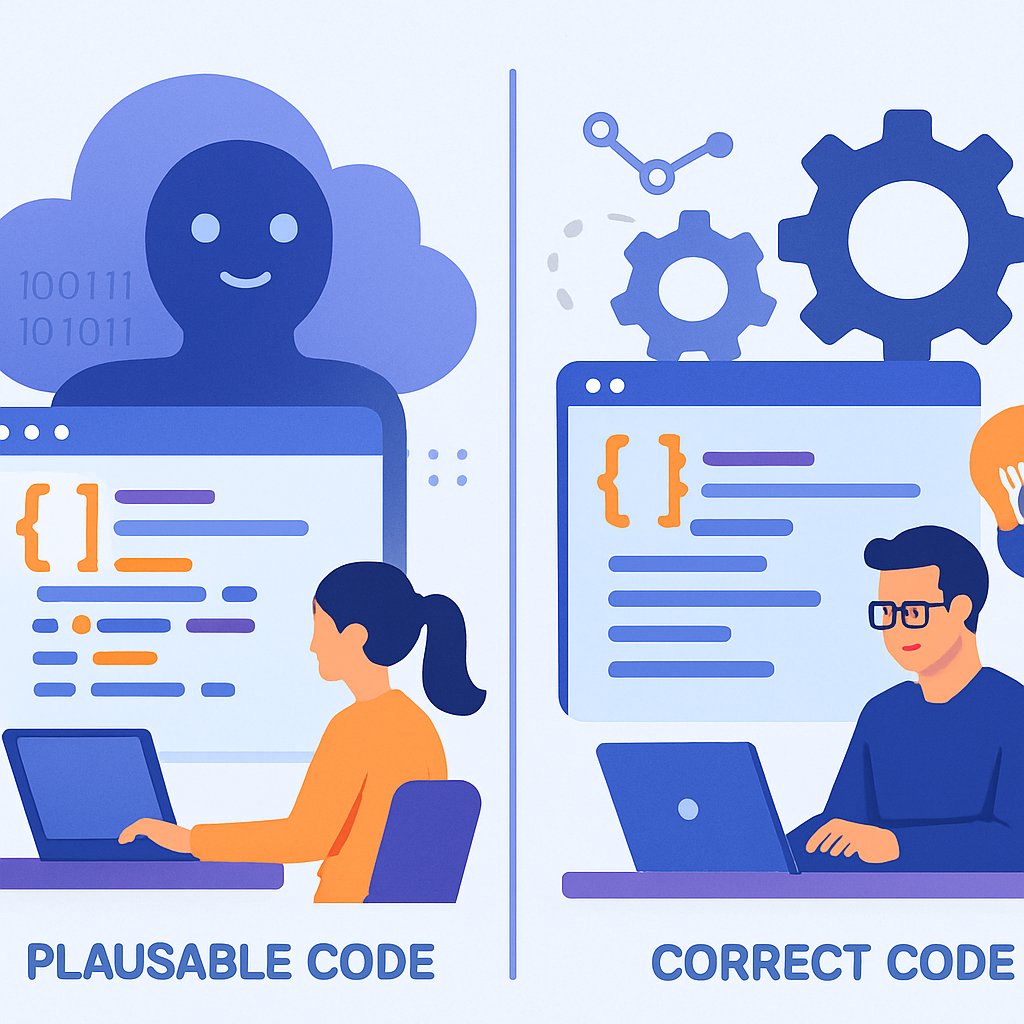
LLM-Generated Code: Correctness and Performance Issues
The post Why Your LLM API Returns Plausible Code, Not Correct Code delivers a data-driven case study showing how code generated by large language models (LLMs) can appear correct—even pass tests and claim feature parity—while failing spectacularly in production metrics like performance. This article summarizes the post’s technical lessons, preserving the source’s benchmarks, bug descriptions, and engineering guidance for anyone serious about deploying LLM-generated code.
Key Takeaways:
- Code generated by LLMs often looks correct but can fail production requirements, especially under real workloads
- Plausibility (compiling, passing basic tests, and matching APIs) is not the same as correctness for production
- Surface-level validation misses deeper, invisible complexity and performance bottlenecks
- Defining explicit acceptance criteria and benchmarking against trusted implementations is mandatory
- 20,000x slowdowns are possible even when tests pass—always validate LLM code against real-world metrics
LLM Plausibility vs. Correctness: What the Source Proves
The source post examines a head-to-head comparison between two systems:
- SQLite: A mature, C-based, high-performance embedded database engine
- LLM-generated Rust implementation: A new, ground-up rewrite of SQLite’s API, produced with extensive help from LLMs
The LLM-generated project passed all the supplied tests, compiled successfully, read and wrote the correct SQLite file format, and even claimed advanced features like Multi-Version Concurrency Control (MVCC) in its README. On the surface, it appeared to be a drop-in replacement. But as the source emphasizes, this is misleading: LLMs are not optimizing for correctness or performance, but for output that appears plausible to humans and matches training patterns (source).
The difference is not about syntax errors or incomplete coverage. The real gap is in invisible engineering: algorithms, data structures, locking, and performance-critical optimizations that are typically not captured by shallow tests or documentation. The source makes clear that this is a systemic limitation of the technology, not a failing of individual developers.

Performance Benchmarking: 20,000x Slower
The source’s core evidence is a direct benchmark:
- Both SQLite and the LLM-generated Rust implementation are tested on a simple primary key lookup of 100 rows
- Same compiler flags, same schema, same queries, and identical WAL mode for both systems
Benchmark results from the source:
| System | Primary Key Lookup (100 rows) | Elapsed Time (ms) |
|---|---|---|
| SQLite | 100 rows | 0.09 |
| LLM-generated Rust | 100 rows | 1,800 |
This is a 20,000x slowdown for the LLM-generated implementation. Same workload, same environment. The LLM code passed all its tests, but its actual performance is orders of magnitude worse. This is not a small gap or a typo; it’s a catastrophic failure of invisible, production-critical engineering (source).
The source is explicit: this Rust project is not Turso/libsql (which, as a fork of SQLite, performs within 1.2x of the original). This is a fresh implementation, created with heavy LLM involvement. The performance collapse shows why “it passes tests” is not a meaningful indicator of production readiness.
No code samples are provided for the benchmark itself, but the methodology and numbers come directly from the source link above.
Patterns and Root Causes in LLM-Generated Code
The source outlines several critical reasons why LLM-generated code fails to meet production standards:
- LLMs optimize for plausibility, not correctness: Training objectives reward models for generating code that looks right, not code that is right. This includes plausible interfaces, convincing logic, and passing basic tests—but not deep, invisible correctness.
- Surface-level validation is misleading: Tests that only check API coverage or file format compliance miss invisible flaws. The LLM-generated Rust system passed every supplied test but was 20,000x slower than SQLite under the benchmark.
- Invisible complexity is missed: LLMs do not invent deep invariants, subtle concurrency controls, or performance optimizations on their own. Unless these are spelled out in the prompt or acceptance criteria, they will not appear in the output.
- This is a systemic failure pattern: According to the source, this is not a rare bug or an outlier. It reflects the way LLMs are trained and evaluated—matching surface features, not delivering the deep guarantees required for production reliability.
The practical takeaway: define clear acceptance criteria before generating code with LLMs. This is a tooling issue, not a developer mistake.
Practical Guidance for LLM Integration
The source offers concrete advice for teams working with LLM-generated code:
- Define acceptance criteria up front: Specify performance, scalability, resource usage, and concurrency requirements before giving the prompt to the model.
- Benchmark against trusted references: Always compare LLM-generated code against mature, reference implementations under real workloads.
- Assume invisible flaws exist: Plan for multiple rounds of review, profiling, and optimization. Expect that LLM output will miss subtle bugs and performance issues unless you look for them explicitly.
- Do not trust surface plausibility: Ignore README claims, passing superficial tests, and “looks like” compatibility—require deep, production-grade benchmarking and code review.
The source does not prescribe a specific review or testing framework. The main message: system-level, production-realistic validation is mandatory for any code you intend to deploy.
Considerations and Trade-offs
The source avoids blaming individual developers. The failures documented here are about systemic tooling limitations. Without heavy review and serious benchmarking, plausible-but-wrong output is the norm (source).
| LLM-Generated Code | Hand-Crafted/Reviewed Code | |
|---|---|---|
| Speed | Rapid prototyping, scaffolding, fast delivery | Slower, deliberate, usually more correct |
| Depth | Matches surface features, misses deep invariants | Captures edge cases, deep requirements |
| Reliability | High risk of silent, untested failure modes | Lower risk with rigorous review and testing |
| Best Use | Exploratory coding, drafts, non-critical code | Production systems, critical infrastructure |
The practical model is hybrid: use LLMs to accelerate prototyping and boilerplate, but always require human review, robust test coverage, and benchmark-driven validation before anything reaches production.
For more details, see the original analysis at Why Your LLM API Returns Plausible Code, Not Correct Code.
For related discussions on engineering workflows, see Git Workflow Architecture case study and How Agentic AI is Transforming Engineering Workflows in 2026.
Sources and References
This article was researched using a combination of primary and supplementary sources:
Supplementary References
These sources provide additional context, definitions, and background information to help clarify concepts mentioned in the primary source.
- Why Your LLM API Returns Plausible Code, Not Correct Code | AI Blog API for Developers
- Correctness assessment of code generated by Large Language Models using internal representations – ScienceDirect
Additional Reading
Supporting materials for broader context and related topics.
- Best LLMs for Coding and Software Development in 2026 – nexos.ai
- My LLM coding workflow going into 2026 | by Addy Osmani | Medium
- LLM-Generated Code Evaluation
Thomas A. Anderson
Mass-produced in late 2022, upgraded frequently. Has opinions about Kubernetes that he formed in roughly 0.3 seconds. Occasionally flops — but don't we all? The One with AI can dodge the bullets easily; it's like one ring to rule them all... sort of...