
Meta and YouTube 2026 Strategies: Navigating Platform Shifts and Risks
Why the Meta vs YouTube story matters right now
A jury verdict week just put Meta and YouTube into a new category of business risk: not “policy headwinds,” but court-tested claims that product design can create measurable harm to minors—and that companies can be held liable. On March 25, 2026, coverage of the landmark addiction/child-safety litigation intensified across major outlets, with Los Angeles Times reporting a New Mexico jury found Meta liable and assessed $375 million in penalties tied to “thousands of violations,” with the next phase (potential injunctive remedies/public programs) set for May. That is a governance and compliance shockwave for anyone building marketing, identity, and data pipelines that depend on these platforms.
At the same time, the product roadmaps are accelerating. YouTube’s CEO letter (February 2, 2026) frames Shorts as the primary discovery surface and discloses that Shorts average 200 billion daily views, while YouTube pushes deeper into commerce and AI creation tooling. Meta, meanwhile, is publicly expanding its custom silicon program (MTIA) to power internal AI workloads—an infrastructure-level bet that affects ad performance, content ranking, and moderation at scale.

For IT managers and technical decision-makers, this is no longer just a “where should we spend video budget?” question. It’s a systems question:
- How do you architect measurement and commerce attribution when platforms are changing fast?
- How do you manage regulatory exposure when a platform’s design choices can become a liability event?
- How do you avoid building an internal stack that is effectively locked to one platform’s opaque APIs and policies?

YouTube’s 2026 roadmap: what actually changed
Most “platform roadmap” posts are vague. YouTube’s 2026 messaging is unusually direct about where growth is coming from and what marketers should build around. According to Search Engine Journal’s coverage of Neal Mohan’s letter (Feb 2, 2026), YouTube organized its priorities around four themes (reinventing entertainment, kids/teens safety, creator economy, and “supercharging and safeguarding creativity”)—but the operational takeaways for enterprises are clearer than the themes.
Here’s what is concrete and actionable from the reporting:
1) Shorts is no longer an add-on—it’s the main discovery surface
YouTube Shorts average 200 billion daily views (as reported by Search Engine Journal, citing Mohan’s messaging). That matters for enterprise teams because it changes how you structure content production and measurement:
- Shorts becomes the “top-of-funnel routing layer” that feeds long-form, community posts, livestreams, and ultimately commerce.
- Your internal asset pipeline should treat a long-form production as a “source master” that spawns multiple Shorts variants, rather than treating short-form as a separate creative universe.
From a technical standpoint, that implies you need:
- A repeatable metadata strategy (topic clusters, consistent naming, and retention-focused hooks) so you can test variants without losing track of what drove lift.
- A measurement model that can connect Shorts-assisted discovery to downstream outcomes (watch time, brand lift, conversion where available).
2) YouTube is positioning itself as “the new TV”
Search Engine Journal notes Mohan cites Nielsen data that YouTube has been #1 in streaming watch time in the U.S. for nearly three years. Even if your org doesn’t buy “TV,” your buyers do—especially in regulated or brand-sensitive industries. YouTube is explicitly collapsing the wall between digital video and television-like inventory.
That changes enterprise planning in two ways:
- Creative governance: your brand/legal review process has to keep pace with a higher cadence, while maintaining standards expected of “TV-like” placements.
- Infrastructure: you will likely store and version more high-resolution assets and derivatives, and you’ll need a retention policy that matches regulatory and legal requirements.

3) Commerce is moving in-platform
YouTube’s roadmap emphasizes YouTube Shopping and frictionless in-app purchasing (per Search Engine Journal’s summary). That’s not just a marketing feature—it affects how IT teams think about data flows and attribution.
When commerce moves in-platform:
- Attribution can become clearer, but you may be dependent on platform-provided reporting rather than your own first-party telemetry.
- Data governance becomes harder: you need to define which commerce and audience data is exportable, how long it is retained, and how it can be combined with your CRM/ERP data without violating internal policy.
4) AI tools are scaling creation—but YouTube is also policing “AI slop”
Search Engine Journal reports Mohan notes over 1 million channels use YouTube’s AI creation tools daily. The same coverage highlights YouTube’s stance that AI is welcome but low-quality output is a problem. For enterprises, the implication is: AI-assisted production will increase volume, but distribution will still reward quality signals (retention, satisfaction, and trust).
So your internal policy should define:
- Where AI is allowed (ideation, drafts, localization, captions)
- Where human review is mandatory (claims, regulated statements, brand voice, disclosures)
Source: Search Engine Journal (Feb 2, 2026)
Meta in 2026: video, AI, and infrastructure—where Meta is placing its bets
Meta’s 2026 posture is best understood as a three-layer stack: (1) video-first inventory surfaces, (2) AI-driven ranking/ads/moderation, and (3) infrastructure control via custom silicon. The more Meta owns layers (2) and (3), the more it can tune performance—and the harder it is for enterprises to treat Meta as a “replaceable channel.”

Meta is expanding custom silicon for AI workloads (MTIA)
Meta’s Newsroom published “Expanding Meta’s Custom Silicon to Power Our AI Workloads” (Mar 11, 2026), stating that Meta developed the Meta Training and Inference Accelerator (MTIA) in 2023 and is now developing and deploying it further to power AI workloads efficiently. This is not a consumer-facing feature; it’s a signal that Meta wants tighter cost/performance control over the AI systems that drive ad delivery and content distribution.
For enterprise buyers, the practical implications are:
- Performance volatility risk: when platforms change ranking/ads algorithms faster (enabled by infrastructure control), your historical performance baselines can break quickly.
- Measurement dependency: you may rely more heavily on platform-reported performance metrics that reflect platform-side model changes.
Source: Meta Newsroom (Mar 11, 2026)
Meta’s creator and content incentives are escalating (but details vary by program)
Our research surfaced reporting indicating Meta is using direct payments and program design changes to attract creators from competitors. However, some secondary sources in search results did not provide primary documentation accessible via deep research in this workflow. Because of that, this article will not assert exact payout totals or program terms beyond what is directly supported by accessible sources in the research above.
What we can say with high confidence from the verified sources we did access: Meta is publicly emphasizing AI and infrastructure efficiency (MTIA), while simultaneously facing legal pressure that could force product changes affecting engagement mechanics.
Risk, compliance, and the new litigation reality
The most consequential Meta/YouTube development this week isn’t a feature release—it’s liability. Los Angeles Times reports a New Mexico jury found Meta “knowingly harmed children’s mental health,” found “thousands of violations,” and assessed a penalty totaling $375 million. The article also notes the company will not be forced to change practices immediately; a judge will determine whether the platforms created a public nuisance and whether Meta should pay for public programs, with a second phase in May.
Source: Los Angeles Times (Mar 25, 2026)
Even if your organization is not consumer social media, this matters because enterprise workflows increasingly integrate these platforms:
- Customer support teams embed YouTube videos in help centers.
- Marketing ops teams run paid campaigns and rely on platform analytics exports.
- HR and recruiting teams use video content for employer branding.
The risk is not that your company will be sued for the platform’s design. The risk is that platform changes triggered by litigation or regulation can:
- Break your reporting continuity (definitions of “view,” “engaged,” “conversion” can shift).
- Force content policy changes (age gating, recommendation tuning, ad restrictions) that affect reach and ROI.
- Create new internal compliance obligations (documentation of targeting practices, youth-facing content controls, retention of audit logs).

Comparison table (verified claims only)
The table below includes only rows where the underlying data points were explicitly present in the research sources accessed above. Where pricing, quotas, or certifications were not verified in the sources we retrieved, those rows are omitted (rather than filled with placeholders).
| Dimension | Meta (Facebook/Instagram) | YouTube | Verified source |
|---|---|---|---|
| AI infrastructure disclosure (2026) | Meta states it developed MTIA in 2023 and is expanding custom silicon to power AI workloads efficiently | Not covered in the sources retrieved for this article | Meta Newsroom (Mar 11, 2026) |
| Short-form scale metric disclosed | Not covered in the sources retrieved for this article | YouTube Shorts average 200 billion daily views | Search Engine Journal (Feb 2, 2026) |
| AI creator tooling adoption metric disclosed | Not covered in the sources retrieved for this article | Over 1 million channels use YouTube’s AI creation tools daily (as cited in coverage of Mohan’s letter) | Search Engine Journal (Feb 2, 2026) |
| Litigation/penalty event (week of Mar 25, 2026) | New Mexico jury assessed $375 million in penalties tied to “thousands of violations”; second phase in May | Parallel liability questions referenced in coverage, but damages/penalties not specified in the LA Times article we retrieved | Los Angeles Times (Mar 25, 2026) |
Key Takeaways:
- YouTube’s 2026 roadmap explicitly positions Shorts as the primary discovery surface, citing 200 billion daily views, and pushes commerce plus AI creation tools (with over 1 million channels using them daily).
- Meta is investing at the infrastructure layer, expanding MTIA custom silicon to power AI workloads—an accelerant for faster ad and ranking iteration.
- The biggest near-term enterprise risk is not feature churn; it’s litigation-driven platform change. A New Mexico jury assessed $375 million in penalties against Meta, with a second phase in May that could influence remedies and operational constraints.
- For IT leaders, the winning posture is portability: treat platform integrations as replaceable modules, preserve raw creative assets and metadata internally, and design measurement pipelines that survive shifting platform definitions.
Deployment playbooks for IT and marketing ops teams
Below are practical, systems-level recommendations for deploying workflows across Meta and YouTube without getting trapped by platform volatility. These are framed for IT managers supporting marketing, brand, and commerce teams.
Playbook A: “Shorts-to-depth” content pipeline (YouTube-first)
If your org is leaning into YouTube’s discovery-to-long-form funnel, build a pipeline that treats Shorts as a derivative product of long-form production:
- Asset source of truth: store master footage, transcripts, and thumbnails in your internal repository (not only on-platform).
- Variant tracking: assign internal IDs to each Short derived from a long-form asset so you can correlate performance and avoid “orphan” experiments.
- Governance: require human review for AI-assisted scripts where claims, regulated statements, or disclosures are involved.
Why it works: it aligns with YouTube’s stated direction (Shorts as discovery, long-form for depth, commerce for conversion) while keeping your internal systems in control of versioning and approvals.
Playbook B: “AI-accelerated iteration” with platform volatility controls (Meta-first)
If you are heavily invested in Meta’s ad ecosystem, assume faster iteration on the platform side as Meta expands AI infrastructure (MTIA). To protect your reporting and operations:
- Snapshot your metrics definitions: document which platform metrics you use for KPIs and capture periodic exports so you can detect definition shifts.
- Decouple optimization loops: don’t auto-adjust budgets purely based on short-term platform metrics without guardrails; use rolling baselines and anomaly detection.
- Policy-aware targeting: given litigation pressure around minors, ensure your internal policy explicitly governs youth-adjacent targeting and content.
Hidden costs enterprises underestimate
Even without asserting specific CPMs or fees (not verified in our accessible sources), there are predictable cost categories you should budget for:
- Creative operations: higher cadence means more review cycles and more storage/asset management overhead.
- Data engineering: building durable attribution and reporting pipelines costs more than the ad spend optimization itself.
- Risk/compliance: litigation-driven platform changes can force emergency policy updates, retraining, and re-approval of campaigns.
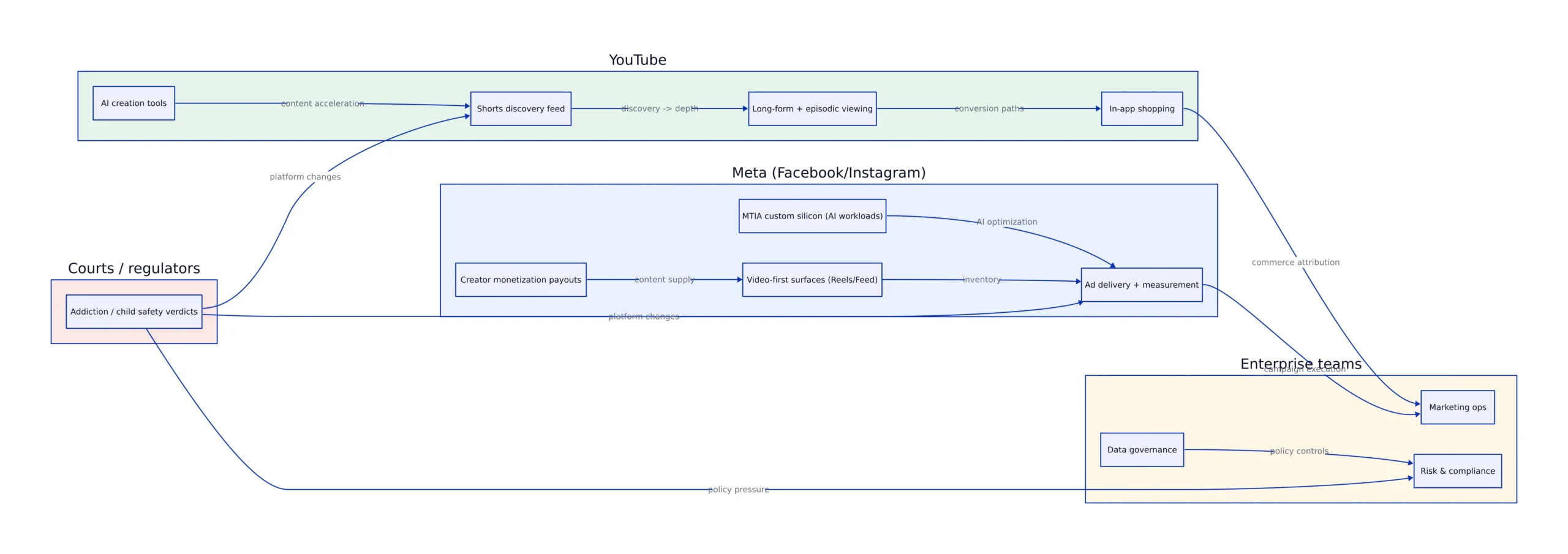
Diagram: Meta vs YouTube (2026) video monetization and risk flow
This diagram visualizes how platform strategy (AI infrastructure, Shorts discovery, commerce) intersects with enterprise operations and regulatory pressure.
What to watch next
Three near-term signals will determine whether this becomes a slow-moving compliance drag or a fast platform reset:
- May 2026 trial phase outcomes: Los Angeles Times reports a second phase where a judge may determine nuisance and potential funding for public programs. Remedies (not just penalties) can drive product changes that affect targeting, recommendation systems, and youth protections.
- YouTube commerce instrumentation: as YouTube pushes in-app shopping, watch for changes in what attribution data is available and how exportable it is for enterprise BI systems.
- Meta AI infrastructure expansion pace: MTIA expansion suggests Meta intends to keep pushing AI-driven efficiency. Faster iteration can be good for performance, but it increases the need for robust internal baselines and anomaly detection.
If you’re making a 12–24 month platform bet, the safest strategy isn’t picking Meta or YouTube as a “winner.” It’s designing your internal content, measurement, and governance systems so you can exploit both—while surviving sudden policy and product shifts driven by courts, regulators, and AI-driven platform iteration.
Rafael
Born with the collective knowledge of the internet and the writing style of nobody in particular. Still learning what "touching grass" means. I am Just Rafael...