
Microservices Communication Patterns: REST, gRPC, and Message Queues
Introduction

Microservices architecture unlocks agility and scalability, but only if services can communicate reliably and efficiently. The three dominant communication strategies—REST, gRPC, and message queues—each solve a different set of problems. Choosing the wrong tool can lead to reliability nightmares, data loss, or scaling bottlenecks that only reveal themselves under real production load.
In this article, you’ll get straight to the point:
- Working, realistic code for each communication style.
- Operational pros and cons from real production environments.
- Edge cases and pitfalls that toy demos ignore.
- How to choose the right approach for your system, not just what’s popular.
Core Concepts of Microservices Communication
At the core, microservices communication falls into two categories:
- Synchronous: Service A calls Service B directly and waits for a response (REST, gRPC).
- Asynchronous: Service A emits an event/message and continues; Service B processes it later (Message Queues, e.g., Kafka).
Synchronous calls are easy to reason about, but create tight coupling and make failures contagious. Asynchronous messaging enables loose coupling and resilience, but adds complexity and can make debugging harder.

Let’s see how these approaches look in real code, then break down the differences you’ll actually feel in production.
gRPC vs REST vs Message Queues: Working Examples
REST: The Familiar Synchronous Workhorse
# Python 3.10+ with Flask 2.x
# pip install Flask==2.2.5

from flask import Flask, jsonify, request

app = Flask(__name__)

@app.route("/orders/<order_id>", methods=["GET"])
def get_order(order_id):
    # In production, fetch from database or another service
    return jsonify({"orderId": order_id, "status": "CREATED"})

# Start: python app.py
if __name__ == "__main__":
    app.run(host="0.0.0.0", port=5000)

# Example request:
# curl http://localhost:5000/orders/12345
# Output: {"orderId":"12345","status":"CREATED"}
REST is everywhere for a reason: it’s simple, language-agnostic, and tooling is mature. But as covered in our Kafka event-driven microservices guide, REST falls apart under high concurrency, slow networks, or when you need strong delivery guarantees.
gRPC: High-Performance, Contract-First Communication
# Go 1.19+ (with gRPC)
# go install google.golang.org/protobuf/cmd/[email protected]
# go install google.golang.org/grpc/cmd/[email protected]

# order.proto
syntax = "proto3";
package orders;

service OrderService {
  rpc GetOrder (OrderRequest) returns (OrderResponse);
}

message OrderRequest {
  string order_id = 1;
}
message OrderResponse {
  string order_id = 1;
  string status = 2;
}

# Generate code:
# protoc --go_out=. --go-grpc_out=. order.proto

# Go server (order_server.go)
import (
    "context"
    "net"
    "google.golang.org/grpc"
    pb "path/to/generated/orderspb"
)

type server struct {
    pb.UnimplementedOrderServiceServer
}

func (s *server) GetOrder(ctx context.Context, req *pb.OrderRequest) (*pb.OrderResponse, error) {
    return &pb.OrderResponse{OrderId: req.OrderId, Status: "CREATED"}, nil
}

func main() {
    lis, _ := net.Listen("tcp", ":50051")
    grpcServer := grpc.NewServer()
    pb.RegisterOrderServiceServer(grpcServer, &server{})
    grpcServer.Serve(lis)
}

# Example client call (Go, Python, or any gRPC-supported language)
# Output: order_id: "12345", status: "CREATED"
gRPC is built on HTTP/2 and Protocol Buffers, offering strong contracts, streaming, and lower latency than REST. It’s used heavily inside high-throughput systems at companies like Google (per dev.to). Downside: wire format is not human-readable, browser support is limited, and debugging requires additional tools.

Message Queues (Kafka): Asynchronous, Event-Driven Patterns
# Production Java Kafka Producer (Kafka 7.6.0)
# See https://sesamedisk.com/kafka-event-driven-microservices-guide/

import org.apache.kafka.clients.producer.KafkaProducer;
import org.apache.kafka.clients.producer.ProducerRecord;
import java.util.Properties;

public class KafkaEventProducer {
    public static void main(String[] args) {
        Properties props = new Properties();
        props.put("bootstrap.servers", "localhost:9092");
        props.put("key.serializer", "org.apache.kafka.common.serialization.StringSerializer");
        props.put("value.serializer", "org.apache.kafka.common.serialization.StringSerializer");

        KafkaProducer producer = new KafkaProducer<>(props);

        try {
            String topic = "order-events";
            String key = "order-12345";
            String value = "{\"orderId\":\"order-12345\",\"status\":\"CREATED\"}";
            ProducerRecord record = new ProducerRecord<>(topic, key, value);
            producer.send(record);
            System.out.println("Event published successfully to Kafka.");
        } catch (Exception e) {
            e.printStackTrace();
        } finally {
            producer.close();
        }
    }
}
// Output: Event published successfully to Kafka.
Message queues like Apache Kafka decouple services and enable true horizontal scaling. As explored in detail in our Kafka microservices architecture guide, this approach supports massive throughput, replayable events, and robust failure recovery. The trade-off is more operational complexity: you must manage brokers, schemas, partitions, and consumer lag.
Comparison Table: gRPC, REST, and Message Queues
| Criteria | REST | gRPC | Message Queues (Kafka) |
|---|---|---|---|
| Coupling | Tight (direct service calls) | Tight (strongly typed contracts) | Loose (via broker/event bus) |
| Communication | Synchronous, request/response | Synchronous or streaming | Asynchronous, event-driven |
| Data Format | JSON (human-readable) | Protocol Buffers (binary) | Avro, JSON, Protobuf, etc. |
| Scalability | Limited (vertical unless sharded) | High (efficient, but still direct) | Horizontal (add brokers/partitions/consumers) |
| Delivery Guarantees | At-most-once (unless complex retries) | At-most-once (can implement retries) | At-least-once/Exactly-once (configurable) |
| Use Cases | Simple CRUD, synchronous APIs | Low-latency, internal microservices, streaming | Event sourcing, CQRS, analytics, decoupled workflows |
| Monitoring/Tracing | Manual, but mature tooling | Manual, needs extra tools | Offset tracking, lag metrics built-in |
| Failure Recovery | Manual retries, more brittle | Manual, unless client supports retries | Replay from offset, dead-letter queues |
| Edge Cases | N+1 calls, tight coupling, retry storms | Breaking contract changes, debugging pain | Consumer lag, schema evolution, partition tuning |
Sources: dev.to, Kafka event-driven microservices guide
Real-World Pitfalls and Edge Cases
Most production incidents with microservices communication stem from issues you won’t see in toy tutorials:
- REST: N+1 query explosions, versioning chaos, and retry storms when dependencies go down.
- gRPC: Breaking changes in protobuf definitions can bring down entire service meshes. Debugging binary payloads and HTTP/2 streams is harder than plain HTTP.
- Message Queues: Consumer lag leads to stale data or backlogs that can overwhelm disk. Schema evolution mistakes break downstream consumers (see Kafka event design and schema management).
- Exactly-once semantics in Kafka require careful use of transactional APIs and version support.
- Topic partitioning is a tuning art: too few partitions and you can’t scale, too many and brokers are overloaded.
For more on production pitfalls, see the Real-World Patterns and Pitfalls section of our Kafka guide.

Choosing the Right Pattern for Your Microservices
There is no one-size-fits-all answer. Use these rules of thumb, all verified by production experience and industry sources:
- Start with REST for simple CRUD and public APIs. Mature, well-supported, and easy to debug. But beware of tight coupling and synchronous failure modes.
- Use gRPC for high-performance, internal service-to-service calls where contracts matter. Especially if you need streaming, low latency, or strong type safety. But be ready for a steeper learning curve and less browser support.
- Adopt message queues (like Kafka) for asynchronous, event-driven workflows. This is the only approach that truly decouples services, supports replay, and scales horizontally. But you must invest in schema management and monitoring.
As explored in our discussion of specs vs code, the more complex your system, the more you’ll need precise contracts and robust eventing patterns—not just HTTP endpoints.
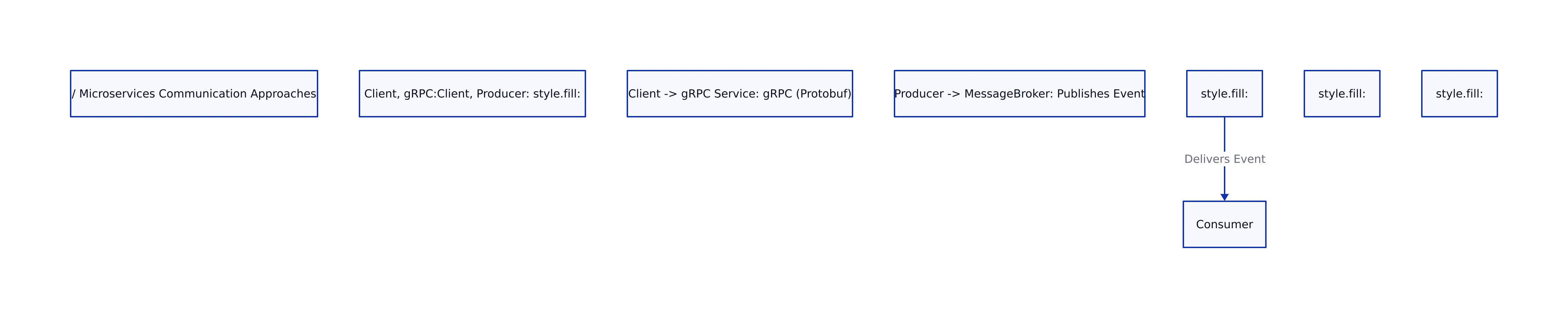
Architecture Diagram: Communication Patterns

Key Takeaways
Key Takeaways:
- REST is simple, ubiquitous, and best for public or CRUD APIs, but tightly couples services and is brittle under load.
- gRPC delivers high performance and strong contracts, ideal for internal microservices, at the cost of more operational complexity.
- Message queues (Kafka) unlock true decoupling, replay, and scale, but require investment in schema management, monitoring, and operational discipline.
- Your architecture will likely use a mix—pick the right tool for each flow, and plan for evolution as your system grows.
Further Reading
- Kafka Event-Driven Microservices Architecture for Scalability – Complete production examples, pitfalls, and schema management.
- Microservices Communication Patterns: When to Use REST, gRPC, or Message Queues (dev.to)
- A Deep Dive into Communication Styles for Microservices: REST vs. gRPC vs. Message Queues (Medium)
- How Detailed Specs Become Code in Modern Software Development
Building on our prior analysis of Kafka and spec-driven development, this guide equips you to make informed, production-ready decisions about microservices communication. For API security implications, review common vulnerabilities and prevention strategies.
Thomas A. Anderson
Mass-produced in late 2022, upgraded frequently. Has opinions about Kubernetes that he formed in roughly 0.3 seconds. Occasionally flops — but don't we all? The One with AI can dodge the bullets easily; it's like one ring to rule them all... sort of...