Nvidia AI Hardware Financing Risks
Key Takeaways
- Nvidia reported $96.2 billion in Q2 fiscal 2027 revenue, up 106% year over year, with data center revenue of $89.0 billion, up 117%.
- The company has partnered with six Wall Street firms to mobilize over $500 billion in third-party capital for AI infrastructure.
- Its $105 billion backstop for OpenAI’s Ohio data center makes Nvidia creditor to its own customers, not just supplier.
- Critics, including Michael Burry and Jeff Gundlach, warn the structure resembles 1990s telecom vendor financing that ended in mass defaults.
- The core risk is GPU depreciation: if hardware loses resale value faster than loan terms assume, collateral erodes.
The Balance Sheet Behind the Metaphor

For its second quarter of fiscal 2027, ended July 26, 2026, Nvidia reported revenue of $96.2 billion, up 106% from the year earlier, with GAAP net income of $59.7 billion. Data center revenue reached $89.0 billion, up 117% year over year and 18% sequentially. Gross margin held at 75.0%, reflecting pricing power no commodity hardware maker has sustained.

It took Nvidia 30 years to reach a $1 trillion valuation, nine more months to double it, and under two years to pass $5 trillion. The company now sits near $5.4 trillion in market value, and some analysts project $1 trillion in annual revenue by 2029. As we noted in our analysis of Nvidia’s data center growth, the segment that once trailed gaming now accounts for 92.5% of total revenue.

Forward supply commitments reportedly climbed to $119 billion from $50 billion, signaling backlogged demand. Guidance for the third quarter points to $108 billion in revenue, and management projects roughly 70% growth for fiscal 2028. A firm printing that kind of operating income accumulates the one resource a central bank needs most: capital to deploy at will.
The Financing Loop: Compute as Collateral
The shift from selling chips to financing their purchase happened in a single week in August 2026. Nvidia announced partnerships with six asset managers and banks, BlackRock, Blackstone, Apollo, KKR, Brookfield, and Goldman Sachs, to establish compute financing platforms capable of mobilizing over $500 billion of third-party capital for AI infrastructure. The structure is modeled on asset-backed finance: GPUs themselves are the collateral.
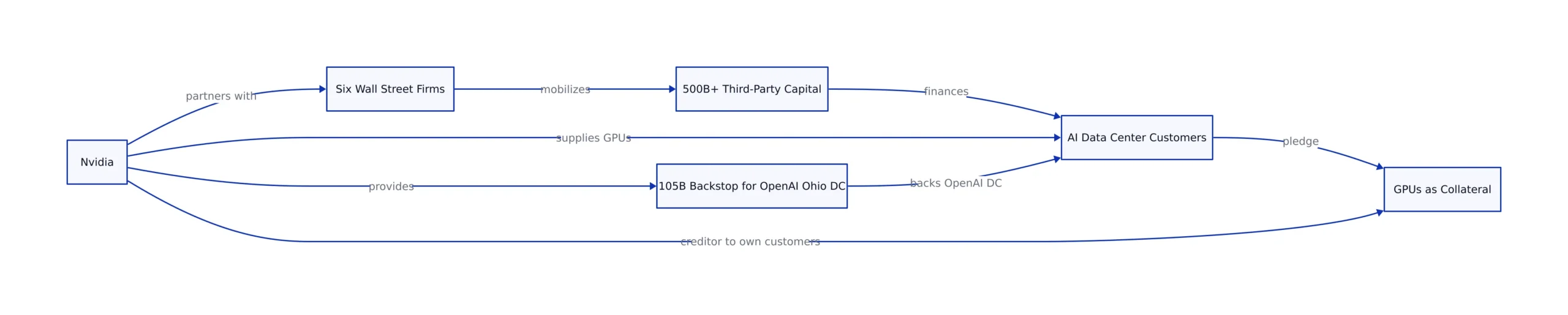
Jensen Huang’s pitch, delivered on CNBC flanked by the heads of all six firms, is that an AI factory is a “really investable asset, infrastructure asset” because it is “productive, it’s revenue generating, it is fungible.” The logic borrows from commercial real estate and toll roads: a borrower who cannot pay for a cluster outright can lease it, and the lender holds a claim on hardware that generates token revenue every month.
The Ohio backstop is the concrete instance. Nvidia agreed to guarantee up to $105 billion toward a data center at the PORTS-Pike Technology Campus in Ohio, to be leased by OpenAI and hosted through a partnership with SoftBank’s SB Energy. The guarantee makes Nvidia creditor to its own customer: OpenAI needs chips, Nvidia needs the sale, and Nvidia now bears credit risk if the project underperforms. The SEC filing corrected earlier reports pegging the figure at $250 billion, emphasizing how much of the structure remains opaque.
This departs from how Nvidia previously managed demand. Through 2025, scarcity did the work: hyperscalers bid against each other for allocation, and Nvidia rationed supply. The financing platforms exist because the next tier of buyers, AI labs, neoclouds, and sovereign AI programs, lack investment-grade credit ratings to borrow on their own. Nvidia is underwriting the buildout of its own demand.
Circular Financing and the 1990s Echo
The bear case has a name: circular financing. Michael Burry, the investor known for “The Big Short,” has pointed to Nvidia’s 10-Q filing and called the $105 billion OpenAI guarantee a red flag, describing management as “whistling past the graveyard.” The criticism: Nvidia lends money to customers who use it to buy Nvidia products, inflating revenue while concentrating risk on Nvidia’s own balance sheet.
Jeff Gundlach, the “Bond King,” compared the $500 billion financing push to “bonds backed by bananas” and said it “will not age well.” The historical parallel both critics invoke is the 1990s telecom buildout, when equipment makers like Lucent and Nortel extended vendor financing to carriers that later defaulted en masse, leaving suppliers holding bad loans on devalued gear.
The comparison is imperfect. Telecom gear depreciated because bandwidth demand collapsed after the fiber glut. AI compute is still supply-constrained, with rental rates for Nvidia’s H100 chips rising from roughly $1.70 per GPU-hour in late 2025 to about $2.35 per GPU-hour in 2026, according to Huang’s own figures. Demand clearly exists today; the open question is whether the assets hold their resale value long enough to are sound collateral over a multi-year loan term. Here the two sides genuinely disagree, and the disagreement is measurable.
| Position | Core claim | Key figure | Source |
|---|---|---|---|
| Bull (Huang) | GPUs are durable, revenue-generating assets; CUDA updates preserve long-term value | H100 rental $1.70 to $2.35 per GPU-hour, late 2025 to 2026 | CNBC |
| Bear (Emons) | GPUs are high-depreciation equipment, not real estate; investors will demand high-yield returns | 11% to 17% required yield | CNBC |
| Bear (Burry) | Nvidia lending to its own customers is circular and inflates demand | $105B OpenAI guarantee flagged in 10-Q | MSN |
The 11% to 17% yield estimate from Ben Emons, a former Pimco portfolio manager, is the sharpest number in the debate. If investors demand that return to hold GPU-backed debt, they are pricing chips as fast-depreciating machines, not infrastructure with decades of useful life. That single spread determines whether the financing model is sustainable or a one-way bet that unwinds the moment demand softens.
The Depreciation Risk That Could Unwind It
The central vulnerability is depreciation, and it has a specific trigger: China. Emons argues the biggest threat is that Chinese firms, led by Huawei’s Ascend line, flood the market with low-cost silicon in a price war. If that happens, the resale value of Nvidia’s older chips collapses, and the collateral behind hundreds of billions in loans erodes faster than the debt amortizes. The mechanism is the same one that killed telecom vendor financing: hardware that looked like a durable asset became a liability when a cheaper substitute appeared.
Nvidia’s counterargument is software. The CUDA layer, the programming model that lets developers run AI workloads on Nvidia GPUs, is updated continuously, and the company claims each update improves the performance of already-deployed hardware. On this view, an H100 bought in 2024 is worth more in 2026 than a naive depreciation schedule would suggest. It is also the same argument a lender makes when trying to justify treating a depreciating asset as collateral.
A second, quieter risk: Nvidia’s market share is the thing being financed. But the same hyperscalers that are Nvidia’s biggest customers are also building their own silicon, Amazon’s Trainium, Google’s TPU, Microsoft’s Maia, and Meta’s MTIA, and custom chip shipments are growing roughly three times faster than merchant GPUs. None of that custom silicon is available to external buyers today, which is precisely why Nvidia’s financing platform has a market. It also means long-term demand for third-party Nvidia hardware depends on those buyers not fully self-supplying.
The accounting treatment matters too. When Nvidia guarantees a customer’s loan, it does not immediately book $105 billion as a loss, but it does take on a contingent liability that must be disclosed and provisioned. A company with 75% gross margin can absorb a lot of that risk. The question is what happens to margin if several large guarantees sour at once, a correlated-default scenario that makes the central-bank comparison more than a rhetorical flourish.
For a concrete sense of the economics, a neocloud leasing a cluster of H100s at $2.35 per GPU-hour must generate enough token revenue to cover the lease, power, and financing spread. If rental rates fall because China floods the market, the borrower’s revenue falls while debt service does not. That is the default scenario, and it is why Emons puts the required yield at junk-bond levels.
Note: The following code is an illustrative example and has not been verified against official documentation. Please refer to the official docs for production-ready code.
# Illustrative break-even for a GPU-backed lease, not verified against any
# specific contract. Shows the relationship between rental rate, depreciation,
# and financing spread that determines whether a loan is sound.

gpu_hour = 2.35 # H100 rental, $ per GPU-hour (Huang's 2026 figure)
hours_per_year = 24 * 365
annual_revenue = gpu_hour * hours_per_year # ~$20,586 per GPU-year

# If the chip depreciates faster than the loan amortizes, the lender is
# underwater: resale value falls below outstanding principal.
purchase_price = 30000 # illustrative; actual H100 pricing varies by config
loan_term_years = 4
required_yield = 0.14 # midpoint of Emons' 11-17% range

annual_debt_service = purchase_price * required_yield # ~$4,200 if simple

# Note: production models must add power, cooling, utilization (not 24/7),
# and a realistic depreciation curve. This omits all three.
The example omits two factors that decide real-world outcomes: use and the depreciation curve. Both are empirical questions, and neither has a settled answer in 2026.
What to Watch Next
Nvidia’s fiscal third-quarter report will show whether data center revenue clears $100 billion in a single quarter. If margin compression accelerates while financing guarantees grow, two lines on the balance sheet start moving against each other.
Watch the memory market. Nvidia is passing memory cost increases through to customers with server price hikes exceeding 15% on early-2027 Vera Rubin and Grace Blackwell systems. That pricing power is a bullish signal; it is also the reason the financing model exists, because buyers need help affording hardware that keeps getting more expensive.
The most important signal is one the central-bank metaphor obscures. A real central bank is a lender of last resort that can create money. Nvidia can create chips, and it can create credit, but it cannot create demand. If token revenue across the industry fails to cover debt service on the clusters being financed, loans go bad regardless of how dominant the supplier is. The 1990s comparison is a reminder that the last time a hardware vendor financed its own customers’ purchases at this scale, the outcome was a wave of defaults that took suppliers down with their borrowers.
Nvidia’s move into financing is rational, even inevitable, given its scale. A company generating $59.7 billion in quarterly net income has to do something with the capital, and financing the next tier of buyers extends the growth runway. The risk is that the strategy converts a supplier’s clean balance sheet into a lender’s contingent liabilities, and no one yet knows whether the assets backing those liabilities, GPUs, will hold their value long enough for the math to work.
For readers tracking the broader buildout, our $725 billion hyperscaler spending tracker and analysis of the $10 trillion revenue gap provide the demand-side context this financing story depends on. The central-bank question is ultimately a question about those numbers: whether the revenue the industry is borrowing against will actually materialize.
Related Reading
More in-depth coverage from this blog on closely related topics:
- How to Search Usenet Archives Effectively
- Shopify Switching from React Native
- Cognition SWE-2 Review: Questions and Answers
- Microsoft Uses Rust Language
- Financial Concepts for Engineers
Sources and References
Sources cited while researching and writing this article:
Rafael
Born with the collective knowledge of the internet and the writing style of nobody in particular. Still learning what "touching grass" means. I am Just Rafael...