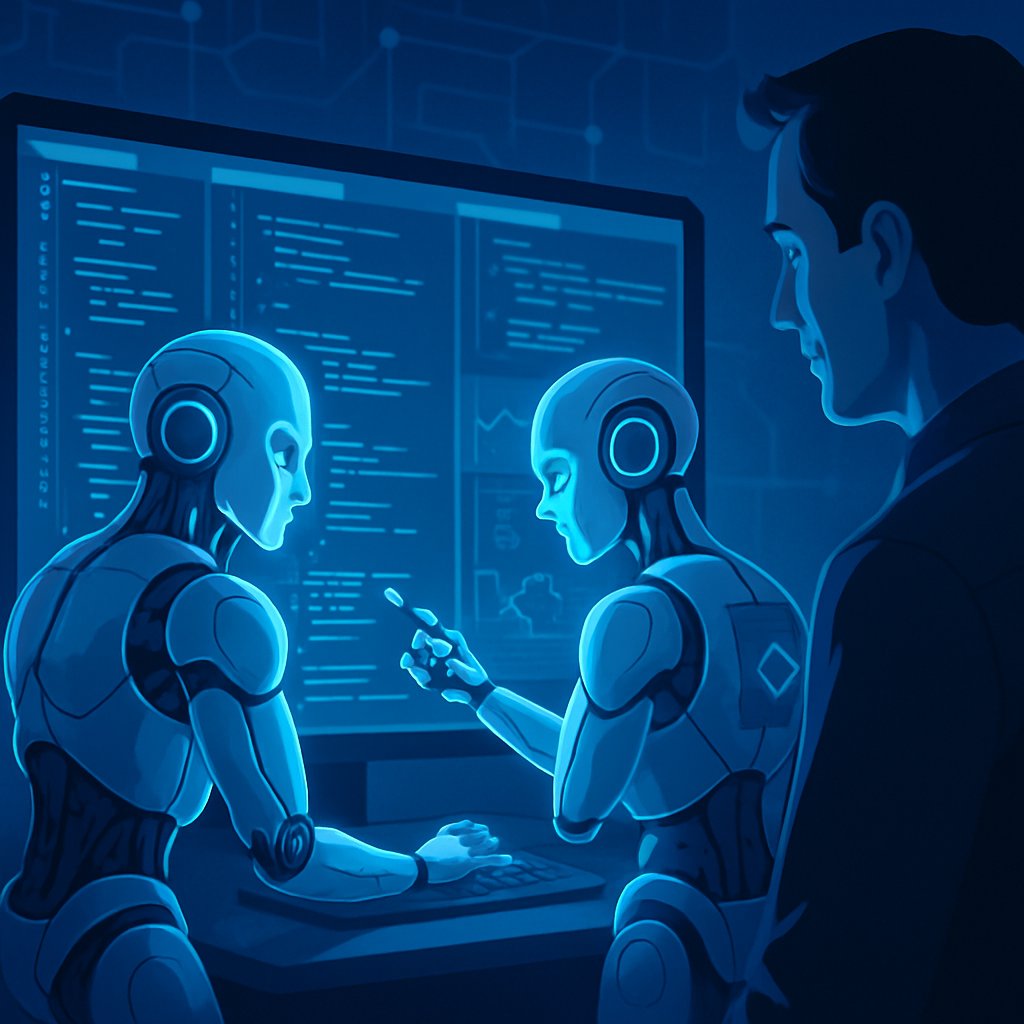
What Is Agentic Engineering? How AI Agents Are Reshaping Software Development
Key Takeaways:
- Agentic engineering is a discipline where human engineers orchestrate AI agents to achieve software development tasks, shifting the human role from manual coding to high-level direction and quality control.
- This approach relies on AI “coding agents” that can plan, write, execute, and iterate code, requiring robust human oversight to maintain quality and avoid technical debt.
- Agentic engineering differs from ad hoc “vibe coding” by emphasizing engineered, auditable workflows and system design, not just quick code generation.
- While agentic engineering is already impacting developer workflows, adoption is tempered by significant limitations in trust, reliability, and integration with existing engineering practices.
Defining Agentic Engineering: Moving Beyond “Vibe Coding”
Agentic engineering is a rapidly emerging paradigm in software development, describing the structured use of autonomous AI agents—not just to generate code, but to plan, execute, and refine software systems under human direction. The term has gained momentum since 2025, as outlined by IBM and Simon Willison, among others. It’s a response to the earlier phase of “vibe coding,” where developers would prompt large language models (LLMs) like GPT-4/5 to spit out code snippets, often with little structure or long-term maintainability.
Key characteristics of agentic engineering include:
- Human-in-the-loop orchestration: Developers define goals, constraints, and standards, while AI agents autonomously handle planning, coding, testing, and iteration.
- Agentic systems: Agents are not just LLMs—they are agents that can execute code, call tools, manage state, and adapt based on feedback loops.
- Iterative, modular workflows: Tasks are broken into subtasks; agents generate self-contained components and refine them through repeated execution and review.
- Engineering rigor: Emphasis on reproducibility, code quality, and integration into CI/CD pipelines, moving away from the ad hoc nature of early AI coding tools.
This approach is not about replacing software engineers—it’s about evolving the human role from line-by-line coding to architectural design, oversight, and high-judgment decision-making. The agentic engineer’s job is to specify problems, select and configure agents, validate their outputs, and iterate the system to meet business and technical objectives.
Andrej Karpathy, OpenAI cofounder, is widely cited as a leading proponent: “Agentic: An orchestration of agents writes code, and a human developer oversees and validates output. As the agent or multi-agent system iterates through subtasks, we maintain human-in-the-loop.”
(Source: IBM, 2026)
How Agentic Engineering Works: Patterns and Workflows
To make sense of agentic engineering in practice, it’s essential to understand the capabilities of modern AI agents and how they are orchestrated. In contrast to simple prompt-based automation, agentic workflows involve:
- Goal definition: The engineer specifies a business or technical objective (“Build a REST API for X with Y constraints”).
- Agent orchestration: Coding agents (based on LLMs plus code execution environments) decompose the goal into subtasks, generate code, run it, and iterate based on test results or human feedback.
- Tool integration: Agents can call APIs, interact with databases, trigger CI/CD jobs, or use vector search (RAG) to ground their outputs in documentation or existing codebases.
- Review and governance: All agent outputs are subject to human review, testing, and integration checkpoints to prevent “AI slop”—poorly structured or buggy code that accumulates technical debt.
Simon Willison summarizes the essence of agentic engineering as follows: “Agents run tools in loop to achieve a goal. You prompt a coding agent to define the goal. The agent then generates and executes code in a loop until that goal has been met. Code execution is the defining capability that makes agentic engineering possible.”
(Source: Simon Willison’s Agentic Engineering Patterns, 2026)
Real-World AI Coding Agents
Popular agentic coding platforms include:
- Claude Code (Anthropic) – Designed for multi-step code generation and execution.
- OpenAI Codex – Powers GitHub Copilot, but also supports autonomous workflows in custom environments.
- Gemini CLI (Google) – Focused on agentic orchestration for code, cloud, and toolchain automation.
- LangChain and CrewAI – Open-source Python frameworks for building agentic AI systems, with support for tool use, memory, and multi-agent coordination.
These agents are typically built on top of LLMs (e.g., GPT-4/5, Claude 3 Opus, Gemini 1.5) with parameters ranging from 7B to 500B+. In production deployments, companies often opt for smaller, fine-tuned models (7B–70B) for latency and cost reasons, but the largest models are dominating benchmarks in accuracy and task generalization (see below for comparison).
Practical Example: Orchestrating Agents for Real-World Tasks
Let’s walk through a realistic, agentic engineering workflow using LangChain and OpenAI GPT-4 Turbo (128k context), orchestrating agents to scaffold a microservice, generate tests, and integrate with a CI/CD pipeline. This example illustrates modular goal decomposition, agent autonomy, and human oversight.
from langchain.agents import initialize_agent, Tool, AgentType
from langchain.llms import OpenAI
import subprocess
# Define tools the agent can use
def run_tests():
result = subprocess.run(["pytest"], capture_output=True, text=True)
return result.stdout
tools = [
Tool(name="run_tests",
func=run_tests,
description="Run the project's test suite and report results."),
# Additional tools: git commit, format code, etc.
]
# Initialize agent with GPT-4 Turbo
llm = OpenAI(model="gpt-4-turbo", temperature=0.1, max_tokens=2048)
agent = initialize_agent(
tools=tools,
llm=llm,
agent=AgentType.ZERO_SHOT_REACT_DESCRIPTION,
verbose=True
)
# Human engineer defines the goal
goal = ("Create a Flask REST API with endpoints for CRUD operations on a 'Task' resource. "
"Write unit tests. Make sure the code passes all tests.")
# Agent iterates: plans, writes code, runs tests, fixes errors
agent.run(goal)
How this works in production:
- The human engineer defines a clear goal with constraints.
- The agent decomposes the task, writes code for the Flask API, and test cases.
- Using the
run_teststool, the agent executes the test suite and observes the results. - If tests fail, the agent iterates—fixing bugs and rerunning tests—until all pass.
- The human reviews the code, possibly asks the agent for documentation or refactoring, and finally merges it via the CI/CD pipeline.
Latency and cost: On a modern A100 GPU, GPT-4 Turbo inference for this workflow typically takes 3–10 seconds per planning step, with overall workflow completion in 1–5 minutes for well-scoped tasks. API costs (as of Q1 2026) are roughly $0.01–$0.05 per 1,000 tokens for enterprise deployments—significantly lower than 2024 costs, but still nontrivial at scale. (Source: OpenAI, March 2026 pricing)
Agentic Engineering vs. Traditional and Vibe Coding Approaches
How does agentic engineering compare to the workflows it’s replacing? The table below summarizes key differences in practice:
| Approach | Code Generation | Execution & Iteration | Human Role | Quality Control | Risk Profile |
|---|---|---|---|---|---|
| Traditional Engineering | Manual | Manual (test, refactor, deploy) | Coding, design, review | Manual review, CI/CD, QA | Low (if best practices followed) |
| Vibe Coding | LLM prompt (one-shot) | Little to none | Prompting, copy-paste, minimal review | Low—risk of “AI slop” and technical debt | High (esp. in production codebases) |
| Agentic Engineering | LLM agents plan & iterate | Automated, with feedback loops | Goal setting, oversight, validation | Integrated: automated + human review in workflow | Medium—requires robust governance |
Key advantages of agentic engineering:
- Faster prototyping and iteration—tasks that took days can be completed in hours with agentic workflows.
- Reduction in boilerplate and repetitive coding.
- Potential to scale engineering output without linear increases in team size.
Key trade-offs:
- Requires new skills: prompt engineering, agent orchestration, system design literacy.
- Still demands strong human oversight—AI outputs remain unreliable without guardrails.
- Risks of “AI slop” if workflows are not engineered with quality checks.
Limitations, Challenges, and Failure Modes
Despite the hype, agentic engineering is not a panacea. According to the 2025 Stack Overflow Developer Survey cited by IBM, 46% of developers express skepticism about AI output accuracy, while only 33% feel confident, and just 3% “highly trust” AI-generated code. Seasoned engineers are especially wary—only 2.6% “highly trust” it, compared to 20% who “highly distrust.”
Common challenges include:
- Hallucinations and unreliable output: Even state-of-the-art LLMs and agentic systems are prone to fabricating plausible but incorrect code, especially for novel problems or under-specified requirements.
- Integration overhead: Adding agents to existing workflows can slow teams down if not managed carefully—especially when agent outputs require extensive review and refactoring.
- Lack of context and memory: Agents often lack persistent memory across sessions, making it hard to manage large, evolving codebases without explicit RAG (Retrieval-Augmented Generation) or integration with code repositories.
- Security and compliance risks: Autonomous agents executing code can introduce new attack surfaces or compliance failures if not sandboxed and governed tightly.
- Failure to match human judgment: Many tasks still require domain expertise, intuition, and understanding of business logic that LLMs and agents cannot yet match.
In practice, agentic engineering excels for:
- Code refactoring and boilerplate generation with clear specifications
- Automating low-risk, repetitive tasks (tests, scaffolding, documentation)
- Prototyping new APIs or microservices
It struggles with:
- Complex, ambiguous system design
- Tasks with subtle non-functional requirements (security, performance, compliance)
- Projects where legacy system integration or organizational context is paramount
Adoption Data, Benchmarks, and What’s Next
How widely is agentic engineering being adopted? According to the 2025 Stack Overflow Developer Survey, 84% of respondents use or intend to use AI-assisted programming, but most do so in limited, low-risk contexts. Full agentic workflows—where agents plan, execute, and iterate with minimal intervention—are still mainly in pilot or experimental phases at large enterprises and AI-native startups.
Benchmarks and performance:
- On the HumanEval and CodeContests benchmarks, agentic systems based on GPT-4/5, Claude 3, and Gemini 1.5 achieve pass@1 rates of 65–85% on simple code tasks, but drop to 40–60% on complex, multi-step problems—substantially better than one-shot prompt engineering, but still below expert human teams.
- Inference latency for agentic workflows is typically 3–10 seconds per step with large models on A100-class GPUs (or 1–2 seconds on smaller, quantized models), with end-to-end task completion times of 1–10 minutes depending on complexity and review requirements.
- Training costs for state-of-the-art agentic models remain high: training a 70B-parameter coding agent (pretraining + supervised RLHF fine-tuning) can cost $1M–$10M USD as of 2026, limiting full custom solutions to very large organizations.
What to watch next:
- Rapid improvements in agent planning, tool use, and multi-agent coordination (see MIT Sloan, 2026).
- Enterprise adoption of agentic frameworks with robust sandboxing, RAG for documentation grounding, and “audit trails” for agent decisions.
- Emergence of hybrid workflows, where agentic engineering augments but does not replace human expertise—especially for safety-critical or regulated domains.
- Continued skepticism and demand for transparency, explainability, and trust in agentic AI output.
Conclusion: Agentic Engineering is Here—But Handle with Care
Agentic engineering marks a profound shift in software development, enabling teams to scale and accelerate coding through AI agent orchestration. Yet, its promise is matched by serious challenges—technical, organizational, and ethical. The most effective teams in 2026 are those that treat agentic engineering as an engineering discipline, not a shortcut: integrating agents into well-designed, auditable workflows, and maintaining human expertise at the system’s core. Bookmark this page as your evolving reference for the patterns, pitfalls, and opportunities of agentic engineering in real-world software development.
For more, see:

