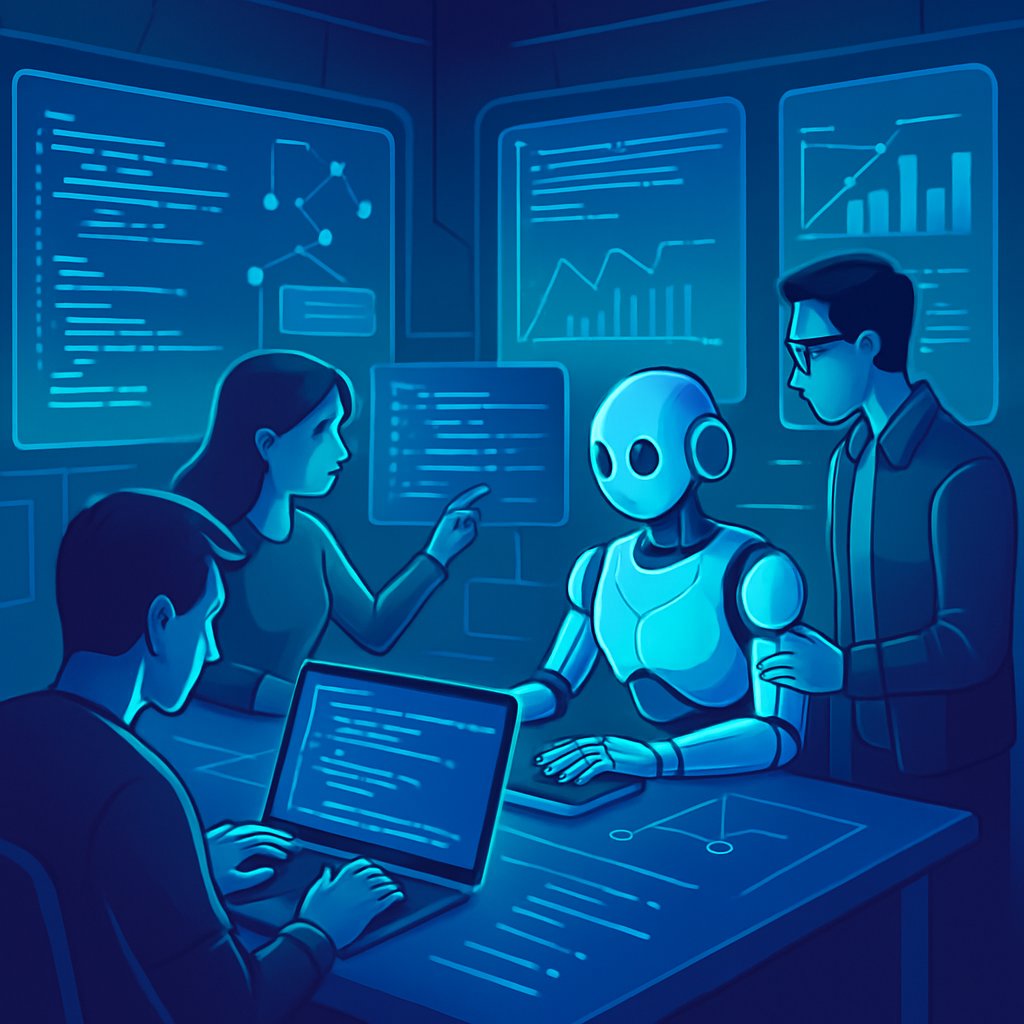
Agentic AI is quietly but fundamentally changing how engineering teams build and deliver software. The hype is real, but the substance is more nuanced: these systems automate repetitive work, speed up delivery, and reshape team coordination—without actually removing the need for skilled engineers. This post draws directly from primary research to clarify what agentic AI is (and isn’t) doing for engineering workflows, how it’s affecting productivity, and what operational risks you need to address when scaling beyond basic automation.
Key Takeaways:
- Agentic AI is reshaping engineering workflows by automating routine tasks, enabling parallelism, and expanding team capacity—without replacing developers (Anthropic 2026 Agentic Coding Trends Report).
- The biggest gains happen when teams combine agentic automation with human oversight, clear agent boundaries, and well-defined review processes.
- Composable architectures amplify both the benefits and the operational risks of agentic AI; rigorous orchestration and artifact management are essential.
- Explainability and auditability are critical as AI agents integrate more deeply into the SDLC—black-box automation introduces new classes of risk.
- Best practices include explicit agent roles, layered review, and continuous validation of all agent-generated artifacts.
Agentic AI in Practice: What’s Actually Changing?
The main impact of agentic AI in 2026 isn’t just more advanced features—it’s a shift in how work gets organized and executed within engineering teams. According to research from Red Eagle Tech (source) and the Anthropic Agentic Coding Trends Report, agentic systems are now handling entire segments of the software development lifecycle:
- Automating repetitive tasks: Agents generate boilerplate code, draft documentation, and create basic tests, freeing engineers for higher-level design and review.
- Supporting human-in-the-loop workflows: Agents run perception–reasoning–action cycles for multistep tasks, but critical architectural and quality decisions remain with experienced engineers (Red Eagle Tech).
- Goal-driven orchestration: Agents can break down feature requests, generate implementation plans, and iterate solutions until specific constraints are met.
Teams adopting agentic workflows see the biggest productivity boost when agents are assigned end-to-end objectives, not just granular prompts. Here’s a practical orchestration pattern (adapted from the cited research):
# Orchestrating multiple agents for a feature delivery pipeline
for task in engineering_tasks:
if task.category == "feature":
code_agent.implement(task)
elif task.category == "test":
test_agent.create_tests(task)
elif task.category == "documentation":
doc_agent.draft(task)
# Orchestrator agent reviews and consolidates all outputs before merge
Parallelization at the task level is now feasible, but only if outputs are reviewed by a dedicated orchestrator agent and ultimately by humans. The Anthropic report is clear—teams that define explicit roles, boundaries, and review loops see the best results. “Set and forget” leads to error propagation and inconsistent deliverables.
- Teams deliver more in parallel, but orchestration and review are non-negotiable.
- Agentic AI augments, not replaces, developers—engineers steer, resolve ambiguity, and innovate.
- Quality depends on workflow design, not just AI tool selection.
For more on how agentic AI is transforming team dynamics and coordination, see this analysis.
Composable Architectures and Productivity
The largest productivity gains from agentic AI are realized when paired with modular, composable system architectures. The Anthropic 2026 report emphasizes that the shift from monolithic applications to microservices and granular APIs allows agents to orchestrate, adapt, and recombine services dynamically. This approach enables:
- Adaptive automation: Agents can discover, compose, and recompose services at runtime, integrating new APIs and tools as needed.
- Faster integration and change velocity: Modular architectures let organizations swap or enhance components without overhauling the entire stack.
- Increased operational complexity: More interfaces and moving parts raise the risk of integration drift and require robust orchestration.
| Architecture Pattern | Agentic AI Benefit | Primary Risk |
|---|---|---|
| Monolithic App | Simpler audit and change tracking | Slower automation, less flexible |
| Composable/Microservices | Rapid, modular agent integration and orchestration | Complexity, interface drift, integration sprawl |
Anthropic’s research shows that agentic AI lets smaller teams achieve scale by automating background tasks and orchestrating distributed workflows. However, composability increases the need for strong artifact management and review processes to prevent “knowledge landfill” and maintain traceability and quality.
- Composable architectures amplify both benefits and risks: Success depends on disciplined orchestration, interface management, and artifact validation.
- Team process is as important as AI capability—blindly adding agents without design discipline leads to chaos, not productivity gains.
Autonomous Integration and Explainability
Agentic AI is making autonomous integration—automatically bridging data and workflows across legacy and modern systems—a practical reality. According to the Anthropic report, agents are being used to:
- Generate integration scripts, adapters, and test cases for connecting diverse systems
- Monitor activity, surface risks, and propose resolutions in real time
- Adapt to schema changes and interface drift faster than manual processes allow
However, these advances introduce new challenges in traceability and explainability. The Anthropic report notes that engineering leaders and regulators increasingly expect a clear, auditable decision chain for every agent-driven integration.
# AI-assisted mapping between source and target systems
integration_request = {
"source_field": "invoice_date",
"target_system": "ERP"
}
proposed_mapping = ai_agent.suggest_mapping(
source_field=integration_request["source_field"],
target_system=integration_request["target_system"]
)
print(proposed_mapping)
# Output: {'erp_field': 'InvoiceDate', 'type': 'date'}
| Integration Approach | Strength | Weakness |
|---|---|---|
| Manual Mapping | High control, full traceability | Slow, not scalable |
| Rule-based ETL | Some automation, faster than manual | Rigid, breaks with schema changes |
| Agentic/AI-Assisted | Adapts quickly, handles drift, scales | Hard to audit reasoning, risk of “black box” |
Key risks flagged in the research:
- Explainability: If agent outputs lack explicit reasoning, it’s difficult to audit or debug errors.
- Error propagation: Schema or logic errors by agents can spread rapidly if unchecked.
- Domain knowledge gaps: Agents may miss business rules if their reference data or prompts are incomplete.
Mitigating these risks requires layered review, robust logging, and the ability to trace every agent action back to its origin.
Pitfalls and Pro Tips
Agentic AI unlocks major automation but introduces new operational risks and complexities. According to the Anthropic 2026 report and Doshby’s industry analysis, production teams repeatedly encounter the following pitfalls:
- Blind trust: Never assume agent outputs are correct. All high-impact artifacts require human or automated review.
- Orchestration complexity: Defining agent roles, permission boundaries, and artifact ownership is essential to avoid “runaway” agents and unintended changes.
- Artifact sprawl: As agents generate more deliverables, only validated artifacts should be promoted. Track provenance and approval status for every output.
- Scope creep: Over-permissive agents may make broad, unintended changes. Explicit permissioning is crucial.
# Human-in-the-loop review for agent outputs
for artifact in agent_generated_artifacts:
if artifact.is_critical:
human_review_queue.add(artifact)
else:
automated_checks.validate(artifact)
Best practices for agentic software workflows:
- Define clear agent roles and permissions; never grant unchecked access.
- Enforce audit trails and rollback support in orchestration systems.
- Continuously review, prune, and track all generated artifacts to prevent “knowledge landfill.”
- Mandate human signoff for all critical or high-impact changes, even if agents propose them.
Teams investing in these controls consistently see more reliable and sustainable gains from agentic AI, according to the Anthropic Agentic Coding Trends Report.
Conclusion and Next Steps
Agentic AI is driving faster delivery and greater productivity in software engineering, not by replacing humans but by enabling new forms of orchestration, parallelism, and review. Teams seeing the best results invest in explicit workflow design, modular APIs, and rigorous artifact management (Anthropic 2026 Agentic Coding Trends Report).
- Pilot agentic workflows on well-bounded, low-risk tasks before rolling out more broadly.
- Design for modularity—expose granular APIs and interfaces to maximize agentic automation.
- Layer orchestration, human review, and artifact management to guarantee quality and traceability.
- Stay up to date with current industry research and evolving best practices as agentic systems mature.
For further reading on composable architectures, auditability, and agentic AI in production, see:
- Anthropic 2026 Agentic Coding Trends Report
- How AI Agents Are Changing Software Engineering Workflows (Doshby Blog)
- Agentic AI is Reshaping Development Workflows, Not Replacing Developers (Red Eagle Tech)
Sources and References
This article draws only from the following research:
References
- Anthropic 2026 Agentic Coding Trends Report
- How AI Agents Are Changing Software Engineering Workflows – Doshby Blog
- Agentic AI is Reshaping Development Workflows, Not Replacing Developers – Red Eagle Tech
Additional Reading
- How agentic AI will reshape engineering workflows in 2026 – CIO
- 8 agentic coding trends shaping software engineering in 2026
Sources and References
This article was researched using the following sources:
References
- Agentic AI is Reshaping Development Workflows, Not Replacing Developers, Says London Tech Firm | FinancialContent
- https://resources.anthropic.com/hubfs/2026%20Agentic%20Coding%20Trends%20Report.pdf?hsLang=en
Additional Reading
- How agentic AI will reshape engineering workflows in 2026 - CIO
- An AI led SDLC: Building an End-to-End Agentic Software Development ...
- How AI Agents Are Changing Software Engineering Workflows