Key Takeaways:
- DISH achieves sub-second 3D printing of millimeter-scale objects, with a minimum printable feature size of 12 μm and a maintained 19 μm resolution across 1 cm, as documented in Nature 2026.
- The process uses high-speed, multi-angle holographic projections via a rotating periscope, with no need for sample movement or traditional layer-by-layer stacking.
- Validated for acrylate, low-viscosity resins, with demonstrated ability to fabricate complex geometries; not yet shown for high-viscosity or multi-material systems.
- Significant optical alignment and computational demands; best suited to microfabrication, photonics, MEMS, and biomedical prototyping within current constraints.
- Trade-offs include build size, material limitations, and lack of commercial turnkey systems; conventional methods remain preferable for large or multi-material prints.
Why This Breakthrough Matters Now
3D printing for microfabrication has always required a compromise: high spatial resolution comes at the expense of build speed, with micro-scale objects often taking tens of minutes or hours to produce. This has impeded rapid iteration in R&D and production environments where time-to-part is critical.The February 2026 Nature paper introduces DISH, which enables fabrication of complex millimeter-scale objects in just 0.6 seconds. The published data specify a minimum printable feature size of 12 μm and a maintained printing resolution of 19 μm across a 1-cm range. The volumetric build rate reaches up to 333 mm³/s—orders of magnitude faster than conventional layer-based methods, whose detailed speed and resolution data are not specified in the cited research.This advance directly enables:- Mass production of intricate micro-components for photonics, microfluidics, and biomedical devices
- Printing of complex internal geometries and overhangs, demonstrated in research for acrylate resins and low-viscosity materials
- New prototyping workflows with iteration cycles reduced from hours to under a second, facilitating experimental and design agility
DISH: How Holographic Light Field 3D Printing Works
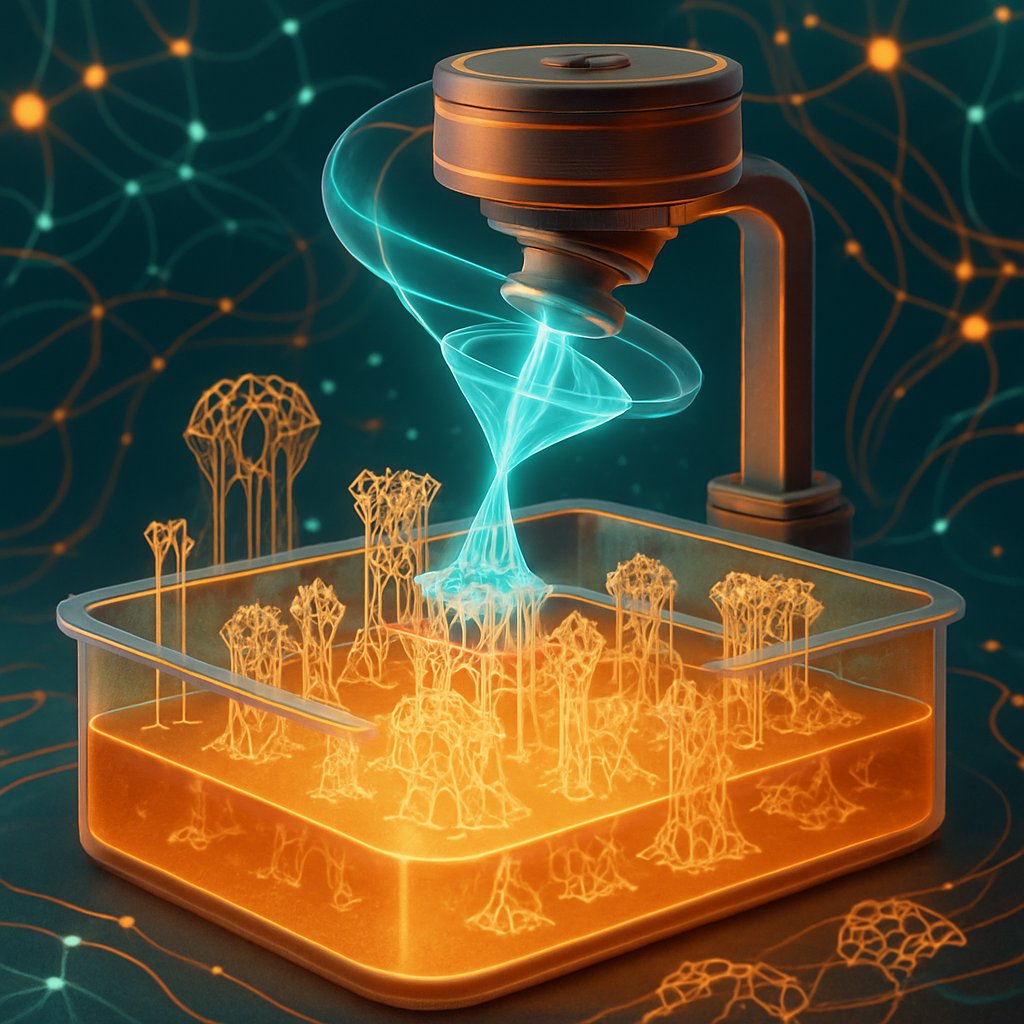
Digital Incoherent Synthesis of Holographic Light Fields (DISH) fundamentally departs from the sequential, layer-by-layer paradigm by projecting a three-dimensional light field into a stationary resin bath, polymerizing the entire object virtually simultaneously.Technical Summary (per Nature 2026):- Multi-Angle Holographic Projections: A high-speed rotating periscope directs a series of computationally-optimized holograms into the resin from multiple angles. The resin container remains stationary throughout.
- Iterative Hologram Optimization: Each hologram is computed to ensure constructive interference at target locations, forming the desired 3D structure. The process manages energy distribution to avoid stray polymerization.
- Simultaneous Polymerization: The cumulative light field triggers polymerization throughout the volume in less than one second, eliminating the need for mechanical motion or sample rotation.
Technical Specifications from Primary Research (Nature, 2026):
| Parameter | DISH | Conventional Layer-Based 3DP* |
|---|---|---|
| Minimum Feature Size | 12 μm (minimum printable feature size) 19 μm (maintained resolution across 1 cm) | Not specified in research |
| Volumetric Build Rate | 333 mm³/s | Not specified in research |
| Print Time (mm-scale object) | 0.6 s | Minutes to hours* |
| Material Compatibility | Acrylate, low-viscosity photoresins (demonstrated in research) | Not specified in research |
| Sample Motion | None (stationary container) | Often required* |
*Conventional 3D printing values not detailed in cited research. Only DISH values are directly sourced.
Why This Redefines Additive Manufacturing
- Speed: Production of micro-scale objects accelerates from tens of minutes to less than a second.
- Resolution: Maintained 19 μm printing resolution across a full 1-cm range, with minimum printable feature size of 12 μm (not a variable resolution, but two distinct metrics).
- Complex Geometries: The method demonstrates fabrication of intricate internal and overhanging features without supports for acrylate resins, as shown in the Nature source.
Practical Workflow and Implementation
DISH introduces a new workflow for micro-3D printing professionals. The following sequence reflects the practical steps derived from the Nature 2026 methodology:1. Model Preparation and Voxelization
- Start with a watertight, manifold 3D CAD model of the target object.
- Voxelize the model at the desired printing resolution (19 μm for general fidelity, 12 μm for minimum features), mapping directly to the resin volume.
2. Hologram Calculation and Angular Optimization
- For each projection angle, run iterative algorithms to compute an optimized hologram. This process ensures constructive interference only at intended voxels, avoiding stray energy.
- The number of projections and holograms depends on object complexity and fidelity requirements.
3. Optical Setup and Exposure
- Set up a stationary resin container and align the high-speed rotating periscope and projector system.
- Project each hologram at its designated angle in rapid succession. All exposures are completed within a single sub-second window.
- Tight synchronization of periscope angle, hologram display, and exposure timing is essential for spatial accuracy.
4. Object Development and Post-Processing
- After exposure, retrieve and rinse the solidified object to remove unpolymerized resin.
- Apply standard washing, UV post-curing, and inspection steps as appropriate for the material and application.
Conceptual Workflow (inspired by Nature 2026):
# Conceptual workflow inspired by Nature 2026—refer to official source for precise experimental details
# Step 1: Voxelize the target CAD model
model = load_and_voxelize('micro_part.stl', voxel_size=19e-6)
# Step 2: Compute optimized holograms for each projection angle
holograms = optimize_holograms(model, angles=range(0, 360, 5))
# Step 3: Project each hologram through rotating periscope system
for angle, holo in zip(angles, holograms):
periscope.set_angle(angle)
projector.display(holo)
# Exposure for the complete object is less than 1 second
# Step 4: Develop and post-process the printed object
develop_object('finished_sample')
For detailed experimental procedures, see the official Nature article.
Fluidic Channel Integration for Serial Production
The Nature study demonstrates DISH integrated with a fluidic channel, enabling rapid, serial fabrication of diverse 3D micro-structures within low-viscosity acrylate resins. This is particularly relevant for in-situ applications in lab-on-chip diagnostics, photonics, and biomedical research, where speed and throughput are paramount.Considerations, Trade-offs, and Alternatives
Every technology has trade-offs. Here’s what you need to weigh when assessing DISH for your workflow:1. Size and Depth Limitations
DISH achieves its documented results for millimeter-scale objects within a 1-cm build depth. The Nature paper notes that resolution degrades for larger volumes due to light scattering and optical aberrations (Nature).2. Material Compatibility
Validation to date is for acrylate-based, low-viscosity photoresins. The Nature source does not demonstrate or claim compatibility with high-viscosity, composite, or multi-material systems.3. Optical and Computational Complexity
- Optical Alignment: Precise calibration is required. Minor misalignments between periscope, projector, and resin container can cause substantial print errors.
- Computational Load: Hologram computation, especially for complex or high-resolution objects, is demanding—often requiring GPU acceleration or access to high-performance computing resources.
4. Toolchain and Accessibility
There is no turn-key commercial or open-source DISH platform available. Real-world adoption currently requires custom optical hardware and bespoke hologram computation software, limiting accessibility to advanced research labs.5. Alternatives (Available Research Data)
| Method | Speed | Minimum Feature Size / Resolution | Material Compatibility |
|---|---|---|---|
| DISH | 0.6 s for millimeter-scale object | 12 μm (minimum feature size) 19 μm (maintained across 1 cm) | Acrylate, low-viscosity photoresins |
| Conventional Layer-Based 3DP | Minutes to hours* | Not specified in research | Not specified in research |
*Conventional 3DP speeds are stated in research as “minutes to hours” for comparable objects. No other direct resolution/material values in cited sources.
If you’re evaluating advanced workflows, see our analysis of Verified Spec-Driven Development for AI-Assisted Engineering.Common Pitfalls and Pro Tips
Common Pitfalls
- Imprecise Calibration: Unlike FDM or DLP, even small misalignments in DISH’s optical path can cause catastrophic print failures—ensure rigorous calibration.
- Material Mismatch: Using resins outside the validated acrylate, low-viscosity range can lead to incomplete curing or structural defects.
- Underestimating Computation: Attempting to calculate holograms for high-complexity models on insufficient hardware leads to delays and subpar results.
Pro Tips
- Start with low-complexity models and validated resins to establish an operational baseline for your setup.
- Utilize computer vision tools for automated, real-time calibration of the optical system.
- Batch-process hologram computation using high-performance hardware, especially in mass production or research screening scenarios.
- Maintain stable environmental conditions (e.g., resin temperature) to ensure repeatability at sub-second timescales.
Conclusion, Next Steps, and Related Reading
DISH’s sub-second volumetric 3D printing represents a fundamental advance in high-speed, high-resolution microfabrication. While currently the domain of advanced research labs with custom hardware and software, the published results set a new benchmark for rapid prototyping and micro-manufacturing in photonics, MEMS, and biomedical research.Actionable next steps:- Study the full Nature paper for in-depth experimental details and setup diagrams.
- Track developments in open hardware/software for accessible DISH implementations.
- Benchmark your own application’s speed and resolution requirements to determine if DISH’s demonstrated advantages justify the complexity.

