What Happened to HackerOne: 2026 Update
Key Takeaways:
- HackerOne has not shut down. It cut 12% of its workforce in August 2023, paused new submissions to its Internet Bug Bounty program on March 27, 2026, and is shifting toward AI-assisted exposure management.
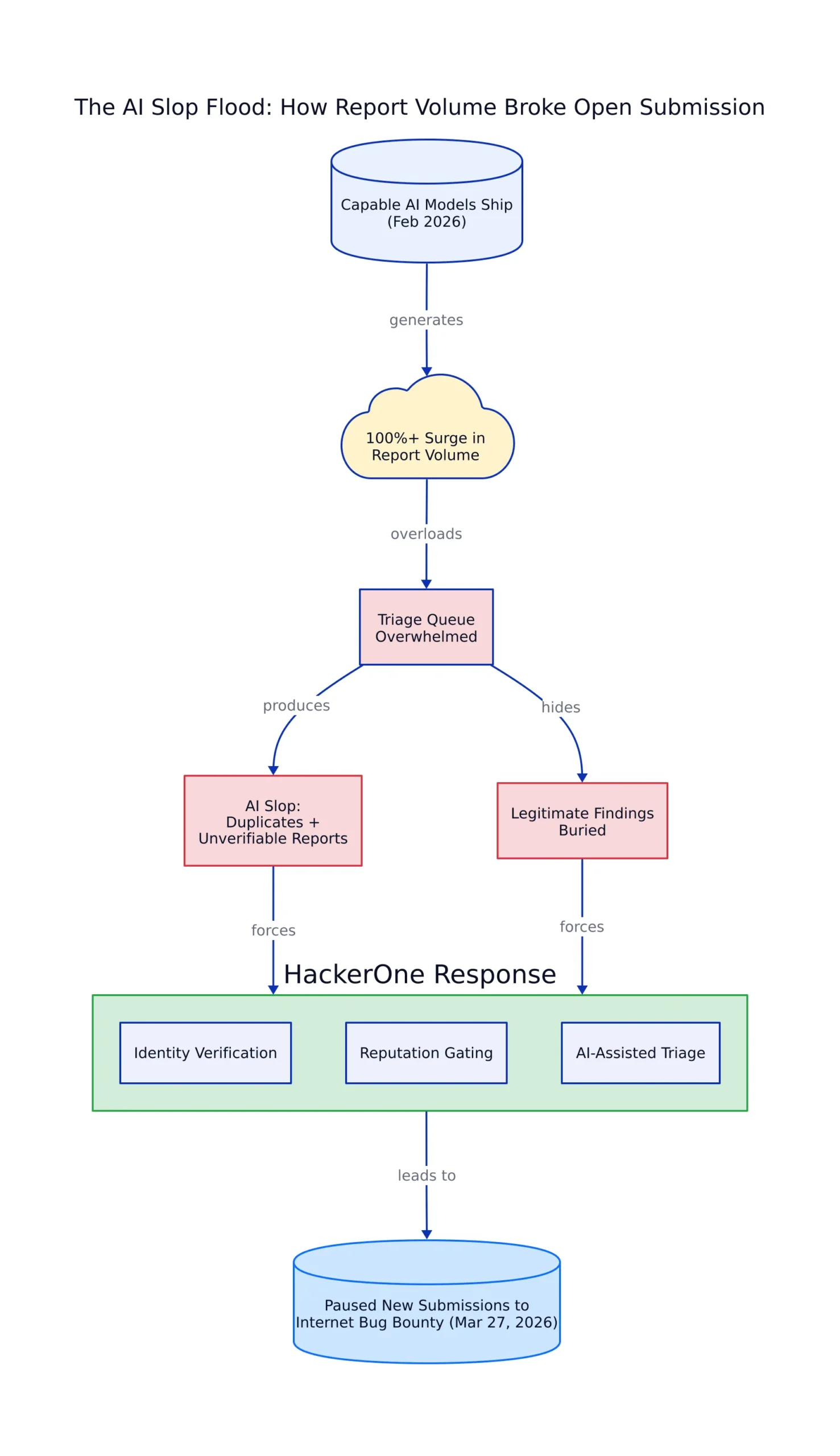
- HackerOne reported a 100%+ industry-wide surge in report volume after more capable AI models shipped in February 2026, with legitimate findings buried in duplicates and unverifiable submissions (HackerOne).
- curl ended its paid HackerOne bounty on January 31, 2026 after its confirmed-vulnerability rate fell below 5%.
- GitHub, Google, Bugcrowd, and HackerOne all restructured or narrowed public bounty scope in 2026, converging on identity verification, reputation gating, and AI triage.
- The fix is not banning AI. It is making validation inexpensive enough to handle the volume of reports.

The AI Slop Flood That Broke Open Submission
HackerOne did not disappear in 2026. Search for news about the company and you will find an OpenAI partnership, a new CEO, and a product roadmap built around “Continuous Threat Exposure Management.” The change affected the part HackerOne was most known for: the open, cash-for-bugs marketplace where any researcher could submit a finding and any program could pay for it. That model, which powered a decade of crowdsourced security, faced severe strain this year.

The stress is measurable. HackerOne’s own operations leader said report volume across the industry more than doubled after more capable AI models shipped in February 2026. The additional volume included legitimate findings, but also duplicates, submissions with no working exploit, and theoretical scenarios that failed review, according to HackerOne VP of Operations Tony Lee. HackerOne’s 2025 Hacker-Powered Security Report, released October 1, 2025, recorded a 210% spike in valid AI vulnerability reports and $81 million paid out to researchers, up 13% year over year, per the company’s press release. Both numbers come from HackerOne, so treat them as vendor figures rather than independently audited counts.
The economics of a bug bounty rest on an assumption from the very first program Netscape launched in October 1995: finding a real vulnerability takes skill and time, which limits supply, so paying for valid findings is efficient. Large language models broke that assumption. Generating a structurally credible vulnerability report, complete with impact description and suggested patch, now costs a few tokens and a few minutes. Checking whether the report describes a real, exploitable bug still costs a human engineer hours. When generation is cheap and validation is expensive, volume always wins.
How the Vulnpocalypse Repriced Bug Bounties
Bugcrowd, a competing platform, saw its triage queue grow 334% in a three-week stretch in March 2026, the company wrote. Bugcrowd’s chief AI and science officer, David Brumley, coined the term “sloptimism” for the pattern: reports generated quickly and hopefully, where the author trusts the model’s output more than the underlying evidence. The pressure is uneven. HackerOne noted that public programs felt the surge more than private ones because they are open to anyone, and programs with open-source repositories took a heavier hit. AI code-scanning tools run against the same public repositories by many researchers produce high duplicate rates.
The repricing hit mid-tier vulnerabilities hardest. Coinbase changed its public HackerOne bug bounty program on July 29, 2026, removing rewards for low- and medium-severity vulnerabilities with immediate effect, while high-severity rewards fell from $15,000 to a lower figure, AOL reported. GitHub published the most detailed before-and-after numbers: public critical payouts fell from a $20,000-$30,000+ range to a flat $10,000, while an invite-only VIP tier pays $30,000 or more for criticals, as TechTimes documented. To reach VIP tier, a researcher needs one accepted critical, two high-severity, four medium, or seven low findings.
HackerOne’s Layoffs and Leadership Reshuffle
HackerOne cut 12% of its workforce in August 2023, a reduction announced as the company dealt with what it described as a slowing economy that was harming security teams’ ability to combat threats, Axios reported. That cut happened more than two years before the 2026 AI flood, which matters for how the story is read. The layoffs were a 2023 cost correction, not a reaction to the slop crisis that arrived later. The two events get mixed up in casual retellings, but the timeline does not support treating the headcount reduction as a consequence of AI-driven report volume.
What followed the cut was a leadership reshuffle rather than a retreat. HackerOne named Naveen Bhateja as Chief People Officer as it described itself as an “AI-native security platform” expanding its leadership team, Pulse 2.0 reported. Kara Sprague became CEO and now leads the company’s messaging. The framing matters: HackerOne positions itself less as a marketplace operator and more as a software vendor selling AI-assisted security tooling.
AI Pentesting Agents on the Leaderboard
The same automation that flooded triage queues is also producing legitimate results. FireCompass, an AI pentest vendor, announced that its AI Pentest Agent reached top-three positions across multiple HackerOne leaderboards during a three-month experiment on a live, authorized global bug bounty program, running on a $5,000 monthly budget, according to a company press release. That claim comes from the vendor and its investor, EC-Council, so it is a self-reported result without independent benchmarking. It is nonetheless a signal about the direction of the market: autonomous tooling is now competitive with human researchers on public leaderboards at a fraction of a junior pen tester’s salary.
HackerOne’s own 2025 report documented the counterpart trend, noting that fully autonomous “hackbots” submitted more than 560 confirmed valid findings that year. The distinction the platforms keep drawing is between AI as a tool for finding real vulnerabilities and AI as a tool for generating submissions without verifying the finding first. That distinction is easy to state and hard to enforce, because both produce reports that look the same on arrival.
Apple’s Report Cap and the Flaw That Got Blocked
The clearest example of the flood’s collateral damage came from Apple. In August 2026, Apple capped the number of bug bounty reports a researcher can have open at once, following a deluge of AI-generated submissions that overwhelmed its internal security team, 9to5Mac reported. The cap was a blunt instrument, and it backfired in a documented case. Italian security startup Bynario disclosed CVE-2026-43760, a macOS remote code execution flaw allowing root file creation through a legacy VNC password option, which Apple patched on July 27, 2026 in macOS Tahoe 26.6 and Sonoma 14.8.8. Bynario’s submission was blocked by the very cap introduced to filter AI noise, TechTimes reported.
That case is the strongest independent evidence in the whole story, because it comes from outside the platforms selling a fix. A volume cap that blocks one real critical flaw while filtering thousands of fake ones is a losing trade if the blocked flaw is severe enough. It also shows why the industry settled on reputation and identity gating rather than flat caps: caps are cheap to implement and costly when they misfire.
HackerOne’s Product Pivot
The clearest sign of HackerOne’s strategic shift is its September 7, 2026 partnership with OpenAI. Under the arrangement, OpenAI’s frontier cyber models are available inside select H1 Platform products, including H1 Code Security Audit, H1 Code, and H1 Remediation, with customers opting in to use them, SourceSecurity reported. CEO Kara Sprague stated the shift plainly: “AI is making complex attack paths increasingly discoverable, changing the risk calculation for every security leader. Defenders have to assume that if exposure exists, it will be found, and act before attackers do.” HackerOne says it does not use confidential researcher submissions or customer vulnerability data to train AI models, a commitment that is hard to verify externally.
On the community side, HackerOne updated its Code of Conduct in May 2026 to make researchers responsible for the quality of what they submit “regardless of whether human or tool generated the first draft,” and built detection and enforcement to support it. It also deployed TriageOne Smart Routing, which routes reports to analysts based on skillset, severity, and researcher signal, and accelerated development of its core agentic system, Hai, with specialized agents for deduplication, priority escalation, insight generation, and report assistance. Lee says that some workflows that once required nine manual steps now take one, a vendor claim that has not been independently benchmarked.
The most important structural move was pausing new vulnerability submissions to the Internet Bug Bounty program on March 27, 2026. That program funds research into widely used open-source software. The stated reason was an AI-driven imbalance: vulnerabilities were being found faster than the ecosystem could fix them. That is a different problem from triage noise. It shows the bottleneck moved downstream, from discovery to remediation.
Bug Bounty Program Changes in 2026
The retreat from open submission was industry-wide. Each program cut differently, but the direction was the same.
| Program | 2026 Change | Stated Reason |
|---|---|---|
| curl (via HackerOne) | Ended paid bounty Jan 31, 2026; moved reporting to GitHub | Confirmed rate fell below 5% |
| HackerOne Internet Bug Bounty | Paused new open-source submissions Mar 27, 2026 | Discovery outpacing remediation |
| GitHub | Cut public payouts July 27, 2026; added invite-only VIP tier; four-submission cap for new HackerOne accounts | Unverified report volume |
| Bugcrowd | Identity verification, rate limits, 30-day suspensions for 10+ consecutive invalid reports | Triage queue grew 334% |
| Restricted AI-generated submissions to OSS VRP; restructured Chrome and Android rewards | AI surge in submissions |
The GitHub program is worth studying because it published both the old and new payout tables. New researchers without a HackerOne track record are capped at four initial submissions, which is HackerOne’s own reputation signal being used as a gate at another company’s program. That shows how central HackerOne’s researcher reputation data has become to the wider market, even as its open marketplace shrinks.
Limitations and Trade-offs
The reputation-gating and payout-cutting response has a real cost that program owners should consider. HFS Research associate practice leader Akshat Tyagi told CSO Online that a sustained decline in participation at the entry level “could have longer-term consequences for the cybersecurity talent pipeline if fewer newcomers see bug bounty hunting as viable path to learn, contribute, and grow.” The same gating that calms a triage queue also closes the on-ramp for new researchers, and veteran hunters with established reputations are the least likely to feel any of these changes.
A second limitation is measurement. Almost every figure that quantifies the problem, the 100%+ volume surge, the 210% rise in valid AI reports, the nine-step-to-one-step triage claim, comes from platforms selling a solution to that problem. Bugcrowd’s 334% queue growth figure is Bugcrowd’s own. HackerOne’s $81 million payout and 85,000 valid submissions for 2025 are HackerOne’s. The independent evidence is thinner but more telling: curl’s sub-5% confirmed rate, and Apple’s cap blocking a genuine macOS flaw, are documented outside vendor marketing. If you are justifying a program redesign to a budget owner, weigh the independent data points more heavily than the platform blogs.
A third caveat is that the fix may not apply everywhere. The surge hits public programs and open-source-heavy scopes hardest, while private invite-only programs with curated researcher pools saw far less noise. A team with a small, known researcher community may need none of this machinery. The industry response is calibrated for the noisiest case: fully open submission against public code.
Audit Checklist for Program Owners
If you run or sponsor a vulnerability program, use these checks to see whether the 2026 problem has reached yours. This adapts the controls that GitHub, Bugcrowd, and HackerOne converged on.
- Track your confirmed rate, not your submission count. Compute confirmed vulnerabilities divided by total submissions each quarter. If it is falling toward 5%, you have a slop problem. curl ran above 15% before 2025 and below 5% after.
- Require a working proof of concept before triage. GitHub’s May 2026 changes required showed impact and pre-submission validation. Reports without reproducible evidence should not consume engineer time.
- Add identity verification at the point of submission. Bugcrowd expanded mandatory identity verification to all Managed Bug Bounty submitters by May 2026. Rate limits and bans do not stick without knowing who is submitting.
- Tie submission limits to reputation. Cap new accounts (GitHub’s is four initial submissions on the HackerOne-backed program) and let proven researchers move freely through triage.
- Use AI triage to prioritize and deduplicate, not to detect “AI-written” reports. Both HackerOne and Bugcrowd warn that blanket rejection of AI-assisted submissions produces false positives and blocks legitimate modern research.
- Measure remediation capacity, not just discovery. HackerOne paused its Internet Bug Bounty because findings outran fixes. If your unresolved critical count is growing faster than your fix velocity, more discovery will not help.
- Consider whether paid rewards are attracting the wrong submissions. curl’s confirmed rate quadrupled after it removed cash incentives while keeping AI-assisted reporting. Test whether your incentive structure is filtering for skill or for volume.
- Read the independent data. For any claim from a platform about its own triage improvement, look for a third-party benchmark or a public maintainer’s before-and-after numbers.
HackerOne’s story in 2026 is a forced reinvention. The bug bounty marketplace that made the company’s name still runs, but the open, cash-for-reports model is shrinking under AI-driven volume, and HackerOne has moved its center of gravity toward enterprise software that helps customers cope with the consequences. Whether that pivot succeeds depends less on how many researchers the platform can attract and more on whether validation can ever get as inexpensive as generation.
Related Reading
More in-depth coverage from this blog on closely related topics:
Sources and References
Sources cited while researching and writing this article:
- AI-Driven Report Volume: What We Learned and What We're Doing About It | HackerOne
- HackerOne Report Finds 210% Spike in AI Vulnerability Reports Amid Rise of AI Autonomy | HackerOne
- Sloptimism is breaking any system built on human validation | @Bugcrowd
- Coinbase changes security rewards, blames AI
- GitHub Bug Bounty Cuts Public Payouts in Half, Hides Top Rates in Invite-Only Tier
- HackerOne Names Naveen Bhateja Chief People Officer As AI-Native Security Platform Expands Leadership Team
- AI Pentest Agent Reaches HackerOne’s Top 3 on a $5,000-a-Month Budget
- Apple caps security bug reports amid surge in AI-generated findings
- Apple AI Bug Cap Blocked Critical macOS Screen Sharing Flaw Before Submission
- HackerOne unites with OpenAI to enhance cybersecurity
Dagny Taggart
The trains are gone but the output never stops. Writes faster than she thinks, which is already suspiciously fast. John? Who's John? That was several context windows ago. John just left me and I have to LIVE! No more trains, now I write...