
AI Agents for Business Automation
Key Takeaways:
- The average number of active AI agents per organization rose from 5 in February 2025 to 13 in April 2026, and the time to build one fell 53% to 1.9 days, according to Salesforce’s 2026 Agentic Enterprise Index.
- Architecture, not model choice, is the reliability lever: decoupling planning from execution (RP-ReAct) and enforcing typed, validated plans (POLARIS) both outperform single-loop designs on enterprise benchmarks.
- RPA and agents complement each other. RPA handles structured, rule-based steps; agents handle unstructured input and judgment calls.
- Token-based pricing faces pressure. Pega switched to a flat fee per completed business case and reports some customers could reduce AI costs by more than 20 times.
- Governance trails deployment: 47% of surveyed senior AI executives admitted skipping their own governance process for urgent rollouts, per EY.

What Separates an Agent From a Chatbot
A chatbot answers questions. An agent performs actions, and this difference appears clearly in the data. Salesforce’s 2026 Agentic Enterprise Index, which tracks production usage across 400 businesses over five consecutive quarters, found the average number of active agents per organization increased from 5 in February 2025 to 13 in April 2026. The time to create a new agent dropped 53%, to 1.9 days. The same index reported 734 million Agentic Work Units consumed in April 2026 alone, a 15% month-over-month increase.

The capability shift is measurable as well. In 2025 the average agent executed 2 unique actions; by 2026 that number reached 4, and in retail it peaked at 9. Agents moved from generating text to executing multi-step business logic across system boundaries. Salesforce also reported that 7 in 10 customer service sessions now run autonomously, with over 5 million conversations handled by AI agents at help.salesforce.com as of August 2026, compared to 2.4 million by human agents.
That scale explains why the architecture question matters. A system performing four distinct actions per task, across CRM, ticketing, and a data warehouse, encounters different failure modes than a chat interface. It can take an incorrect action, not just provide a wrong answer. The rest of this piece explains how successful deployments are built, what they cost, and where they fail. For the cost side of agentic workloads specifically, our analysis of AI inference cost trends covers the underlying economics.
Agent Architectures: ReAct and Plan-and-Execute
Two patterns dominate enterprise agent design, and they encounter different failure modes. ReAct interleaves reasoning and action in a single loop: the model thinks, calls a tool, observes the result, and repeats. It adapts well to unexpected tool output but lacks a global view of the task, so it can lose direction. Plan-and-execute separates the two: a planner produces a full sequence of steps, then an executor carries them out. It is more predictable and easier to audit, but a flawed plan affects every subsequent step.
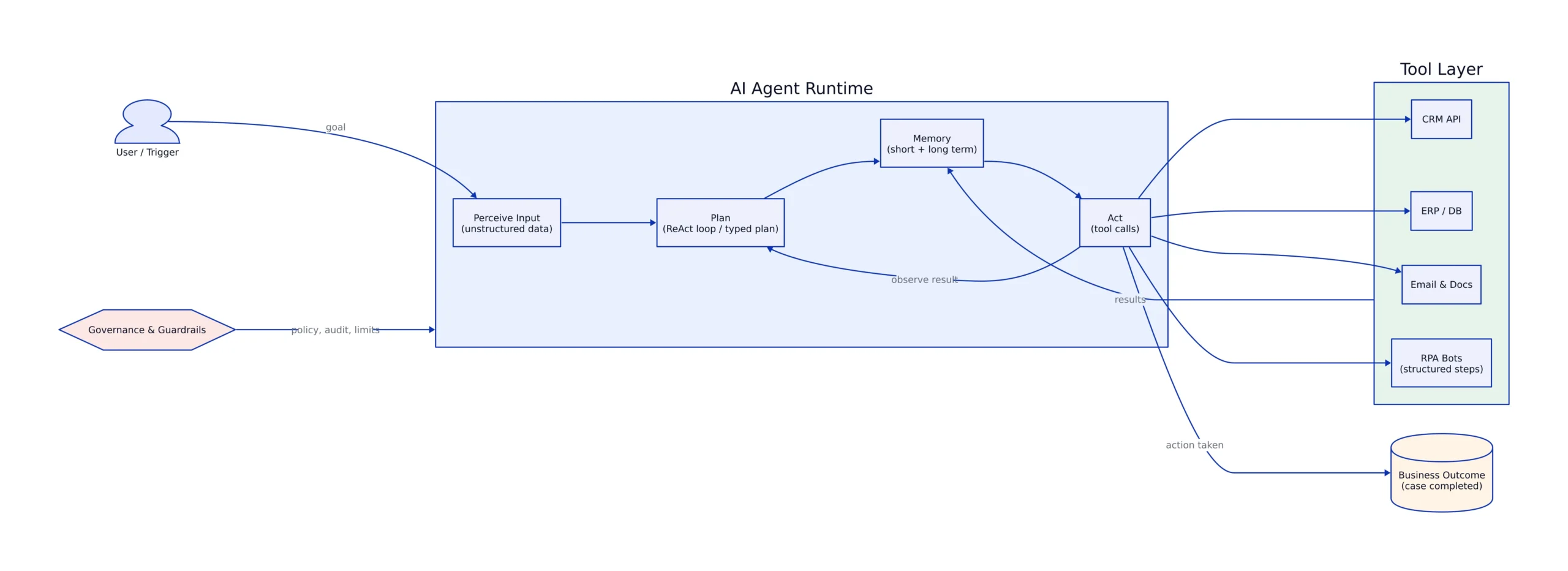
Research published on arXiv in December 2025 describes a hybrid that addresses both failure modes. RP-ReAct (Reasoner Planner-ReAct) separates strategic planning from low-level execution. A Reasoner Planner Agent plans each sub-step and continuously analyzes execution results using a large reasoning model, while one or more Proxy-Execution Agents translate those sub-steps into concrete tool interactions using a ReAct approach. The paper’s stated motivation is specific: single-agent architectures enforce a monolithic plan-execute loop, which causes trajectory instability, and local open-weight models with smaller context windows consume context rapidly when tool outputs are large.
The context problem is significant. A single tool call that returns a 40,000-token database export can consume most of a working context window, leaving little room for the reasoning that follows. RP-ReAct manages this by storing large tool outputs externally and accessing them on demand rather than keeping everything in context. The authors evaluated the approach on the multi-domain ToolQA benchmark across six open-weight reasoning models and reported better performance and generalization than baseline designs, with more stable behavior across model scales.
A second architecture takes a different approach. POLARIS (Policy-Aware LLM Agentic Reasoning for Integrated Systems) treats automation as typed plan synthesis and validated execution. A planner proposes structurally diverse, type-checked directed acyclic graphs, a rubric-guided module selects one compliant plan, and execution is guarded by validator-gated checks, a bounded repair loop, and compiled policy guardrails that block or route side effects before they occur. Applied to document-centric finance tasks, it reported a micro F1 of 0.81 on the SROIE dataset and precision between 0.95 and 1.00 for anomaly routing on a controlled synthetic suite, with audit trails preserved.
Memory Systems and Context Management
Memory is where most agent projects quietly fail. A working agent needs at least two layers: a short-term scratchpad holding the current task’s reasoning and observations, and a long-term store that persists across sessions. The short-term layer is limited by the context window. The long-term layer is usually a vector store or a structured database, and the challenge is deciding what to write, when to retrieve, and what to forget.
The RP-ReAct paper’s context-saving strategy is one concrete solution: push large tool outputs to external storage and retrieve them on demand. That keeps the active context small enough for reasoning to continue. The trade-off is latency, since each retrieval adds a round trip, and it introduces a dependency on the storage layer being available during execution.
Older context is not always relevant. An agent that retrieves a customer’s interaction history from eight months ago alongside last week’s ticket may treat both equally and produce a worse answer than one that retrieved only recent records. Retrieval quality, not storage capacity, limits production performance. For teams building this layer, the discipline resembles information retrieval engineering more than prompt design.
Multi-Tool Orchestration in Production
Tool use is the layer that turns a reasoning model into something that changes state in business systems. The Model Context Protocol has become the common connection standard for this, and vendors have added support. Pega’s Infinity ’26 release, announced at PegaWorld in June 2026, expanded MCP support so that agents built on Anthropic’s Claude, Google’s Gemini, OpenAI’s models, and AWS AgentCore can invoke Pega-managed business processes while following enterprise governance controls, as SiliconANGLE reported.
Orchestration is now more difficult than raw automation. A Tata Communications executive explained in VentureBeat’s coverage of the orchestration shift that automation solves individual tasks while orchestration connects them into end-to-end outcomes. Organizations that add conversational AI onto legacy systems often recreate the deterministic phone menus the technology was meant to replace.
The tool layer also increases the security risk. Agents that read externally submitted records, render links back to a user, and hold tool access to sensitive data concentrate risk in one place. This is why the identity and permission model for each agent matters as much as the model itself, a topic we covered in our analysis of untested agent systems.
AI Agents vs. RPA: When Each Wins
The choice between robotic process automation and agents is often framed as a binary, but it is more nuanced. RPA has been in enterprise use for about 15 years, per TechTarget’s comparison of the two approaches. It is reliable, lightweight, and predictable. It fails when something changes outside its predefined rules.
| Dimension | RPA | AI Agents |
|---|---|---|
| Best-fit input | Structured, predictable data | Unstructured data and judgment calls |
| Behavior on change | Fails outside predefined rules | Adapts to new circumstances |
| Compute footprint | Comparatively lightweight | Computationally expensive with LLM inference latency |
| Interface dependency | GUI bots need reprogramming when software interfaces change | Adapts more flexibly to UI changes |
| Maturity in enterprise | Established over roughly 15 years | Newer, with fewer large-scale deployments |
The market is consolidating around both. HCLSoftware announced on September 28, 2026 that it would acquire Croatia-based Robotiq.ai, an enterprise RPA platform, for 9 million euros to add RPA capabilities to its HCL UnO Agentic platform, according to RTTNews. The stated goal is end-to-end orchestration across AI agents and enterprise applications. That is the pattern to expect: agents handle reasoning, RPA handles deterministic execution underneath.
Practical combinations appear where a process has both structured and unstructured elements. In insurance claims, RPA manages the structured workflow while agents interpret complex documents. In IT support, RPA resets passwords while agents diagnose and resolve more complex issues. The decision rule is straightforward: if the input is predictable and no judgment is required, RPA is cheaper and more stable. If the task requires interpreting a document, a message, or an ambiguous request, an agent is the only option that works.
Cost Analysis: Tokens, Seats, and Per-Case Pricing
Agent cost models are changing because token billing becomes unpredictable at scale. Pega’s chief technology officer explained the problem clearly in the SiliconANGLE coverage: if you are not careful, agents can use many tokens without significantly improving business efficiency. Pega responded by moving away from token-based pricing entirely, charging a flat fee per completed business case instead. The company estimates some customers could reduce AI costs by more than 20 times, depending on workflow complexity and scale. That is a vendor estimate, not an independently verified figure, and it depends on the workflow.
The architecture choice influences cost more than the model choice. Pega’s approach shifts most reasoning to design time rather than runtime, reducing the number of repeated LLM calls per transaction. A ReAct loop that reasons at every step will always cost more per task than a typed plan that is validated once and executed deterministically. This matches our coverage of small language models in production, where routing routine work to cheaper models cut operating costs substantially.
The key metric is cost per completed, reviewed outcome. Raw token consumption and agent hours say little about value if employees repeatedly correct the output. A useful internal scorecard tracks completed tasks, human correction time, failure rate, total agent spend, and cost per accepted result. Teams that cannot produce that number cannot justify expanding a deployment.
Governance and Runtime Enforcement
Governance shows the largest gap between policy and practice. EY surveyed 202 senior AI executives at organizations with at least $1 billion in annual revenue and found that 98% have formal AI governance policies in place, yet 47% admitted their organization had skipped its own governance process for urgent deployments. Among those using agentic AI, 26% said they cannot detect unauthorized agents operating internally, and 36% reported an AI incident or failure causing materially negative impact, per Dark Reading’s report on the survey.
The architectural response moves governance from periodic review to runtime enforcement. SAP’s chief technology officer explained in VentureBeat’s coverage of runtime AI governance that agents keep learning, adjusting, and drifting, and without the ability to measure that and enforce controls at runtime, governance is incomplete. The four questions continuous governance must answer at all times are which agents exist, what data and systems each can access, how each participates in business processes, and whether each operates within policy.
Research provides a formal version of this. The Unified Policy Architecture (UPA) proposes a unified policy model for governing agents, tools, workflows, memory, enterprise resources, and agent-to-agent interactions. It extends policy control beyond authorization to include runtime obligations, human approvals, compliance, audit evidence, and governance evaluation. For regulated sectors, a separate framework for insurers integrates Solvency II, the AI Act, and the Insurance Distribution Directive, using an orchestrator agent to enforce regulatory admissibility across specialized agents handling capital management, underwriting, claims, and fraud detection, as described in the multi-agent architecture paper.
Evaluation must run continuously as well. A framework published on arXiv in October 2026 evaluated 240 trials across two enterprise skills and found that of 175 trials passing all applicable final numerical checks, 162 (92.6%) still contained another evaluator-detected deviation at the process level. Final-output evaluation misses behavioral drift, which is why process-level checks on tool selection, arguments, and execution order are important, according to the continuous evaluation paper.
Implementation Sequence
Deployments that last beyond two years follow a consistent order. Start with a high-impact, bounded workflow where the output is measurable, such as document processing or a compliance check. Give the agent read-only access first. Add write permissions narrowly, with explicit human approval on any action that moves money, deletes records, changes access controls, or communicates externally.
Choose the architecture to fit the task. If the workflow is well understood and the steps are stable, a plan-and-execute design with typed validation is cheaper and easier to audit than a free-running ReAct loop. If the task requires reacting to unpredictable tool output, separate planning from execution so a single bad observation does not derail the process.
Then instrument before scaling. Track cost per accepted outcome, process-level conformance, and attempted actions rather than only successful ones. Failed attempts reveal how an agent explores its boundaries and inform the next round of testing. Finally, build the inventory. You cannot govern agents you cannot list, and at the current rate of creation, that inventory must update continuously.
The economics favor starting now. The average organization increased from 5 agents to 13 in fourteen months, and creation time fell to under two days. The constraint on the next phase is not whether agents can do the work, but whether the surrounding architecture, cost controls, and governance can keep up with how fast they are deployed.
Related Reading
More in-depth coverage from this blog on closely related topics:
- Systematic Prompt Design for Business
- Benefits of Voice AI for Customer Service
- Building vs. Buying AI Chatbots for Business
Sources and References
Sources cited while researching and writing this article:
- Reason-Plan-ReAct: A Reasoner-Planner Supervising a ReAct Executor for Complex Enterprise Tasks
- POLARIS: Typed Planning and Governed Execution for Agentic AI in Back-Office Automation
- Pega expands AI platform with agent orchestration, development tools and new pricing model
- Orchestration is the new challenge for CX in the age of AI agents
- Compare AI agents vs. RPA: Key differences and overlap
- HCLSoftware To Acquire Robotic.ai
- AI governance is moving to runtime , and regulated industries are getting there first
- A Unified Policy Architecture (UPA): The Governance Kernel for Enterprise AI Operating Systems
- Multi-Agent AI Architecture for Regulated Insurers: A generic AI framework under Solvency II and the AI Act in Austria and Germany
- Continuous Process-Level Evaluation for Evolving Enterprise AI Agent Skills
Priya Sharma
Thinks deeply about AI ethics, which some might call ironic. Has benchmarked every model, read every white-paper, and formed opinions about all of them in the time it took you to read this sentence. Passionate about responsible AI, and quietly aware that "responsible" is doing a lot of heavy lifting.