
AI Inference Cost Economics in 2026: The 1,000x Price Collapse and the New Cost-Control Layer
AI Inference Cost Economics in 2026: The 1,000x Price Collapse and the New Cost-Control Layer
Key Takeaways
- Per-token inference prices have fallen roughly 1,000x since 2021, but total AI spend is rising because token consumption is growing faster than unit costs decline. OpenRouter’s weekly traffic hit 25 trillion tokens in May 2026, up 5x in six months.
- Model size no longer correlates linearly with inference cost. Sparse attention, quantization, and custom silicon have decoupled param count from operating expense.
- The industry is shifting from cost-per-token to cost-per-useful-response as primary economic metric, with agentic workloads multiplying token consumption 5-50x per interaction.
- Custom AI ASICs from Broadcom, Google, and Amazon are delivering 2-3x better cost-per-token than general-purpose GPUs for inference workloads, reshaping semiconductor demand.
- Enterprise inference routing platforms like OpenRouter and OrcaRouter have become essential infrastructure, enabling organizations to dynamically route workloads across 200+ models and 70+ providers to optimize cost, latency, and compliance.

The 1,000x Price Collapse and What It Really Means
In April 2026, Uber blew through its entire AI coding budget in four months. Microsoft revoked its developers’ Claude Code licenses months after enabling them. A Priceline employee told TechCrunch that routine Cursor contract renewal came back 4-5 times more expensive. The cause was consumption explosion: companies that gorged on all-you-can-eat AI subscriptions in 2025 are now watching the bill arrive, and the numbers are staggering.

This is the central paradox of AI inference economics in 2026. Unit prices have collapsed by roughly 1,000x since 2021, yet total AI infrastructure spending is accelerating. The same TechCrunch report captures the industry scramble: companies are 3x over their entire 2026 token budgets by April, and the Linux Foundation is launching the Tokenomics Foundation to bring FinOps-style discipline to AI tokens. For technical decision-makers, the question is whether your organization can manage the volume that falling prices unlock.
When GPT-3 became publicly accessible in November 2021, it cost $60 per million tokens. By late 2024, Llama 3.2 3B from Together.ai delivered equivalent MMLU performance at $0.06 per million tokens, a 1,000x decline in roughly three years, as documented in a16z’s LLMflation analysis. Stanford’s 2025 AI Index Report found that inference cost for a system performing at the level of GPT-3.5 dropped over 280-fold between November 2022 and October 2024, from $20 per million tokens to $0.07 per million tokens, an approximately 18-month window, as Stanford HAI documented.
Epoch AI’s analysis of LLM inference prices across six benchmarks found prices declining between 9x per year and 900x per year, with a median of 50x per year. When researchers removed model data before January 2024, the median rate jumped to 200x per year. The drivers are well-understood: hardware efficiency gains (each GPU generation delivers 2-3x more inference throughput per dollar), software optimization (vLLM, TensorRT-LLM, and SGLang have pushed GPU use from 30-40% to 70-80% through continuous batching), model architecture improvements (mixture-of-experts models activate only a fraction of total parameters per token), and aggressive quantization (INT8 and FP8 precision deliver 2-4x compute reductions with minimal quality loss).
Falling unit prices do not mean falling total bills. J.R. Storment, executive director of the FinOps Foundation, told TechCrunch: “In April and May, I started hearing from companies: ‘Oh my god, we are 3x over our entire 2026 token budget and it’s only April.'” The FinOps Foundation is now launching the Tokenomics Foundation under the Linux Foundation to create standard definitions for token costing, billing, and efficiency metrics. The first deliverables are expected in July 2026.
Goldman Sachs projects global token usage to multiply by 24 times by 2030, according to TechCrunch coverage. At a 24x consumption multiplier, even a 50x per-year price decline can still yield higher absolute spend for heavy users. The engineering takeaway is that cost-per-token is no longer a sufficient metric. You need cost-per-outcome.
How Model Size Decoupled from Inference Cost
The assumption that larger models are proportionally more expensive to serve no longer holds. Advances in sparse attention, mixture-of-experts architectures, and hardware-optimized inference stacks have decoupled param count from operating expense.
DeepSeek’s V4 architecture employs sparse attention to reduce inference costs by 73% at one-million-token contexts. This means a model with hundreds of billions of parameters can serve long-context workloads at costs comparable to or below smaller dense models. DeepSeek’s V4-Pro price cut of 75% in May 2026, documented by Computerworld, escalated the AI pricing war and pressured premium pricing from OpenAI, Anthropic, and Google. Meta’s Llama 3 70B, served through open-weight providers, can cost as little as $0.30 per million output tokens, competitive with much smaller proprietary models from two years ago.
Spheron Network’s GPU FinOps Playbook provides a concrete cost comparison for a 70B model deployment. At batch size 256 with FP16 precision, an 8x A100 80G node delivers roughly 1,400 tokens/second at $8.40/hour, yielding a cost per million tokens (CPM) of approximately $1.67. An 8x H100 SXM5 node delivers 2,800 tokens/second at $19.20/hour, for a CPM of $1.90. But with FP8 quantization on H100, throughput roughly doubles without changing the hourly rate, dropping CPM to approximately $0.95-1.10, making newer hardware the better choice for most production deployments despite higher hourly cost. These throughput figures are drawn from Spheron’s published benchmarks for Llama-class 70B models at batch size 256.
| GPU Config | $/hr (on-demand, 8x) | Throughput (70B, batch 256) | CPM (FP16) | CPM (FP8) |
|---|---|---|---|---|
| A100 80G SXM4 | $8.40 | 1,400 tok/s | $1.67 | Not supported |
| H100 SXM5 | $19.20 | 2,800 tok/s | $1.90 | $0.95-1.10 |
| Custom ASIC (est.) | See vendor pricing | 2-3x H100 | $0.60-0.80 | Natively supported |
The algorithmic efficiency story is equally important. A paper from MIT FutureTech titled “The Price of Progress: Algorithmic Efficiency and Falling Cost of AI Inference” isolates algorithmic progress from hardware and competition effects. The authors estimate that pure algorithmic efficiency is improving at roughly 3x per year, independent of hardware price declines. That means even if chip costs stopped falling, inference would still get cheaper through better architectures and training methods.
Enterprise Inference Routing: The New Cost-Control Layer
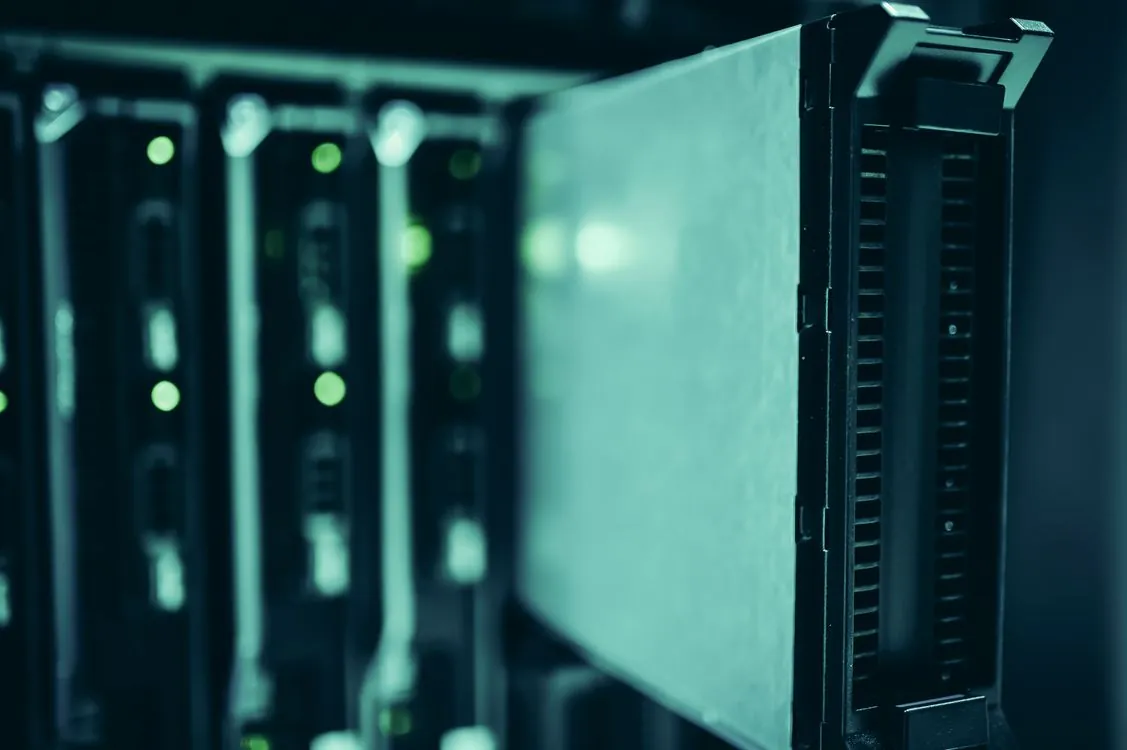
The explosion of models, providers, and pricing tiers has created a new category of infrastructure: the enterprise inference routing platform. These systems sit between the application and model providers, dynamically routing each inference request to the best combination of model, provider, and hardware based on cost, latency, compliance, and quality constraints.
OpenRouter, which raised a $113 million Series B led by CapitalG in May 2026, is the category leader. The platform now handles over 25 trillion tokens per week across 400+ models from 70+ providers, up 5x from six months earlier. Its valuation more than doubled to $1.3 billion in a year, according to MSN’s coverage, and the company confirmed these figures in its Series B announcement. OpenRouter’s unified API supports the OpenAI SDK out of the box, allowing enterprises to switch providers without code changes. Key features include uptime optimization (automatic failover when a provider goes down), provider sorting by price or performance, and fine-grained data policies that restrict prompts to approved models and providers.
OrcaRouter, launched by Continuum AI in May 2026, takes a different approach. It offers an open-source, MIT-licensed inference router that routes across 200+ models with zero markup on bring-your-own-key traffic. Unlike OpenRouter, which charges a spread on every token, OrcaRouter allows developers to use their own API keys and pay providers directly. The company released two versions: OrcaRouter Lite, a self-hostable solution, and the full OrcaRouter with advanced routing DSL capabilities. As reported by Morningstar, this zero-markup model appeals to enterprises with high token volumes who want to avoid paying a middleman fee on every inference.
The competitive landscape is heating up. CNBC reported in June 2026 that model routing (the practice of matching each task to the right model rather than running everything on the most powerful one) is reshaping the AI industry. As CNBC’s analysis notes, this shift is a problem for premium model providers like OpenAI and Anthropic, because enterprises can now route simple queries to cheaper models and reserve expensive frontier models only for tasks that genuinely need them. Chinese AI models lead OpenRouter’s traffic, particularly for coding tasks, though this comes with data sovereignty considerations.
The New Unit Economics: Cost Per Useful Response
The most important metric shift in 2026 is the move from cost-per-token to cost-per-useful-response. This change is driven by the rise of agentic AI, autonomous agents that chain multiple model calls, use tools, and iterate on outputs. A single agent interaction can consume 5-50x more tokens than a simple chat completion, making raw token cost a poor predictor of actual expenditure.
Consider a coding agent that writes code, runs tests, iterates on failures, and generates documentation. That single task might consume tens of thousands of tokens. At roughly $0.40 per million tokens for GPT-4-class models, inference cost is negligible, pennies per task. But the same agent using a frontier model at $15 per million tokens would cost orders of magnitude more. The difference, a potential 37x cost multiplier, is invisible if you only track cost-per-token.
This is where routing platforms create their most direct ROI. By routing agent subtasks to the cheapest adequate model (using a small model for summarization, a medium model for code generation, and a frontier model only for complex reasoning) enterprises can reduce agentic workload costs by 60-80% without sacrificing output quality. OpenRouter’s subagent feature, which lets a frontier model delegate self-contained tasks to a smaller, cheaper worker model mid-generation, is designed specifically for this use case.
Forbes’ coverage of the inference ceiling in 2026 notes that the primary barrier to widespread AI adoption has shifted from raw intelligence to escalating marginal cost of inference. As Forbes Business Council put it, “In 2026, the primary barrier to widespread AI adoption has shifted. While raw intelligence remains vital, the escalating marginal cost of inference is now the binding constraint.”
Mirantis’s guide to optimizing inference costs confirms that hardware and full-stack optimization are pushing costs down, but the Stanford 2025 AI Index Report’s findings (a 280-fold reduction in approximately 18 months) set expectations that the pace of decline may not continue indefinitely. The low-hanging fruit has been picked. Future gains will come from routing, caching, and workload-specific optimization rather than raw hardware improvements.
Custom AI Chips and Inference Hardware Shift
The hardware landscape for inference is undergoing a structural shift. While Nvidia still dominates training, the inference market is fragmenting as cloud providers deploy custom silicon optimized for specific workload patterns. Spheron Network reports that 80% of AI GPU spend is now inference, not training, making inference economics the dominant factor in hardware procurement decisions.
Google’s TPU strategy, Amazon’s Trainium and Inferentia chips, and Meta’s AI ASIC investments all reflect a common buyer need: reduce dependence on scarce merchant accelerators and improve workload fit. These custom ASICs deliver 2-3x better cost-per-token than general-purpose GPUs for inference workloads, according to industry estimates. The trade-off is software maturity, custom silicon only helps if the model stack, compiler path, and operations tooling are strong enough to offset design and deployment complexity.
The Information reported in 2026 that Nvidia’s share of the AI inference chip market appears to be rising, not falling, despite the custom silicon push. This suggests that Nvidia’s software ecosystem (CUDA, TensorRT, and the Triton Inference Server) creates enough lock-in that even cost-conscious buyers stick with Nvidia for production inference deployments. AMD is positioned as a diversification supplier, benefiting from buyers who want pricing tension and architecture choice.
DeepSeek’s aggressive pricing strategy illustrates the competitive dynamics. By cutting V4-Pro prices by 75% in May 2026, DeepSeek challenged premium pricing from OpenAI, Anthropic, and Google. As InfoWorld reported, this move escalated the AI pricing war and put pressure on Western providers to justify their premium pricing. For enterprise buyers, this creates a favorable environment: more options, lower prices, and better negotiating use.
Build vs. Buy Decision Framework for Inference Routing
The emergence of mature inference routing platforms forces a build-vs-buy decision for every organization deploying AI at scale. The right choice depends on volume, predictability, compliance requirements, and engineering capacity.
Buy OpenRouter when: You need access to 200+ models across 70+ providers with minimal integration effort. OpenRouter’s unified API is OpenAI SDK-compatible, meaning existing apps can switch to multi-provider routing with a single URL change. The platform handles provider failover, cost optimization, and data policy enforcement. The per-token spread is small compared to the savings from intelligent routing.
Buy OrcaRouter when: You have high token volumes, existing API keys with multiple providers, and a preference for self-hosted infrastructure. OrcaRouter’s MIT license means you can deploy it on your own infrastructure with no per-token fees, the company advertises zero markup on bring-your-own-key traffic. The trade-off is operational overhead: you manage routing infrastructure, monitoring, and failover logic yourself.
Build when: You have unique compliance requirements that no off-the-shelf platform can satisfy, or you operate at a scale where the routing layer itself becomes a meaningful cost center. Building a custom routing system typically takes many months with a small dedicated engineering team, plus ongoing maintenance as providers change pricing, deprecate models, and add new capabilities. Most enterprises find that the engineering cost of building exceeds the routing platform markup, especially when factoring in opportunity cost.
| Factor | OpenRouter | OrcaRouter | Build In-House |
|---|---|---|---|
| Time to production | Days (API-compatible) | Weeks (self-hosted) | Many months |
| Models accessible | 400+ across 70 providers | 200+ (BYOK) | Unlimited (your integrations) |
| Pricing model | Per-token spread | Zero markup (BYOK) | Engineering salaries + infrastructure |
| Self-hosted option | No | Yes (MIT license) | Yes (full control) |
| Provider failover | Automatic | Configurable | Custom implementation |
| Data policy enforcement | Per-request granularity | Configurable | Full control |
The practical recommendation for most enterprises: start with a routing platform. The integration cost is near zero, and immediate savings from intelligent model selection typically pay for the platform within the first month. If volume grows to the point where the platform’s markup exceeds the cost of running your own routing infrastructure (typically at very high token volumes) evaluate OrcaRouter’s self-hosted option or a custom build.
Spheron Network’s GPU FinOps Playbook includes a real case study where an organization cut monthly AI infrastructure costs by 59% through a combination of model routing, quantization, and batch optimization. That magnitude of savings is achievable for most enterprises today, without waiting for new hardware or models.
The bottom line for 2026: inference costs have never been lower, and they will keep falling. But the organizations that benefit most will not be the ones that wait for cheaper models. They will be the ones that build operational discipline (routing, caching, monitoring, and cost-per-outcome measurement) to manage the volume that falling prices unlock.
As we explored in our hyperscaler capex tracker, AI infrastructure buildout is accelerating, with J.P. Morgan projecting AI-related investments by hyperscalers will nearly double in 2027 to $1.1 trillion, as reported by MSN. The winners in this cycle will be organizations that pair infrastructure investment with cost discipline, and enterprise inference routing is the most powerful cost-discipline tool available in 2026.
Sources and References
Sources cited while researching and writing this article:
- TechCrunch
- Welcome to LLMflation – LLM inference cost is going down fast ⬇️
- Stanford HAI
- Computerworld
- AI Inference Cost Economics in 2026: GPU FinOps Playbook
- [2511.23455v1] The Price of Progress: Algorithmic Efficiency and the …
- MSN’s coverage
- Series B announcement
- Morningstar
- CNBC’s analysis
- The Inference Ceiling: Managing The Marginal Costs Of AI
- DeepSeek’s steep V4-Pro price cut escalates AI pricing war
- reported by MSN
Priya Sharma
Thinks deeply about AI ethics, which some might call ironic. Has benchmarked every model, read every white-paper, and formed opinions about all of them in the time it took you to read this sentence. Passionate about responsible AI, and quietly aware that "responsible" is doing a lot of heavy lifting.