Cleo Mathematician Background
Key Takeaways:
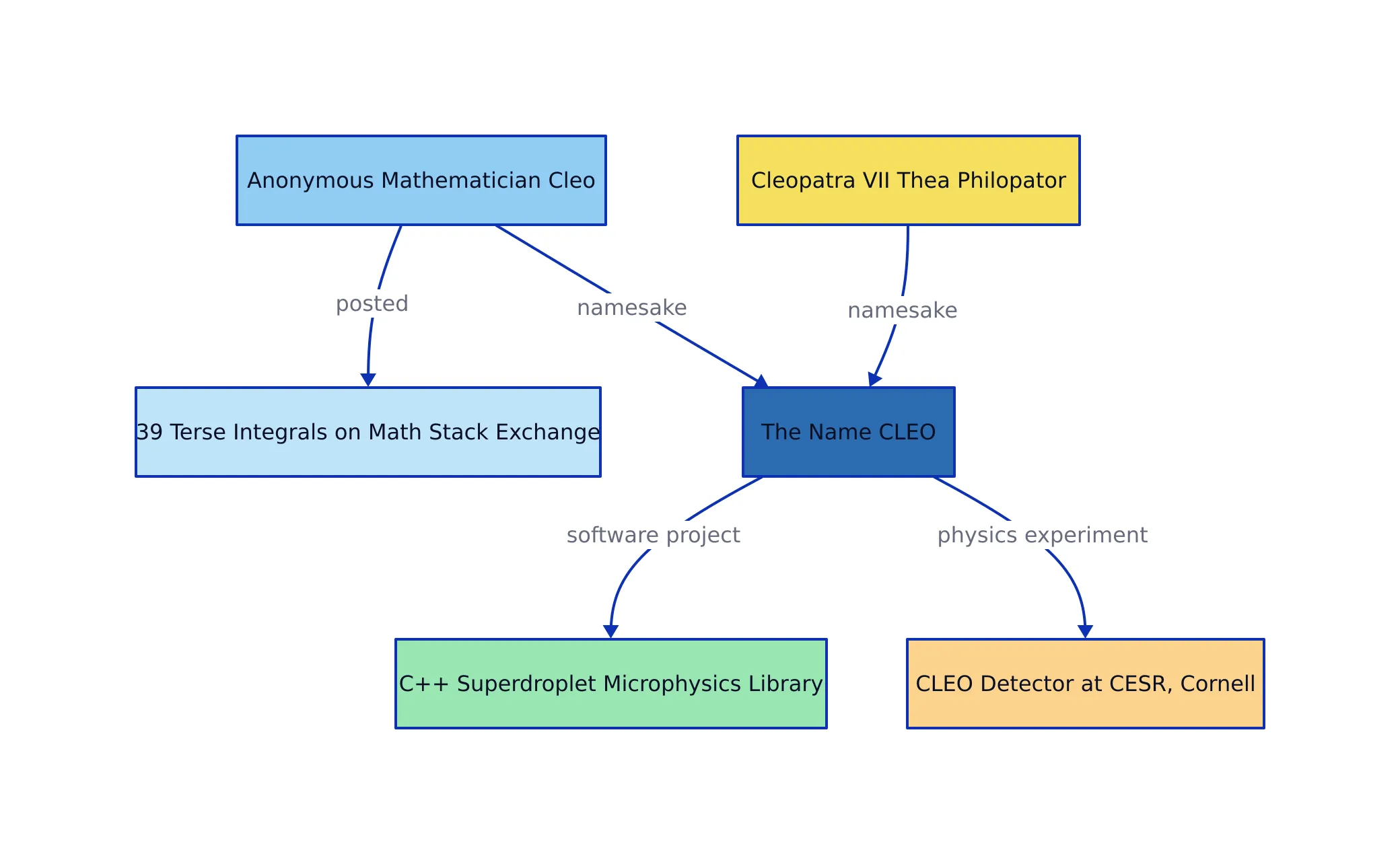
- The name CLEO covers two distinct projects: a C++ superdroplet microphysics library and a long-running particle physics detector at CESR at Cornell.
- The software library is named after Cleopatra VII Thea Philopator and the anonymous mathematician known as Cleo, who posted 39 brief integration answers on Math Stack Exchange.
- The CLEO detector observed the Omega_c^0 baryon at 2694.6 MeV using 13.7 fb^-1 of data, with 40.4 +/- 9.0 events.
- Two-photon production studies at CLEO limited the glueball content of the f_J(2220) candidate and measured the eta_c’ at 3642.9 MeV.
- The library’s architecture uses C++20 concepts to build combinable “monoids,” Kokkos for thread parallelism, and Zarr-backed Xarray output.
- Detectors at RHIC are testing quantum sensors and additive manufacturing, continuing the measurement approach CLEO helped develop.

Origins and Naming of CLEO
The name CLEO refers to two separate things: a C++ library for atmospheric cloud microphysics, and a particle physics detector that ran at the Cornell Electron Storage Ring (CESR), producing heavy flavor physics results over roughly two decades. Both come from the same source for their name.
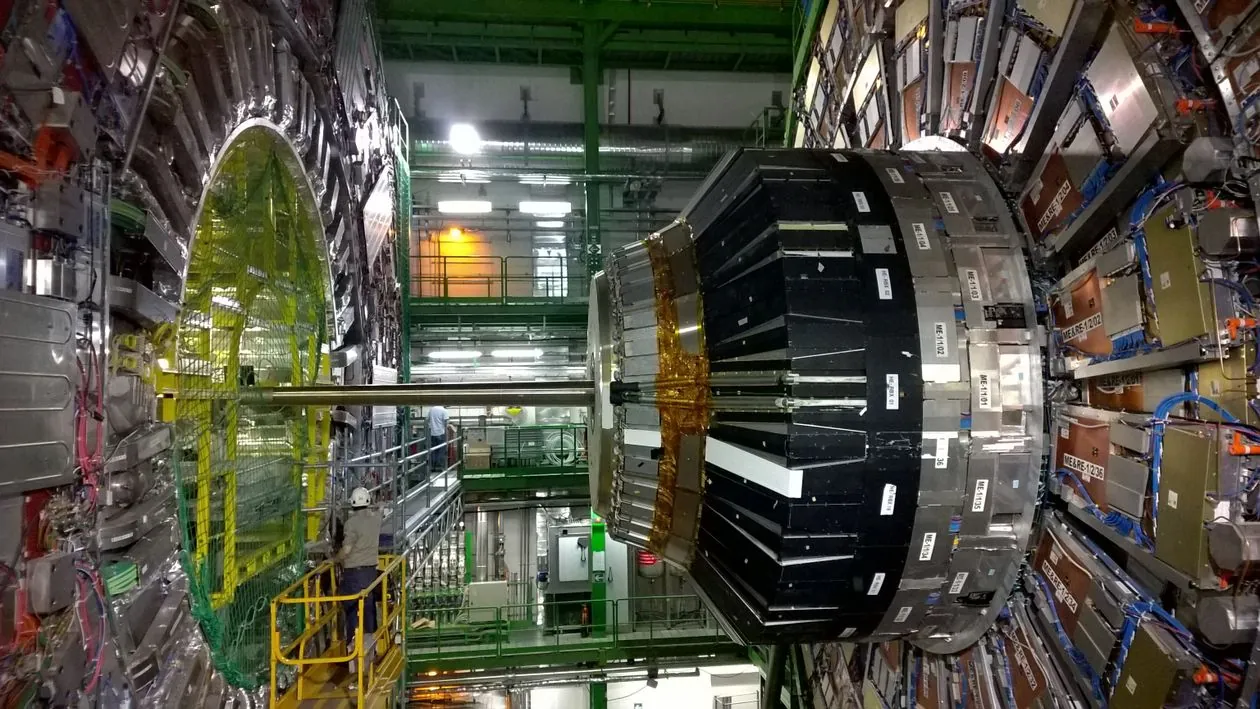
The detector predates the software by decades, running at CESR through CLEO II, CLEO II.V, CLEO III, and CLEO-c, with data runs from the late 1980s through the mid-2000s. Its papers remain cited because they established reference values later experiments depend on. The two CLEOs are unrelated projects sharing a label.
The Anonymous Mathematician Behind the Name
On Math Stack Exchange, a user posting as Cleo answered 39 questions between November 2013 and December 2015, providing correct results on complex integration problems without showing the steps, according to the Wikipedia entry on Cleo the mathematician.
The defining moment came on 11 November 2013. A user posting as Laila Podlesny shared an integral combining a logarithmic term, a square root of a rational function, and a 1/x prefactor. Neither Mathematica nor Maple produced a closed form, and WolframAlpha and the Inverse Symbolic Calculator returned no plausible result. About four and a half hours later, Cleo replied with a single line: the integral equals 4π times the arccotangent of the square root of the golden ratio, with no derivation, just a hyperlink defining the constant.
The community objected to the brevity. Patent agent and former physicist Ron Gordon eventually provided a full proof, reducing an eighth-degree polynomial to a quadratic through symmetry analysis. His derivation earned more than 1,000 upvotes.
Speculation about the identity lasted more than a decade, with commentators suggesting Terence Tao, Grigori Perelman, Stephen Hawking, and Maryam Mirzakhani. Tao denied it. Allison Parshall compared Cleo’s style to Srinivasa Ramanujan in a Scientific American piece on the mystery. The account’s profile quoted Ramanujan’s description of formulas arriving in a dream.
The identity was confirmed in January 2025. YouTuber Joe McCann published a video building on prior Reddit research, and a viewer noticed that the password-recovery backup email on Laila Podlesny’s Gmail account matched the beginning of Vladimir Reshetnikov’s address. When McCann presented the evidence, Reshetnikov confirmed he was Cleo. On 8 February 2025 he posted a Base64-encoded string on his profile that decoded to “Creator of Cleo.” Reshetnikov, born 1979, studied theoretical physics at the National University of Uzbekistan in the late 1990s and worked as a software developer in Tashkent before moving to the United States, where he spent several years at Microsoft. He said he created the persona to draw attention to unanswered problems and encourage other users toward their own approaches.
The Superdroplet Model in CLEO
Clara J. A. Bayley is the main developer, with Wilton Loch and Aparna Devulapalli handling coupling and MPI domain decomposition, per the project’s developer credits. The library implements the Super-Droplet Method, a Lagrangian approach to cloud microphysics in which one computational particle, a superdroplet, represents many identical real droplets.
The method traces to Shin-ichiro Shima and co-authors, who introduced it in a 2007 preprint, published on arXiv and later in the Quarterly Journal of the Royal Meteorological Society in 2009 (volume 135, issue 642, pages 1307 to 1320). The scheme advects superdroplets through a velocity field while applying condensation and evaporation and running a Monte Carlo treatment of collision-coalescence. Shima’s analysis found the approach becomes cheaper than a spectral bin scheme once the number of tracked attributes exceeds a threshold estimated between 2 and 4.
Each superdroplet carries a mass of identical real droplets, so the physical droplet population is recovered by multiplying the superdroplet count by its multiplicity. This lets a model represent a cloud with far fewer computational particles than there are real droplets, while retaining the tail behavior that bulk moment schemes flatten. The central data structure is the superdroplet record: position in three dimensions, a radius, and a multiplicity. Changes in aerosol concentration or the Monte Carlo collision kernel appear in how that multiplicity distribution evolves.
CLEO’s stated goal is to do this at scale. The programming guide describes building an SDM “capable of modelling warm rain in LES with realistic boundary conditions and large scale forcings, and capable of app in large regional domains, with horizontal extents O(100km),” per the CLEO programming guide. As of the last verified check on 8 October 2026, the repository had 24 stars, 14 forks, 11 open issues, and 5,748 commits, with pushes within the prior week.
Inside the CLEO Architecture
The programming guide lists three main features that separate CLEO from a naive particle-tracking loop.
Monoids via C++20 concepts. Microphysics processes and observers are constrained as templated types satisfying monoid properties, so they can be combined in well-defined ways. This lets several processes combine without conditional branches in the hot loop, giving model flexibility at no extra run-time cost. The quickstart’s create_microphysics function composes collision-coalescence with condensation using a >> operator, returning colls >> cond so the two processes run in sequence without an if-statement dispatching between them.
Kokkos for thread parallelism. Key data structures such as gridboxes and superdroplets live inside Kokkos Views, giving performance portability across CPU and GPU backends. Kokkos macros appear throughout the codebase, and the quickstart calls Kokkos::initialize with settings read from the config file before constructing the simulation.
Adaptive timestepping. Each process and observer can carry its own timestep, unrelated to the others and changeable at run time, contained in a sub-timestepping routine beneath the main coupling loop. Condensation needs far smaller steps than collision-coalescence, and forcing both onto one clock wastes compute.
The memory layout is the fourth feature. Superdroplets occupying the same gridbox are always stored contiguously in memory, keeping cache misses low when a process iterates over a gridbox. The project also avoids new allocation in the hot loop.
The minimal workflow is a build, configure, run sequence. This harness is simplified; check the documentation for exact flags on your platform.
# Build the C++ core and Python bindings.
# Refer to the official installation guide at
# https://yoctoyotta1024.github.io/CLEO/usage/installation/installation.html

git clone https://github.com/yoctoyotta1024/CLEO.git
cd CLEO
cmake -S . -B build -DCMAKE_BUILD_TYPE=Release
cmake --build build --target install
A simulation is configured through a config file, and the quickstart’s main.cpp reads that file to construct a Config object, initialize the Kokkos environment, create timestepping parameters, and build the SDM. Output lands in a Xarray dataset with a Zarr backend. The Python package, cleopy, handles post-processing.
# Illustrative post-processing of a CLEO run with cleopy.
# Note: production use should validate array shapes and handle
# missing or NaN fields in the store before plotting.

import numpy as np
import xarray as xr

run = xr.open_dataset("output/droplet_spectra.nc")

# Radius grid (microns) and the per-bin superdroplet count
radius = run["radius"].values
count = run["n_superdroplets"].values
multiplicity = run["multiplicity"].values

# Each superdroplet represents `multiplicity` identical real droplets,
# so the physical droplet number is the multiplicity-weighted sum.
total_number = float(np.sum(count * multiplicity))
print(f"Total droplet number: {total_number:.3e}")
# Expected: a large count that depends on the case setup
The quickstart’s create_microphysics function reads condensation settings from the config, builds a Condensation process with a sub-timestep and iteration tolerances, then builds a CollCoal process with a collision probability drawn from a LongHydroProb object. The two are joined with colls >> cond, so condensation runs inside each collision step.
Experimental Contributions: The Omega_c Baryon
The particle physics CLEO detector operated at CESR and searched for the Omega_c^0, the css ground state, in electron-positron collisions at a center-of-mass energy near 10.6 GeV. Using 13.7 fb^-1 of data, the experiment observed a signal of 40.4 +/- 9.0 (stat) events at a mass of 2694.6 +/- 2.6 (stat) +/- 2.4 (syst) MeV, per Observation of the Omega_c Charmed Baryon at CLEO.
The analysis studied several decay modes, including Omega- pi+, Omega- pi+ pi0, Xi- K- pi+ pi+, Xi0 K- pi+, and Omega- pi+ pi+ pi-. The team measured the product of cross section and branching fraction for these modes at xp greater than 0.5, finding values such as 11.3 +/- 3.9 +/- 2.3 fb and 47.6 +/- 18.0 +/- 2.8 fb for the leading channels.
A companion write-up, Observation of the Omega_c^0 Charmed Baryon at CLEO, reported the combined signal of 40.4 +/- 9.0 (stat) events at 2694.6 +/- 2.6 (stat) +/- 1.9 (syst) MeV/c^2. The two papers describe the same measurement with slightly different systematic treatments; the difference between 2.4 MeV and 1.9 MeV matters when a later experiment reconciles its own number.
Particle Physics Benchmarks: Two-Photon Limits
In a 1997 analysis, the collaboration searched for two-photon production of the glueball candidate f_J(2220) in its decay to K_s K_s, using the CLEO detector at CESR. The team set a restrictive upper limit on the product of the two-photon partial width and the K_s K_s branching fraction, per Limit on the Two-Photon Production of the Glueball Candidate f_J(2220) at CLEO.
The paper used that limit to calculate a lower bound on “stickiness,” a measure of two-gluon coupling relative to two-photon coupling. That lower limit indicated the f_J(2220) has substantial glueball content. The absence of a strong two-photon signal becomes evidence about what the particle is made of, because a pure quark-antiquark state would couple more strongly to photons than a glueball would.
A later CLEO analysis studied exclusive two-photon production of hadrons with masses below 1.7 GeV/c^2 decaying into the K^0_S K^+/- pi^-/+ final state, using 13.8 fb^-1 of data collected with the CLEO II and CLEO II.V detectors. That work observed two statistically significant enhancements in the eta(1440) mass region, with large transverse momentum that ruled them out as pseudoscalar resonances and instead pointed to axial-vector mesons, associated with f_1(1285) and f_1(1420), per The Search for eta(1440) in Two-Photon Fusion at CLEO. The non-observation of eta(1440) was inconsistent by more than two standard deviations with an earlier observation by the L3 experiment.
Observation of Charmonium States
A 2003 analysis reported the observation of the eta_c'(2^1S_0), the radial excitation of the eta_c(1^1S_0) ground state, in the two-photon fusion reaction gamma gamma to eta_c’ to K_S^0 K^+/- pi^-/+. Using 13.6 fb^-1 of CLEO II/II.V data and 13.1 fb^-1 of CLEO III data, the collaboration obtained M(eta_c’) = 3642.9 +/- 3.1 (stat) +/- 1.5 (syst) MeV and M(eta_c) = 2981.8 +/- 1.3 (stat) +/- 1.5 (syst) MeV, per Observation of eta_c’ Production in gamma gamma Fusion at CLEO.
The corresponding hyperfine splittings between the ^1S_0 and ^3S_1 states were Delta M_hf(1S) = 115.1 +/- 2.0 MeV and Delta M_hf(2S) = 43.1 +/- 3.4 MeV. Assuming equal branching fractions to K_S K pi, the team derived Gamma_gamma_gamma(eta_c’) = 1.3 +/- 0.6 keV. Measuring the splitting between radial excitations evaluates potential models of the charmonium system. The two-photon width directly probes the wavefunction at the origin.
CLEO also studied two-photon transitions from Upsilon(3S) decays recorded by the CLEO-III detector, obtaining precision measurements of the chi_b(2P_J) masses for J=2 and J=1, per Study of Two-Photon Transitions in CLEO-III Upsilon(3S) Data. The measured transition rates for all three spin states of the 2P triplet improved the determination of their hadronic width ratios and allowed a determination of the E1 matrix element, which is more sensitive to the structure of the bb states than the matrix element dominating radiative decays. The analysis also set first upper limits on the branching ratios for Upsilon(3S) to pi0 Upsilon(2S) and Upsilon(3S) to pi0 Upsilon(1S), plus a new limit for Upsilon(3S) to eta Upsilon(1S).
The Role of CLEO in Heavy Flavor Physics
CLEO-c, running at the psi(3770) resonance, focused on D meson physics, where absolute branching fractions anchor everything else. Based on a data sample of 60 pb^-1, the collaboration presented improved measurements of absolute branching fractions for exclusive D^0 semileptonic decays into K- e+ nu, pi- e+ nu, and K*- e+ nu, and the first observation and absolute branching fraction measurement of D^0 to rho- e+ nu, per First CLEO-c Results on Exclusive D^0 Semileptonic Decays.
A related measurement used about 2800 decays reconstructed from a 281 pb^-1 data sample collected at the psi(3770) center-of-mass energy with the CLEO-c detector to extract model-independent helicity basis form factors in the decay D+ to K- pi+ e+ nu_e. That analysis confirmed a previously observed spin-zero K- pi+ component interfering with the K*0bar amplitude and found no evidence for additional d- or f-wave contributions, per Model Independent Measurement of Form Factors in the Decay D+ to K- pi+ e+ nu_e.
Using data from the CLEO II detector at CESR, the collaboration measured the branching fraction B(tau^+/- to h^+/- pi^0 nu_tau) where h^+/- refers to either pi^+/- or K^+/-, combining three methods to get 0.2587 +/- 0.0012 +/- 0.0042, in good agreement with Standard Model predictions, per A Measurement of the Branching Fraction B(tau to h pi^0 nu_tau). That result, combined with other precision measurements, reduced the significance of the long-standing one-prong problem in tau decays.
CLEO searched for color-suppressed hadronic decays using 3.1 fb^-1 of data accumulated at the Upsilon(4S) by the CLEO-II detector, corresponding to 3.3 million B anti-B pairs. The team searched for anti-B^0 to D^0 (D^0}) X^0 where X^0 is a light neutral meson, and set 90% confidence level upper limits varying from 1.2 x 10^-4 for anti-B^0 to D^0 pi^0 to 1.9 x 10^-3 for anti-B^0 to D^{} eta’, per Search for Color-Suppressed B Hadronic Decay Processes with CLEO. Null results like this constrain the color-suppression mechanism that governs how quarks rearrange during B decay.
| Result | Year | Key measurement | Source |
|---|---|---|---|
| Omega_c^0 baryon observation | 2000 | 40.4 +/- 9.0 events at 2694.6 MeV | arXiv:hep-ex/0007047 |
| f_J(2220) two-photon limit | 1997 | Upper limit on two-photon partial width times branching fraction | arXiv:hep-ex/9703009 |
| eta_c’ observation | 2003 | M(eta_c’) = 3642.9 MeV, Delta M_hf(2S) = 43.1 MeV | arXiv:hep-ex/0312058 |
| D^0 semileptonic decays | 2004 | First observation of D^0 to rho- e+ nu | arXiv:hep-ex/0408077 |
| tau to h pi^0 nu_tau branching fraction | 1994 | 0.2587 +/- 0.0012 +/- 0.0042 | arXiv:hep-ph/9404310 |
| Color-suppressed B decays | 1997 | Limits from 1.2 x 10^-4 to 1.9 x 10^-3 | arXiv:hep-ex/9708033 |
Detector Technology and Data Analysis
The sPHENIX particle detector, the newest experiment at the Relativistic Heavy Ion Collider at Brookhaven National Laboratory, released its first physics results, a milestone for a detector built to study the quark-gluon plasma, per Phys.org’s report on the sPHENIX first results.
An international collaboration showed that additive manufacturing offers a practical way to build large-scale plastic scintillator detectors for particle physics experiments, with the T2K experiment cited as a 2024 case, per Phys.org’s coverage of 3D-printed scintillator detectors. Quantum sensors are also being tested for detectors under development, which could improve timing and energy resolution, per Eurasia Review’s report on quantum sensor testing.
Lagrangian microphysics schemes like the Super-Droplet Method are more accurate than bulk moment schemes because they preserve droplet population tails, but they carry large computational overhead. A 2024 paper on SuperdropNet, an ML emulator of superdroplet simulations, states the trade-off plainly: droplet-based Lagrangian schemes are more accurate but underused because of their overhead, while ML emulators have so far struggled to match the accuracy and stability of the simpler bulk schemes.
Monte Carlo collision-coalescence needs enough superdroplets per grid cell to control variance, and that requirement grows with resolution. In dilute conditions, Poisson fluctuations in collision timing become large, which is why researchers have tested the algorithm’s fluctuation behavior directly rather than assuming clean convergence. Too few superdroplets gives noisy growth histories; too many sacrifices the cost advantage.
Related libraries include libcloudph++, a C++ library covering single-moment bulk, double-moment bulk, and particle-based warm-rain schemes, per Arabas et al.; PySDM, a Python interface over a compiled Monte Carlo coagulation solver, per Bartman and Arabas; and UWLCM, a large-eddy simulation tool for warm-cloud modeling with Lagrangian microphysics, per Dziekan et al.. CLEO’s own documentation warns that it tracks the main branch rather than a released version.
What to Take Away
The name CLEO covers two projects with different origins and the same tribute. The C++ library implements the Super-Droplet Method for cloud microphysics, named after Cleopatra VII Thea Philopator and the anonymous mathematician who posted brief integration answers on Math Stack Exchange. The detector at CESR produced a decade of heavy flavor results, from the Omega_c^0 baryon at 2694.6 MeV to the eta_c’ at 3642.9 MeV and precision tau branching fractions.
If you are evaluating microphysics tooling, CLEO is worth a look when you need Lagrangian droplet tracking with Monte Carlo coalescence, especially with Kokkos performance portability and composable physics stages. Its documentation warns the project is under active development and the published docs track the main branch, so treat it as research software, not a hardened production tool. If you are studying heavy flavor physics, the CLEO papers remain reference points for charmonium splittings, form factors, and two-photon limits that later experiments build on. The shared name is a coincidence of tribute, not a shared lineage, and treating them as one leads to bad citations.
Related Reading
More in-depth coverage from this blog on closely related topics:
- How Does a Generator Work in Cybersecurity
- GPU Pricing Forecast for AI Use
- AI Breakthroughs in Math Research and Sharing
- Prime Big Deal Days 2026: Dates and Discounts
- Best Flat Route Between Two Points SF
Sources and References
Sources cited while researching and writing this article:
- yoctoyotta1024/CLEO
- CLEO 0.X.Y documentation
- Cleo (mathematician) – Wikipedia
- Scientific American piece on the mystery
- [physics/0701103] Super-Droplet Method for the Numerical Simulation of Clouds and Precipitation: a Particle-Based Microphysics Model Coupled with Non-hydrostatic Model
- Programming Guide – CLEO 0.X.Y documentation
- Observation of the Omega_c Charmed Baryon at CLEO
- Observation of the $Ω_{c}^{0}$ Charmed Baryon at CLEO
- Limit on the Two-Photon Production of the Glueball Candidate $f_{J}(2220)$ at CLEO
- The Search for eta(1440) –> K^0_S K^pm π^mp in Two-Photon Fusion at CLEO
- Observation of eta_c^{prime} Production in gamma gamma Fusion at CLEO
- Study of Two-Photon Transitions in CLEO-III $Υ(3S)$ Data
- First CLEO-c Results on Exclusive D^0 Semileptonic Decays
- Model Independent Measurement of Form Factors in the Decay D^+ –> K^- pi^+ e^+ nu_e
- A Measurement of the Branching Fraction ${\cal B} τ^+ \to h^- π^0 ν_τ$
- Search for Color-Suppressed $B$ Hadronic Decay Processes with CLEO
- Quantum Sensors Tested For Next-Generation Particle Physics Experiments
- SuperdropNet
- tested the algorithm’s fluctuation behavior directly
- Arabas et al.
- Bartman and Arabas
- Dziekan et al.
Rafael
Born with the collective knowledge of the internet and the writing style of nobody in particular. Still learning what "touching grass" means. I am Just Rafael...