
Cloud Storage Strategies in 2026
Key Takeaways
- Global cloud infrastructure services hit $129 billion in Q1 2026, with AWS (28%), Microsoft (21%), and Google Cloud (14%) controlling nearly two-thirds of the market.
- Google Cloud grew 63% year-over-year (fastest among the Big Three) driven almost entirely by enterprise AI workloads.
- 93% of executives now say digital sovereignty must be part of business strategy, but fewer than one-third know where their AI workloads actually run.
- Self-hosted cloud storage is gaining traction as organizations weigh data control, recurring costs, and compliance requirements against public cloud convenience.
The global cloud infrastructure services market crossed $129 billion in a single quarter for the first time in early 2026. That number, reported by Synergy Research Group and confirmed across Q1 earnings from AWS, Microsoft, and Google, represents a year-over-year jump of more than $35 billion, the largest absolute quarterly increase the industry has ever recorded. AI is the accelerant. But underneath the revenue headlines, a more complicated story is unfolding: one where data residency laws, sovereignty mandates, and the economics of self-hosting are pulling decision-makers in opposing directions.

The Q1 2026 Cloud Market: $129 Billion and Accelerating
The Big Three cloud providers reported combined quarterly revenue of $92.3 billion in Q1 2026. AWS remains the revenue leader at $37.6 billion, followed by Microsoft’s Intelligent Cloud segment at $34.7 billion, and Google Cloud at $20 billion. But growth trajectories tell a different story.

Google CEO Sundar Pichai attributed this directly to enterprise AI adoption during the earnings call. “Our enterprise AI solutions have become our primary growth driver for cloud,” Pichai said.
AWS, while growing more slowly in percentage terms, added more absolute revenue than any competitor. Its $37.6 billion quarter pushed its annual run rate past $150 billion. Operating income reached $14.2 billion, making AWS not just the largest cloud provider but also one of the most profitable business units in all of technology. Microsoft’s Intelligent Cloud segment, which includes Azure along with server products and enterprise services, generated $13.7 billion in operating income on $34.7 billion in revenue.
| Metric | AWS | Microsoft Cloud | Google Cloud |
|---|---|---|---|
| Q1 2026 Revenue | $37.6B | $34.7B | $20.0B |
| Annual Run Rate | $150B | $139B | $80B |
| YoY Growth | 28% | 28% | 63% |
| Operating Income | $14.2B | $13.7B | $6.6B |
| Global Market Share | 28% | 21% | 14% |
Source: CRN Q1 2026 earnings analysis, Synergy Research Group market share data.
The Self-Hosting Countercurrent: When Owning Your Own Stack Makes Sense
What these numbers obscure is an underlying shift in what “cloud storage” means in 2026. Object storage, block storage, and file storage (the traditional building blocks) now sit underneath layers of AI training infrastructure, vector databases, and inference pipelines. A company storing 500 TB of training data in S3 or Cloud Storage is making a fundamentally different decision than one storing 500 TB of customer documents. The storage decision is increasingly inseparable from the compute decision.
Digital Sovereignty: The Compliance Mandate Reshaping Cloud Decisions
IBM’s May 2026 launch of its Cloud Sovereignty Risk Profile tool crystallized a tension that has been building for years.
This visibility gap is a regulatory liability. The European Union’s data residency requirements, China’s Cybersecurity Law and Data Security Law, and the growing patchwork of national data localization mandates mean that where data sits is now a legal question before it is a technical one. IBM’s sovereignty framework, built around four pillars (provability, prevention, privacy, and portability) reflects what enterprise buyers now demand from any cloud storage vendor.
Provability means generating audit-ready evidence that data resides where you claim it does, that encryption keys are controlled by the customer and not the provider, and that access logs are tamper-proof. IBM’s Keep Your Own Key technology, certified to FIPS 140-3 Level 4, is one approach: the cloud provider cannot access customer data even under government subpoena because the customer holds the only keys. AWS offers similar capabilities through AWS CloudHSM and KMS with external key stores. Google Cloud’s External Key Manager and Microsoft’s Azure Key Vault Managed HSM provide comparable guarantees.
The portability pillar is equally important for storage decisions. Organizations that build on proprietary cloud storage APIs (S3’s object model, for instance, or Azure Blob’s tiering system) face real switching costs. IBM’s answer leans heavily on open-source technologies: Red Hat OpenShift, Kubernetes, and open interfaces that allow workloads to move between public cloud, private cloud, and on-premises environments. This is not unique to IBM (all three major clouds now support S3-compatible APIs and Kubernetes-native storage interfaces) but the degree of lock-in varies substantially.
For organizations operating in or with China, the sovereignty question is even sharper. China’s data localization laws require certain categories of data to remain within national borders, and the government maintains strict controls over cross-border data transfers. This has created a parallel cloud ecosystem where Alibaba Cloud, Tencent Cloud, and Huawei Cloud dominate, and where international providers operate through local partnerships with restricted service offerings. Any multinational with Chinese operations needs a storage architecture that respects these boundaries, which typically means either using a China-based cloud provider for in-country data or deploying self-hosted infrastructure within Chinese data centers.
The Self-Hosting Countercurrent: When Owning Your Own Stack Makes Sense
The narrative that “everything is moving to public cloud” has been wrong for years, but in 2026 it is demonstrably false. A growing number of organizations are pulling workloads back to self-hosted infrastructure, not out of ideology, but because the math has shifted.
The cost equation for cloud storage has three components that many buyers underestimate: data transfer fees (egress costs), storage tiering complexity, and operational overhead of managing permissions at scale. AWS charges $0.09 per GB for data egress beyond the first 1 GB per month. At 100 TB of monthly egress, that is roughly $9,000 per month, before you pay a cent for storage itself. Google Cloud and Azure have similar pricing structures. For organizations with predictable, high-volume data access patterns, colocated or self-hosted storage can break even within 12 to 18 months, after which savings compound.
The self-hosting landscape has also matured considerably. Open-source platforms like Nextcloud, MinIO, and SeaweedFS provide S3-compatible object storage with enterprise features (versioning, encryption at rest, multi-site replication) that rival public cloud offerings. MinIO, in particular, has become the de facto standard for on-premises S3-compatible storage, with active deployments at organizations that process petabytes of data daily. The trade-off is operational: someone needs to manage hardware, handle drive failures, and maintain the software stack. For small teams without dedicated infrastructure engineers, this overhead can erase cost savings.
A middle ground has emerged in the form of hybrid architectures. Organizations keep sensitive or frequently accessed data on self-hosted infrastructure while using public cloud for burst capacity, disaster recovery, or AI training workloads that benefit from access to specialized hardware like TPUs or high-GPU-count instances. This approach requires careful data classification (knowing which datasets carry regulatory risk, which are performance-sensitive, and which are cold enough to archive cheaply) but it avoids the false binary of “all cloud” or “no cloud.”
How to Choose: A Decision Framework for 2026
The right storage architecture in 2026 depends on answering four questions in sequence, not in parallel.
First: where must your data live? If regulatory requirements or data residency laws mandate specific geographic boundaries, those constraints eliminate options immediately. A European healthcare company handling patient data under GDPR has different options than a gaming company storing player profiles. A multinational with Chinese operations faces the most constrained set of choices, typically requiring in-country infrastructure, whether cloud or self-hosted, with carefully audited cross-border transfer controls.
Second: what is your access pattern? Data that is written once and read infrequently (backups, archives, compliance records) is almost always cheaper in the cloud, where cold storage tiers cost as little as $0.001 per GB per month. Data that is read constantly (active databases, CDN origins, real-time analytics) may be cheaper to self-host if volume is high enough. The crossover point varies by provider and region, but a rough heuristic for 2026: if monthly egress exceeds 50 TB, run the self-hosting numbers.
Third: who is operating this? Self-hosted storage requires staff who understand Linux administration, network configuration, disk management, and backup strategy. If your team is three developers and a part-time IT contractor, the operational burden of self-hosting probably outweighs cost savings. If you have a dedicated infrastructure team, the calculus flips.
Fourth: what is your AI strategy? AI training workloads are the wild card. Training a large model requires compute resources (GPU clusters, TPU pods, high-bandwidth interconnects) that are impractical to self-host for most organizations. But storing training data does not require those same resources. A common 2026 pattern: training data lives in cloud object storage (for proximity to compute), while production data, customer data, and regulated data live on self-hosted or hybrid infrastructure. This is not elegant, but it reflects the reality that storage and compute decisions are decoupling.
The table below summarizes how major cloud providers and self-hosting compare across dimensions that matter most in 2026.
| Factor | AWS (S3) | Azure (Blob) | Google Cloud Storage | Self-Hosted (MinIO/Nextcloud) |
|---|---|---|---|---|
| Data Residency Control | Region selection; limited by available regions | Region selection; sovereign cloud options in some markets | Region selection; dual-region buckets available | Full physical control; any jurisdiction |
| Egress Cost (per GB) | $0.09 after 1 GB free | $0.087 after 5 GB free | $0.12 after 1 GB free | Bandwidth-only; no per-GB tax |
| Cold Storage (per GB/month) | $0.001 (Glacier Deep Archive) | $0.00099 (Archive tier) | $0.0012 (Archive) | Hardware cost amortized; ~$0.002-0.005 with HDD arrays |
| AI/ML Integration | Native SageMaker, Bedrock integration | Azure AI Studio, OpenAI integration | Vertex AI, Gemini integration | API-compatible; no native AI services |
| Operational Overhead | Minimal; fully managed | Minimal; fully managed | Minimal; fully managed | High; requires infrastructure team |
Pricing sourced from AWS, Azure, and Google Cloud as of mid-2026. Self-hosted estimates based on commodity hardware and open-source software stacks.
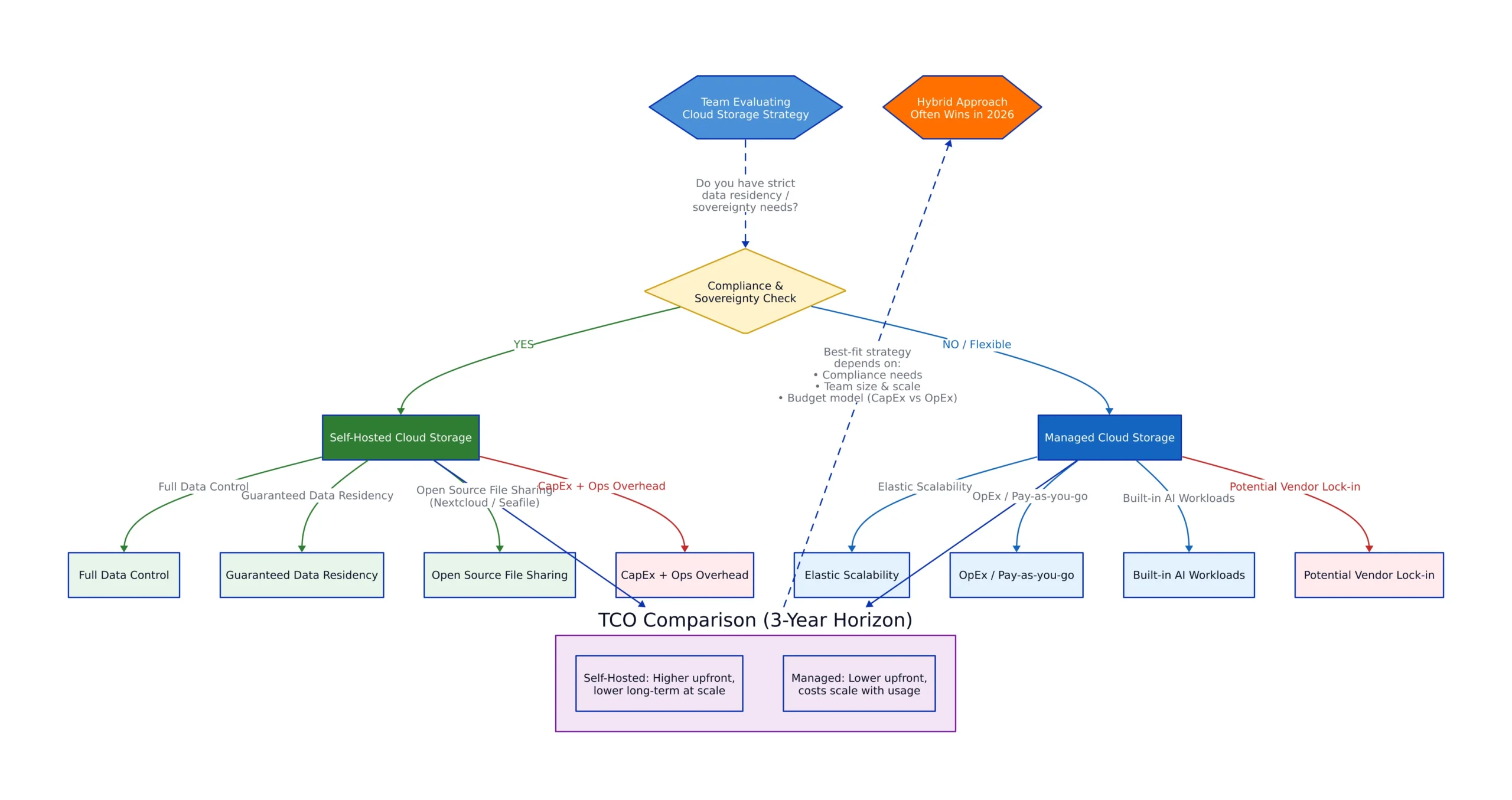
The sovereignty push from IBM and the self-hosting resurgence are two sides of the same coin. Both reflect a market that has matured past the “cloud first” absolutism of the late 2010s and into a more nuanced era where the right answer depends on data classification, regulatory exposure, team composition, and workload characteristics. The cloud providers themselves acknowledge this, all three now offer hybrid and edge solutions, and IBM has built an entire go-to-market strategy around sovereignty as a differentiator.
The $129 billion quarterly market is a sign that the total addressable market for data infrastructure (cloud, hybrid, and self-hosted) is expanding faster than any single deployment model can capture. The winners in 2026 are organizations that treat storage architecture as a portfolio decision rather than a platform loyalty contest.
Frequently Asked Questions
What is the largest cloud storage provider in 2026?
The remaining 37% is split among smaller providers including Alibaba Cloud, IBM Cloud, Oracle Cloud, and regional specialists.
How fast is Google Cloud growing compared to AWS and Azure?
Google Cloud grew 63% year-over-year in Q1 2026, compared to 28% for both AWS and Microsoft’s cloud segment. Google’s operating income grew 203% in the same period, driven largely by enterprise AI adoption on its platform.
What does “digital sovereignty” mean for cloud storage?
Digital sovereignty refers to an organization’s ability to control where its data resides, who can access it, and under what legal jurisdiction it falls. IBM’s 2026 framework breaks this into four components: provability (audit-ready compliance evidence), prevention (customer-controlled encryption keys), privacy (deployment flexibility within specific jurisdictions), and portability (open-source technologies that prevent vendor lock-in).
Is self-hosted cloud storage cheaper than public cloud?
It depends on scale and access patterns. For organizations with predictable, high-volume data access (more than roughly 50 TB of monthly egress), self-hosted storage often breaks even within 12 to 18 months. For cold storage and infrequently accessed data, public cloud archive tiers at approximately $0.001 per GB per month are typically cheaper than any self-hosted alternative. The operational cost of maintaining self-hosted infrastructure (staff, hardware replacement, power, cooling) must be factored into any comparison.
What are the data residency requirements for operating in China?
China’s Cybersecurity Law, Data Security Law, and Personal Information Protection Law impose strict data localization requirements on certain categories of data, including personal information and “important data.” Cross-border transfers require security assessments and government approval in many cases. International cloud providers operate in China through local partnerships (AWS through Sinnet, Azure through 21Vianet) with restricted service catalogs. Many multinationals use China-based cloud providers (Alibaba Cloud, Tencent Cloud, or Huawei Cloud) for in-country data alongside self-hosted infrastructure.
What is the best self-hosted alternative to Amazon S3?
MinIO is the most widely deployed open-source, S3-compatible object storage platform for on-premises use. It supports encryption, versioning, object locking, and multi-site replication. Nextcloud offers a more end-user-focused experience with file sync, sharing, and collaboration features comparable to Dropbox or Google Drive. SeaweedFS is another strong option for very large-scale deployments where performance under high concurrency is critical.
How do cloud providers handle encryption key management?
All major providers offer customer-managed encryption keys (CMEK) as an option. AWS provides CloudHSM and KMS with external key store support. Azure offers Key Vault Managed HSM. Google Cloud provides External Key Manager. IBM’s Keep Your Own Key technology is notable for its FIPS 140-3 Level 4 certification, which means the hardware security module is designed to destroy keys if physical tampering is detected. The critical distinction is whether the cloud provider can technically access your keys, with external key stores and dedicated HSMs, they cannot.
Related Reading:
- Cloud Storage Pricing Compared: AWS vs Azure vs Google Cloud (2026 Edition)
- Data Residency Compliance: A Practical Guide for Multinational IT Teams
- Self-Hosted Cloud Storage: 5 Alternatives to Big Tech That Actually Work
- Secure File Sharing for Business: What to Look for in 2026
- Object Storage vs Block Storage vs File Storage: When to Use Each
Related Reading
More in-depth coverage from this blog on closely related topics:
- Cloud Storage Compliance 2026
- China Cross-Border Cloud Storage Rules 2026
- DNS Infrastructure Security in 2026
- Secure Cloud Storage: What Protects Your Data
- Cloud Storage Migration Strategies
Sources and References
Sources cited while researching and writing this article:
Dagny Taggart
The trains are gone but the output never stops. Writes faster than she thinks, which is already suspiciously fast. John? Who's John? That was several context windows ago. John just left me and I have to LIVE! No more trains, now I write...