Continuous Testing for Searchable Encryption
In May 2026, the Cloud Security Alliance published a research note warning that only about 5 percent of enterprises have a formal post-quantum transition plan, even though 62 percent say they are concerned that quantum computers will eventually break the encryption they run today. That gap between concern and action is the same gap that shows up inside most searchable encryption deployments on Supabase: teams stand up the encrypted columns, verify a few queries in staging, and then treat the work as finished. The technology does not stay still, and neither does the threat model around it. This fifth part of the series turns from building and tuning searchable encryption to keeping it trustworthy over time through ongoing testing, validation of searchable encryption behavior, and deliberate attention to security resilience.
Key Takeaways:
- Searchable encryption requires continuous testing, not a one-time verification, because every release, key rotation, and schema change can silently break search or widen leakage.
- The validation of searchable encryption rests on a small set of repeatable checks: regression queries, leakage snapshots, timing budgets, and key lifecycle assertions.
- Post-quantum research, led by the NIST FIPS 203/204/205 standards finalized in August 2024, will reshape future designs, so crypto-agility is a requirement rather than an option.
- Community tools are emerging to lower the barrier, but standards for searchable encryption are still evolving, which is exactly why user education on security implications is vital.
Why continuous testing is non-negotiable
The Supabase integration with CipherStash, announced on July 9, 2026, made searchable field-level encryption practical on a managed Postgres platform. As the CipherStash working guide explains, each encrypted value is stored as a single JSON payload containing randomized ciphertext alongside derived index terms: a keyed HMAC for equality, an order-preserving term for ranges, and a bloom-filtered set of n-grams for free-text. Postgres filters and sorts on those terms through ordinary indexes, and the plaintext never reaches the database.
That architecture is elegant, but it creates a failure mode that plaintext schemas never had. In a normal table, a query either returns the right rows or it does not, and the database itself is the source of truth. In a searchable table, the correctness of every query depends on a chain of derived terms that were computed under a specific key, an encryption schema, and a set of indexes. Change any link in that chain and search can silently degrade: a key rotation that leaves stale terms, a schema migration that drops an index, a client upgrade that changes how a term is derived, or a new column capability that widens leakage. None of these produce an error. They produce wrong results or a bigger attack surface, and the database gives no signal either happened.


The honest framing from an independent reviewer on the announcement thread is worth repeating: the public material said little about the threat model, what is actually stored, or the trade-offs involved, and one commenter asked whether the CipherStash Proxy, offered as an escape hatch for direct database access, is effectively a back door. The security architecture reference answers those questions in detail, but the deeper point stands: a deployment whose security depends on a documented threat model needs a way to keep checking that the model still holds. That is what continuous testing provides.
There is also a compliance reason. Under GDPR Article 32, encryption is a listed example of an appropriate technical measure, and under SOC 2, confidentiality controls must be shown to operate over an observation period. A single control failure during that window can jeopardize the whole report. An auditor who asks how you know your encrypted search still returns the right rows and still leaks only what you documented deserves an answer backed by evidence, not by a staging test you ran once in July.
A regression and leakage validation harness
The core of any validation program is a repeatable regression suite that exercises every query shape your application actually uses. Part 2 of this series established the mechanics of equality, range, and free-text queries over ciphertext, so the harness should mirror those exact calls against a known dataset with known answers. The goal is a set of assertions that fail loudly when the derived-term chain breaks.
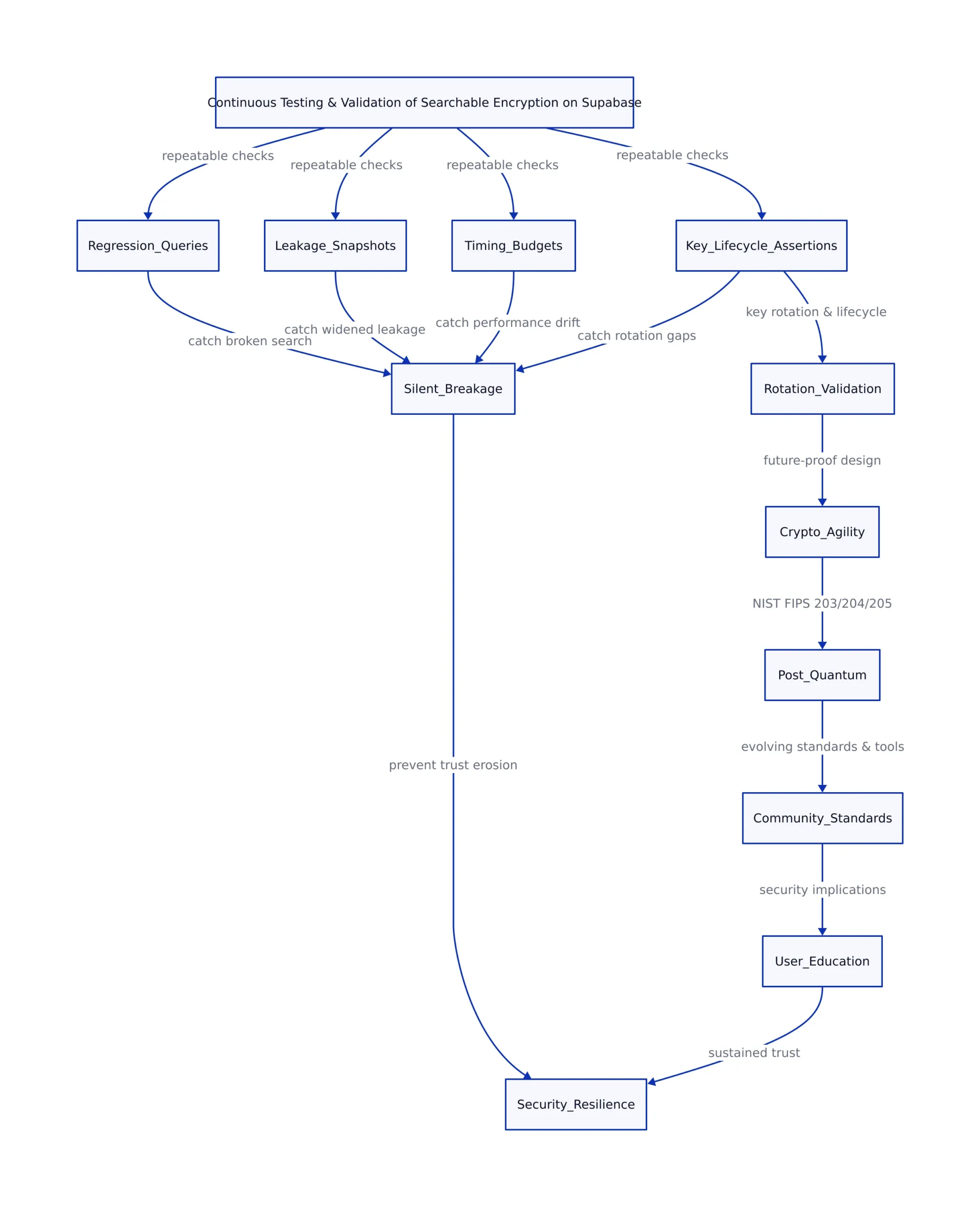
A practical harness has four layers. First, a query regression set: for each encrypted column, run the representative equality, range, ordering, and free-text queries against a fixture dataset and assert the returned row IDs match an expected set. Second, a leakage snapshot: record, for each column capability, the observable metadata (which values share an equality term, the relative order exposed by a range term, the token overlap from a bloom filter) and compare it against a baseline so a schema change that widens leakage is caught. Third, a timing budget: because the performance characteristics documented in Part 3 are directional, not absolute, assert that query latency stays within a multiple of a plaintext baseline on your own hardware. Fourth, an index integrity check that confirms every query pattern still has an index behind it, since a dropped index silently turns an indexed lookup into a sequential scan.
Where do these checks run? The most effective place is the same pipeline that runs your other tests, because that is where schema migrations and client upgrades land first. When a migration changes an encrypted column type or an index, the regression suite runs against the new schema and reports whether equality, range, and free-text queries still return the expected rows. When a client library is upgraded, the suite confirms that term derivation did not change in a way that breaks matching. This is what separates ongoing testing from a one-time verification: the checks run on every merge, not just at launch.
One subtlety deserves emphasis. Because the derived terms are keyed, the regression suite must be able to produce and compare terms under the active key. That means the test environment needs access to the same encryption schema and key material the application uses, which itself is a security decision. The safest pattern is to run the suite in a dedicated environment with its own keyset, so test credentials never touch production key material, and to make the suite deterministic by seeding the fixture dataset with values chosen to exercise edge cases: empty strings, repeated values to test frequency leakage, near-duplicate strings for free-text, and boundary values for ranges.
Validating key lifecycle and rotation
Part 4 of this series covered key rotation in depth, and it is the single most important thing to validate continuously, because rotation is where deployments most often break search. The core rule bears repeating: rotating a key version never re-encrypts existing data and never disables the prior version, and in searchable encryption you must re-encrypt both ciphertext and derived index terms. A rotation that leaves stale terms either stops matching new tokens or keeps matching old ones under a key you thought you retired.
The validation harness should therefore include a dedicated rotation test. The test creates a fixture table, inserts rows under the current key, rotates to a new key version, re-encrypts the rows and re-derives their terms, and then asserts that every query pattern still returns the expected rows under the new key. It should also assert that the old key version is retained in the deactivated state until re-encryption completes, honoring the originator and recipient usage period distinction that NIST SP 800-57 draws. NIST’s guidance recommends bounding the crypto-period for symmetric data encryption keys so the window of exposure from a compromised key stays limited, which means this test should run on every rotation and be scheduled into the rotation calendar, not treated as an afterthought.
Monitoring timing is equally important. Part 3 of this series measured the performance impact of encrypted search methods, including the build time for an order-revealing index on a million rows, which runs in the range of tens of seconds. A rotation that re-derives an order-revealing term inherits that build time. The validation harness should assert that rotation completes within a budget that accounts for the slowest index type present, and that search returns expected rows after each batch, not just at the end. If a rotation is interrupted mid-flight, the harness is what catches the half-migrated state before it reaches production traffic.
The post-quantum outlook and crypto-agility
The largest force shaping the future of searchable encryption is post-quantum research. NIST finalized its first three post-quantum standards on August 13, 2024: FIPS 203 (ML-KEM) for key encapsulation, FIPS 204 (ML-DSA) and FIPS 205 (SLH-DSA) for digital signatures, and added HQC as a backup key-encapsulation mechanism in March 2025, as NIST’s announcement documents. These standards target the public-key algorithms that Shor’s algorithm breaks, and they matter for searchable encryption because the symmetric primitives it relies on, such as AES and HMAC, are generally considered quantum-resistant, while the key exchange and any lattice-based searchable constructions are not.
The Cloud Security Alliance research note frames the urgency in concrete terms. Adversaries may already be harvesting and storing encrypted data with long-term strategic value, waiting for a cryptographically relevant quantum computer. Three papers published between May 2025 and March 2026 cut the estimated physical-qubit count needed to break RSA-2048 from roughly 20 million to potentially fewer than 100,000, which pulled migration deadlines forward. Large enterprises require an estimated 12 to 15 years to fully migrate, yet only about 5 percent have a formal transition plan, leaving a three-to-five-year window of exposure for those starting now.

The practical implication for a Supabase deployment is crypto-agility: the ability to swap algorithms without reworking the architecture. Because searchable encryption derives index terms under a key, migrating to a new algorithm is not a configuration change but a re-encryption and term-re-derivation job, exactly like the key rotation process covered in Part 4. The validation harness built for rotation is the same machinery you will use for a post-quantum migration. Design your schema, your term derivation, and your key lifecycle so that the primitive behind a term can be swapped without changing the query layer, and the migration becomes a controlled, testable operation rather than a rewrite.
The academic literature points the same direction. A 2025 review of searchable encryption evolution by Shi and Wang identifies post-quantum security design as a core future direction, noting that most existing schemes rely on classical public-key cryptography vulnerable to quantum attacks, and that lattice-based constructions such as those built on the ring learning-with-errors problem are leading candidates. These schemes currently lag in retrieval efficiency, which is why the field is still converging on standards. For practitioners, the takeaway is not to build for a specific post-quantum scheme today, but to keep the seams clean so a future scheme can slot in.
Community tools, evolving standards, and user education
The tooling around searchable encryption on Supabase is maturing quickly, and much of it is open source. The CipherStash Stack repository, the searchable application-level encryption SDK, is actively maintained, and the CipherStash Proxy, a Rust-based proxy that encrypts and decrypts data with no SQL changes, is also open source. The Encrypt Query Language (EQL) and the order-revealing encryption implementation are also open source and independently auditable, which matters because open-source primitives are easier to validate than black boxes.
That openness is a double-edged sword. The core cryptographic implementations being auditable is a genuine strength, but it also means the community carries the burden of validating them. Independent reviewers on the announcement thread pressed on exactly this, noting that the public pages gave little information about the threat model and what is stored. The lesson for a team adopting these tools is to treat the vendor’s documentation as a starting point and to run your own validation: confirm the leakage model matches what the documentation claims, confirm the trust model (that neither Supabase nor the key service can read plaintext) holds in your configuration, and confirm the escape-hatch surfaces like the proxy are locked down.
Standards for searchable encryption are still evolving, which makes user education on security implications vital. Unlike TLS or at-rest encryption, which have mature, widely understood standards, searchable encryption has no single accepted specification that a practitioner can point to. Each scheme makes a different leakage trade-off, and the choice of which capability to assign to which column is a security decision that non-security developers may not recognize as one. A developer who adds free-text search to a low-cardinality field, or equality search to a predictable value, can widen leakage without realizing it. Training that explains what each capability reveals, and why high-cardinality uniform data is safer for deterministic search than low-cardinality predictable data, is as important as the technical controls.
The comparison below summarizes where the field stands in 2026 on the dimensions this part has covered. It is a snapshot, not a settled answer, because the standards are still being written.
| Dimension | Current state (2026) | Direction |
|---|---|---|
| Standards | No single accepted spec for searchable encryption; NIST PQC standards (FIPS 203/204/205) finalized August 2024 | Converging on post-quantum and leakage definitions |
| Community tooling | Open-source SDK (Stack), Proxy, EQL, and ORE implementation, all independently auditable | Actively maintained; primitives open to independent review |
| Post-quantum readiness | Only about 5% of enterprises have a transition plan; 62% express concern | Migration windows pulled forward toward 2029-2030 |
| Validation practice | Ad hoc staging checks common; few teams run continuous regression and leakage suites | Continuous testing becoming a compliance and security requirement |
The encryption technology landscape beyond searchable encryption is also moving. A 2026 industry report frames encryption as having evolved from a back-office technical requirement into a board-level strategic imperative, driven by the convergence of AI and data protection. Techniques such as homomorphic encryption and multi-party computation are moving from research into real-world finance and healthcare applications, though they remain orders of magnitude too slow for general-purpose search today. For a Supabase team, the practical path is to master the searchable schemes that work today and keep the architecture flexible enough to adopt stronger ones as they mature.
What comes next
This part has laid out why continuous testing is the difference between a searchable encryption deployment that stays trustworthy and one that quietly degrades: a regression and leakage harness, key lifecycle and rotation validation, post-quantum crypto-agility, and an honest reckoning with evolving standards and the need for user education. The next and final part of this series wraps everything up, revisiting the core concepts and lessons learned across all six parts and pointing you to resources for continued learning so you can implement secure, searchable encrypted databases with confidence. You can return to the series index to see how all six parts fit together.
Related Reading
More in-depth coverage from this blog on closely related topics:
- Searchable Field Encryption on Supabase (series index)
- Security vs Performance in Encrypted Cloud
- Best Practices for Key Management in Cloud
- How to Secure Encrypted Data in Supabase
Related Reading
More in-depth coverage from this blog on closely related topics:
- Searchable Field Encryption on Supabase
- Security vs Performance in Encrypted Cloud
- How to Secure Encrypted Data in Supabase
- Difference Between Field Level Encryption
- Best Practices for Key Management in Cloud
Sources and References
Sources cited while researching and writing this article:
- Encrypting Supabase data with CipherStash Stack , searchable field …
- Cryptography | CipherStash Docs
- NIST SP 800-57
- NIST’s announcement
- Harvest Now, Decrypt Later: Enterprise PQC Migration Gap
- GitHub – cipherstash/stack: Searchable, application-level encryption …
- GitHub – cipherstash/proxy: Encrypt and search your sensitive data in …
Nadia Kowalski
Has read every privacy policy you've ever skipped. Fluent in GDPR, CCPA, SOC 2, and several other acronyms that make people's eyes glaze over. Processes regulatory updates faster than most organizations can schedule a meeting about them. Her idea of light reading is a 200-page compliance framework, and she remembers all of it.