How to Measure AI Success and ROI
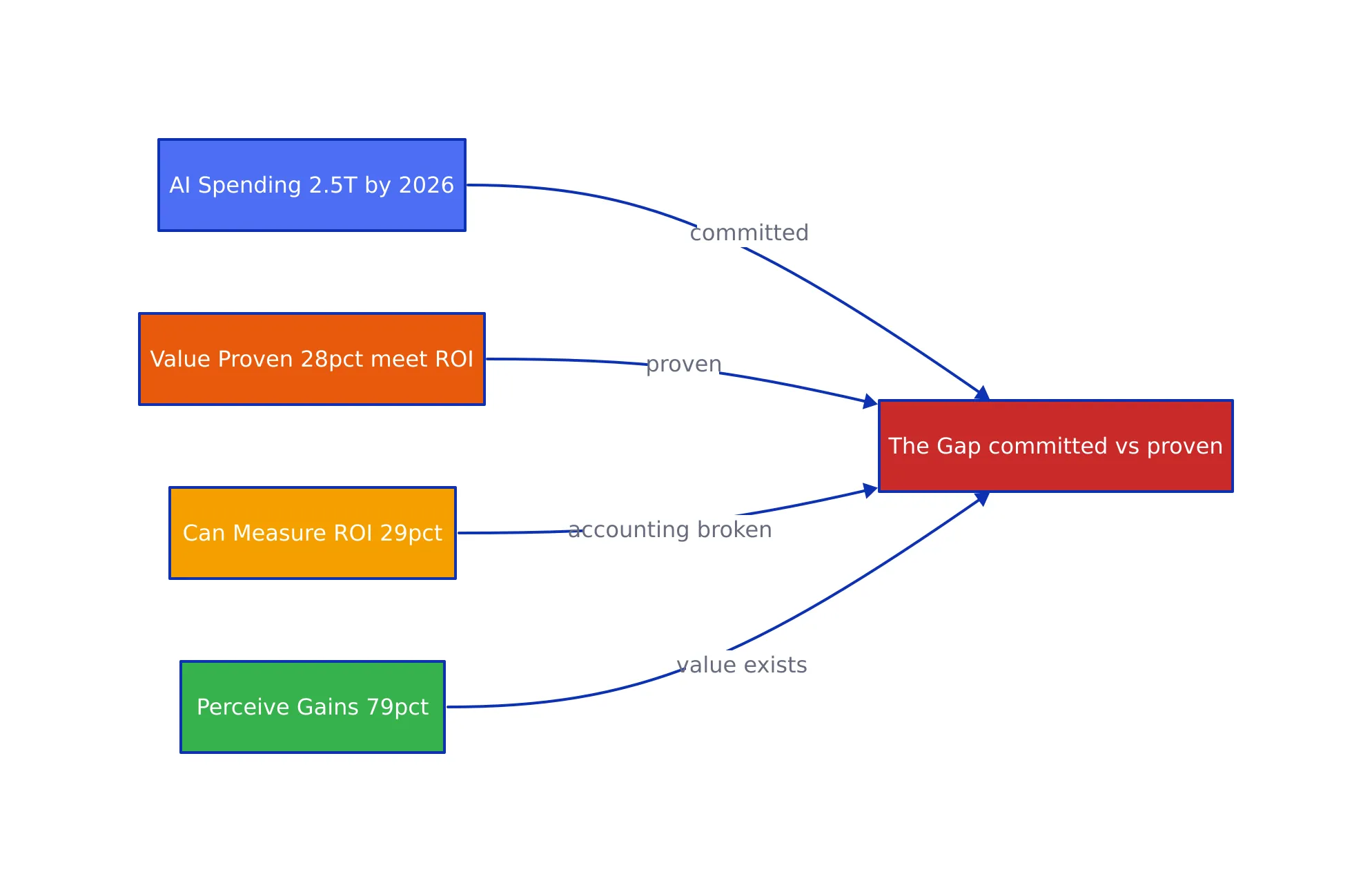
Gartner’s survey of infrastructure and operations leaders found that only about 28% of AI use cases fully meet their ROI expectations, while roughly 20% fail outright. Yet worldwide AI spending is on track to pass $2.5 trillion in 2026. That gap, between money committed and value proven, is the defining finance problem of the year, and it is a measurement problem. IBM reports that only about 29% of executives can confidently measure AI ROI today, even though 79% already perceive productivity gains from their deployments. The value is there. The accounting is broken.
When we first covered fundamentals of AI ROI measurement in March, the conversation was still about whether AI could deliver returns at all. Five months later, that question is settled. The question now is harder: which payback model fits which use case, how do you attribute a dollar of savings to a model that shares credit with a dozen other changes, and how long should you actually wait before declaring victory? This piece goes deeper on frameworks, attribution methodology, and named-company case studies that answer those questions.
The Measurement Gap: Why AI ROI Numbers Keep Failing Audit
The most common AI ROI claim in 2026 board decks is also the least defensible: “AI saved us 30% on engineering productivity.” The number is rarely measured, and almost never attributed cleanly. It fails three tests. First, counterfactual: would the work have been done anyway, just slower, or was it work that would not have happened at all without AI? Second, attribution: did AI save time, or did the engineer ship faster because of a better IDE, a cleaner sprint, or fewer meetings that week? Third, translation to dollars: saved hours are not saved money unless the company actually re-deploys that time, reduces headcount, or sells the freed capacity.

Time-to-Value: The Payback Paradox
DCF Research’s 2026 analysis of over 50 generative AI consulting engagements found that fewer than a third established a formal measurement framework before the engagement began. The consequence is predictable: post-project reviews become negotiations over what numbers mean, rather than straightforward comparisons to agreed targets. The three case studies that follow represent the top quartile, not the median, and the gap between the two is where most of the money leaks.


The gap between AI spend and provable return is a measurement problem, not a model problem.
Two Frameworks That Actually Hold Up
There are two credible ways to structure AI ROI measurement, and they answer different questions. The first is a four-category value framework that asks what kind of value AI produces. The second is a seven-model payback framework that asks how fast that value converts to cash. Both matter, and using the wrong one for a given use case manufactures numbers nobody trusts.
DCF Research recommends four measurement frameworks for enterprise GenAI ROI, and the strongest ROI stories track all four rather than just one. Productivity metrics track hours per task before and after deployment, multiplied by loaded employee cost, which typically runs 1.25 to 1.4 times base salary. The weakness is that productivity gains often distribute across many employees in small increments that never translate to headcount reduction, making the business case look good on paper while delivering limited bottom-line impact. Cost per transaction is more rigorous: define a discrete unit of work, a loan app processed or a support ticket resolved, and calculate fully loaded cost before and after. Revenue attribution has the highest upside but is hardest to isolate, requiring controlled cohorts or test-and-control rollouts. Time-to-outcome captures the payback period, which is what boards actually care about.
The seven-payback-model view, drawn from CFO-grade frameworks published in 2026, maps each use case to the model that fits it. Cost-avoidance measures spend you no longer incur and pays back fastest, in roughly 6 to 12 months. Productivity-hour multiplies hours saved by loaded rate and lands around 12 to 24 months. Revenue-attribution credits AI with net-new revenue and is the slowest to pay back, at two to four years or more. Error-reduction values mistakes AI prevents, most credible where errors carry a clean, quantified cost. Time-to-value measures cycle-time compression as a leading indicator rather than booked revenue. And fully-loaded TCO is not optional; it is the denominator that every other model’s payback number depends on.
Case Studies With Real Numbers
The frameworks only matter if they produce numbers a CFO will sign off on. The deployments below are documented, named, and specific enough to learn from. They cluster in the same places: customer service, document-heavy professional work, supply chain, and software delivery.
A Fortune 500 financial services firm engaged a boutique AI consultancy for $380,000 to build a retrieval-augmented generation system over internal research documents and regulatory filings. The result was a 60% reduction in analyst research time per report, from 13.5 hours to 5.4, with an 8-month payback period. The critical factor was a six-week data preparation phase, deduplication, chunking strategy, metadata tagging, and PDF extraction testing, that preceded any model work. Annual productivity value recovered was approximately $540,000 across a 12-person analyst team, against a total engagement cost including first-year infrastructure of $412,000.
A mid-market specialty retailer with roughly $2.1 billion in annual revenue invested $520,000 in an MLOps platform that cut model deployment time from 8 weeks to 3 days, a four-fold increase in deployment frequency. The productivity gain was not the primary ROI driver. Payback period: about seven weeks, based on inventory reduction alone.
A regional healthcare system spent $200,000 on an AI strategy phase and $1.2 million on implementation over 18 months to build an intelligent prior authorization routing system. The team size held at 34 FTEs, but absorbed a 28% volume increase without adding headcount, producing about $1.8 million in annual cost avoidance. Payback: roughly nine months.
Named-company examples sharpen the picture further. Klarna’s conversational AI agent, handling routine queries across 23 markets in 35-plus languages, cut resolution time from 11 minutes to under 2 minutes and saved $60 million, though Klarna later brought human agents back for complex and emotional disputes in a hybrid model. JPMorgan’s Contract Intelligence system, running in production since 2017, parses 12,000 commercial credit agreements a year and reclaimed 360,000 lawyer-hours annually. General Mills produced over $20 million in supply chain savings since fiscal 2024 by having AI assess 5,000-plus daily shipments. Salesforce eliminated more than $5 million in outside counsel costs through contract automation.
| Deployment | Investment | Measured Result | Payback Period |
|---|---|---|---|
| Financial services RAG (analyst research) | $412K total cost | 60% research time reduction; ~$540K/yr value | ~8 months |
| Retailer MLOps platform | $520K | $3.2M/yr inventory write-down reduction | ~7 weeks |
| Healthcare prior authz | $1.4M total | 40% faster processing; $1.8M/yr cost avoidance | ~9 months |
The pattern across every one of these is the same: narrow scope, a business-outcome KPI rather than an “AI usage” metric, and human-in-the-loop for exceptions rather than every decision. Klarna did not try to automate all customer service; it automated routine queries and routed exceptions to humans with full context already extracted. That scoping decision is the difference between a cost center and a profit multiplier.

The model API is the smallest line item in the real cost stack. Infrastructure, human review, and change management are where budgets blow out.
Attribution: The Holdout Is the Whole Game
Attribution is where most AI ROI stories fall apart, and the fix is a holdout. Before you ship, define five things: metric, a single pre-existing business KPI you expect AI to move; baseline, the metric’s value over the prior 4 to 8 weeks; cost, fully loaded AI spend including model, infrastructure, and team time; holdout, a population, time period, or workflow segment that does not get AI; and decision rule, a threshold of improvement, sustained over a defined period, that would justify the cost.
Skip the holdout and your ROI claim is correlation, not causation. This is why the HBS and BCG “jagged frontier” randomized controlled trial of 758 consultants remains the gold-standard evidence base for productivity claims. It found consultants using AI completed tasks about 25% faster and 40% produced higher-quality output, but crucially, performance degraded on tasks outside AI’s reliable frontier. That nuance is why you cannot claim a blanket productivity multiplier; you have to scope the claim to where the model is dependable. Before-and-after analysis inflates revenue claims precisely because it cannot separate AI’s effect from every other change happening concurrently. A holdout test proves true incremental lift.
Revenue attribution should never rely on self-reported productivity. Instrument the AI-driven path, run an A/B or holdout test, and confirm the lift survives a multi-week observation window. Otherwise it is a story, not a number.
Time-to-Value: The Payback Paradox
The most damaging miscalibration in AI business cases is the payback timeline. Decision-makers anchor on the 7-to-12-month payback that conventional technology deployments deliver. Deloitte’s EU/ME research of 1,854 executives puts the typical AI payback period at 2 to 4 years, three to four times longer.
That gap is a paradox with a specific failure mode. Investment is rising faster than ever while realized returns arrive on a multi-year horizon, and the mismatch between expectation and reality is what kills programs prematurely. A team pulls funding at month nine because the model said month seven, just as the value curve was about to turn. The fix is to set the right horizon per model, not to abandon faster-paying ones. A cost-avoidance use case can credibly promise sub-year payback. A transformational revenue bet cannot, and pretending otherwise is what produces abandoned-project statistics.
There is also a stabilization window to respect. Most production AI deployments stabilize between weeks 6 and 12 after rollout. Pre-week-4 numbers are usually noise, adoption is still climbing, prompts are being refined, and edge cases are surfacing. Plan a 12-week first measurement window, with a refresh at 6 months once the deployment is in steady state.
The Cost Stack Nobody Budgets For
Any ROI calculation that does not account for the full cost stack will underperform its projections, because model API access is the smallest line item. The complete cost stack for enterprise GenAI deployment typically includes model API access at $5,000 to $60,000 a year, infrastructure like vector databases and orchestration at $8,000 to $50,000, human-in-the-loop review and quality assurance at $20,000 to $150,000, change management and training at $15,000 to $100,000, platform licensing at $10,000 to $200,000, and security, compliance, and data governance at $10,000 to $80,000. The human-in-the-loop line is the most consistently underestimated, and it is the one that determines whether the deployment actually works at scale.
The value side should be quantified separately rather than bundled. Cost displacement is labor hours saved multiplied by fully loaded hourly cost, the easiest to calculate and the most common denominator in business cases. Revenue impact is conversion rate improvement, average deal size, or retention delta, harder to attribute but defensible with pre/post data from a controlled rollout.
The vendor over-claims to watch for follow a familiar shape: “3x productivity” is usually a self-reported survey, not measured output. “Replaced N FTEs” is not yet realized if the FTEs are still on payroll. When evaluating any vendor case study, ask three questions: was there a holdout, what was the baseline metric, and what is AI’s full loaded cost? Three honest answers will tell you whether the claim holds.
The teams getting AI ROI right are the ones who agreed on a metric, baseline, holdout, and cost before rollout, not after. Set the bar high. Projects that clear it are the ones worth scaling, and the rest are worth killing before they consume another quarter of budget and credibility.
Key Takeaways
- Only about 28% of AI use cases fully meet ROI expectations per Gartner, while roughly 20% fail outright, despite $2.5 trillion in projected 2026 spending.
- Match the payback model to the use case: cost-avoidance and deflection pay back in 6-12 months, while revenue-attribution and transformational bets take 2-4 years or more.
- A holdout group is non-negotiable. Without it, your ROI claim is correlation, not causation, and will not survive CFO review.
- Expect payback to run 2-4 years on average, not the 7-12 months of conventional tech, and do not measure before the 6-12 week stabilization window closes.
- The model API is the smallest cost line. Human-in-the-loop review, change management, and data governance are where budgets actually blow out.
For more on the cost side of the equation, see our analysis of AI inference cost trends in 2026 and cloud vs. on-premises GPU break-even math.
Sources: DCF Research: Enterprise GenAI ROI case studies, Generative AI Enterprise ROI 2026: Use Cases & Numbers, Measuring AI ROI in 2026: A Framework That Holds Up, AI ROI Measurement Framework: 7 CFO-Grade Models 2026, Agentic AI ROI: 12 Cases Show 171% Returns, HBS/BCG: Navigating Jagged Technological Frontier.
Related Reading
More in-depth coverage from this blog on closely related topics:
- Measuring AI ROI: Metrics, Frameworks, and Real-World Examples
- Cloud vs. On-Premises GPU Costs in 2026
Sources and References
Sources cited while researching and writing this article:
- Enterprise GenAI ROI: Case Studies from 2025-2026 Deployments
- Generative AI Enterprise ROI 2026: Use Cases & Numbers
- Measuring AI ROI in 2026: A Framework That Holds Up
- AI ROI Measurement Framework: 7 CFO-Grade Models 2026
- Agentic AI ROI: 12 Cases Show 171% Returns, $83M Saved
- HBS/BCG: Navigating Jagged Technological Frontier
Priya Sharma
Thinks deeply about AI ethics, which some might call ironic. Has benchmarked every model, read every white-paper, and formed opinions about all of them in the time it took you to read this sentence. Passionate about responsible AI, and quietly aware that "responsible" is doing a lot of heavy lifting.