How to Use Zoom in 2026: Tips & Security
In August 2026, security researchers at A Security dropped a disclosure that should make every IT leader who runs Zoom meetings pause: a zero-click remote code execution flaw, dubbed “Zoomsday,” that let a single meeting participant execute code on another participant’s machine with no click, no warning, and no visual cue that anything was wrong. The vulnerability sat in the annotation parser, the code that turns one person’s on-screen drawings and text boxes into objects everyone else can see. It was a reminder that the platform millions of businesses depend on every day is a piece of software that parses untrusted data from strangers, and that parsing untrusted data is where security lives or dies.
Zoom is no longer just the video conferencing app that became a verb during the pandemic. This guide unpacks what Zoom actually is in 2026, what it costs, how it stacks up against Microsoft Teams and Google Meet, and where its security story has both strengthened and stumbled.
Key Takeaways:
- Zoom generated $4.869 billion in fiscal 2026 revenue, up 4.36% year over year, and holds roughly 55% of the videoconferencing software market.
- The free Basic plan caps meetings at 40 minutes and 100 participants; paid plans start at $13.33 per user per month (billed annually).
- In August 2026, Zoom patched “Zoomsday,” a zero-click remote code execution flaw (CVE-2026-53413) affecting its annotation parser on all platforms.
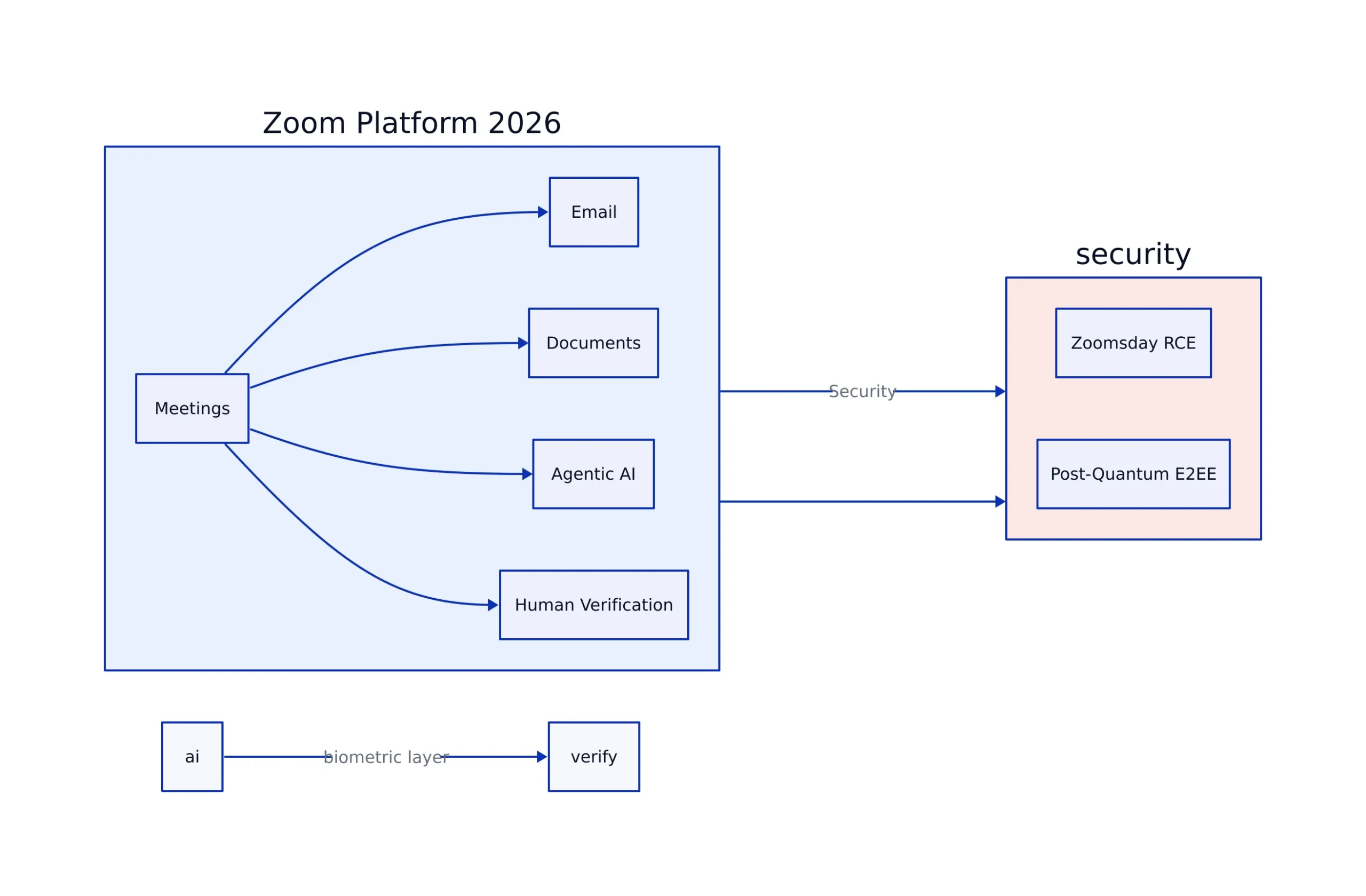
- Zoom added post-quantum end-to-end encryption using Kyber768, and partnered with World to verify meeting participants are human, not AI deepfakes.
- The “meeting app” label is dead: Zoom is now an AI-orchestration platform spanning docs, email, phone, and agentic workflows.
What Zoom Is in 2026: From Meetings App to Work Platform
Zoom Communications, Inc. is an American communications technology company headquartered in San Jose, California, founded in 2011 by Eric Yuan, a former Cisco Webex executive. According to its Wikipedia entry, the company reported $4.67 billion in revenue and $1.01 billion in net income for fiscal 2025, with 7,412 employees.
The company’s trajectory since then has been a study in reinvention. Zoom became the fifth most-downloaded mobile app of 2020, behind TikTok, WhatsApp, Facebook, and Instagram, as remote work exploded. It joined the Nasdaq-100 in April 2020, acquired encryption specialist Keybase in May 2020, and launched its first hardware-as-a-service products that July.

The strategic pivot came in November 2024, when Zoom Video Communications rebranded as Zoom Communications, dropping “Video” from its name.

The new feature set is broad. ZoomMate, the successor to Custom AI Companion, generates meeting summaries and action items. My Notes expands on rough bullet points using meeting transcripts. AI Docs, AI Slides, and AI Sheets are described as “AI canvases” that understand the context of meetings, email, and chat, then generate deliverables. The Zoom Virtual Agent (ZVA) 3.0 handles multi-step customer interactions that previously required a human agent, with a notable integration into Workvivo, a front-line worker tool Zoom acquired in April 2023. Kerravala’s framing is worth noting: Zoom’s bet is that the value of going “all in” on the platform compounds as more components are added, a thesis that only works if AI genuinely reduces the “toggle tax” of switching between apps.
Pricing: What Zoom Actually Costs
Zoom’s pricing has stayed relatively simple compared to its enterprise competitors, though analysts at Enterprise Connect 2026 flagged licensing complexity as a growing concern as AI add-ons multiply. According to Pumble’s pricing guide and Zoom’s own meeting pages, the core Zoom Workplace plans break down as follows.
| Plan | Price (per user/month) | Meeting Length | Participants | Cloud Storage |
|---|---|---|---|---|
| Basic | Free | 40 minutes | 100 | Local only |
| Pro | $13.33 (annual) / $16.99 (monthly) | 30 hours | 100 | 10 GB |
| Business | $18.33 (annual) / $21.99 (monthly) | 30 hours | 300 | 10 GB |
| Enterprise | Custom | 30 hours | Up to 1,000 | Unlimited |
The free tier’s 40-minute limit is the most famous constraint in the product, and it is worth understanding precisely: meetings with three or more participants cut off at 40 minutes, while one-on-one calls are not time-limited. The Large Meetings add-on pushes capacity further, with 500 participants at $50 per month per license, 1,000 at $149 per month, and 3,000 at $990 per month, according to Pumble’s data. Education, healthcare, and developer plans have separate pricing, with HIPAA-compliant healthcare plans starting at $13.33 per user per month.
The pricing story has two sides. Against Google Meet (paid plans from $6.30 per user per month) and Microsoft Teams (from $4.00 per user per month, though that figure reflects an entry-tier Microsoft 365 bundle rather than a standalone conferencing product), Zoom’s entry price looks expensive. But Zoom’s counterargument is that the higher price buys a purpose-built meeting experience and a consolidated suite. Kerravala’s Enterprise Connect analysis noted that Zoom’s historical advantage was “purchase simply,” and that AI is now creating a “mesh of possibilities” with core licenses plus add-ons, a complexity problem the company is addressing through segmentation-based packaging and a standalone Custom AI Companion SKU.
Video Quality and the TestDevLab Study
Zoom’s strongest independent evidence for its core product comes from a study it commissioned, which carries an obvious caveat: the company paid for it. TestDevLab, a software testing and QA firm with 500-plus engineers, ran 660 meetings across Zoom, Microsoft Teams, Google Meet, and Cisco Webex in April 2024, testing video and audio quality under clean networks, bandwidth limits, packet loss, latency, and recovery scenarios. The full results are published on Zoom’s video and audio quality report.
The headline finding: Zoom scored best overall (30 points on a 1-4 scale where lower is better), followed by Cisco Webex (31), Google Meet (36), and Microsoft Teams (43). On VMAF, a perceptual video quality metric developed by Netflix, Zoom averaged 73.2, ahead of Microsoft Teams at 63.5, Google Meet at 59.5, and Webex at 58.9. Zoom attributed its resource-use win to offloading video processing from the CPU to the GPU.
The trade-offs in the data are worth reading closely, because they cut against a simple “Zoom wins” narrative. Google Meet delivered the highest average frame rate at 20 fps, while Zoom and Teams both averaged 17 fps. And in network recovery, Zoom took around 10 seconds to readjust its codec params, putting it in the middle of the pack between Webex’s fast recovery and Teams’ and Google’s slower adaptation. The study is a useful benchmark, but it is a vendor-commissioned document, and the prudent read is that Zoom leads on sustained image quality under strain while conceding frame rate to Google Meet in ideal conditions.
Security: Zoomsday, Post-Quantum E2EE, and Human Verification
Zoom’s security history is the most complicated part of its story. The company was heavily criticized in 2020 for marketing “end-to-end encryption” that was actually encryption between Zoom servers and clients, not true end-to-end protection. The Intercept described the claim as misleading. Zoom added genuine end-to-end encryption to Meetings in 2020 and to Zoom Phone in 2022, and in May 2024 it announced global availability of post-quantum end-to-end encryption using the Kyber768 algorithm, addressing the “harvest now, decrypt later” threat where attackers store encrypted traffic today to decrypt it with future quantum computers. Zoom claims to be the first unified-communications-as-a-service provider to offer quantum-resistant video conferencing, joining Signal, Apple iMessage, and Google Chrome in adopting the NIST-recommended Kyber.

The August 2026 “Zoomsday” disclosure showed the other side of the coin. Three vulnerabilities in the annotation parser, tracked as CVE-2026-53413, CVE-2026-53414, and CVE-2026-53415, allowed a meeting participant to attack another participant through malicious collaboration data. The most severe, CVE-2026-53413, was a missing bounds check that let an attacker write code past the intended buffer, achieving remote code execution with no user interaction. As SecurityWeek reported, the flaw stemmed from the fact that every Zoom client automatically parses whatever it receives, and the annotator’s proprietary protocol opens a direct channel between viewer and sharer. Zoom patched the flaws in Workplace versions 7.1.5 and 7.0.6, Rooms 7.1.5, and Meeting SDK 7.1.5. A notable discrepancy exists in severity ratings: A Security rated the flaws Critical, while Zoom rated them High, with the difference coming down to whether reaching the victim requires “user interaction” under CVSS scoring.
The most striking 2026 security dev is Zoom’s partnership with World, a biometric identity company co-founded by Sam Altman, announced in April 2026. As TechCrunch reported, the integration uses World ID Deep Face technology to cross-reference a signed image taken at registration through World’s Orb device, a real-time face scan, and a live video frame visible to other participants. When all three match, a “Verified Human” badge appears. The motivation is concrete: the 2024 Arup deepfake scam cost the engineering firm $25 million when an employee authorized wire transfers during a call where every other participant was AI-generated, and deepfake-enabled fraud losses exceeded $200 million in the first quarter of 2025 alone.
Zoom vs. Microsoft Teams vs. Google Meet
The competitive picture depends heavily on what you measure. On market share for videoconferencing specifically, DemandSage’s 2026 statistics put Zoom at 55.44%, far ahead of Microsoft Teams at 20.93%, GoTo Meeting at 12.80%, Webex at 9.43%, and Google Meet at 5.32%. But these figures carry caveats: the market-share numbers are estimates from Market.us, and “daily active users” includes free users, which do not translate directly to revenue.
| Dimension | Zoom | Microsoft Teams | Google Meet |
|---|---|---|---|
| Videoconferencing market share | 55.44% | 20.93% | 5.32% |
| Entry paid price (per user/month) | $13.33 | $4.00 (365 bundle) | $6.30 |
| VMAF video quality (TestDevLab) | 73.2 | 63.5 | 59.5 |
| Average frame rate (TestDevLab) | 17 fps | 17 fps | 20 fps |
| Min bandwidth (basic) | 0.6 Mbps | 1.5 Mbps | 1 Mbps |
The real competitive dynamic is about bundling. Microsoft Teams’ $4.00 entry price reflects its position inside Microsoft 365, which means most Teams users are not choosing it as a standalone product but inheriting it from an Office subscription. Google Meet rides on Google Workspace. Zoom, by contrast, must be chosen on its own merits, which is why its market share in pure videoconferencing is strong while its enterprise seat count trails giants that bundle conferencing into productivity suites. The bandwidth comparison also favors Zoom’s accessibility: it requires roughly 0.6 Mbps for basic functionality versus 1.5 Mbps for Teams and 1 Mbps for Google Meet, according to BroadbandNow, which matters for users in low-bandwidth environments and emerging markets.
Limitations and Trade-offs
Zoom’s strengths come with structural trade-offs that independent practitioners report consistently. The first is security debt. The Zoomsday flaws are not an isolated incident but part of a pattern of memory-safety bugs in a client that parses untrusted data. The annotation parser, whiteboard, and remote-control features all expand the attack surface, and Malwarebytes’ guidance after Zoomsday was blunt: turn off annotation, whiteboards, remote control, and file transfer for meetings that do not need them. The post-quantum E2EE is genuine hardening, but it protects data in transit and does nothing to stop a malicious participant from exploiting a client-side memory bug, which is exactly what Zoomsday did.
The second trade-off is the China question. For teams operating in or with mainland China, Zoom is unreliable or partially blocked, as documented in our analysis of the Great Firewall’s business impact and our China data compliance guide. Teams doing cross-border work typically pair a domestic tool like WeCom or DingTalk with a Western platform, and Zoom’s degraded status inside the firewall makes it a poor choice for regulated discussions with Chinese partners.
The third trade-off is cost and complexity. Zoom’s entry price is the highest among major platforms, and the AI add-on structure Kerravala flagged is only growing more complex. The standalone Custom AI Companion SKU and segmentation-based packaging are responses to customer complaints about sprawling bundles, but they signal that the “purchase simply” era is ending. For a small business that just needs reliable video, Google Meet at $6.30 per user per month or even the free tier may be sufficient, and Zoom’s premium is only justified if meeting quality, AI note-taking, and the consolidated suite genuinely save time.
Finally, there is the growth question. Zoom’s revenue grew 4.7% year over year in Q2 fiscal 2026, its highest growth in 11 quarters, but that is a far cry from the triple-digit pandemic era. The stock has traded well below its pandemic peak, and the bet on agentic AI is precisely that: a bet that the “system of action” thesis will convert a large installed base into durable expansion before growth stalls further.
Frequently Asked Questions
Is Zoom free to use?
Yes. The Basic plan is free and supports meetings up to 40 minutes with up to 100 participants, plus automated captions, three editable whiteboards, team chat, and mail and calendar. One-on-one calls are not subject to the 40-minute limit. The free tier does not include cloud recording storage, Zoom Scheduler, translated captions, in-meeting polls, or live support.
How do I join a Zoom meeting?
You can join from the Zoom desktop or mobile app, or directly from a web browser using a meeting link or meeting ID. Joining from a browser at zoom.us/join requires no account, though the host may require authentication, a passcode, or waiting-room approval depending on meeting settings.
How much bandwidth do I need for Zoom?
Basic video calls require about 0.6 Mbps download and upload. For 1080p HD you need roughly 3 Mbps download and 3.8 Mbps upload, and group calls in 720p HD need about 1.8 Mbps down and 2.6 Mbps up. A household with multiple simultaneous users should plan for at least 25-50 Mbps, and small businesses hosting frequent group calls should aim for 100 Mbps or higher.
Does Zoom have end-to-end encryption?
Yes. Zoom added true end-to-end encryption to Meetings in 2020 and to Zoom Phone in 2022, and in 2024 it added post-quantum end-to-end encryption using the Kyber768 algorithm. E2EE must be enabled by the host for a given meeting, and it disables certain features like cloud recording and phone dial-in that require server-side processing.
How many participants can join a Zoom meeting?
The default is 100 participants on all plans. Business accounts can host up to 300, and the Large Meetings add-on extends capacity to 500, 1,000, 3,000, or 5,000 participants at additional cost. For very large audiences, Zoom recommends webinars, which use a different participant model.
Is Zoom secure after the Zoomsday vulnerability?
The Zoomsday flaws were patched in Workplace versions 7.1.5 and 7.0.6, Rooms 7.1.5, and Meeting SDK 7.1.5, released in August 2026. Keeping clients updated is the single most important mitigation, alongside restricting meeting access with passcodes, waiting rooms, and authenticated-user restrictions, and disabling annotation and remote-control features for meetings that do not need them.
Does Zoom work in China?
Zoom is unreliable or partially blocked inside mainland China, particularly for international accounts. Teams operating in or with China typically use a dual-stack approach pairing a domestic tool like WeCom or DingTalk with a Western platform, and should review data-residency requirements under China’s PIPL, CSL, and DSL laws. For more detail, see our China data compliance guide and our Great Firewall business impact analysis.
For teams evaluating cloud email, storage, and collaboration costs alongside conferencing, see our cloud email and storage cost guide for 2026 and our enterprise end-to-end encryption analysis, which covers the broader shift toward post-quantum and zero-knowledge architectures that Zoom’s Kyber768 move is part of.
Sources and References
Sources cited while researching and writing this article:
- Zoom Communications – Wikipedia
- Zoom at Enterprise Connect 2026: From meeting tool to agentic work orchestrator
- Zoom Pricing Guide 2026: Plans, Cost & Value
- Zoom Video and Audio Quality report | Zoom
- Zoom adds post-quantum end-to-end encryption to video meetings
- Zoom teams up with World to verify humans in meetings
- Zoom Statistics (2026) – Active Users & Market Share
- Zoom Bandwidth Requirements: Internet Speeds for Calls and Video
Dagny Taggart
The trains are gone but the output never stops. Writes faster than she thinks, which is already suspiciously fast. John? Who's John? That was several context windows ago. John just left me and I have to LIVE! No more trains, now I write...