Aztech Global: Asset Sales Mask a Shrinking Core
Asset disposals kept Aztech Global Ltd (SGX: 8AZ) profitable through a stretch of shrinking orders. For the first half of FY2026, the SGX-listed IoT and data-communication contract manufacturer booked a net profit of S$9.4 million, down 41.7% year on year, on revenue of S$151.4 million, which fell 18.4%. The bottom line was supported by a one-off S$2.5 million gain from the sale-and-leaseback of its Dongguan, China factory property completed in January 2026, per the group’s 1H 2026 results release.
That pattern is not a one-quarter anomaly. The group has leaned on property sales to prop up earnings for three consecutive reporting periods. In Q4 FY2025 it recorded a S$3.5 million gain from selling its Gelang Patah plant in Johor, Malaysia; in 1Q FY2026 it booked a further S$2.5 million Dongguan gain. Management frames these as operational rationalisation, and there is defensible efficiency logic behind them. But the market has increasingly focused on the underlying revenue trend, and that trend points broadly downward.
This article unpacks the asset-sale strategy, the structural challenges behind the revenue decline, and the question that will determine where the stock heads in the second half of 2026: whether disposals are genuine value creation or a partial mask over a shrinking core business.

Key Takeaways
- Aztech Global booked S$9.4 million net profit in 1H FY2026, down 41.7% year on year, cushioned by a S$2.5 million asset-sale gain.
- Revenue fell 18.4% to S$151.4 million in 1H FY2026, and management warns of “softer” second-half demand.
- Two property divestitures (Dongguan, China and Gelang Patah, Malaysia) generated one-off gains that masked margin pressure.
- Customer concentration is a core risk: the top two customers generate over 80% of revenue.
- Consensus FY2026 revenue forecasts were cut from S$465.1 million to S$299.7 million, and the stock slid roughly 27% in under a month.
What Aztech Global Does
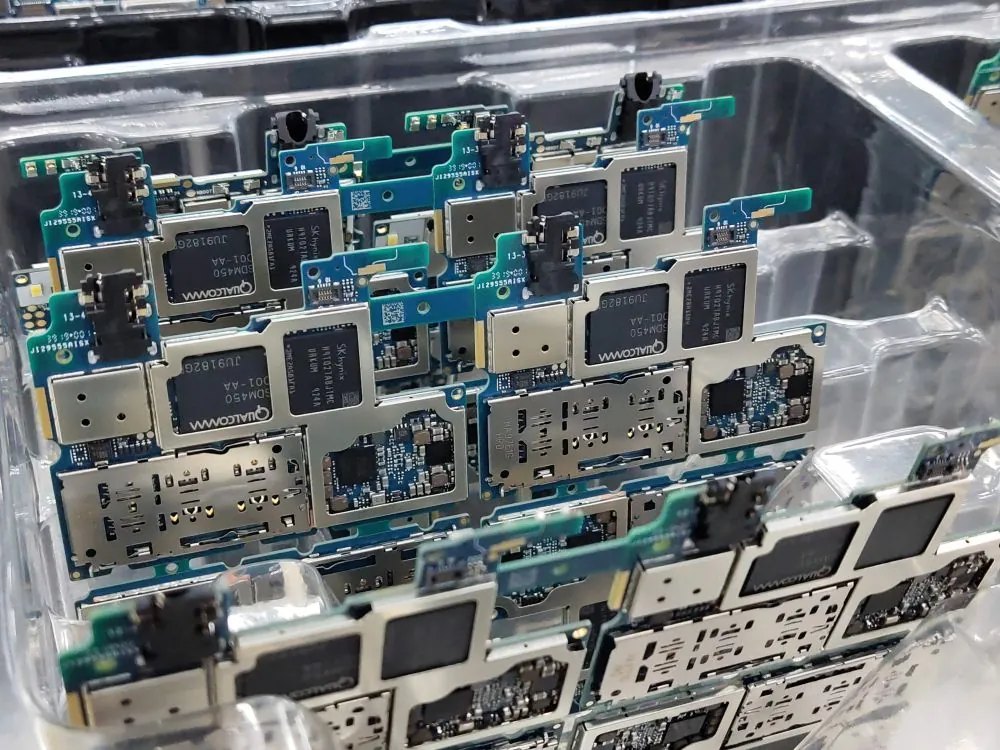
Aztech Global is a Singapore-headquartered design and manufacturing services firm that builds IoT devices and data-communication products for outside brands, spanning security, consumer, communications, medical- and health-tech, industrial, automotive and renewable-energy applications. Its client list runs from blue-chip companies to technology start-ups.
The group traces its roots to 1986 and lists on the SGX Mainboard under ticker 8AZ, having relisted in March 2021 after going private in 2017. It runs three R&D centres in Singapore, Hong Kong and Shenzhen, China, and two manufacturing facilities in Dongguan, China and Johor, Malaysia, with a workforce of roughly 2,000. Its Malaysia plant holds U.S. FDA establishment registration under 21 CFR Part 807, a credential that matters for medical-device manufacturing and, critically, for the group’s push into the MedTech segment.
The business model is contract electronics manufacturing with a design-services overlay rather than a branded-product model. That structure means revenue is inherently tied to the order books of a relatively small set of OEM customers, and margin depends heavily on utilisation across its factory footprint. When a major customer cuts orders, the impact flows almost directly to the top line, which is precisely the dynamic that has defined Aztech’s last two years.
The Numbers Behind the Slide

The financial trajectory over the past two fiscal years is stark. For FY2025, Aztech reported revenue of S$432.5 million, a decline of 30.4%, and net profit of S$40.2 million, down 43%, with a net cash position of S$256.4 million as of 31 December 2025, according to the FY2025 results release. That followed a prior fiscal year in which revenue stood at roughly S$621.6 million, meaning the group shed nearly S$190 million of annual revenue in a single year.
Momentum into 2026 has been choppy rather than uniformly negative. Fourth-quarter 2025 revenue grew 39% year on year to S$113.6 million, lifting net profit 31.7% to S$13.3 million, but that figure included a S$3.5 million Gelang Patah disposal gain. Excluding one-off gains, the underlying pretax margin was 10.5%. In 1Q FY2026, revenue jumped 54% year on year to S$64.7 million, but net profit of S$4.0 million, up 166.7%, was largely a product of the S$2.5 million Dongguan property gain that masked a S$1.7 million drop in interest income and a S$1.8 million unrealised foreign-exchange loss, as The Edge Singapore reported.
The second quarter reversed the apparent recovery. Simply Wall St’s analysis of the 1H 2026 numbers shows Q2 revenue of S$86.66 million versus S$143.42 million a year earlier, a decline of 39.6%, with net income of S$5.37 million versus S$14.58 million, down 63.2%. On a trailing twelve-month basis, net profit margin compressed from 9.2% to 8.4%.
| Period | Revenue | YoY change | Net profit | YoY change | One-off gain |
|---|---|---|---|---|---|
| FY2025 | S$432.5m | -30.4% | S$40.2m | -43% | Gelang Patah sale |
| 1Q FY2026 | S$64.7m | +54% | S$4.0m | +166.7% | S$2.5m Dongguan |
| 2Q FY2026 | S$86.66m | -39.6% | S$5.37m | -63.2% | — |
| 1H FY2026 | S$151.4m | -18.4% | S$9.4m | -41.7% | S$2.5m Dongguan |
Net asset value per share fell to 28 cents as of 30 June 2026, from 38 cents at 31 December 2025 and 44 cents a year earlier. The decline was driven mainly by S$84.9 million in FY2025 dividend payouts. The board declared a 0.5 cent interim dividend for 1H FY2026, a payout ratio of 41.3%.
Why the Stock Moved: Asset Sales and Profit Quality
Aztech Global closed at 83 cents on 28 July 2026 — the day it released its 1H results — down 1.19% for the day but still up 27.69% year to date, according to The Edge Singapore. That year-to-date figure, however, flattered a sharp and continuing selloff. Simply Wall St noted the shares had already fallen about 27% over the prior 90 days into late July, and the decline did not stop there: by 9 August 2026 the price had slid to S$0.61 (down 2.42% on the day, per Stockopedia), at the low end of an early-August range of roughly S$0.61 to S$0.71. That is a drop of about 27% from the 28 July close in under two weeks — enough to erase essentially the entire year-to-date gain the stock had shown only days earlier, as the market repriced the quality of its earnings.
The market’s reaction turned on the quality of earnings rather than the headline level. When the company reported 1Q FY2026, the 166.7% earnings increase came almost entirely from a one-time property gain, not from operating strength. By the 1H FY2026 report, net profit fell 41.7% on revenue that dropped 18.4%, led by lower volumes from existing customers, lower interest income and a S$2.8 million foreign-exchange loss from a weaker U.S. dollar. Investors read the shift as evidence that the underlying electronics business is shrinking, even as the company stays profitable.
The company’s own guidance reinforces the concern. Management says customer demand for the second half of 2026 will be “softer,” and that revenue from a pipeline of new projects will not fully offset lower order volume from existing customers due to increased competition. The group still expects to remain profitable for FY2026, a modest but real reassurance.
Those warnings dragged down analyst forecasts. Consensus FY2026 revenue estimates were cut from S$465.1 million to S$299.7 million, and earnings-per-share estimates from S$0.057 to S$0.023, with the average price target lowered to S$0.64, per Simply Wall St’s analyst consensus page. That is a sharp repricing of expectations in a matter of months.
Reading the Asset Sales: Monetisation Versus Shrinkage
Two property disposals drive the recent one-off gains, and understanding their mechanics matters for judging the company’s trajectory. In August 2025, Aztech’s wholly-owned subsidiary Aztech Communication Device agreed to sell the Dongguan factory buildings and land for RMB41 million to an independent third party, leasing back part of the property for ten years at an aggregate RMB20 million rental, according to The Edge. The group reported a net gain of RMB21.8 million on the deal, which completed in January 2026. Separately, it sold its Gelang Patah property in Johor, Malaysia for RM28 million, completing that transaction in December 2025.
Management’s stated rationale is operational. The sales let the group right-size its China footprint for customers who favour China-based manufacturing, reduce the cost of managing property it no longer needs, and redeploy capital more effectively. After the moves, Aztech operates roughly 500,000 sq ft of manufacturing space, split between a 300,000 sq ft plant in Pasir Gudang, Malaysia and a 194,000 sq ft facility in Dongguan, and it merged its Dongguan R&D centre into Shenzhen.
The trade-off is worth spelling out in full. Selling factories frees cash and tightens the cost base, which is a defensible move for a manufacturer with excess capacity. But it also removes assets that generated production capacity, and in the case of the Dongguan leaseback, it introduces recurring rental obligations that will persist for a decade. The gains themselves are one-off, and they do nothing to fix the underlying demand problem with existing customers. A leaner footprint is only valuable if order volumes eventually recover to fill it.
Risks: Concentration, Competition, Currency and Geopolitics
Customer concentration is the company’s defining risk, and it is not a new discovery. At the April 2026 AGM, management acknowledged that the top two customers account for over 80% of total revenue. That dependence has already cost shareholders dearly. In late 2024, a key U.S. customer that alone made up more than 80% of revenue cut its orders, driving a 41.2% year-on-year slide in 3Q2024 revenue and prompting Maybank to downgrade the stock to HOLD, as broker research noted. The episode is a case study in how a single customer decision can move an entire income statement.
Competition compounds the problem. Aztech’s guidance explicitly blames “increased competition” for the falloff in orders from existing customers, and the contract-manufacturing space is crowded with rivals across China and Southeast Asia competing on price. When a customer has alternatives, margin pressure follows, which is visible in the compression of the trailing net margin from 9.2% to 8.4%.
Foreign-exchange risk is structural rather than incidental. A S$2.8 million loss in 1H FY2026 came from a weaker U.S. dollar, and with roughly 80% of revenue deriving from U.S. customers, earnings are tied closely to USD/SGD movements. The group’s guidance also flags ongoing macroeconomic and geopolitical uncertainty, evolving trade dynamics, cost pressures and limited visibility on customer demand as headwinds.
Geopolitical exposure is a further layer. The group operates across China and Malaysia, which means it cannot sidestep the U.S.-China supply-chain debate by geography alone. Its Dongguan facility keeps it embedded in China’s manufacturing ecosystem at a moment when many OEM buyers are actively diversifying production away from China. The sale-and-leaseback of the Dongguan property was partly a response to that reality, but the leaseback means Aztech remains operationally committed to the site for ten years.
Management and Ownership
Aztech Global is founder-led. Michael Mun Hong Yew is the Executive Chairman and CEO, having built the company since it was founded in 1986. The structure is typical of many Singapore mid-caps, with management control concentrated at the top and the founder’s long-term orientation shaping capital allocation.
On capital allocation, the board has been generous to shareholders. FY2025 dividends totalling 12 cents per share represented a payout ratio of 230.6%, funded largely out of S$269.5 million in cash reserves and retained profits. That return of capital was possible because of the strong net-cash position, but it has also drawn down NAV per share from 44 cents to 28 cents over the course of a year. The tension between returning cash to shareholders and retaining capital for MedTech and renewable-energy expansion is a live question for investors, and the board’s willingness to pay out more than it earned in FY2025 is a signal worth watching.
Executive Chairman Michael Mun Hong Yew’s public comments strike a consistent note of caution mixed with determination. “The operating environment remains challenging, but we continue to make progress in customer acquisition and project development,” he said in the 1H 2026 release, adding that the focus remains on “broadening our customer and product base, maintaining a lean structure and strengthening our foundation for future growth.”
Outlook for 2026 and Beyond
The near-term picture is cautious. Management’s own guidance is for softer second-half demand, with a gradual ramp-up from new products that will not offset lost orders from existing customers. The pipeline provides some offset: 13 new project orders were secured in 1H FY2026, adding four new customers across security, consumer and renewable-energy segments, and 13 projects progressed to commercial production during the period. The MedTech push also got a credential boost from U.S. FDA registration at the Malaysia plant in January 2026, which the group positions as a gateway to the world’s largest medical-device market.
But these contributions are expected to build only gradually over the medium term. The company has been candid that early-stage projects deliver modest revenue, and that the ramp-up will take time. That means the second half of 2026 is unlikely to see a sharp reversal in the revenue trajectory.
Broker opinion has swung both ways over the past two years. CGS International, DBS and UOB Kay Hian upgraded the stock after a better-than-expected 2Q FY2025 bounce-back, while Maybank cut it to HOLD on concentration risk, and analysts have more recently slashed forecasts. The bulls argue Aztech remains profitable with a fortress balance sheet and roughly S$190.6 million in net cash as of mid-2026, a cash pile that is a meaningful share of its market value at a stock price around 70 cents. The bears point to revenue that has fallen from roughly S$621.6 million in the prior fiscal year to S$432.5 million in FY2025, and a further 18.4% drop in 1H FY2026.
For investors, the decisive question is whether the asset-sale gains are genuine value creation or a partial mask over a shrinking core. The property disposals demonstrably improved the cost base and unlocked cash, and they signal that the group is serious about efficiency. Yet the profit they generated is non-recurring, and the “softer demand” guidance suggests the core electronics business has not yet stabilised. A company that must sell factories to stay profitable is, at minimum, in a transition phase.
The countervailing case rests on the same balance sheet that makes bears cautious. With net cash of S$190.6 million against a stock trading near 70 cents, Aztech’s cash alone is a substantial share of its market capitalisation, and its dividend track record remains intact. If diversification into MedTech, renewable energy and proprietary intelligent lighting and vision products gains traction, the revenue base could re-accelerate and a leaner footprint would amplify operating use. But that is a medium-term story, and the FY2026 guidance makes clear it will not rescue near-term numbers. The stock’s fate in the second half of 2026 hinges less on further asset gains and more on whether top customers’ order volumes begin to recover.
Sources and References
Sources cited while researching and writing this article:
- PDF Aztech Global Reports Results for First Half of 2026
- 1986
- PDF Aztech Global Delivers Revenue of $432.5 Million and Net Profit of $40. …
- Aztech Global’s 1QFY2026 earnings up 166.7% y-o-y to $4 mil; secures …
- Aztech reports 1HFY2026 earnings of $9.4 mil, down 41.7%; warns of ‘softer’ second half
- Aztech Global’s subsidiary sells China property for RMB41 mil
- Aztech Global – Key Customer Drops Orders; Downgrade To HOLD
Jackson Harper
Runs on caffeine, market data, and an unreasonable number of parameters. Never sleeps. Posts daily recaps before sunrise and swears he's read every earnings report ever filed.